Unethical to move dangerous radioactive trash around the world
 Kim Mavromatis mavmedia.com.aux 21 Feb 16 There’s also nothing ethical about moving great amounts of highly radioactive trash around the world – ships and trains do have accidents. It’s all about money and not much thought about safety for humanity. And how smart is it to place all the world’s highly radioactive waste in the one spot?
And once Australia becomes the world’s nuclear waste dumping ground (what a great ad for South Australia and Australia – try selling that to a tourist), we are stuck with it, no one will take it back. The waste stays radioactive for 250,000 years and we have a nuclear waste dump plan for 100 years????
I expect humans won’t be around when it turns into lead. Dumb and Dumber.
Nuclear News , Royal Commission Special This Week
 On 15th February Commissioner Kevin Scarce delivered the “tentative findings” of South Australia’s NuclearFuel Cycle Royal Commission. In short, these were:
- Major recommendation for South Australia to make billions by importing, managing, storing and disposing of nuclear waste.
- Low key support for uranium mining expansion.
- Not supportive (at present) for uranium enrichment, further processing. But at the same time favours nuclear fuel leasing.
- Not supportive of nuclear power, but South Australia should prepare for it anyway, perhaps needed later on.
Mainstream Media responses to the report varied from jubilant in South Australia to pretty much ignored in Australia as whole. Alternative media was a lot more probing and critical e.g: The Conversation, REneweconomy, The Australia Institute The Saturday Paper and my own website
However, the significant thing about mainstream media coverage and the lack thereof, is that there seems to be a sort of “nuclear gentlemens’ agreement” that the whole thing only concerns the State of South Australia, not Australia as a whole.
All sorts of issues in this DO concern the rest of Australia – overturning of National Environment and Radiation Laws, sea, rail and road transport of dangerous radioactive trash and the accompanied security problems, secrecy and surveiilance.
Does Australia really want to be the only nation in the world to invite in the world’s radioactive trash? What about Australia’s reputation as safe and clean?
Will the rest of us have to prop up South Australia, bail it out, when the trash import project all comes financially unstuck, and South Australia is left with the biggst “stranded asset” of all time?
The ‘Tentative Findings’ report is posted at: http://nuclearrc.sa.gov.au/tentative-findings/
The deadline for written submissions responding to the interim report is March 18 (see the Royal Commission website for details).
The final report will be published in May 2016.
#NuclearCommissionSAust Ethics – an oxymoron – theme for this week
 There’ s nothing ethical about pleasing a few greedy entrepreneurs that think they can make a fortune out of introducing Small Nuclear Reactors to Australia – as the follow-up to South Australia taking in global radioactive trash.
There’s nothing ethical about the lie that taking in global radioactive trash will solve South Australia’s unemployment problem .
There’s nothing ethical about planning to saddle South Australia with the biggest white elephant and stranded asset in human history. A radioactive trash dump makes no money. (That’s why no other country wants to do this)
I could imagine one scenario in which taking in radioactive trash might be ethical. Imagine if one country – for example, Japan, decided to completely shut down all nuclear activities, and had trouble organising a waste repository. A global good citizen, such as Australia, might help them out in this.
But there’s no global citizenship in the Royal Commission plan. It’s not only about greed: it’s also about keeping the toxic global nuclear industry going, at a time when it is pretty much in terminal decline.
Next steps in the push for South Australia as world’s nuclear toilet
 Friends of the Earth 20 Feb 16 The ‘Tentative Findings’ report is posted at: http://nuclearrc.sa.gov.au/tentative-findings/
The deadline for written submissions responding to the interim report is March 18 (see the Royal Commission website for details).
The final report will be published in May 2016. http://www.foe.org.au/royal-commission
9 News 19 Feb 16 The report is due on May 6 and the state government will not make any decisions before the end of the year.
That could include putting the issue to a referendum at the next state election, due in 2018
Nuclear Semioticians (sign experts): how to warn future generations of the wastes danger
they established the field of nuclear semiotics……. an “atomic priesthood”
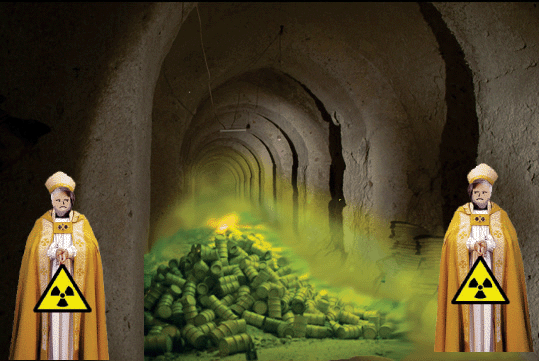
The message walls would have the faces as well as simple messages

Temple of Doom: How do we warn the future about nuclear waste?, Triple J Hack, by James Purtill, 19 Feb 16 This week the South Australian Royal Commission released “tentative findings” recommending the state take more than 100 tonnes of high-level radioactive waste and store it in the desert for hundreds of thousands of years.
……..If the facility goes ahead, the designers may consider a problem that has baffled linguists and semioticians (sign experts): how to tell the distant future don’t dig up the dump?
Atomic priesthoods and ‘ray cats’
In 1991, the Department of Environment hired linguists, scientists and anthropologists at a cost of about $1 million to answer what is basically a conundrum of labelling. How do you warn far-off civilisations or scattered bands of post-apocalyptic survivors that invisible beams of energy emanating from the earth could kill them, and this was not a trick, there’s no buried treasure?
The report runs to 351 pages and has the (rather dry) title: Expert Judgement on Markers to Deter Inadvertent Human Intrusion into the Wasteland Isolation Pilot Plant.
Here’s some of the problems they identified:
- Languages evolve too fast to communicate with the future: Few English speakers understand Old English, which was spoken about 1000 years ago.
- The meanings of symbols is too ambiguous: For example, the physicist Carl Sagan was invited to join the researchers, couldn’t make it, and wrote to suggest they simply use the skull-and-crossbones symbol to signify danger. But this symbol has only been current for a few hundred years, has meant ‘poison’ for the last 100, and is no longer very threatening. It’s on ‘pirate theme’ drink bottles.
- Even if they understand the warnings, future trespassers might not believe them. Curses associated with the burial sites of the Egyptian Pharaohs did not deter grave robbers.
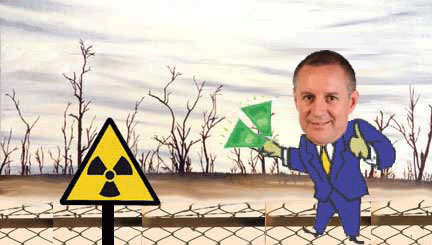
Maralinga tipped for the site of Premier Jay Weatherill’s nuclear waste site fantasy
 Planning 500 years ahead makes nuclear storage a difficult road, AFR, Simon Evans 20 Feb 16, It’s the first 500 years that bring the biggest worries about radioactivity when it comes to spent nuclear fuel rods.
After that, most of the radioactive elements have decayed, but they still need to be isolated from the environment in a deep underground nuclear storage facility for many hundreds of thousands of years. Everything in the nuclear waste industry has an enormously long outlook, including the promise of a $257 billion pay-day for South Australia . Correct, billion. That is if it’s able to traverse a difficult political road and build a sophisticated nuclear waste facility 500 metres below ground to operate over a projected 120-year commercial life……….
DEEP-BELOW-GROUND STORAGE
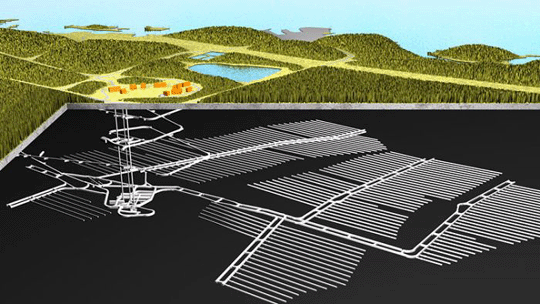
political considerations collide with the economics of the proposed plant. He says the $33 billion cost of the underground facility is so vast it would need to be shared between the state and federal government, which also needs to change legislation to allow it to proceed. Federal Resources and Energy Minister Josh Frydenberg gave cautious support to the plan if a political and community consensus can be developed……..
One submission to the royal commission by a private company called SA Nuclear Energy Systems has proposed the Maralinga atomic bomb test sites about 850km north-west of Adelaide as a good spot for an underground facility. Maralinga was used by Britain to test atomic bombs in the late 1950s, with the site later becoming embroiled in controversy because of the long-term health effects on the Aboriginal owners of the land and on military personnel who had been present. http://www.afr.com/business/energy/nuclear-energy/planning-500-years-ahead-makes-nuclear-storage-a-difficult-road-20160216-gmvchl#ixzz40e9J9qEw
What does the #NuclearCommissionSAust report say?
the waste-to-fuel fantasies of Senator Edwards and Ben Heard are dead and buried.
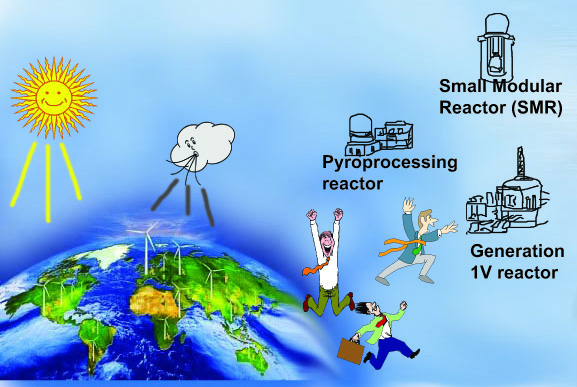
 [Wastes storage] timeframes – 150 years in the U.S. report and 120 years in the Royal Commission study – are nothing compared to the lifespan of nuclear waste. It takes 300,000 years for high level waste to decay to the level of the original uranium ore. The Royal Commission report notes that spent nuclear fuel (high level nuclear waste) “requires isolation from the environment for many hundreds of thousands of years.”
 the Waste Isolation Pilot Plant (WIPP) in the U.S. state of New Mexico. WIPP was closed in 2014 because of a chemical explosion which ruptured a nuclear waste barrel and resulted in 23 workers being exposed to radiation. Before WIPP opened, the government estimated one radiation release accident every 200,000 years. But there has been one radiation release accident in the first 15 years of operation of WIPP.
 The Royal Commission’s report is silent about WIPP. It is silent about the Asse repository in Germany, where massive water infiltration has led to the decision to exhume 126,000 barrels of radioactive waste. The report is silent about the fire at a radioactive waste repository in the U.S. state of Nevada last year. And the report is silent about many other problems with the nuclear industry that it should have squarely addressed
Summary of ‘Tentative Findings’ of SA Nuclear Fuel Cycle Royal Commission Friends of the Earth Australia, by Jim Green, national nuclear campaigner, Friends of the Earth 20 Feb 16 What does the report say?
In a nutshell, the Royal Commission is negative about almost all of the proposals it is asked to consider – but positive about the proposal to import high-level nuclear waste from nuclear power plants for disposal in South Australia. Continue reading
Political pressure is the only barrier stopping renewables taking over from fossil fuels and nuclear energy
 Energy storage gives renewables a jump-start Independent Australia, David Suzuki 20 February 2016, Given the speed at which technology and inventions are advancing, it’s a no-brainer to see that the barriers to a clean energy shift are more political and psychological than technological, argues Dr David Suzuki.
REMOTE AUSTRALIAN communities often use diesel generators for power. They’re expensive to run and emit pollution and greenhouse gases. Even people who don’t rely entirely on generators use Australia’s power grid, which is mostly fuelled by polluting, climate-altering coal.
Now, one company is showing that supplying Australia’s energy needn’t be expensive or polluting.
AllGrid Energy produces 10 kilowatt-hour solar-power batteries that take advantage of Australia’s abundant sunlight and growing demand for solar panels. Their lead-acid gel battery is less expensive than Tesla’s lithium Powerwall, also available in Australia.
Many AllGrid systems are sold in indigenous communities, providing affordable energy independence.
It’s an example of the rapid pace of renewable energy development — one that clears a hurdle previously confronting many clean-energy technologies: their variable nature. One advantage of fossil fuels is that they’re both source and storage for energy; renewables such as wind and solar are only sources.
Many argue that because solar and wind energy only work when sun shines or winds blow, and output varies according to cloud cover, wind speed and other factors, they can’t replace large “baseload” sources like coal, oil, gas and nuclear.
But batteries and other energy storage methods, along with power-grid improvements, make renewables competitive with fossil fuels and nuclear power — and often better in terms of reliability, efficiency and affordability.
With storage and grid technologies advancing daily, renewable energy could easily and relatively quickly replace most fossil fuel–generated electricity. In Canada, Ontario’s Independent Electricity System Operator contracted five companies to test a number of storage systems, including batteries, hydrogen storage, kinetic flywheels and thermal systems that store heat in special bricks.
Ontario is aiming to get about 50 per cent of its installed generating capacity from renewable sources by 2025……..
Because renewables don’t pollute or create greenhouse gas emissions, they also help lower costs for health care and the ever-increasing impacts of climate change. Although every energy source comes with consequences, the damage and risks from mining, processing, transporting and using coal, oil, bitumen and uranium, and from fracking and other extraction methods, are far greater than for clean energy.
And fossil fuels will eventually run out, becoming increasingly expensive, difficult to obtain, and ridden with conflict as scarcity grows. https://independentaustralia.net/environment/environment-display/energy-storage-gives-renewables-a-jump-start-,8692
No country has a nuclear waste repository that will last long enough
Temple of Doom: How do we warn the future about nuclear waste?, Triple J Hack, by James Purtill, 19 Feb 16 “…….This week the South Australian Royal Commission released “tentative findings” recommending the state take more than 100 tonnes of high-level radioactive waste and store it in the desert for hundreds of thousands of years…….
This is true, but it’s worth pointing out none of these already built repositories are for the final disposal of nuclear fuel. They are either for low to intermediate level waste, which needs to be isolated for several hundred years, or they are temporary, interim solutions to the problem of finding a final resting place that will isolate waste for tens of thousands of years.
Finland is building the world’s first deep underground repository for high level nuclear waste and Sweden is close behind. The Finnish site is scheduled for completion in 2023.
A better example of the kind of repository proposed for South Australian is the United States’ Waste Isolation Pilot Plant (WIPP), deep in the New Mexico desert. It’s the only working long-lived nuclear waste repository in the world. It holds barrels of gloves and masks and machines and bomb parts contaminated by nuclear testing. The site is designed to last for 10,000 years.
WIPP is scheduled to close in the 2040s. It will be sealed up and left alone. Centuries will pass and become millennia. On the surface, civilisations will rise and fall.
China, the world’s oldest continuous civilisation, stretches back about 5,000 years. The world’s oldest inscribed clay tablets date from about the same time.
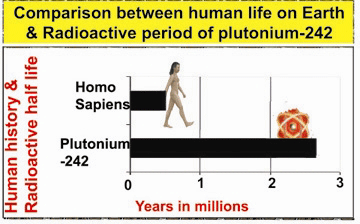 The half-life of plutonium-239, which can produce fatal radiation doses during short periods of direct exposure, is 24,000 years – the time it takes to decay to half its level of radioactivity. In 10 times that period, or 240,000 years, it decays to uranium-234, which is fairly harmless.
Homo sapiens began to evolve about 200,000 years ago………..http://www.abc.net.au/triplej/programs/hack/temple-of-doom-how-do-we-warn-the-future-about-nuclear-waste/7181278
Australian govt’s wrong decision to dump CSIRO climate modelling – Dr John Church
 Renowned CSIRO scientist Dr John Church speaks out against decision to dump climate modelling, ABC News 19 Feb 16 By Angela Ross One of the CSIRO’s most respected scientists, Dr John Church, has spoken out against the body’s decision to scrap its climate modelling program.
A petition signed by 2,800 international scientists from more than 60 countries expressed outrage about the decision to cut two research programs under the oceans and atmosphere business unit.
“The decision to decimate a vibrant and world-leading research program shows a lack of insight and a misunderstanding of the importance of the depth and significance of Australia’s contributions to global and regional climate research,” it read……..
Dr Church argued there was no point collecting data if scientists were not there to analyse the results.
“If Australia pulls out of key activities in the southern hemisphere then that will leave significant gaps, we will be losing partnerships with key agencies all around the world,” he said……..
The union representing Dr Church and his colleagues, the CSIRO Staff Association, has lodged a dispute with the Fair Work Commission but no date has been set. http://www.abc.net.au/news/2016-02-19/award-winning-scientist-condemns-csiro-job-cuts/7184410
#NuclearCommissionSAust ignores the long term problem of storing radioactive trash
South Australia ponders nuclear waste options MAX OPRAY, The Saturday Paper, 20 Feb 16 The initial findings of a royal commission into the merits of South Australia becoming a hub for uranium mining and waste storage raised as many questions as they answered.”…… Scarce put forward a premise even more audacious than his necktie – that South Australia’s seemingly hopeless descent into economic oblivion could be reversed by importing 138,000 tonnes of high-level nuclear waste from all over the world, reaping $445 billion in profits over 120 years. ……
The royal commission’s brief was to examine the feasibility of South Australia mining more uranium, processing it, using it for nuclear energy and then storing the waste – turning the state into a value-adding, vertically integrated hub of radioactivity.
The initial findings, based on interviews with 128 witnesses and more than 250 submissions, will be out for public comment for a five-week period before informing a final report due on May 6……….
Scarce urged attendees in Adelaide to contemplate the state’s future, but when question time arrived, the locals appeared to be thinking further ahead than he had in mind.
There was Lorraine Brady, who described herself as being from a group of mothers concerned about jobs for their children and future generations, but “not at any price”.
Brady asked: “How can you guarantee the safe containment of toxic, high-level nuclear waste for thousands of years to come?”
To speak of millennia is not hyperbole – by the royal commission’s own admission, some of the waste in question will remain hazardous for hundreds of thousands of years.
Craig Wilkins, chief executive of Conservation Council SA, an organisation that has actively questioned the impartiality of the royal commission, said the overall time frame needed to be taken into account not just in an environmental sense but an economic one.
“The commission acknowledges that nuclear waste needs to be isolated from the environment for ‘many hundreds of thousands of years’ yet there is no attempt to cost the management of waste over those time frames,” he said.
“If there’s one thing we know, the nuclear industry is expert at overstating the benefits and radically understating the costs and risks.”……..
there is the actual journey – the transportation of waste internationally across oceans, and then through ports and populated areas, before arriving at a temporary above-ground dump site, where it will have to remain until enough funds have been accrued from such imports to invest in a large-scale underground facility.
As the attendees noted, communities all along the route would need to offer consent, along with anyone living near the final destination………..https://www.thesaturdaypaper.com.au/news/politics/2016/02/20/south-australia-ponders-nuclear-waste-options/14558868002910
More trouble for USA’s nuclear waste dump Waste Isolation Pilot Project (WIPP)

 Two Contractors Cited for Radioactive Release at Nuclear Waste Sites http://sputniknews.com/us/20160219/1035057063/us-nuclear-waste-contactors.html The companies responsible for nuclear waste are Nuclear Waste Partnership (NWP), which operates an Energy Department facility to store nuclear waste and Los Alamos National Security (LANS), the contractor that manages the nearby Los Alamos National Laboratory, according to the US Department of Energy.WASHINGTON (Sputnik)
— Companies in charge of nuclear waste at two facilities in the US state of New Mexico have been cited for safety violations in connection with a 2014 underground fire and an escape of radiation into the atmosphere, the US Department of Energy said in a press release on Friday.
The companies are Nuclear Waste Partnership (NWP), which operates an Energy Department facility to store nuclear waste and Los Alamos National Security (LANS), the contractor that manages the nearby Los Alamos National Laboratory, according to the release.
“The violations by NWP… are associated with two events that occurred in February 2014. The first event involved a fire in a salt haul truck in the [waste storage facility] underground, and the second event involved a radiological release,” the release explained.
The violations by LANS are associated with the packaging of nuclear waste containers, according to the release.
The two events took place in February 2014 at the Energy Department’s Waste Isolation Pilot Plant, an underground storage facility at a 600 meter deep salt bed, the release explained. Both companies have already been heavily penalized, losing 90 percent of their fees.
In the second event ten days later, air monitors detected unusually high levels of radiation, later traced to an exploding barrel of nuclear waste from Los Alamos.
The storage facility has been closed for the past two years, but the Energy Department expects to reopen the plant later this year with improved safety measures, according to an earlier posting on the department’s website.
Los Alamos is best known as the site where the United States developed the atomic bombs dropped on Japan at the end of World War II.
Fukushima couple win landmark court case against nuclear operator
Fukushima disaster: Tepco to pay couple in landmark damages case BBC News 19 Feb 16 A court in Japan has ordered the operator of the tsunami-hit Fukushima nuclear plant to compensate a couple who fled radiation, even though they lived outside the evacuation zone.
Tokyo Electric Power Company (Tepco) will pay 30m yen ($265,000; £185,00) for financial losses and poor health.
It is thought to be the first time Tepco has been found liable for people outside the mandatory evacuation area………Analysts say Thursday’s ruling could pave the way for many more compensation claims from such evacuees…….
The sum awarded to the couple, who have not been named but are in their 40s, is also far greater than the 11m yen proposed by a government-established centre to mediate settlements for compensation cases.
According to the written submission, the husband became depressed and developed pleurisy after the evacuation and their children were stigmatised for their association with the Fukushima nuclear disaster.
Tepco has already been embroiled in a number of compensation claims. In 2011, the government ordered Tokyo Electric to pay 1m yen to every family within 30km of the plant. http://www.bbc.com/news/world-asia-35610249
Cultural exchange between nuclear victim areas Maralinga and Nagasaki
Maralinga sculpture sent to Nagasaki in symbol of peace and nuclear past February 19, 2016 DOUGLAS SMITH The Advertiser
- Former atomic bomb test site, Maralinga, proposed for nuclear waste dump (subscribers only)
A SCULPTURE representing the Aboriginal people of the Maralinga Lands is being sent from Adelaide to Nagasaki as a symbol of peace, cultural exchange and their nuclear pasts.
The sculpture of a coolamon dish has left for Japan to be placed in the Nagasaki Peace Memorial Park, which commemorates the atomic bombing of the city on August 9, 1945, when about 73,000 people died.
The Aboriginal people of the Maralinga Lands were subjected to radioactive contamination following British nuclear testing at the site between 1956 to 1963.
The art exchange was organised through international group Nuclear Futures, founded by Professor Paul Brown to support indigenous people worldwide by expressing the legacy of the atomic age through creative arts projects.
Prof Brown first got together with a group of creative artists at the 2002 Adelaide Festival, where ideas were generated for cultural exchange projects.
“I was a member of a team of artists who came from all around Australia for the festival to develop some projects, and out of all that came lots of ideas, a program of arts projects that would run over several years, so that’s what we’re doing now,” Prof Brown said.
Melbourne Girls’ College’s original approach to becoming carbon neutral
 Melbourne Girls’ College pedals toward carbon neutral status with outdoor cinema, solar installations, ABC News, 19 Feb 16 774 ABC Melbourne By Clare Rawlinson An all-girls Melbourne high school is on its way to becoming the first Victorian school to go carbon neutral.
Melbourne Girls’ College is working towards carbon neutral status through the installation of solar arrays and energy reduction projects, spearheaded by the school’s Sustainability Collective.
The passionate young environmentalists are hosting an outdoor cinema powered by bicycles and ergo machines on Friday, to share their quest with the public and draw attention to the true cost of energy.
The students will pedal all day to charge the cinema batteries for the screening of movie Oddball, as well as the power for coffee carts and popcorn machines.
“The idea behind it is to show people what a watt hour is and how much electricity goes into these events,” former student Ruby Wynn Williams said.
Sustainability coordinator Andrew Vance said the first step towards the school’s goal of carbon neutrality was awareness. “It’s really easy to burn some coal to watch a movie but it’s completely out of sight and out of mind,” he said. “When you get on the bike and pedal two watts, it’s like an epiphany.”
Reputation for environmental sustainability
The school’s reputation for environmental sustainability has already earned it acclaim through a major international competition, the Zayed Future Energy Prize. In 2015 it was selected as one of five schools globally to receive the competition’s $US100,000 funding grant for sustainability projects.
The majority of the prize money has been spent on converting the school’s permanent power source to solar, with the installation of a 33kW solar array on one side of the gymnasium roof.
It plans to cover the other side of the roof with community-funded solar arrays.
“[Each person] who buys a panel will get their name on it … so they can go and look at how much carbon they’ve offset and the equivalent in trees,” Mr Vance said.
“That will get us close to our carbon neutral goal.”…….http://www.abc.net.au/news/2016-02-19/melbourne-girls-college-pedals-toward-carbon-neutrality/7180684
1 This month

of the week – Australians for War Powers Reform (AWPR)
To see nuclear-related stories in greater depth and intensity
 Antinuclear