#NuclearCommissionSAust ignores the long term problem of storing radioactive trash
 South Australia ponders nuclear waste options MAX OPRAY, The Saturday Paper, 20 Feb 16 The initial findings of a royal commission into the merits of South Australia becoming a hub for uranium mining and waste storage raised as many questions as they answered.”…… Scarce put forward a premise even more audacious than his necktie – that South Australia’s seemingly hopeless descent into economic oblivion could be reversed by importing 138,000 tonnes of high-level nuclear waste from all over the world, reaping $445 billion in profits over 120 years. ……
The royal commission’s brief was to examine the feasibility of South Australia mining more uranium, processing it, using it for nuclear energy and then storing the waste – turning the state into a value-adding, vertically integrated hub of radioactivity.
The initial findings, based on interviews with 128 witnesses and more than 250 submissions, will be out for public comment for a five-week period before informing a final report due on May 6……….
Scarce urged attendees in Adelaide to contemplate the state’s future, but when question time arrived, the locals appeared to be thinking further ahead than he had in mind.
There was Lorraine Brady, who described herself as being from a group of mothers concerned about jobs for their children and future generations, but “not at any price”.
Brady asked: “How can you guarantee the safe containment of toxic, high-level nuclear waste for thousands of years to come?”
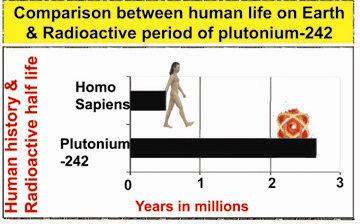
To speak of millennia is not hyperbole – by the royal commission’s own admission, some of the waste in question will remain hazardous for hundreds of thousands of years.

Craig Wilkins, chief executive of Conservation Council SA, an organisation that has actively questioned the impartiality of the royal commission, said the overall time frame needed to be taken into account not just in an environmental sense but an economic one.
“The commission acknowledges that nuclear waste needs to be isolated from the environment for ‘many hundreds of thousands of years’ yet there is no attempt to cost the management of waste over those time frames,” he said.
“If there’s one thing we know, the nuclear industry is expert at overstating the benefits and radically understating the costs and risks.”……..
there is the actual journey – the transportation of waste internationally across oceans, and then through ports and populated areas, before arriving at a temporary above-ground dump site, where it will have to remain until enough funds have been accrued from such imports to invest in a large-scale underground facility.
As the attendees noted, communities all along the route would need to offer consent, along with anyone living near the final destination………..https://www.thesaturdaypaper.com.au/news/politics/2016/02/20/south-australia-ponders-nuclear-waste-options/14558868002910
No comments yet.
1 This month
15 April – Zoom –Nuclear Power is Not the Solution
Apr 15, 2026 01:00 AM in Canberra, Melbourne, Sydney

Join the International Physicians for the Prevention of Nuclear War (IPPNW) on Tuesday, April 14th for a timely webinar exploring the risks associated with nuclear power and challenging the myth that it offers a simple, safe, carbon-free solution to the climate crisis

21 April Webinar: No Nuclear Weapons in Australia
Start: 2026-04-21 18:00:00 UTC Canberra, Melbourne, Sydney (GMT+10:00)
End: 2026-04-21 19:30:00 UTC Canberra, Melbourne, Sydney (GMT+10:00)
Event Type: Virtual
A virtual link will be communicated before the event.
Host Contact Info: australia@icanw.org

of the week – Australians for War Powers Reform (AWPR)
To see nuclear-related stories in greater depth and intensity
 Antinuclear
Leave a comment