Could renewable power be Port Augusta’s saviour?

THE “dominoes” are lined up for Port Augusta to switch from coal-fired to solar thermal power generation and advocates are urging governments to summon the “political will” to secure the project….(subscribers only)
http://www.adelaidenow.com.au/news/south-australia/solar-thermal-power-push-to-keep-jobs-in-port-augusta/news-story/dd0e42df6d28e5e0bb5959966ac676be
Port Augusta community keenly concerned about renewable energy versus nuclear industry developments
Key points:
- Regional job losses and nuclear royal commission findings have some locals worried
- Government minister Geoff Brock says no nuclear decisions have been taken
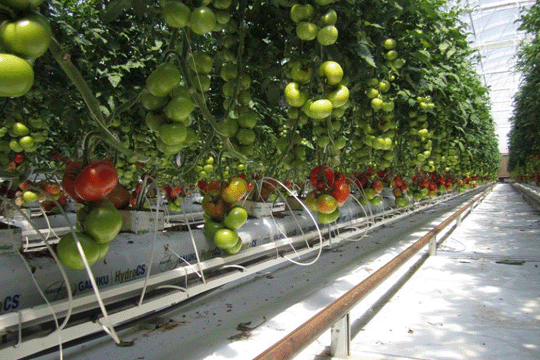
- Tomato greenhouses using desalinated water are praised for creating local jobs
Hundreds of residents are expected at Port Augusta’s Central Oval complex to quiz visiting Government ministers on a range of issues including jobs.
The regional city is gearing for an imminent closure of Alinta’s Port Augusta power stations.
 Mayor Sam Johnson expressed hope a range of options including hydroponic farming and renewable energy projects would create a secure future for the Port Augusta region.
“There is an area around Port Augusta which is clearly one of the world’s best sites when it comes to wind … also [ideal for] solar virtually from just south of Port Augusta right up to Roxby Downs,” he said.”As you go over towards Whyalla and Cowell, [that area] has been identified for anyone that wants to invest in wave technology.”
Government ministers are expected to tour Sundrop Farms’ vast tomato greenhouses at Port Augusta, which use desalinated sea water for crop production in the arid region. State Regional Development Minister Geoff Brock praised such ventures at a time of job losses elsewhere. “They will have around 200 people working there full-time and the good thing about this [is] Sundrop have just won an innovative award in Germany on an international scale,” he said.
“They’re going to have the research and development [functions] located at Port Augusta, so this is state of the art.”
Radioactive nuclear waste worries for northern SA residents Nuclear concerns will also be high on the agenda for the public forum and for Cabinet as it meets in the far north region. The Port Augusta Mayor said there was significant local concern about the future prospect of radioactive waste being transported through the northern region.
Mr Johnson said talk of a possible nuclear waste facility for the state’s north was a hot topic among residents. He said if any high-level waste was ever shipped in via Whyalla or Port Pirie, it would also be likely to be transported through Port Augusta.
 “The only way to go … is through Port Augusta, which has a two-lane bridge which has been in need of a little bit of work,” he said.
“There’s effectively no alternative detour access route and should there be an incident that occurs on that bridge then that has significant impacts not just for Port Augusta but also potentially the eco or marine environment.”…….http://www.abc.net.au/news/2016-02-28/jobs-nuclear-waste-port-augusta-forum-country-cabinet/7205842
10 year plan for 100% renewable energy
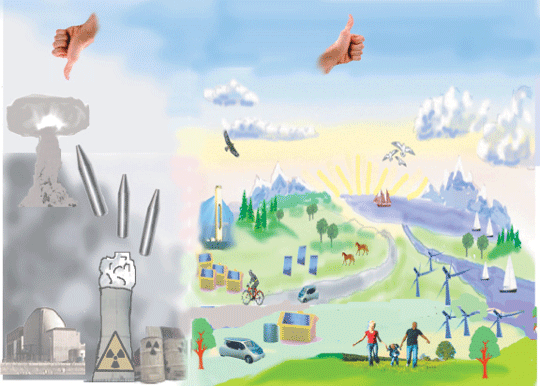 100% Renewable Energy: What We Can Do in 10 Years Yes! Magazine It will take at least three decades to completely leave behind fossil fuels. But we can do it. And the first step is to start with the easy stuff. Richard Heinberg Feb 22, 2016
If our transition to renewable energy is successful, we will achieve savings in the ongoing energy expenditures needed for economic production. We will be rewarded with a quality of life that is acceptable—and, perhaps, preferable to our current one (even though, for most Americans, material consumption will be scaled back from its current unsustainable level). We will have a much more stable climate than would otherwise be the case. And we will see greatly reduced health and environmental impacts from energy production activities.
But the transition will entail costs—not just money and regulation, but also changes in our behavior and expectations. It will probably take at least three or four decades, and will fundamentally change the way we live.
Nobody knows how to accomplish the transition in detail, because this has never been done before. Most previous energy transitions were driven by opportunity, not policy. And they were usually additive, with new energy resources piling onto old ones (we still use firewood, even though we’ve added coal, hydro, oil, natural gas, and nuclear to the mix).
Since the renewable energy revolution will require trading our currently dominant energy sources (fossil fuels) for alternative ones (mostly wind, solar, hydro, geothermal, and biomass) that have different characteristics, there are likely to be some hefty challenges along the way.
Therefore, it makes sense to start with the low-hanging fruit and with a plan in place, then revise our plan frequently as we gain practical experience. Several organizations have already formulated plans for transitioning to 100 percent renewable energy. David Fridley, staff scientist of the energy analysis program at the Lawrence Berkeley National Laboratory, and I have been working for the past few months to analyze and assess those plans and have a book in the works titled Our Renewable Future. Here’s a very short summary, tailored mostly to the United States, of what we’ve found.
Level One: The Easy Stuff Continue reading
Australia’s Labor and Liberal Parties unite in dismissing community concerns on nuclear waste dumping
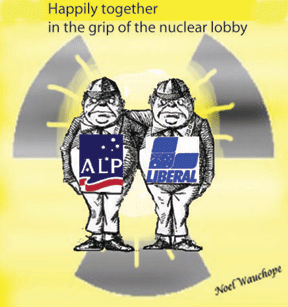 Liberal and Labor vote to ignore waste dump community concerns 22 Feb 2016 | Scott Ludlam The Labor and Libberal parties have voted together against a senate motion acknowledging the community opposition to each of the six locations shortlisted as a site for a nuclear waste dump.
“It’s not as though this motion asked a lot of the government, but for the opposition to cower from it is disappointing and weak,” Australian Greens Deputy Leader and Nuclear Issues Spokesperson Senator Scott Ludlam said today.
“The government is shirking their own process. After months of assurances that they would heed community concerns, they’re desperately trying to downplay those concerns or ignore them altogether.
“We should be investigating all avenues to minimise waste, we should have a genuinely independent inquiry to investigate long-term stewardship options for spent fuel, reprocessing wastes, and other categories of radioactive waste. And we certainly should categorically rule out the importation of international nuclear waste,” Senator Ludlam concluded.
The senate motion opposed by Labor and the Coalition can be viewed here: http://scott-ludlam.greensmps.org.au/content/motions/strong-local-opposition-all-6-proposed-nuclear-waste-dump-sites
Will the Australian govt impose a Lucas Heights nuclear waste dump on a South Australian community?
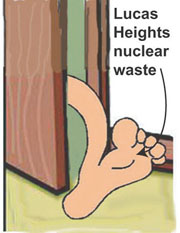 We will soon see how much in a rush the government is with the issue. Will it try to find a site by any means, even if this implies imposing it on a community or will it take its commitment not to do so seriously and maybe take the steps necessary to find a long-lived solution to a long-lived problem?
| By Anica Niepraschk , 29 February 2016 The federal government – once again – is looking for a place to dump its nuclear waste. All attempts over the last twenty years have failed – and so might this one, at least if the government is sticking to the promises it made in its new approach.The process is to be voluntary and no dump is to be located anywhere without community consent. These are the words at least. 28 sites across Australia had been nominated by landowners last year and were reduced to a shortlist of six by the Department for Resources.
The six sites are in Hale (NT), not far from Alice Springs, Hill End in NSW, Oman Ama in Queensland and three sites in South Australia: two in the Kimba region (Cortlinye and Pinkawillinie) and Wallerbidina/ Barndioota, outside Hawker. The South Australian shortlisted sites also get increasingly entangled in a debate as to whether the state might offer itself up as the world’s nuclear waste dump, accepting high-level nuclear waste from power reactors around the world. This was the key prospect outlined in the tentative findings of the Royal Commission into the Nuclear Fuel Cycle, released last week. All six sites are so far highly contested by the local communities, Continue reading |
South Australia a great State not a Waste State – communities visit Federal Parliament
 Flinders Ranges and Kimba residents voicing nuclear concerns to Federal Parliament http://www.transcontinental.com.au/story/3753842/local-voice-on-nuclear-goes-national/?cs=1538 28 Feb 16
FLINDERS Ranges and Kimba representatives will travel to Parliament House in Canberra next week, with delegates from three other sites across Australia targeted for a national radioactive waste dump joining them.
South Australia has three nominated sites – two at Kimba and one just north of Hawker in the Flinders Ranges. The visit comes a week before the closure of public comment on the National Radioactive Waste Management Project on March 11.
Meetings have been requested with the key decision maker federal Resources Minister Josh Frydenberg and other ministers to discuss community concerns ahead of the submission deadline.
Toni Scott and her family neighbour in Kimba a part of a group of locals within affected areas.She has been in regular contact and feels taking their message directly to Canberra will be an important way to step up campaigning efforts to ensure community concerns are recognised and reflected. “We are going to Canberra because our concerns must be heard,” Ms Scott said.
“Communities deserve to be treated better than what this process has delivered thus far and we want to get our message across face to face.”
Regina McKenzie has regularly spoken against the planned proposal near Hawker.“Its important that we get the message through to the government – no means no,” Ms McKenzie said.”We don’t want to live next to a radioactive waste dump. “SA is a great state not a waste state.”
AGL proceeding with Silverton wind farm project in far west NSW
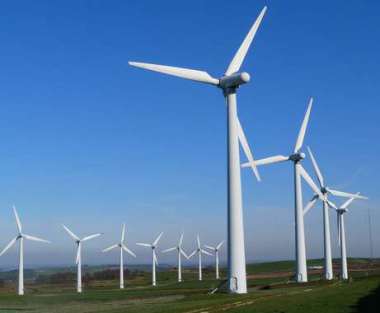 AGL vows to go ahead with Silverton wind farm project in far west NSW ABC Broken Hill
By Declan Gooch 27 Feb 16 Energy company AGL has reaffirmed its commitment to the Silverton wind farm project in far west New South Wales, and says studies of the site will get under way within weeks.
The proposed site along the Barrier Ranges just outside the Silverton township was first proposed in 2007 by Epuron, but stalled after AGL took over in 2012. AGL blamed uncertainty about the federal government’s Renewable Energy Target for the pause, with development approval set to run out in May.
The company announced at a community meeting on Thursday night it applied that day to have another five years added to the approval, and announced a new project manager, Adam Mackett.”We’re already doing work through the hydrogeological study where we’re committed to this project, so we’re showing that,” Mr Mackett said. “It is a half-a-billion-dollar project so before we then fully commit to constructing it we need to do a bit of work.”
Mr Mackett is no stranger to the state’s far west, having managed the construction of the Broken Hill solar farm around 25 minutes away. He also oversaw the construction of South Australia’s Hallett wind farm.
“We’re confident of having [the Silverton project] extended, we think the Silverton wind farm is a fantastic opportunity.”
AGL hopes the wind farm will generate enough power to supply around 120,000 average homes.
Funding will be contributed from AGL’s newly-announced Powering Australian Renewables Fund, which will be seeded partly by the Broken Hill solar farm……… AGL said it hopes its Powering Australian Renewables fund will be set up by the middle of the year, and that the extension to the project’s approval will be signed off in the next three months. http://www.abc.net.au/news/2016-02-26/agl-vows-to-go-ahead-with-silverton-wind-farm-project/7202338
The dangers in Australia’s uranium deal with India
The blame, in this case, falls on the Australian Government, who went against the wishes of its joint committee to carry on with the agreement – and ignored existing loopholes in the safeguards – that may provide the opportunity for nuclear proliferation
This is a great opportunity for Australia to consider the several alternative energy exportation means available to them that are just as likely to succeed and without risking regional instability in the Indo-Pacific region. These include solar and wind power
It is vital that Australia rethinks the impact of exporting uranium to India while maintaining its strong bilateral relations with the country. The Government must also come to realise how this deal can affect the current dynamics of South Asia, the wider Indo-Pacific region and the perception of Australia across the global community. Regional instability in an already volatile region is the last thing Australia needs to get involved in.
The cost of Australia’s uranium deal with India https://independentaustralia.net/politics/politics-display/the-cost-of-australias-uranium-deal-with-india,8723#.VtIfhLJpus0.twitter

THERE IS NO DOUBT that the civil nuclear deal recently signed by Australia and India, for the purpose of exporting uranium, has raised various important questions regarding the use of Australian uranium in India.
Despite these questions being asked, various government officials have reassured the international and domestic community that the deal will build on the bilateral relationship between the two nations, through economic and strategic means.
Yet, it is quite clear that there are various risks involved on Australia’s part, which in turn, can significantly hamper their geopolitical reputation and affect their bilateral relationships with other nations — potentially leading to instability in South Asia. Continue reading
Australia at risk of missing its 2020 renewable energy target
Some continue to blame the sluggish investment on the uncertainty created by then Prime Minister Tony Abbott’s ferocious push across 2014 and 2015 to cut the renewable energy target. Last year the government and Labor struck a deal to lower the target.
In recent times there have been some positive signs of movement.. This month energy giant AGL launched an investment fund aimed at delivering 1000 megawatts worth of renewable energy, while Origin Energy head Grant King was quoted saying his company was preparing to back new projects………
 Australia risks missing clean power goals, with households to pick up the bill, SMH, February 28, 2016 Tom Arup Environment editor, The Age Australia risks not hitting its 2020 renewable energy target with analysts now forecasting that interim goals will be missed – a situation that will trigger penalties that households will have to pay.
Many in the energy industry agree that this year will be “make or break” for achieving the end-of-decade target, which aims to deliver about 23 per cent of Australia’s electricity from clean technologies such as wind and solar.
“This year is critical” said Kane Thornton, who heads the Clean Energy Council……….. Continue reading
The “Humanitarian Initiative” leading to Prohibition of Nuclear Weapons

Through a series of international conferences on the humanitarian consequences of nuclear weapons and a formal pledge to “fill the legal gap for the prohibition and elimination of nuclear weapons” endorsed by 123 governments, non-nuclear weapon states are working to stigmatize, prohibit and eliminate nuclear weapons.
By stigmatizing nuclear weapons — declaring them unacceptable and immoral for all — the international community can start demanding and pressuring the nuclear-armed states and their military alliances to deliver what they’ve actually promised: a world free of nuclear weapons.
Stigmatize and Prohibit: New UN Talks on Nuclear Weapons Start Today, Huffington Post, 02/21/2016 Beatrice FihnExecutive Director, International Campaign to Abolish Nuclear Weapons
When North Korea tested a nuclear weapon in January, condemnation from all around the world flowed within minutes. A week later, the United States carried out a mock nuclear weapons test of a new type of “more usable” warhead in the Nevada desert. Aside from a small number of civil society organizations, the international community was silent.
Just two weeks ago, North Korea carried out a rocket launch and thereby tested the capability to launch long-range missiles, capable of delivering nuclear weapons on targets far, far away. The world once again rose up and criticized this, with statements by the United Nations Security Council and condemnations from Foreign Ministers all around the world.
Early this morning, the United States tested its Minuteman III intercontinental ballistic missile, a missile that is intended for launching nuclear bombs on Russia or any other target on the other side of the world. Again, few seem to care.
The United Nations Secretary-General has said, “There are no right hands for the wrong weapon”. But many in the international community often act with implicit acceptance of American, British, French, Russian, and Chinese nuclear weapons.
The “Humanitarian Initiative”, however, is challenging this implicit acceptance. Continue reading
Greenpeace Launches Scientific Investigation Into Fukushima Disaster’s Effect On Pacific Ocean,
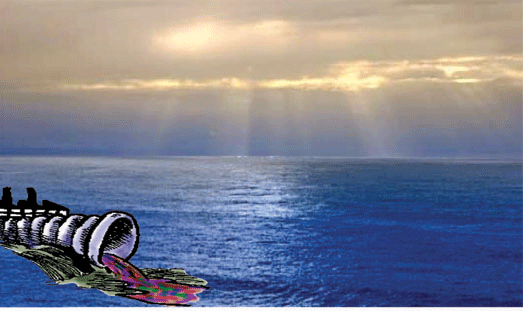 Clean Technica, February 26th, 2016 by Joshua S Hill Nearly five years after the Fukushima nuclear disaster, Greenpeace has launched a high-tech investigation into the radiation effects of the meltdowns on the Pacific Ocean. “…… Greenpeace Japan announced Thursday that it is conducting an underwater investigation into radiation contamination of the Pacific Ocean caused by the disaster. According to Greenpeace, the investigation will be conducted aboard a Japanese research vessel using a one of a kind Remotely Operated Vehicle fitted with a sensitive gamma radiation spectrometer and sediment sampler.
Mr Naoto Kan, the former Prime Minister of Japan and leader at the time of the nuclear accident, joined the crew of the Greenpeace Flagship, the Rainbow Warrior, on the opening day of the investigation, and called for a complete phase out of nuclear power. Continue reading
The End of the Nuclear Age
The End of the Nuclear Age, Handelsblatt, BY KLAUS STRATMANN, 28 Feb 16
Even before the Fukishima disaster, it was clear that nuclear power was dangerous, unreliable and too risky for civil use. The growth of renewable energy is now rendering them obsolete, argues Handelsblatt’s energy expert. The pictures from Fukushima are etched on the collective memory of mankind. They drastically changed the perception of civil use of nuclear power, especially in Germany.
And yet work continues on new nuclear reactors worldwide. Isn’t that paradoxical?
Five years after the reactor catastrophe caused by an earthquake, there are still unsolved problems at the site of the Japanese nuclear power station, underlining the fact that nuclear accidents render helpless even the most technically sophisticated societies.
To this day, there is still no convincing concept for the recovery of melted fuel rods in the destroyed reactors. Nor are there realistic estimates of the costs caused by the catastrophe. However, nobody seriously doubts that they will ultimately amount to a figure in the high triple-digit billions…..(registered readers only) https://global.handelsblatt.com/edition/375/ressort/opinion/article/end-of-the-nuclear-age
Gas company APA joins throng to spend on renewable energy projects
APA aims to ramp up renewable energy spending, The Age February 28, 2016 Brian Robins APA wants a seat at the table in the multibillion-dollar investment boom in renewable energy sources over the next few years amid national moves to meet the mandated renewable energy target.
This month, AGL said it might launch a $3 billion fund to build renewable energy projects such as wind and solar farms.
Rival Origin Energy said it might invest in similar projects but would most likely buy the output under long-term contracts.
Under federal government policy, one-fifth of electricity must be sourced from renewable energy by 2020. The move is expected to hasten the closure of heavily polluting coal-fired power stations…….
APA is considering several projects, including a potential solar farm in Western Australia, if it wins support from Australian Renewable Energy Agency funding and signs a power sales agreement. It is also bidding on an estimated 90MW of wind turbine capacity in the Northern Territory………http://www.theage.com.au/business/apa-aims-to-ramp-up-renewable-energy-spending-20160224-gn2a1g.html
BHP coalmine on the brink
Australia’s biggest coal export mine is struggling to turn a profit after recent price slides…. (subscribers only)
http://www.theaustralian.com.au/business/mining-energy/bhp-mount-arthur-coal-mine-on-the-brink-as-profits-dive/news-story/b37ef63a3b8cda29d7cfaf8427c5b210
1 This month
15 April – Zoom –Nuclear Power is Not the Solution
Apr 15, 2026 01:00 AM in Canberra, Melbourne, Sydney

Join the International Physicians for the Prevention of Nuclear War (IPPNW) on Tuesday, April 14th for a timely webinar exploring the risks associated with nuclear power and challenging the myth that it offers a simple, safe, carbon-free solution to the climate crisis
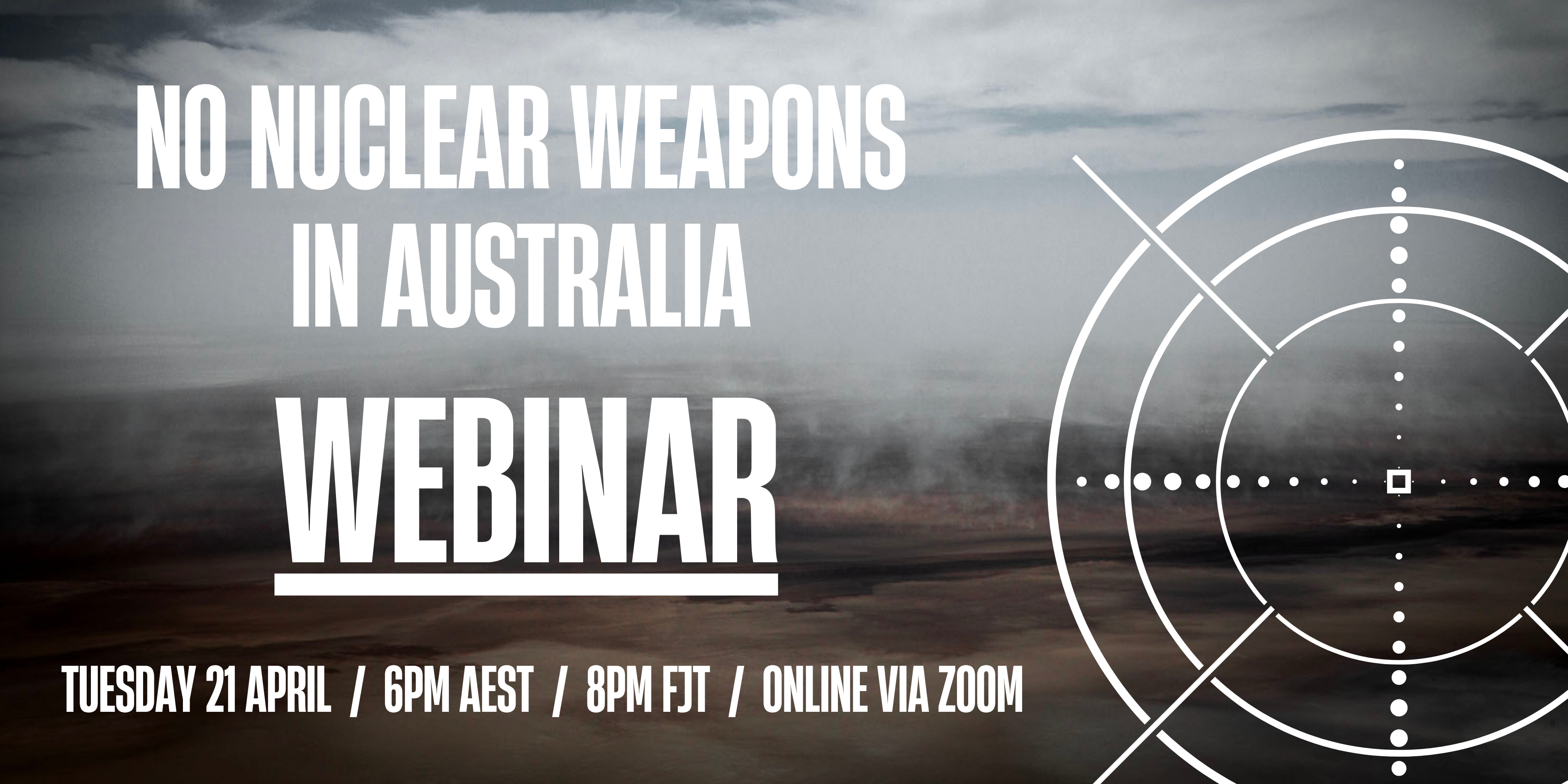
21 April Webinar: No Nuclear Weapons in Australia
Start: 2026-04-21 18:00:00 UTC Canberra, Melbourne, Sydney (GMT+10:00)
End: 2026-04-21 19:30:00 UTC Canberra, Melbourne, Sydney (GMT+10:00)
Event Type: Virtual
A virtual link will be communicated before the event.
Host Contact Info: australia@icanw.org

of the week – Australians for War Powers Reform (AWPR)
To see nuclear-related stories in greater depth and intensity
 Antinuclear