NUCLEAR POWER – A DINOSAUR IN A DEATH SPIRAL?,
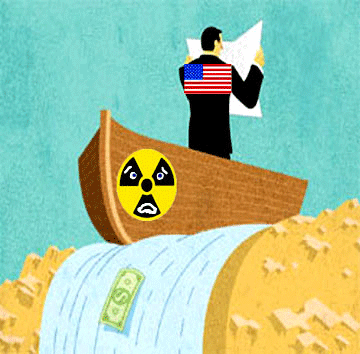 In general, the more experience accumulated with a given technology, the less it costs to build. This has been dramatically illustrated with the falling costs of wind and solar power. Nuclear, however has bucked the trend, instead demonstrating a sort of “negative learning curve” over time.
Dan Levitan, 29 Feb16 “………….Mark Jacobson, director of the Atmosphere/Energy Program at Stanford University, has published state-specific plans showing how 100-percent renewables penetration would be achievable. The National Renewable Energy Laboratory, part of the U.S. Department of Energy, published its “Renewable Electricity Futures Study” in 2012 and explained a clear path to 80 percent penetration in the U.S. Others have shown similar routes forward.
When it comes to any energy source, it is cost that sits at the root of the discussion. Nuclear proponents argue that there are impediments to having a grid entirely run on renewables. Buongiorno, for example, says that the intermittency of solar and wind can realistically only be addressed by adding large amounts of electricity storage (in the form of large batteries or other newer tech such as compressed air) to the grid, and that would change the ongoing “renewable prices are plummeting” narrative.
“When I hear people say ‘Oh, the costs are coming down,’ the costs for generation may be coming down, but if installing that capacity forces me to have energy storage, you have to add those costs,” he says. Think of it like buying a car: The baseline price sounds okay, but it’s all the options and add-ons that’ll get you. Buongiorno says he expects the costs of nuclear construction will come down, and that when storage costs for renewables are factored in, nuclear — with its reliable, 24/7 output — starts to look much more attractive as an alternative.
Billions and Billions
When it comes to any energy source, it is cost that sits at the root of the discussion. Adding more nuclear to the grid could reduce some of the burden on renewables and storage, but the economics of nuclear itself could prove an insurmountable roadblock.
In general, the more experience accumulated with a given technology, the less it costs to build. This has been dramatically illustrated with the falling costs of wind and solar power. Nuclear, however has bucked the trend, instead demonstrating a sort of “negative learning curve” over time.
According to the Union of Concerned Scientists, the actual costs of 75 of the first nuclear reactors built in the U.S. ran over initial estimates by more than 200 percent. More recently, costs have continued to balloon. Again according to UCS, the price tag for a new nuclear power plant jumped from between US$2 billion and US$4 billion in 2002 all the way US$9 billion in 2008. Put another way, the price shot from below US$2,000 per kilowatt in the early 2000s up to as high as US$8,000 per kilowatt by 2008.
Steve Clemmer, the director of energy research and analysis at UCS, doesn’t see this trend changing. “I’m not seeing much evidence that we’ll see the types of cost reductions [proponents are] talking about. I’m very skeptical about it — great if it happens, but I’m not seeing it,” he says.
Some projects in the U.S. seem to face delays and overruns at every turn. In September 2015, a South Carolina effort to build two new reactors at an existing plant was delayed for three years. In Georgia, a January 2015 filing by plant owner Southern Co. said that its additional two reactors would jump by US$700 million in cost and take an extra 18 months to build. These problems have a number of root causes, from licensing delays to simple construction errors, and no simple solution to the issue is likely to be found.
In Europe the situation is similar, with a couple of particularly egregious examples casting a pall over the industry. Construction began for a new reactor at the Finnish Olkiluoto 3 plant in 2005 but won’t finish until 2018, nine years late and more than US$5 billion over budget. A reactor in France, where nuclear is the primary source of power, is six years behind schedule and more than twice as expensive as projected.
“The history of 60 years or more of reactor building offers no evidence that costs will come down,” Ramana says. “As nuclear technology has matured costs have increased, and all the present indications are that this trend will continue.”……….
Cousins to the fear of a massive meltdown are both the worry over nuclear weapons proliferation and concerns over waste disposal. Spent nuclear fuel is currently stored on the site of nuclear plants in pools of water or sealed in dry cask storage, anddecades-old arguments over geologic repositories are unlikely to be resolved any time soon. With regard to weapons, nuclear plants produce plutonium during the course of their reactions, which can be made into bombs if enough is accumulated; terrorism and theft are thus constant worries. Both of these issues work to extend the shadow of risk stretching out behind nuclear power, and both lack immediate solutions………….
[Small nuclear reactors ] Allison Macfarlane, director of George Washington University’s Center for International Science and Technology Policy and the former chairman of the U.S. Nuclear Regulatory Commission, notes that of the various companies working on these only one (NuScale Power) is currently expected to actually submit application materials to regulators in 2016 — a step that is still years removed from actual functioning reactors.
No comments yet.
1 This month
15 April – Zoom –Nuclear Power is Not the Solution
Apr 15, 2026 01:00 AM in Canberra, Melbourne, Sydney

Join the International Physicians for the Prevention of Nuclear War (IPPNW) on Tuesday, April 14th for a timely webinar exploring the risks associated with nuclear power and challenging the myth that it offers a simple, safe, carbon-free solution to the climate crisis

21 April Webinar: No Nuclear Weapons in Australia
Start: 2026-04-21 18:00:00 UTC Canberra, Melbourne, Sydney (GMT+10:00)
End: 2026-04-21 19:30:00 UTC Canberra, Melbourne, Sydney (GMT+10:00)
Event Type: Virtual
A virtual link will be communicated before the event.
Host Contact Info: australia@icanw.org

of the week – Australians for War Powers Reform (AWPR)
To see nuclear-related stories in greater depth and intensity
 Antinuclear
Leave a comment