Australia needs to ‘get very serious’ about dealing with heatwaves
Australia underprepared to deal with ‘killer heat’, Climate Council report says Australia is underprepared to deal with the escalating problem of extreme “killer” heatwaves and a “whole of society approach” is needed to deal with the problem, a Climate Council report says. ABC News, 3 Mar 16

- The 2009 heatwave killed over 370 people
- Heatwaves have killed more people than fires, cyclones, floods
- Cardiac arrests triple during heatwaves
- Whole of society approach needed to make changes
There were more than 370 deaths during the heatwave of 2009 and climate forecasts indicate there will be longer, hotter and more intense heatwaves in future, according to The Silent Killer: Climate change and the impact of extreme heat.
The number of record hot days in Australia has doubled in the past 50 years.
Heatwaves have killed more Australians than any other natural hazard and have caused more deaths since 1890 than bushfires, cyclones, earthquakes, floods and severe storms combined, the report said.
The heat places “a dramatic demand” on public facilities such as hospitals and the system is so stretched there is no capacity to increase services.
In the 2009 heatwave, emergency callouts jumped by 46 per cent and there was a tripling of cardiac arrests.
“Our argument is no-one should die from heat in Australia,” said Dr Liz Hanna, the report’s author. We know it’s hot, we know when it’s coming, we know quite a lot about what’s needed. “What we need to do is just make this happen.”
Australia needs to ‘get very serious’ about dealing with heatwaves Dr Hanna said there needs to be greater flexibility in how hospitals operate, and extra capacity in the emergency services.”It’s not only boosting capacity to respond to what we’ve had, we need to plan to boost our capacity for what’s yet to come because the worst hasn’t really happened yet,” she said………http://www.abc.net.au/news/2016-03-02/australia-underprepared-to-deal-with-killer-heat-report-says/7212408
New climate brings hope to Clean Energy Finance Corporation
The Turnbull government is leaving open the prospect of keeping the Clean Energy Finance Corporation alive…. (subscribers only)
http://www.theaustralian.com.au/national-affairs/climate/new-climate-brings-hope-to-clean-energy-finance-corporation/news-story/d29030ea5556e55a009270c9bedf2b2c
Larissa Waters explains Australia’s revolving door of polluters and politicians
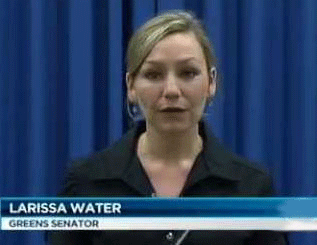 Larissa Waters: Ban donations from mining companies and stop ministers working for them, Larissa Waters, Guardian, 1 Mar 16 The fossil fuel industry’s influence on politics is disproportionate to the contribution the sector makes to employment, writes Senator Larissa Waters In Australian politics, there is a revolving door that swings round and round, fuelled by money and self-interest.
Into it go former politicians and their staffers and out pop even more highly paid mining company executives and fossil fuel lobbyists.
The list of former politicians and staffers who’ve scored cushy positions in the fossil fuel sector is depressingly long – I’ve listed just some of them that I’m aware of below.
The revolving door in part explains why there has never been a coal mine or gas project refused under our federal laws.
The massive political donations, made by this desperate industry trying to cling on through taxpayer subsidies, make up another reason for the tick-and-flick approach.
A very generous $3.7m was tipped into the pockets of the federal Liberal, National and Labor parties in the last three years – and much more when you include donations made at branch and state levels.
Such large amounts of money buys influence, and buys favourable policy settings for this dying industry. For every dollar of their $3.7m contribution to the election warchests of the big parties, they get more than $2,000 back from the taxpayer purse………..
The influence of these pervasive fossil fuel donations on our political system has left the job-rich clean energy industry to deal with the investment uncertainty created by a government ruled by climate dinosaurs.
And despite the change of prime minister and the talk of agility and innovation, the revenue-positive Clean Energy Finance Corporation and the Australian Renewable Energy Agency, which supports cutting-edge, genuinely innovative technology, are both on the Turnbull government’s chopping block.
Now is the time to be increasing public investment in job-rich clean energy to take advantage of the global transition that is already happening, while Australia is missing out.
The revolving door between politicians and the mining lobby needs to be slammed shut and political donations from fossil fuel companies must come to an end.
The Greens have legislation before the Senate to ban donations from fossil fuel companies,………http://www.theguardian.com/commentisfree/2016/mar/01/larissa-waters-ban-donations-from-mining-companies-and-stop-ministers-working-for-them
Australian Conservation Foundation monitors Australia’s biggest polluters
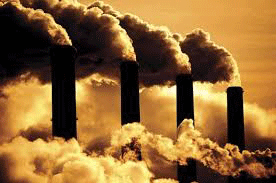 Australia’s 10 biggest climate polluters 2016 http://apo.org.au/resource/australias-10-biggest-climate-polluters-2016 Australian Conservation Foundation 29 February 2016 Australia’s 10 biggest polluters – all energy and mining companies – continue to rely on last century’s fuels to generate energy and conduct their businesses.
Foreword
In the 12 months since the Australian Conservation Foundation’s first report on Australia’s 10 biggest climate polluting companies, energy giant AGL has gone from #3 to #1 and miner Glencore has entered the list for the first time.
Despite what the federal government tells Australians, the amount of climate pollution Australia pumps into the sky is rising.
And Australia’s 10 biggest polluters – all energy and mining companies – continue to rely on last century’s fuels to generate energy and conduct their businesses.
This report, based on the very latest available data, describes each company, explains how the company creates climate pollution and summarises what each says on the public record about climate change.
These 10 companies are responsible for the equivalent of nearly a third of Australia’s climate pollution. Together, they are responsible for pouring more climate pollution into the atmosphere than Switzerland, Ireland, and Denmark combined.
And government policies encourage them to keep doing what they’ve been doing for decades. Meanwhile, the world is changing.
In Paris in December last year, 195 countries agreed to keep “the increase in the global average temperature to well below 2°C above pre-industrial levels and to pursue efforts to limit the temperature increase to 1.5°C above pre-industrial levels.”
To achieve this goal all countries have to work hard to cut climate pollution.
But in 2014-15 Australia’s climate pollution increased by 1.3 per cent. That’s more than seven million additional tonnes of planet-warming pollution pumped into our skies in just one year.
Why? In axing the carbon price, the government removed the one policy Australia had to reduce climate pollution from the energy sector, leaving electricity generators – and the rest of us – largely reliant on coal for our power.
The truth is the energy sector is crying out for government leadership to help the industry make the transition to a zero-pollution future.
At an energy forum hosted by ACF last year representatives of energy companies, superannuation funds, financial services companies and investors agreed the early closure of coal-fired power stations was inevitable and the federal government needed to manage this transition.
AGL’s chief executive Andrew Vesey has called on the federal government to develop a “clear and equitable policy” to close the least efficient power stations. “It is important that older, less efficient and reliable power stations are removed from Australia’s energy mix,” Mr Vesey said. “Decarbonisation and modernisation of Australia’s electricity system are important goals requiring effective policy.”
The calls are there – from the energy companies, investors, environmentalists and infrastructure experts. Now, the government must take the lead.
ACF urges the federal government to commit to a phased closure of Australia’s coal-fired power stations. This means starting with the dirtiest and least efficient stations, helping affected workers and communities with the transition and drawing up comprehensive plans to clean up and rehabilitate old mine sites and power stations.
The big polluters identified in this report own some of the world’s dirtiest coal-fired power stations. Every day these dirty power stations are spewing out pollution. Every day they are making climate change worse.
Australians already live with the impacts of climate change. Last year was the world’s hottest recorded year, the 39th consecutive year of above average temperatures. This has fuelled droughts, bushfires, heatwaves and other extreme weather events across the country. This summer ancient parts of Tasmania’s alpine World Heritage wilderness were burnt by bushfires for the first time in a thousand years. These big polluting companies are making this situation worse every day.
It’s time for Australia to get out of last century’s energy sources and leap into a brighter future powered by clean energy.
Tasmania needs to ramp up its wind and solar power
 Tasmanian power crisis reveals urgent need for more renewable energy
With Tasmania’s hydropower plants idle due to low rainfall, and a faulty cable connecting the state to the mainland grid, it’s clear a better long-term solution is needed, Guardian, Max Opray, 3 Mar 16 The timing couldn’t have been any worse. On 20 December 2015, the undersea cable connecting Tasmania with mainland Australia malfunctioned, leaving the island state’s energy infrastructure stranded without help – just when it was needed most.
The bulk of Tasmania’s internal energy capacity comes from its extensive hydroelectric network but, with 2015 delivering the driest spring on record, water levels in the state’s dams were catastrophically low. More than ever, the Apple Isle was counting on electricity imported via the Basslink cable so that the hydroelectric dams could be given time to replenish.
Obscured by the Bass Strait’s silty seabed, the fault in the cable is yet to be identified, let alone repaired, and things are getting desperate.
Dam water levels are at 16.8% and falling, low enough that aquatic ecosystems are being put under strain. State-owned energy providerHydro Tasmania had in December already reassembled and rebooted the old Tamar Valley gas-fired generators to ease the burden on the dams and is now spending $44m on importing temporary diesel generators with 200MW of capacity to help keep the lights on while the state waits for cables to be fixed or the rain to arrive…….
Phil Harrington, [the Tasmania-based senior principal of carbon and energy at Pitt & Sherry] says adding more wind farms into the mix would perfectly complement the existing hydro capacity.
“It’s a marriage made in heaven basically,” he says. “The dams act as a big battery so you don’t have to worry about the intermittency of wind and, in turn, there is the opportunity to capture wind farm power when the wind is blowing and reduce the draw on dams.”
Harrington notes that ramping up wind capacity would not just be beneficial in preventing the current crisis from repeating but could also bring long-term economic benefits by allowing the state to consistently export rather than import energy.
That’s without even factoring in the reduced carbon emissions that would result from in-house renewables as opposed to imported electricity from fossil fuel power plants.
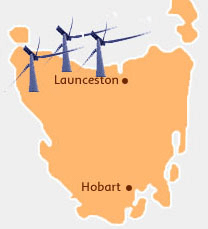
There are several planned wind farm projects around Tasmania, including West Coast Wind’s 33-turbine Granville Harbour proposal, but an unfavourable legislative and investment climate has seen progress stall in recent years.
Harrington also advocates improving energy efficiency and lifting the solar feed-in tariff, which the Tasmanian government slashed by two-thirds in 2013……..http://www.theguardian.com/sustainable-business/2016/mar/03/tasmanian-power-crisis-reveals-urgent-need-for-more-renewable-energy
Sam Kelton: Why it will be good to be green in Adelaide’s CBD
THE Adelaide City Council is seeing green and if it has its way wants to see Adelaide become a carbon neutral city by 2025…. (subscribers only)
http://www.adelaidenow.com.au/news/opinion/why-it-will-be-good-to-be-green-in–adelaides-cbd/news-story/64458a07df65398ed13cd652513ea801
Carbon cut as lights go out on coal-fired power
Coal-fired power generation is quietly being phased down, with eight of the nation’s 12 dirtiest stations shuttered….. (subscribers only)
http://www.theaustralian.com.au/national-affairs/climate/carbon-cut-as-lights-go-out-on-coalfired-power/news-story/448f76a427ed2f37f86dd087902faa72
Greens senator Larissa Waters attacks ‘corrupting influence’ of mining industry – video
http://www.theguardian.com/environment/video/2016/mar/01/greens-senator-larissa-waters-attacks-corrupting-influence-of-mining-industry-video 1 Mar 16 Larissa Waters says the mining sector’s political influence is disproportionate ‘when you look at the actual contribution that sector makes to our employment’ and gross domestic product. She says of what she describes as the industry’s ‘corrupting’ influence: ‘In the last three years both big parties have received $3.7m from the fossil fuels sector’ and questions what the companies receive in return. Waters says: ‘They get their approvals … There has not been a coalmine refused under our federal laws in history. There has not been a coal seam gas project refused under our federal laws in history’
1 This month
7 April – WEBINAR – Australia and the Doomsday Clock – Preventing nuclear war through NoFirstUse and other policies
Online | Tuesday April 7, 4:00-5:30pm, Australian Eastern Time / 8:00-9:30am Central Europe Time
– Access the registration link
15 April – Zoom –Nuclear Power is Not the Solution
Apr 15, 2026 01:00 AM in Canberra, Melbourne, Sydney

Join the International Physicians for the Prevention of Nuclear War (IPPNW) on Tuesday, April 14th for a timely webinar exploring the risks associated with nuclear power and challenging the myth that it offers a simple, safe, carbon-free solution to the climate crisis

21 April Webinar: No Nuclear Weapons in Australia
Start: 2026-04-21 18:00:00 UTC Canberra, Melbourne, Sydney (GMT+10:00)
End: 2026-04-21 19:30:00 UTC Canberra, Melbourne, Sydney (GMT+10:00)
Event Type: Virtual
A virtual link will be communicated before the event.
Host Contact Info: australia@icanw.org

of the week – Australians for War Powers Reform (AWPR)
To see nuclear-related stories in greater depth and intensity
 Antinuclear