The nuclear industrial chain – full of false promises
The Commission – unsurprisingly given the overwhelming market sentiment – has stated it is 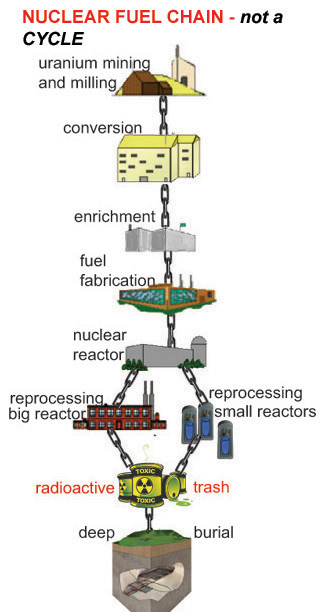 unconvinced about the chances for any uranium industry expansion and acknowledges nuclear power is not commercially viable in the foreseeable future.
A range of state and federal laws expressly preclude such an activity [importing nuclear waste] and there is continuing community contest and no bi-partisan political support. In July 2015 Labor’s national conference re-affirmed that it would ‘remain strongly opposed to the importation and storage of nuclear waste that is sourced from overseas in Australia’.
Unlike the global nuclear power sector which is dying out due to growing costs, public opposition and the rise of renewables – nuclear waste is like zombie waste – it remains undead. From its beginning to its never-end the nuclear industrial chain is full of false promises and real problems, and the Commission’s waste talk demands serious scrutiny and critical attention.
Failed Uranium Promises Highlights Need For Caution On Radioactive Waste Plans New Matilda, By Dave Sweeney on March 3, 2016 “……….Against this background, around 12 months ago South Australian Premier Jay Weatherill announced a Royal Commission to explore opportunities to expand the nuclear industry in SA. The Commission was tasked with examining development options over four broad areas: uranium mining, expanded uranium processing, domestic nuclear power and the storage and management of high-level radioactive waste.
The move surprised many at the time both because of SA’s leading role in renewable energy production (the state is on track to be 50 per cent powered by renewables this year) and the Fukushima inspired retreat from the nuclear industry.
Early commentators criticised the Commission’s pro-industry terms of reference and heavily skewed pro-nuclear ‘expert’ panel. They argued then that the process was either a Trojan Horse for, or would inevitably drift to, support for a renewed push for international radioactive waste disposal in Australia.
This view was vindicated in the Commissions recently released tentative findings.
The Commission – unsurprisingly given the overwhelming market sentiment – has stated it is unconvinced about the chances for any uranium industry expansion and acknowledges nuclear power is not commercially viable in the foreseeable future. Yet, as anticipated by critics, the Commission was glowing about the opportunities that could come from hosting international high-level radioactive waste.
Proposals to store or dispose of global radioactive waste in Australia are not new. Former PM Bob Hawke routinely re-visits the issue and an international consortium called Pangea Resources made a serious push to develop a facility in a remote part of Western Australia in the 1990’s.
The Commission has correctly identified that radioactive waste management is an unresolved environmental challenge. However its enthusiasm exceeds its evidence when it comes to analysis of cost, complexity and the history of failed international waste storage or disposal programs. Managing nuclear waste has proven to be a problem without a satisfactory global solution.
Some countries, most notably Finland, are advancing deep geological burial sites. But after seven decades of commercial nuclear power operations not one nation has a final disposal site for high-level waste.
Against this international landscape of failed projects, timeline delays and massive cost overruns it is hard to see Australia providing the silver bullet. Australia has limited nuclear industry experience and infrastructure, and lacks the required regulatory framework.
A range of state and federal laws expressly preclude such an activity and there is continuing community contest and no bi-partisan political support. In July 2015 Labor’s national conference re-affirmed that it would ‘remain strongly opposed to the importation and storage of nuclear waste that is sourced from overseas in Australia’.
Australia’s dismal track record over more than two decades in relation to managing our own relatively modest stockpile of radioactive waste also provides scant reason for confidence in the Commission’s global ambition.
The issue, especially in a federal election year, now increasingly becomes one of politics given the plans profound national implications and the critical need for bi-partisan support.
Premier Weatherill is keen to talk with the Commonwealth Government ahead of the Commission’s final report on May 6. While the SA Government does not currently have a fixed view, the Premier has stated he is ‘prepared to consider such a proposition’ and will respond to the state Parliament before the end of the year.
Unlike the global nuclear power sector which is dying out due to growing costs, public opposition and the rise of renewables – nuclear waste is like zombie waste – it remains undead. From its beginning to its never-end the nuclear industrial chain is full of false promises and real problems, and the Commission’s waste talk demands serious scrutiny and critical attention.
This could start with asking two questions: are the options really so scarce that South Australia’s and Australia’s best economic chance requires hosting some of the world’s worst waste? And, with its track record from mine-site to reactor would you really trust the nuclear industry, forever? https://newmatilda.com/2016/03/03/failed-uranium-promises-highlights-need-for-caution-on-radioactive-waste-plans/
No comments yet.
1 This month
7 April – WEBINAR – Australia and the Doomsday Clock – Preventing nuclear war through NoFirstUse and other policies
Online | Tuesday April 7, 4:00-5:30pm, Australian Eastern Time / 8:00-9:30am Central Europe Time
– Access the registration link
15 April – Zoom –Nuclear Power is Not the Solution
Apr 15, 2026 01:00 AM in Canberra, Melbourne, Sydney

Join the International Physicians for the Prevention of Nuclear War (IPPNW) on Tuesday, April 14th for a timely webinar exploring the risks associated with nuclear power and challenging the myth that it offers a simple, safe, carbon-free solution to the climate crisis

21 April Webinar: No Nuclear Weapons in Australia
Start: 2026-04-21 18:00:00 UTC Canberra, Melbourne, Sydney (GMT+10:00)
End: 2026-04-21 19:30:00 UTC Canberra, Melbourne, Sydney (GMT+10:00)
Event Type: Virtual
A virtual link will be communicated before the event.
Host Contact Info: australia@icanw.org

of the week – Australians for War Powers Reform (AWPR)
To see nuclear-related stories in greater depth and intensity
 Antinuclear
Leave a comment