South Australian Government pro-nuclear waste dump PR campaign set to roll
The Premier’s announcement today that the State Labor Government will move to repeal part of the 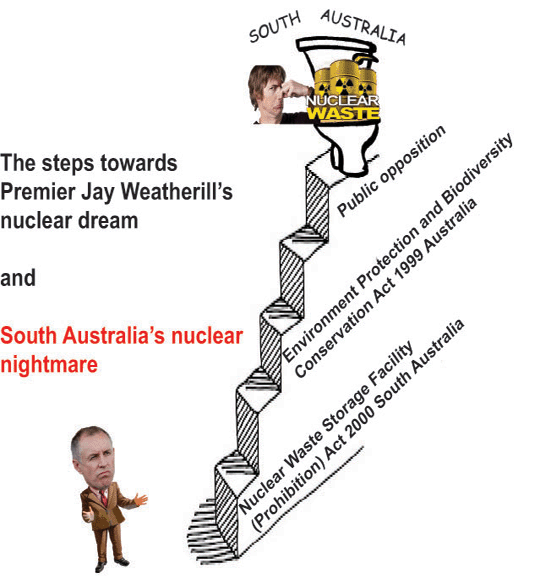 Nuclear Waste Storage Facility (Prohibition) Act 2000, indicates that a taxpayer-funded pro-nuclear waste dump public relations campaign is on its way.
The Government says the repeal is necessary in order to consult with the community over the Nuclear Royal Commission’s findings.
“That’s just not true”, according to SA Greens Leader and environmental lawyer, Mark Parnell MLC.
“The Act only prohibits the use of public money to “encourage or finance any activity associated with the construction or operation of a nuclear waste storage facility in this State”. It doesn’t preclude genuine public consultation that asks South Australians whether or not they believe SA should host a high-level nuclear waste dump. Genuine consultation with the South Australian community is allowed, even if it uses Government resources. What isn’t allowed is a biased or one-sided PR campaign that “encourages” the construction or operation of a nuclear waste dump.”
“If the Government’s intentions were honourable, it wouldn’t need to repeal this legislation.”
“What is most galling is that the Premier isn’t even prepared to wait for the Royal Commission’s final report in May before legislating to be able to spruik a nuclear waste dump. The Government had said it would wait until the end of the year before deciding what to do with the Royal Commission’s findings. Rushing now to repeal this legislation suggests that it’s mind might already be made up.
“If this legislation is repealed, the Government will be able to legally spend millions of dollars of taxpayers’ money to promote SA as the Nuclear Waste State. It will also be able to conduct detailed planning and design work for a nuclear waste dump, with only the final consent requiring Parliamentary approval,” concluded Mark Parnell.
South Australia nuclear law repeal opens door to taxpayer funded spin
Conservation Council of South Australia 7 Mar 16 The move by the Weatherill Government to repeal parts of the SA Nuclear Waste Storage Prohibition Act even before the Nuclear Royal Commission hands down its final report is deeply disappointing.
“This move is cold comfort for communities in Kimba and the Flinders Ranges who are currently in the frame for a national radioactive waste facility,” said Conservation SA Chief Executive, Craig Wilkins.
“With the Royal Commission months from handing down its final report, Premier Weatherill is clearly jumping the gun.
“The South Australian public now has every right to question how genuine the ‘listening’ process in response to the Royal Commission will be over the coming months.
“They will rightly be outraged if the Government intends to free up taxpayer funds to spin an unpopular nuclear waste dump proposal,” he said.
The object of the Nuclear Waste Storage Facility (prohibition) Act is to ‘protect the health, safety and welfare of the people of South Australia and to protect the environment in which they live by prohibiting the establishment of certain nuclear waste storage facilities in this state.’ The Act expressly bans the use of public money ‘for the purpose of encouraging or financing any activity associated with the construction or operation of a nuclear waste storage facility in this State’. This clause is now set for repeal.
Rose Lester, Yankunytjatjara Anangu woman said: “When many Anangu people have clearly expressed opposition to nuclear industry, weakening any protection is not a step in the right direction for reconciliation. It is very disheartening that people who don’t have strong connection to country change laws to suit their ideology rather than acknowledging and respecting the law of the land.”
South Australian Laws to be repealed to allow tax-payer funding for nuclear activity
 The State Government will move this week to repeal laws that prevents it from consulting on the merits of a nuclear waste storage facility once the Royal Commission hands down its final report to Government due in May.
Section 13 of the Nuclear Waste Storage Facility (Prohibition) Act 2000, states: “Despite any other Act or law to the contrary, no public money may be appropriated, expended or advanced to any person for the purpose of encouraging or financing any activity associated with the construction or operation of a nuclear waste storage facility in this State.”
We now have a real dill, Barnaby Joyce, for a Deputy Prime Minister
 When you look at what’s going on in politics in USA – it becomes clear that profound ignorance is no barrier for a man to become a presidential candidate.
But that’s America. Surely in Australia, things are a bit more intelligent! But no. We’ve suffered the international embarrassment of Tony Abbott as PM – with his simplistic three word slogans and quasi religious beliefs on climate etc.
That was bad enough. We breathe a little, now having Malcolm Turnbull, who has the facility for making progressive statements, while sticking to the antediluvian policies of the Liberal Coalition.
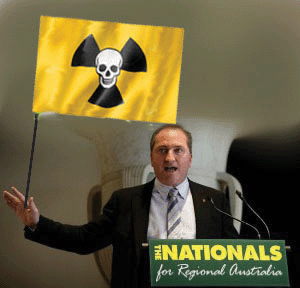
But what happens if Malcolm gets knocked over by a bus?
Mon dieu! We now have Barnaby Joyce as Deputy Prime Minister. Internationally and nationally, if Joyce ever gets his hands on the tiller – it won’t just be funny. Be afraid. Be very afraid.
Canberra’s renewable energy now paying dividends
 ACT government leads the way on renewable energy March 6 2016 The Canberra Times
The ACT government’s commendable commitment to renewable energy has the potential to deliver for this community on a number of levels.
The first, and most obvious, is that Canberrans have shifted further away from dependence on fossil fuel generated electricity than almost any other mainland state or territory.
The second is that while the ACT government’s 2015 commitment to 100 per cent renewable energy by 2025 was initially mocked in some circles, the aspirational nature of that goal is now paying dividends.
The territory is expected to reach 60 per cent of power generation from renewables by the end of next year and 90 per cent by 2020. Both of these figures are impressive given the federal government’s much more modest target of 23.5 per cent from renewables by the end of the decade.
That Canberra’s commitment to this path occurred at the same time the federal government was openly hostile to investment in renewables and after former treasurer Joe Hockey said wind farms were a blight on the landscape makes it even more remarkable.
The announcement that, as a result of the “reverse auction” process initiated by the territory, Sapphire has been awarded a contract to build a local 100 megawatt hour windfarm for completion by April 2018, is the latest in a number of positive steps…….
With the Royalla 20 megawatt solar power plant in operation since September 2014 and the 13 megawatt Mugga Lane solar park expected to come on line this year, considerable expertise is already available on the solar power front as well……
It is remarkable that these achievements have been delivered while, at the same time, local power consumers continue to enjoyed the lowest electricity prices in the nation. http://www.canberratimes.com.au/comment/ct-editorial/act-government-leads-the-way-on-renewable-energy-20160304-gnawvc.html
The myth that a nuclear reactor is needed for medical uses
A very comprehensive 2010 OECD Nuclear Energy Agency report found reactor based isotope production requires significant taxpayer subsidies, as the cost of sale does not cover the cost of production.
The report concludes: “In many cases the full impact of Mo-99/Tc-99m provision was not transparent to or appreciated by governments… The full costs of waste management, reactor operations, fuel consumption, etc were not included in the price structure. This is a subsidisation by one country’s taxpayers of another country’s health care system. Many governments have indicated that they are no longer willing to provide such subsidisation.”
What is needed urgently is a debate about how much waste we make. We have a choice: whether we follow ANSTO’s expensive business model to ramp up reactor manufacture (and the long-lived radioactive waste that goes with it), or collaborate with Canada to develop cyclotron manufacture of isotopes that does not produce long-lived nuclear waste.
Debunking the myths around medicine and a nuclear waste dump
The Federal government is seeking a location for a nuclear waste facility. But the provision of information to communities has been problematic, with some major flaws.
Claims have been made that provision of nuclear medicine services is a key reason to build it, but existing medical waste makes up a very small proportion of the total waste requiring disposal.
In addition, little has been said about ANSTO’s business plan to greatly ramp up Australia’s reactor based production of isotopes from 1 per cent to over 25 per cent of the world’s market, which will massively increase the amount of long-lived radioactive waste produced in the future.
A new process may reduce the volume of the waste, but the actual quantity of radioactive material to store will be significantly greater, and will become most of the radioactive waste Australia produces.
In Australia nuclear medicine isotopes are indeed useful, but according to Medicare figures represent less than 3 per cent of medical imaging. They are most commonly used for bone scans and some specialised heart scans. They are not needed (as claimed by government) for normal X-rays, most heart scans and the vast majority of cancer treatments (surgery, chemotherapy and radiotherapy). Continue reading
Barnaby Joyce shows his ignorance on renewable energy
Memo to Barnaby: If you want cheap electricity, nuclear is not the answer, REneweconomy, By Sophie Vorrath on 4 March 2016 [good graphs] There’s right, and there’s wrong… and then there’s Barnaby Joyce. Joyce – Australia’s LNP minister for agriculture who was recently sworn in as deputy leader of the entire country – was right when he declared the cost of electricity bills to be one of the uppermost issues for Australian consumers, in an interview with the Adelaide Advertiser on Thursday.
He was wrong, however, when he suggested that the answer to the issue of electricity prices was not renewable energy, but nuclear, what he described as the “the ultimate renewable energy”.
Joyce, as we learned in our piece last year, “Barnaby Joyce’s renewable energy target: 100% ignorance” is one of the biggest opponents of wind farms in the Coalition, and it’s a little ironic to see that his electorate is about to became a major renewable energy hub, with two large wind farms and solar farms to be built near Glen Innes.
So it’s not necessarily surprising that he took another pot shot at renewables in the Murdoch media today……….
Back in 2013, he made his feelings clear, when he lamented to the Senate the “insane lemming-like desire to go to renewables” in Australia, and questioned what it would do to the national economy.
What is a little surprising is his endorsement of nuclear as a suitable and cheap alternative for new electricity generation in South Australia, as old coal-fired power is retired, when this is precisely the opposite finding arrived at by various recent and significant studies on the subject, not least of all the SA Royal Commission into nuclear power for Australia. Continue reading
South Africa’s solar-powered airport

 Africa gets its first solar-powered airport By Milena Veselinovic, for CNN March 4, 2016 (CNN) South Africa has ramped up its green credentials by unveiling the continent’s first solar-powered airport.
Located halfway between Cape Town and Port Elizabeth, George Airport will meet 41% of its energy demand from a brand new 200 square meter solar power plant built on its grounds.
The facility, which was officially launched last week, has 3,000 photovoltaic modules, and will gradually increase capacity to deliver 750Kw power when it reaches full production…….
The airport serves the Western Cape town of George which lies in the heart of the scenic Garden Route, famous for its lush vegetation and lagoons which are dotted along the landscape.
It handles over 600,000 passengers a year, many of them tourists, but it’s also a national distribution hub for cargo such as flowers, fish, oysters, herbs and ferns.
The clean energy initiative follows in the footsteps of India’s Cochin International airport — the world’s first entirely solar powered airport, and Galapagos Ecological Airport, built in 2012 to run solely on Sun and wind power.
Around 635 million people, or 57% of the population, are estimated to live without power on the continent, with that number climbing to 68% in Sub-Saharan Africa.
Last year, a UK start-up collaborated with Shell to build a solar-powered soccer pitch in the Nigerian city of Lagos, but governments are also increasingly harnessing the Sun’s energy for major infrastructure projects.
Last month, Morocco switched on what will be the world’s largest concentrated solar plant when it’s completed. It is predicted to power one million homes by 2018. In Rwanda, a $23.7 million solar plant has increased the country’s generation capacity by 6% and lighting up 15,000 homes. http://edition.cnn.com/2016/03/04/africa/george-airport-solar-south-africa/index.html?utm_source=twitter&utm_medium=post&utm_term=africa,airport,solar,renewables&utm_campaign=greenpeace&__surl__=IgNX8&__ots__=1457298969501&__step__=1
Waste dump submissions due this Friday, Flinders Ranges petition and more….
 Submission close this coming Friday March 11, 2016 for you to submit comments to the National Radioactive Waste Management Project – this process has shortlisted three nominated sites in SA – two in Kimba and one in the Flinders Ranges. SA has battled before against a intermediate and low level waste dumps and won!
Check out the BNI website HERE for some great tips on making a submission and more information on the current process. Remember, you need to get them in by Friday March 11 at 5pm!
A petition has just been set up to oppose the site at Wallerberdina in the Flinders Ranges becoming a nuclear waste dump. The petition is HERE – please sign, share and crank it out there.
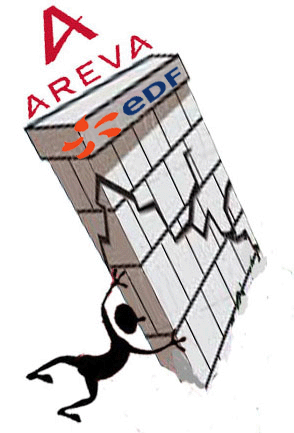
Nuclear Royal Commission advisers EDF, AREVA in deep financial trouble
 French Mastery of Nuclear Power at Stake in U.K. Reactor Project, Bloomberg Francois De Beaupuy March 4, 2016
-
EDF faces dilemma of whether to proceed with $26 billion plant
-
Unions argue for a delay because company’s future is `at risk’
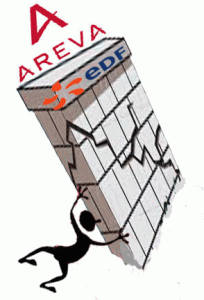 Electricite de France SA, the world’s largest operator of nuclear power plants, is stuck in a multibillion-dollar quandary that will shape its future.
Going ahead with new EPR atomic plants in the U.K. would strain the limits of its balance sheet as slumping electricity prices across Europe reduce cash flow. Dropping the Hinkley Point venture in southwest England would further damage the image of a new French-designed reactor, already tarnished by delays and cost overruns at projects elsewhere…….
The EPR reactor design from French nuclear group Areva SA was once a symbol of the nation’s engineering prowess. EDF’s former Chief Executive Officer Pierre Gadonneix predicted it would sell “like hotcakes” around the world. Project setbacks and the safety fears following the Fukushima disaster in Japan in 2011 stymied those plans, while a flood of competing energy supplies from solar and wind has left one of the nation’s most important industries in distress. Continue reading
Five years on, Fukushima’s dead zone remains abandoned, uninhabited
five years on, an area 12 miles around the plant remains a dead zone, abandoned and uninhabited.
 At intervals beside the roads, heaped up in huge piles, lie half a million black plastic bags containing radioactive topsoil, scraped off the surface of the land in an effort to persuade farmers to start work here again.
Some of the dead zone will never return to life. Futaba, the closest town to the plant, will probably be turned into a radioactive waste dump.
thousands of workers are now being bussed in to the cleanup effort at the power station, the radioactive fuel rods which melted down are all still there. Even after five years, radiation levels inside the reactor buildings are still too high for workers to enter, making it hard to even plan the task that needs to be done, let alone carry it out.
Fukushima: Inside the dead zone where the legacy of nuclear disaster still rulesFive years since a tsunami led to disaster at Japan’s Fukushima nuclear plant, Andrew Gilligan explores the ghost towns left in its wake, Telegraph UK, By Andrew Gilligan, in Fukushima, video by Julian Simmonds, additional editing by Charlotte Krol 06 Mar 2016

Along the rest of the country’s blasted east coast, the wreckage has been at least cleared away, even if not much has yet been put in its place. But in Futaba, time stopped on the night of 11 March 2011, when those residents who’d survived the giant wave fled, as they thought, for their lives from something even more frightening.
The buildings which collapsed in the earthquake have simply been left – rubble, roof tiles and all. The ceremonial torii gate of the Shinto shrine is lying exactly where it fell, on its side jutting out into the street. But most of the town is physically intact. It was just abandoned, and clearly in a very great hurry….. Continue reading
1 This month
7 April – WEBINAR – Australia and the Doomsday Clock – Preventing nuclear war through NoFirstUse and other policies
Online | Tuesday April 7, 4:00-5:30pm, Australian Eastern Time / 8:00-9:30am Central Europe Time
– Access the registration link
15 April – Zoom –Nuclear Power is Not the Solution
Apr 15, 2026 01:00 AM in Canberra, Melbourne, Sydney

Join the International Physicians for the Prevention of Nuclear War (IPPNW) on Tuesday, April 14th for a timely webinar exploring the risks associated with nuclear power and challenging the myth that it offers a simple, safe, carbon-free solution to the climate crisis

21 April Webinar: No Nuclear Weapons in Australia
Start: 2026-04-21 18:00:00 UTC Canberra, Melbourne, Sydney (GMT+10:00)
End: 2026-04-21 19:30:00 UTC Canberra, Melbourne, Sydney (GMT+10:00)
Event Type: Virtual
A virtual link will be communicated before the event.
Host Contact Info: australia@icanw.org

of the week – Australians for War Powers Reform (AWPR)
To see nuclear-related stories in greater depth and intensity
 Antinuclear