Don’t nuclear waste Australia! Make a stand!
Dave Sweeney, Australian Conservation Foundation, 9 Mar 16 Six communities in regional and remote areas around the country are on a government shortlist as possible sites to house Australia’s radioactive waste.
Toni Scott from Kimba in South Australia visited Parliament House last week with farmers, residents and Traditional Owners from every community on the list. “I’m the direct neighbour of a site and I’m here to say to Minister Frydenberg this process is wrong. He needs to stop and start again and get it right. He’s got time to do that.”
Josh Frydenberg, the Minister for Resources, Energy and Northern Australia, has promised not to impose radioactive waste on a site without broad community support. It is now time to honour this promise.
Public comment on the proposed six sites ends this Friday. Will you make a public comment in the next 48 hours and take a stand with Toni?
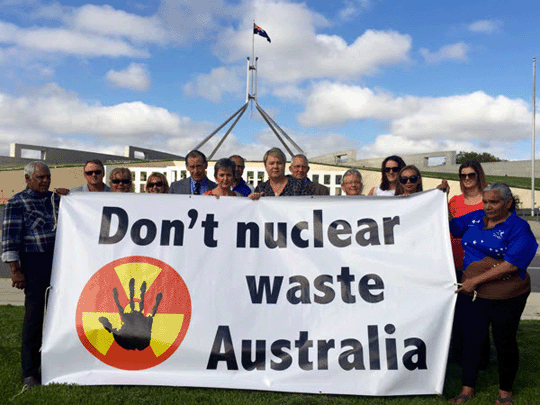
I was at Parliament with Toni and the other representatives from the six proposed sites and they’re concerned, suspicious and opposed.
Radioactive waste is caused by splitting atoms. We cannot let it split communities.
Peter Woolford, a grain grower from Kimba, said, “The mental health issues that the process has created, the stress and the anger and the deep division in our community is real. We are here as one to make sure our concerns are heard. The process is wrong and it’s damaging our communities.”
Regina McKenzie, a Traditional Owner from the Flinders Ranges, worries that the Indigenous cultural work done in her community over many years will be lost. “There was no consultation whatsoever. We all found out when it was released on the news and we feel it’s an attack on our belief system.”
Peter Kenny, a Traditional Owner from Walkabout Bore, so wanted to represent his community he travelled out of the Northern Territory and in a large plane for the first time.
Annette Clement from Oman Ama in southern Queensland stated, “We feel it’s been unfairly foisted upon us. We were told it wouldn’t come to a community if we said no. We say no but they continue to coerce us with inferred incentives – money – and guilt.”
Most of Australia’s radioactive waste is currently securely stored in a facility at Lucas Heights in NSW and there is no reason to rush to move it anywhere else. We have the time to finally develop a credible and considered approach to radioactive waste management.
For two decades successive governments have tried to impose radioactive waste on unwilling remote communities. The most recent attempt, at Muckaty in the Northern Territory, was shelved after sustained Aboriginal and community opposition. The current approach must avoid replicating the mistakes of the past.
ACF wants to see responsible radioactive waste management, not more pressure on communities.
How we handle radioactive waste is an issue that lasts longer than this generation. It’s not contained to any single post code. We don’t need to rush, but we do need to get it right.
Sallys Flat: How “ordinary people” are fighting back against nuclear waste dumping
 Nuclear dump site journey continues “http://www.westernadvocate.com.au/story/3777432/finish-lines-in-sight-for-hill-end-eco-warriors/
By LOUISE EDDY March 9, 2016, The past three months have seen three unlikely environmental advocates embark on a journey that has taken them all the way to Canberra and the halls of power.
Transitioning Byron Shire to Zero Carbon
 Plan to transition Byron shire to zero carbon, Echo Daily, 7 Mar 16
Professor David Hood will be guest speaker at a meeting titled Transitioning Byron Shire to Zero Carbon to be held at Byron Council Chambers on March 15. Christobel Munson
Byron Shire is well placed to bring to life a vision where carbon use can be reduced to zero in 10 years’, predicts Professor David Hood.
‘National research organisations such as Beyond Zero Emissions have proved Australia has the technology and the technical skills to implement this vision. And parts of Europe and China are already starting to migrate their economies, environment and life styles to a post carbon world. If they can do it, it can certainly be done here.’
Keynote speaker at the Sustainability Seminar being held from 6 to 9pm on Tuesday 15 March in Byron Council Chambers, Professor Hood AM, an environmental and civil engineer and councillor with the Australian Conservation Foundation, is also the leader of the QUT Sustainability Research & Teaching programs.
He will introduce the evening with an update on the latest findings in the world of climate change. Professor Hood is amazed at how our political leaders are taking such huge risks with the planet’s ecosystems when they wouldn’t dream of allowing engineers to fiddle with current risk factors in their work.
‘We have already exceeded the amount of carbon that we can burn to say with certainty that we will not exceed a two-degree C rise in global average temperature – a rise that many experts say is dangerous for climate impact’, he says.
‘Yet by approving massive new coal mines, we are heading into an area where we seem to be saying that a 66 per cent chance of staying under two degrees is OK. Exceeding two degrees will likely cause massive extinction of life on Earth………..
The aim of the Zero Emissions Byron project is to protect and sustainably improve the shire’s economy, while developing resilience to mitigate against the effects of climate change. A community initiative, volunteer teams have been working for some months to ascertain baseline emissions data, then draw up strategic plans to reduce emissions in five sectors: transport, energy, land use, waste and buildings. Information on the ZEB project will be available on the night.
See www.zerobyron.org for more information
Transitioning Byron Shire to Zero Carbon
Tuesday 15 March 6 – 9pm, Byron Council Chambers, Station Street, Mullumbimby
Food, tea and coffee will be available. http://www.echo.net.au/2016/03/plan-to-transition-byron-shire-to-zero-carbon/
Transcontamination: that’s what’s really happening with Fukushima nuclear debris
It’s time the Japanese government tackles the issues head-on. Either it takes the exceedingly unpopular step of imposing a more secure facility on one or more unwilling communities, or it must acknowledge the obvious, which is that the core of Fukushima’s exclusion zone will become a gigantic de facto nuclear waste dump indefinitely.
Playing Pass the Parcel With Fukushima http://www.nytimes.com/2016/03/08/opinion/playing-pass-the-parcel-with-fukushima.html?_r=0 PETER WYNN KIRBYMARCH 7, 2016 OXFORD, England — In the five years since the earthquake, tsunami and nuclear meltdowns that devastated Fukushima Prefecture, the Japanese government has undertaken mammoth efforts to decontaminate irradiated communities.
Thousands of workers have removed millions of tons of radioactive debris from backyards and fields, roadsides and school grounds. They have scraped away acres and acres of tainted soil, collected surface vegetal matter, wiped down entire buildings and hosed and scrubbed streets and sidewalks.
The cleanup effort is staggering in scale, and unprecedented. Japan’s leaders hope to restore for human habitation more than 100 cities, towns and villages scattered over hundreds of square miles. The government has allocated more than $15 billion for this work.
The Japanese authorities call these efforts josen (decontamination), but the word is misleading and the activity largely a fallacy. What’s happening is more like transcontamination: Once the radioactive debris is collected and bagged, it is transferred from one part of Fukushima to another, and then another.

The waste is placed in bags, which are periodically collected and brought to provisional storage areas (kari-kari-okiba), before being moved to more secure, though still temporary, storage depots (kari-okiba). Officials at the Ministry of the Environment have said up to 30 million tons of radioactive waste will eventually be moved to yet another, third-level interim storage facility near the crippled Fukushima Daiichi plant. But no significant construction has begun. In fact, the authorities haven’t even managed to convince all the relevant absentee landowners in the area to sell the necessary plots.
So for now the radioactive waste is either lying around or being moved around. Throughout Fukushima, there are large cylindrical plastic sacks — each roughly the size of a hot tub and weighing about a ton when full — stacked in desultory heaps by the side of roads, near driveways or in abandoned lots. In the town of Tomioka in mid-October, I saw three dozen bags piled along the edges of a small cemetery, overtaken by weeds.
The bags deteriorate after three years, meaning that the waste has to be repackaged regularly. Sacks are sometimes moved from one facility to another, based on their levels of radioactivity, which vary and can shift over time. By last fall, there were more than 9 million one-ton bags of radioactive waste. Standard trucks carry fewer than 10 bags at a time — meaning that radioactive material is regularly rotating around Fukushima in a slow-motion version of pass the nuclear parcel. Continue reading
Restoring social order? Treaty with Alyawarr people first!
 “Sir – I am an Alyawarr traditional custodian and I am calling for a treaty on the back of
Dr Dennis Jensen MP’s controversial speech in Parliament last week regarding Aborigines. …
Greater autonomy within Aboriginal communities is necessary to address these issues and the way to achieve this is through treaties, and I call for one between the
Commonwealth Government and the Alyawarr people.
Indigenous leaders praise Victoria’s commitment to talk about treaty
Calla Wahlquist, The Guardian Australia:
http://www.theguardian.com/australia-news/2016/mar/03/indigenous-leaders-praise-victorias-commitment-to-talk-about-treaty
“Government agreement to hold convention on treaty comes as support for
constitutional recognition wanes among some Indigenous people …
Rod Little, co-chair of the National Congress of Australia’s First Peoples, said
Victoria should be applauded for having the courage to open up debate.
“We have talked about treaty for a long time but there is this fear
[from governments] and we haven’t explored that fear that governments have …
we haven’t even sat down to look at this issue and discuss what is a treaty,
and what would it look like,” he said.
“All people have done is jump to the defensive position.” … “
Government trashing Australia’s international reputation, with climate study cuts to CSIRO
“our whole reputation is at risk … it’s our international reputation in delivering results”.
A petition signed by 150 scientists attending the conference has called on the Federal Government to reconsider the organisation’s restructure.
 Global spotlight on CSIRO cuts as work culture turns toxic, inquiry hears , ABC News, 7 Mar 16 Australia’s top marine scientists are warning that the country’s international scientific standing will be damaged by the CSIRO’s climate restructure.
About 350 jobs nationally are expected to go by mid 2017, including positions from the Oceans and Atmosphere Unit and 100 from land and water research.
A total of 191 staff work in the Oceans and Atmosphere division in Tasmania.
Scientific leaders from the Australian Antarctic Division (AAD) and Institute for Marine and Antarctic Studies (IMAS) are giving evidence before the Senate’s Select Committee into Scrutiny of Government Budget Measures in Hobart. Continue reading
Sea level rise due to climate change will be worse than we thought
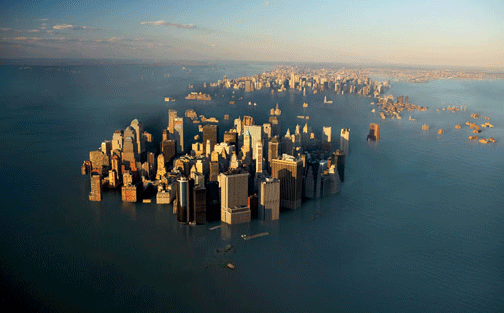
Sea level rise threatens larger number of people than earlier estimated, Science Daily, March 8, 2016
- Source:
- Aalto University
- Summary:
- More people live close to sea coast than earlier estimated, researchers have concluded after a new study. These people are the most vulnerable to the rise of the sea level, increased number of floods and intensified storms. By using recent increased resolution datasets, researchers estimate that 1.9 billion inhabitants, 28% of the world’s total population, live closer than 100 km from the coast in areas less than 100 meters above the present sea level.
-
- By 2050 the amount of people in that zone is predicted to increase to 2.4 billion, while population living lower than 5 meters will reach 500 million people. Many of these people need to adapt their livelihoods to changing climate, say Assistant Professor Matti Kummu from Aalto University.The study found that while population and wealth concentrate by the sea, food must be grown further and further away from where people live. Highlands and mountain areas are increasingly important from food production point of view, but also very vulnerable to changes in climate.
- Over the past century there has been a clear tendency that cropland and pasture areas have grown most in areas outside the population hotspots, and decreased in coastal areas. This will most probably only continue in the future, summarises Professor Olli Varis from Aalto University…….http://www.sciencedaily.com/releases/2016/03/160308105053.htm
European Parliamentary group now calling for an end to nuclear power
 Now a new ‘Alliance of Regions for Phasing out Nuclear Power across Europe’ — formed of lawmakers in the European Parliament — is calling for an end to nuclear power in the EU, claiming it is no longer economical.
“The costs of the projects are handed on to EU citizens, via subsidies. This can no longer continue… It is absolutely absurd — especially while the cost of renewable energy is falling — to continue investing in such a high risk technology. The EU should turn away from these dangerous and misguided energy investments, which would have serious consequences for decades to come,” they said.
 Euro Lawmakers Call for End to ‘Uneconomic’ Nuclear Power http://sputniknews.com/europe/20160308/1035964776/europe-nuclear-power-question.html, 8 Mar 16 The future of nuclear power stations in Europe has been called into question by lawmkares in the European Parliament following the sudden resignation of a senior director in French energy giant EDF over a new power plant in the UK. Continue reading
Treaty, Yeah! The Undeniable Case For A National Settlement With Australia’s First Peoples
Liam McLoughlin, New Matilda: https://newmatilda.com/2016/03/05/treaty-yeah-the-undeniable-case-for-a-national-settlement-with-our-first-peoples/
“Treaty, yeah! Treaty now! Liam McLoughlin makes the case for supporting a treaty with the mob. …
Treaty has been a clarion call from Indigenous communities and their allies for decades. …
More recently, a variety of Aboriginal leaders have repeated calls for a Treaty.
These calls were crystallised in an online campaign launched by a group called Concerned Australians in 2014. …
In fact, Australia is the only Commonwealth country without a Treaty with its First Peoples. …
change always comes from the grassroots, not from so-called “national leaders”. … “
Victorian government’s treaty talks a first for Australia
Myles Morgan, The Point, NITV http://www.sbs.com.au/nitv/the-point-with-stan-grant/article/2016/03/07/victorian-governments-treaty-talks-first-australia 7 March 16:
“A meeting of Indigenous Victorians say ‘No’ to recognition, and ‘Yes’ to treaty, setting the state on a historic path. …
“Overwhelmingly, it was unanimously voted that the mob in the room didn’t support constitutional recognition.”
[said Taungurong man Adam Frogley]
“it might be used as political leverage, like. ‘if it can happen in Victoria why the hell can’t it happen here?’”
[said Melbourne University academic and Wiradjuri lawyer Mark McMillan]
The Victorian Government is stepping into a void left by the Turnbull Government, according to Minister Hutchins.
1 This month
7 April – WEBINAR – Australia and the Doomsday Clock – Preventing nuclear war through NoFirstUse and other policies
Online | Tuesday April 7, 4:00-5:30pm, Australian Eastern Time / 8:00-9:30am Central Europe Time
– Access the registration link
15 April – Zoom –Nuclear Power is Not the Solution
Apr 15, 2026 01:00 AM in Canberra, Melbourne, Sydney

Join the International Physicians for the Prevention of Nuclear War (IPPNW) on Tuesday, April 14th for a timely webinar exploring the risks associated with nuclear power and challenging the myth that it offers a simple, safe, carbon-free solution to the climate crisis

21 April Webinar: No Nuclear Weapons in Australia
Start: 2026-04-21 18:00:00 UTC Canberra, Melbourne, Sydney (GMT+10:00)
End: 2026-04-21 19:30:00 UTC Canberra, Melbourne, Sydney (GMT+10:00)
Event Type: Virtual
A virtual link will be communicated before the event.
Host Contact Info: australia@icanw.org

of the week – Australians for War Powers Reform (AWPR)
To see nuclear-related stories in greater depth and intensity
 Antinuclear