The Sorry History of the Liberal Party’s Religious Conversion to Climate Denialism
Lest anyone assume that this is an issue only for the Liberals, it should be noted that the Australian Labor Party’s climate policies have hardly been consistent, veering from indifference under Paul Keating, to grave moral challenge under Rudd, and finally the “art of the possible” under Julia Gillard. Meanwhile, the arcane accounting rules around the Kyoto Protocol have allowed both Labor and Liberal governments to draw a veil over the true progress.
As economist Ross Garnaut warned in 2008, it may be that the problem is simply too wicked for our democratic system to cope.
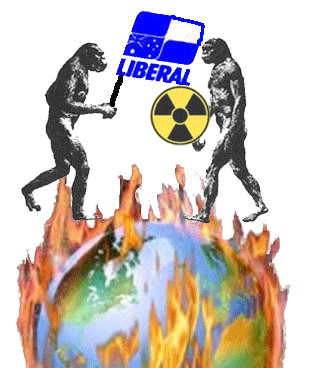 How climate denial gained a foothold in the Liberal Party, and why it still won’t go away, The Conversation, Marc Hudson, March 10, 2016 It seems the Liberal Party is still having trouble letting go of climate denial, judging by the New South Wales branch’s demand that the Turnbull government arrange a series of public debates on climate science.
Leaving aside the fact that this kind of town hall debate would only entrench opposing viewpoints rather than making scientific headway (a task best left to peer-reviewed journals), it is not the only recent example of Liberal Party members seeking to stoke doubts over the reality of climate change.
Last September, Liberal National Party senator Ian Macdonald told the federal parliament that Australia’s children have been “brainwashed” about human-induced climate change, which he described as “a fad or a farce or a hoax” and “farcical and fanciful”.
Two months earlier, Macdonald’s fellow LNP MP George Christensen attended the Heartland Institute’s climate sceptic conference. There he described climate concerns as “hysteria” and the stuff of science fiction.
And a month before that, rural Liberals called for a parliamentary inquiry into climate science, while urging Australia not to sign any binding agreement at December’s Paris climate talks.
This pervasive climate scepticism might make it look like this is a longstanding position within the Liberal Party. But history tells rather a different story.
The forgotten history of Liberal climate positions
Journalist Paul Kelly’s 1992 book The End of Certainty documents how the then opposition leader, John Howard, called for a firmer pro-environment stance after his party’s 1987 election defeat.
The following year, with climate change making headlines around the world in the wake of NASA scientist James Hansen’s US congressional testimony, Howard’s shadow environment minister Chris Puplick undertook what Kelly describes as an “exhaustive consultation” on the issue. The result was a 1989 policy paper, which paved the way for a 1990 Liberal federal election platform that called for deeper emissions cuts than Labor’s.
In his excellent 2007 book High and Dry, the author and former Liberal speechwriter Guy Pearse reports how in the mid-1990s he offered to work with the Australian Conservation Foundation to canvass Coalition MPs to “find the most promising areas of common ground – initiatives we could work on together when the party finally came to federal office”……….
Too wicked a problem?
Lest anyone assume that this is an issue only for the Liberals, it should be noted that the Australian Labor Party’s climate policies have hardly been consistent, veering from indifference under Paul Keating, to grave moral challenge under Rudd, and finally the “art of the possible” under Julia Gillard. Meanwhile, the arcane accounting rules around the Kyoto Protocol have allowed both Labor and Liberal governments to draw a veil over the true progress.
As economist Ross Garnaut warned in 2008, it may be that the problem is simply too wicked for our democratic system to cope.
But with the Paris climate agreement signed, we need action not words. As for the value of holding official debates about the veracity of climate science – well that’s debatable at best. https://theconversation.com/how-climate-denial-gained-a-foothold-in-the-liberal-party-and-why-it-still-wont-go-away-56013
No comments yet.
1 This month
Chernobyl: The Lost Tapes – A good documentary on Chernobyl on SBS available On Demand for the next 3 weeks– https://www.sbs.com.au/ondemand/tv-program/chernobyl-the-lost-tapes/2352741955560
15 April – Zoom –Nuclear Power is Not the Solution
Apr 15, 2026 01:00 AM in Canberra, Melbourne, Sydney

Join the International Physicians for the Prevention of Nuclear War (IPPNW) on Tuesday, April 14th for a timely webinar exploring the risks associated with nuclear power and challenging the myth that it offers a simple, safe, carbon-free solution to the climate crisis

21 April Webinar: No Nuclear Weapons in Australia
Start: 2026-04-21 18:00:00 UTC Canberra, Melbourne, Sydney (GMT+10:00)
End: 2026-04-21 19:30:00 UTC Canberra, Melbourne, Sydney (GMT+10:00)
Event Type: Virtual
A virtual link will be communicated before the event.
Host Contact Info: australia@icanw.org

of the week – Australians for War Powers Reform (AWPR)
To see nuclear-related stories in greater depth and intensity
 Antinuclear
Leave a comment