David Suzuki praises South Australia’s renewable energy, urges State to shun nuclear waste dump
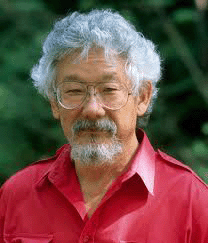 David Suzuki tells WOMADelaide audience SA should shun nuclear waste dump, ABC News 13 Mar 16 Globally renowned environmentalist and scientist David Suzuki has taken his messages to WOMADelaide, the four-day world of music, arts and dance festival in Adelaide.
He told the audience at the long-weekend event that South Australians should not build a nuclear waste dump, a venture currently under consideration after the state held a royal commission into the nuclear fuel cycle.
That inquiry recommended construction of a storage facility because of the billions of dollars of revenue it could bring to the state, which is struggling with the nation’s highest unemployment rate.
Dr Suzuki said SA should not become the world’s nuclear garbage can, as it should be up to countries producing waste to store it.
The scientist told the WOMAD audience that Indigenous people had a valuable perspective on the issue.
“To South Australians, to all Australians, I say if you want to deal seriously with the issue of nuclear waste, let the Kaurna and the other Indigenous groups make the decisions,” he said.
“They’re the only ones that provide the viewpoint and the perspective to do it.
Suzuki says human ingenuity vital
Dr Suzuki also praised South Australia’s ongoing pursuit of renewable energy projects.
He said humans had created the possibility of their own extinction, but he believed they also had the ingenuity to find environmental solutions.
“You’re at 40 per cent renewable energy now on the way 50 and possibly 60. South Australians should be boasting to the world about what you are doing here,” he said……… http://www.abc.net.au/news/2016-03-13/david-suzuki-womadelaide-nuclear-waste-dump/7243068
The plight of Japan’s thousands of radioactive decontamination workers
 Workers at ruined nuclear plant in Japan are indigent, shunned, Arkansas Online, By MARI YAMAGUCHI THE ASSOCIATED PRESS MINAMISOMA, 14 Mar 16 Japan — The ashes of half a dozen unidentified laborers ended up at a Buddhist temple in this town just north of the crippled Fukushima nuclear plant. Some of the dead men had no papers, others left no emergency contacts. Their names could not be confirmed and no family members had been tracked down to claim their remains.
They were simply labeled “decontamination troops” — unknown soldiers in Japan’s large-scale cleanup campaign to make Fukushima livable again five years after radiation poisoned the fertile countryside.
The men were among the 26,000 workers — many in their 50s and 60s from the margins of society with no special skills or close family ties — tasked with removing the contaminated topsoil and stuffing it into tens of thousands of black bags lining the fields and roads. They wipe off roofs, clean out gutters and chop down trees in a seemingly endless routine.
Coming from across Japan to do a dirty, risky and undesirable job, the workers make up the very bottom of the nation’s murky, caste-like subcontractor system long criticized for labor violations. Vulnerable to exploitation and shunned by local residents, they typically work on three-to-six-month contracts with little or no benefits, living in makeshift company barracks. And the government is not even making sure that their radiation levels are individually tested.
“They’re cleaning up radiation in Fukushima, doing sometimes unsafe work, and yet they can’t be proud of what they do or even considered legitimate workers,” said Mitsuo Nakamura, a former day laborer who now heads a citizens’ group supporting decontamination laborers. “They are exploited by the vested interests that have grown in the massive project.”
Residents of still partly deserted towns such as Minamisoma, where 8,000 laborers are based, worry that neighborhoods have turned into workers’ ghettos with deteriorating safety. Police data show arrests among laborers since 2011 have climbed steadily from just one to 210 last year, including a dozen yakuza, or gangsters, police official Katsuhiko Ishida told a prefectural assembly. Residents are spooked by rumors that some laborers sport tattoos linked with yakuza, and by reports that a suspect in serial killings arrested in Osaka last year had worked in the area.
“Their massive presence has simply intimidated residents,” said Mayor Katsunobu Sakurai. “Frankly, the residents need their help but don’t want any trouble.”
Most of the men work for small subcontractors that are many layers beneath the few giants at the top of the construction food chain. Major projects such as this one are divided up among contractors, which then subcontract jobs to smaller outfits, some of which have dubious records.
The Ministry of Health, Labor and Welfare examined more than 300 companies doing Fukushima decontamination work and found that nearly 70 committed violations in the first half of last year, including underpayment of wages and overtime and failure to do compulsory radiation checks. Those companies were randomly chosen among thousands believed to be working in the area.
“Violations are so widespread in this multilayer subcontract system. It’s like a whack-a-mole situation,” said Mitsuaki Karino, a city assemblyman in Iwaki, a Fukushima city where his civil group has helped workers with complaints about employers.
Karino said workers are sometimes charged for meals or housing they were told would be free, he said, and if they lose jobs or contracts aren’t renewed, some go homeless.
“It’s a serious concern, particularly for workers who don’t have families or lost ties with them,” he said.
Government officials say they see no other way than to depend on the contracting system to clean up the radiated zone, a project whose ballooning cost is now estimated at $44 billion………….
Officials keep close tabs on journalists. Minutes after chatting with some workers in Minamisoma, Associated Press journalists received a call from a city official warning them not to talk to decontamination crews.
Beyond the work’s arduous nature, the men also face radiation exposure risks. Inhaling radioactive particles could trigger lung cancer, said Junji Kato, a doctor who provides health checks for some workers.
Although most laborers working in residential areas use protective gear properly, others in remote areas are not monitored closely, according to workers and Nakamura, the leader of the radiation workers support group. Many are not given compulsory training or education about dealing with radiation, he said.
Though group leaders’ radiation exposure levels are regularly checked, decontamination workers’ individual levels have not been systematically recorded. The government introduced a system in 2013 but only for a fee, and many lower subcontractor workers are likely not covered. Even non-alarmist experts say that workers’ doses must be kept individually for their own records as well as for studies of low-dose radiation impact……..http://www.arkansasonline.com/news/2016/mar/13/workers-at-ruined-nuclear-plant-in-japa/?f=business
Nuclear power is now redundant: dispelling the “baseload” myth
 Dispelling the nuclear ‘baseload’ myth: nothing renewables can’t do better! Ecologist 10th March 2016 The main claim used to justify nuclear is that it’s the only low carbon power source that can supply ‘reliable, baseload electricity’, writes Mark Diesendorf – unlike wind and solar. But not only can renewables supply baseload power, they can do something far more valuable: supply power flexibly according to demand. Now nuclear power really is redundant.
We have all heard the claim. We need nuclear power because, along with big hydropower, it’s the only low carbon generation technology that can supply ‘reliable baseload power’ on a large scale……
Underlying this claim are three key assumptions. First, that baseload power is actually a good and necessary thing. In fact, what it really means is too much power when you don’t want it, and not enough when you do. What we need is flexible power (and flexible demand too) so that supply and demand can be matched instant by instant.
The second assumption is that nuclear power is a reliable baseload supplier. In fact it’s no such thing. All nuclear power stations are subject to tripping out for safety reasons or technical faults. That means that a 3.2GW nuclear power station has to be matched by 3.2GW of expensive ‘spinning reserve’ that can be called in at a moments notice.
The third is that the only way to supply baseload power is from baseload power stations, such as nuclear, coal and gas, designed to run flat-out all the time whether their power is actually needed or not. That’s wrong too.
Practical experience and computer simulations show it can be done……… Continue reading
The tipping point for Antarctica’s melting ice sheets
Tipping point: how we predict when Antarctica’s melting ice sheets will flood the seas https://theconversation.com/tipping-point-how-we-predict-when-antarcticas-melting-ice-sheets-will-flood-the-seas-56125 March 14, 2016 Antarctica is already feeling the heat of climate change, with rapid melting and retreat of glaciers over recent decades.
Ice mass loss from Antarctica and Greenland contributes about 20% to the current rate of global sea level rise. This ice loss is projected to increase over the coming century.
A recent article on The Conversation raised the concept of “climate tipping points”: thresholds in the climate system that, once breached, lead to substantial and irreversible change.
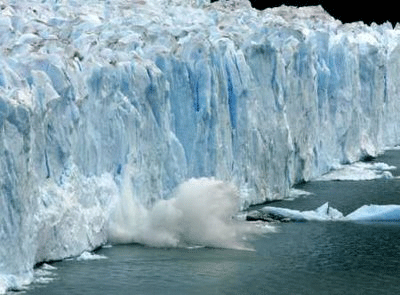
Such a climate tipping point may occur as a result of the increasingly rapid decline of the Antarctic ice sheets, leading to a rapid rise in sea levels. But what is this threshold? And when will we reach it?
What does the tipping point look like? The Antarctic ice sheet is a large mass of ice, up to 4 km thick in some places, and is grounded on bedrock. Ice generally flows from the interior of the continent towards the margins, speeding up as it goes.
Where the ice sheet meets the ocean, large sections of connected ice – ice shelves – begin to float. These eventually melt from the base or calve off as icebergs. The whole sheet is replenished by accumulating snowfall.
Floating ice shelves act like a cork in a wine bottle, slowing down the ice sheet as it flows towards the oceans. If ice shelves are removed from the system, the ice sheet will rapidly accelerate towards the ocean, bringing about further ice mass loss.
A tipping point occurs if too much of the ice shelf is lost. In some glaciers, this may spark irreversible retreat.
Where is the tipping point? Continue reading
1 This month
7 April – WEBINAR – Australia and the Doomsday Clock – Preventing nuclear war through NoFirstUse and other policies
Online | Tuesday April 7, 4:00-5:30pm, Australian Eastern Time / 8:00-9:30am Central Europe Time
– Access the registration link
15 April – Zoom –Nuclear Power is Not the Solution
Apr 15, 2026 01:00 AM in Canberra, Melbourne, Sydney

Join the International Physicians for the Prevention of Nuclear War (IPPNW) on Tuesday, April 14th for a timely webinar exploring the risks associated with nuclear power and challenging the myth that it offers a simple, safe, carbon-free solution to the climate crisis

21 April Webinar: No Nuclear Weapons in Australia
Start: 2026-04-21 18:00:00 UTC Canberra, Melbourne, Sydney (GMT+10:00)
End: 2026-04-21 19:30:00 UTC Canberra, Melbourne, Sydney (GMT+10:00)
Event Type: Virtual
A virtual link will be communicated before the event.
Host Contact Info: australia@icanw.org

of the week – Australians for War Powers Reform (AWPR)
To see nuclear-related stories in greater depth and intensity
 Antinuclear