South Australia Nuclear Waste Dump Plan – Future Safety Is Unknown!
 A high-level nuclear waste dump for SA Can it be done safely?

Conservation Council South Australia 18 Mar 16 The honest answer to this question is: we don’t know. No-one knows, because in all the years since the Hiroshima bomb, not one country in the world has worked out how to store high level nuclear waste safely for the length of time it remains dangerous to humans.
The US spent over $10 billion and invested 20 years planning to store high-level nuclear waste at Yucca Mountain, Nevada, only to abandon the plan due to community opposition.
The Royal Commission often mentions Finland, which is building a waste facility. But the Finnish site is not even complete − it will only start receiving used fuel next decade. And it will only take their own domestic waste. Before we know whether the Finnish technology will even work, the Royal Commission proposes that we in SA import 20 times their planned volume.
The only real-life experience with a deep underground nuclear waste facility anywhere in the world is the intermediate-level Waste Isolation Pilot Plant (WIPP) in the US state of New Mexico.
This was supposed to be the most advanced, efficient and safest facility ever developed by any country.
In 2014 there was a fire at the WIPP closely followed by an unrelated rupture of one of the underground barrels, followed by failure of the filtration system designed to keep radiation from the outside environment. Workers were exposed to radiation and the WIPP will now be closed down for at least four years and the repair bill will be over $500 million.
Investigations into these incidents highlight substandard hazard identification and management, and WIPP operators themselves acknowledge that complacency and cost-cutting set in within just 10−15 years of the facility opening.
Even repositories for low and short-lived intermediate-level waste (let alone high-level waste) have run into trouble. Three repositories in the USA have been closed because of environmental problems. Farmers in the Champagne region of France have taken legal action in relation to a leaking radioactive waste dump. In Asse, Germany, all 126,000 barrels of waste already placed in a repository are being removed because of large-scale water infiltration over a period of two decades.
And then there’s the issue of safe transport across oceans, through ports and along SA roads for 70 years.
Choosing to import toxic waste is a forever choice. If we can’t guarantee we can store it safely for tens of thousands of years we shouldn’t take it in the first place.
The SA Royal Commission proposal
The Royal Commission recommends we import high level nuclear waste and temporarily place it in above ground storage for at least 17 years while a deep underground repository is built.
But what happens if the underground repository doesn’t actually work? By then we will already have the toxic waste on our soil and and we can’t give it back. What then?
No comments yet.
1 This month
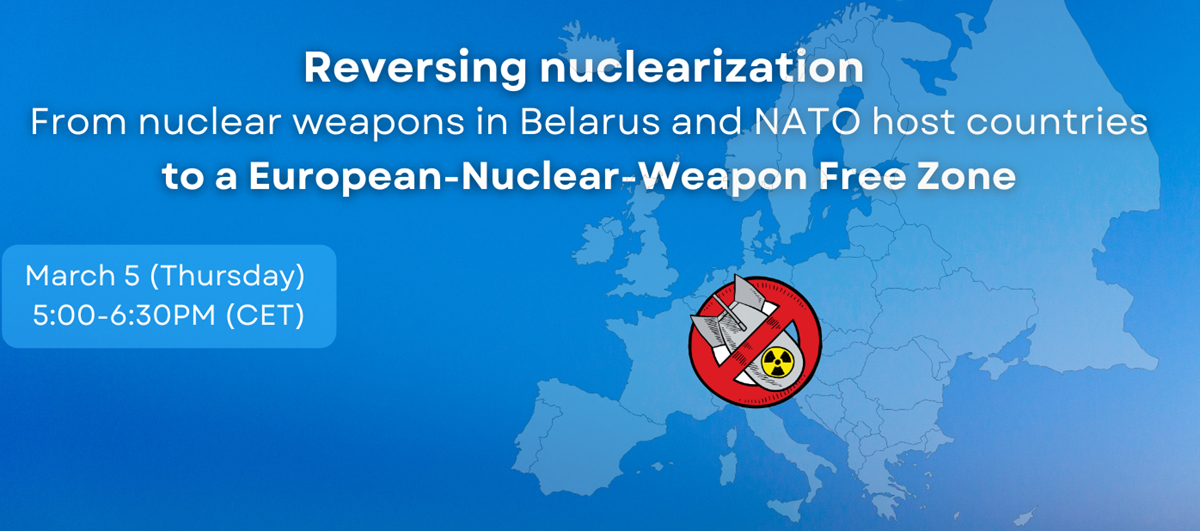
6 March -Online – Reversing nuclearization:
From nuclear weapons in Belarus and NATO host countries to a European-Nuclear-Weapon Free Zone
Mar 6, 2026 03:00 AM in Canberra, Melbourne, Sydney

of the week – Australians for War Powers Reform (AWPR)
To see nuclear-related stories in greater depth and intensity
 Antinuclear
Leave a comment