Record heat: renewable energy key to slowing climate changge
 Record-breaking autumn temperatures points to a hotter future, environmentalists warn http://www.abc.net.au/news/2016-03-20/hot-autumn-weather-across-australia-may-have-consequences/7261312?section=environmentRecord-breaking hot weather across Australia in autumn could have long-ranging consequences, the Climate Council says, with warmer conditions set to continue.
Key points:
- March temperatures in south-eastern Australia up by 12C, report says
- Perth recently had more 40-degree days than ever before
- Environmentalists say high temperatures point to human-driven climate change
In the first week of March, temperatures in parts of south-eastern Australia were 12 degrees Celsius warmer than average, the report titled The Heat Marches On said.
The Climate Council’s Tim Flannery said El Nino weather patterns had caused Australia to heat up, and that hotter conditions were expected in future.
“As long as El Nino persists, we will see these very hot conditions,” he said.
“Once El Nino fades, we will go back to less extreme conditions.
“But the next El Nino will bring a higher spike again, because the background level of greenhouse gases that is capturing ever more heat just continues to grow.”
Mr Flannery said the heat was having consequences around the world.
“The fact that we have seen record high temperatures over the Arctic ocean through this winter … means that we are looking towards a summer with potentially very low ice volumes,” he said.
“That will have a global impact. These warm conditions throughout the earth now are really having an impact on humanity in so many ways.
“Droughts, enhanced fire conditions, changed rainfall patterns, shrinking glaciers. We are now living in a new climate.”
Renewable energy is key: environmentalists
The Climate Council report said Perth had suffered through more 40-degree days in 2015-2016 than ever before, and Sydney recorded 39 consecutive days over 26C this year.
The first nine days of March in Victoria were about 10C above average, the report said, and Echuca sweated through eight days in a row above 38C. Climate Council chief executive Amanda McKenzie said extreme heat had a big impact.”As it gets hotter, fire risk is exacerbated. We saw that in Tasmania with the extreme fire in the World Heritage Area,” she said.
The report said the unusually high temperatures pointed to human-driven climate change.
Ms McKenzie said extreme conditions would continue unless Australia moved away from fossil fuels and towards more renewable energy.
“We have moved from a period of climate change concern where scientists have been warning us about the consequences of climate change, to now an era of climate change consequences,” Ms McKenzie said.
“We are seeing extreme heat, hot days; heatwaves are longer, they are hotter, they are happening more often. We will see that accelerate if we don’t do anything more.”
On the sidelines of last year’s climate talks in Paris where leaders struck a deal to slow the pace of global warming to well below 2C, Foreign Minister Julie Bishop said fossil fuels still had a future in Australia.
Ms Bishop said long-term change would come through new energy technologies.
NO TO NUCLEAR WASTE DUMP – say women and Labor voters
Women and Labor voters opposed to international nuclear waste dump in South Australia, poll finds Adelaide Now, March 21, 2016 PREMIER Jay Weatherill will need to win the support of women and his own Labor voters if the State Government decides to back the construction of an international nuclear waste storage facility in South Australia.
The results of a new opinion poll show almost 60 per cent of women and most Labor voters are opposed to a global nuclear waste facility being located in the state.
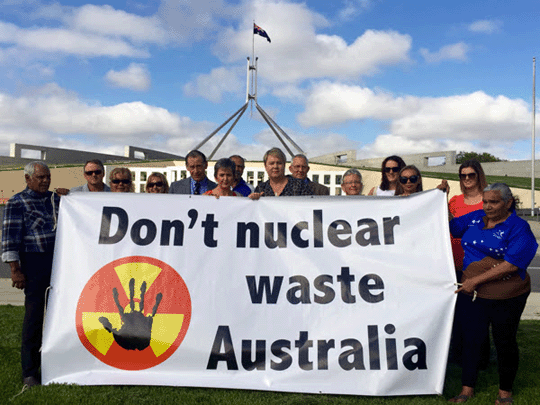
The ReachTEL Poll of 1077 SA residents conducted on March 10 found that 37 per cent of voters supported of voters supported an international nuclear waste dump, 48.5 per cent were opposed and 14 per cent were undecided.
The poll was commissioned by left-wing think tank The Australia Institute, which will tomorrow release a report critical of the international nuclear waste proposal.
Australia Institute executive director Ben Oquist said South Australians were increasingly aware of the risks posed by the project, including the damage it could do to the state’s reputation.
“I think people are increasingly wise to the projects that are jobs-rich, versus those that are expensive, likely to involve a large upfront government subsidy and won’t produce long-term jobs,’’ Mr Oquist said.
Those industries that are jobs-intensive are potentially put at risk by South Australia’s brand being threatened by a global nuclear waste dump.’’
Almost 49 per cent of Liberal, 28 per cent of Labor, 12 per cent of Greens voters backed the proposal.
But 52 per cent of Labor, 38 per cent of Liberal and 71 per cent of Greens were opposed……http://www.adelaidenow.com.au/news/south-australia/women-and-labor-voters-opposed-to-international-nuclear-waste-dump-in-south-australia-poll-finds/news-story/35d4ad38cadbaae4798ca89e91c74f5f
Renewable energy has overtaken nuclear power in India

 Cheaper renewable energy has soared past nuclear power, Business Standard 18 Mar 16, Renewable energy in India has overtaken nuclear power as the country seeks carbon-free sources of energy to balance its reliance on coal. Such energy generation in India is higher than its nuclear power generation and is growing at a much faster pace because it is cheaper and quicker to install. The cost of renewable energy is now lower than the cost of nuclear power and does not come with attendant risks, such as this week’s radioactive fuel leak in Gujarat.
Renewable-energy generation in India was 61.8 billion units, versus 36.1 billion units of nuclear-power generation during the financial year (FY) 2014-15. Renewable energy accounted for 5.6 percent of electricity generated in India, against 3.2 percent for nuclear power.
Renewable energy has been growing at a faster pace than nuclear power over two years. During 2013-14 and 2014-15, renewable energy grew at 11.7 percent and 16.2 percent, respectively, while nuclear-power growth has been almost flat over the same period.
If the 2022 solar target is met, it will become India’s second largest energy source. The bulk of India’s renewable energy comes from wind, but solar energy is growing faster with installed capacity reaching 5,775 mega watts (MW) in February 2016. The national solar mission has set a target of 100,000 MW of solar power by 2022. If this target is met, renewable energy will become the second largest source of power for India after coal, and ahead of hydropower, natural gas and nuclear energy…….http://www.business-standard.com/article/news-ians/cheaper-renewable-energy-has-soared-past-nuclear-power-special-to-ians-116031800578_1.html
Movement for a treaty with Australia’s First Nations gathers momentum
 Tony McAvoy, The Point with Stan Grant, NITV:
Tony McAvoy: The time to push for a treaty is right now
‘Australia’s first Indigenous Senior Counsel, Tony McAvoy is a strong advocate
for treaty over recognition.
He addressed the ‘Need for Treaty’ forum in Sydney on Tuesday night.’
http://www.sbs.com.au/nitv/the-point-with-stan-grant/article/2016/03/15/tony-mcavoy-time-push-treaty-right-now
15 Mar 16:
“KEY POINTS
* A treaty is achievable
* There must be an acknowledgment that Australia was not settled
* The assertions of sovereignty by the British Colonies, and now by
the Commonwealth of Australia, are flawed
* We need an Assembly of First Nations
* There must be land reform
* There must be changes to the land tenure arrangements
* There must be reparations, compensation and equitable benefit sharing
* Structural reform needs to take place at many levels
* There needs to be guaranteed representation in Parliament … ”
Redfern forum: ‘Treaty framework achievable within next few years’
15 Mar 16:
“Over one-hundred people attend a landmark meeting to discuss a way forward for treaty in the next few years. In front of a packed crowd in Sydney’s Redfern Community Centre, Wirra man and Australia’s first Indigenous Senior Counsel Tony McAvoy opened the night with a decisive plan for treaty. “It is achievable that within the next few years, that we will have set a
framework for treaties to be entered into by First Nations,” says Mr McAvoy. “I think the time is now and I don’t think we should defer it,” he said to applause front the audience. … “
India’s alarming history of safety failures at nuclear power stations
This is not the first time that India is facing safety issues regarding its nuclear program. In historical context one can generate a list of leaks, fires and structural damages that have been faced by India’s civilian nuclear power sector. There are abundant examples of oil leaks, hydrogen leaks, fires and high bearing vibrations which often shut down numbers of nuclear reactors in India.
Lack Of Nuclear Sanity In India Anaya Shahid Mar 20 16, http://www.eurasiareview.com/19032016-lack-of-nuclear-sanity-in-india-oped/ Ironically on March 14, 2011 after the Japan’s nuclear disaster, India was the first country to announce that Fukushima reactors were safe. Top officials of the Department of Atomic Energy (DAE) were of the view that Indian nuclear reactors will continue to work as they are safe and also claimed that what happened in Fukushima was not a “nuclear accident”.
S.K. Jain, the Chairman and Managing Director of Nuclear Power Corporation was propagating on Fukushima accident that, “There is no nuclear accident or incident in the Japan’s Fukushima plants. It is a well-planned emergency preparedness program which the nuclear operators of the Tokyo Electric Power company are carrying out to contain the residual heat after the plants had an automatic shutdown following a major earthquake.”
Now it is really scary that on the 5th anniversary of Fukushima, an emergency has been declared at the Kakrapar nuclear plant in Gujarat near Surat after a major heavy water leak in a nuclear reactor. Continue reading
France’s new nuclear station facing years of delay
 EDF’s French nuclear plant faces years of further delay, Ft.com, 20 Mar 16 EDF’s new nuclear power station in France faces years of further delays if tests confirm that the steel used in its reactor is flawed, the country’s atomic watchdog has warned.
It is one of the clearest signals to date of the scale of the setback faced by the French utility. The flagship plant at Flamanville in Normandy has already been subject to years of delays and cost overruns, which have made it difficult for EDF to fund the identically designed £18bn reactor at Hinkley Point in the UK — a key element in Britain’s energy strategy.
Initially, Flamanville was expected to cost €3.3bn and start operations in 2012 — it is now planned to start in 2018 at a cost of €10.5bn.
But Julien Collet, the deputy director of France’s Nuclear Safety Authority, has said that it could be delayed further by several years, depending on the results of tests started last year and due to end this summer on the steel being used in the reactor core.
If the steel fails the tests, regulators could order EDF to rip out and replace the top and bottom of the reactor vessel. Mr Collet told the Financial Times: “It takes a lot of time to build new components like this — we’re talking years.”
The difficulties EDF is having with the steel at Flamanville have been caused by problems with the process of cooling and cutting a 450-tonne ingot of steel, which created an area the size of a dinner plate that was slightly more brittle than it should have been.
Areva, the French nuclear company in whose reactor business EDF is due to take a controlling stake, is working with regulators to test an identical piece to determine if it could lead to weakness in the reactor vessel.
The problem was discovered in late 2014 but EDF opted to push ahead with construction, potentially making it much more difficult to replace the faulty steel if needed……..
having agreed to fund 66.5 per cent of the [UK’s Hinkley Point C nuclear] project last year, EDF has delayed giving it final approval, with some at the top of the company arguing more investors should be brought in first.
Finding outside investment has been difficult because of the problems being experienced with other EPRs in France and Finland, according to senior people within the company………http://www.ft.com/intl/cms/s/0/73d62552-ec65-11e5-bb79-2303682345c8.html#axzz43TzEfz49
1 This month

of the week – Australians for War Powers Reform (AWPR)
To see nuclear-related stories in greater depth and intensity
 Antinuclear