Easter week – nuclear news Australia
 Nuclear terrorism a possibility in Belgium – and elsewhere. But oh no, not in Australia! Except – has everyone forgotten Willy Brigitte? Brigitte was sent to Sydney in 2007 as part of a cell that trained terrorists in Pakistan, with a plan to bomb the Lucas Heights nuclear reactor, was convicted in France.
South Australia Nuclear Fuel Chain Royal Commission has gone a bit quiet, since announcing its enthusiasm for nuclear waste importing. It’s supposed to publish the submissions in response to its “Tentative Findings” – not happening as yet. Ultimate findings to be released on May 6th. Meanwhile a few more people have made their responses available, including an excellent one from Valdis Dunis, particularly examining issues of finance and insurance.
Roderick Campbell, in New Matilda, demolishes the Royal Commission’s economic argument for importing nuclear waste. The Australia Institute agrees with him.
South Australia’s Labor govt wants to scrap law against expenditure towards nuclear waste dumping. NO TO NUCLEAR WASTE DUMP – say women and Labor voters. The ethics of burdening future South Australians with nuclear wastes? – Conservation Council of South Australia. Uncertainty created by Australian govt’s new Clean Energy Fund.
France, (and everybody else) touting sales of nuclear submarines to Australia.
RENEWABLE ENERGY Big financial benefits in locating solar and wind power together– study. Turnbull’s new cleantech fund likely to sink without trace. Turnbull govt “clean energy” plan designed to stall renewable energy projects? Prime Minister Turnbull suggests Port Augusta solar thermal plant for federal clean energy plan (but is he fair dinkum?)
Turnbull cuts climate research money – spends it on ‘wind farm health effects‘ Omigawd! Australia’s peak medical body is funding 3.3 $million research into ‘wind turbine sickness’.
Further revelations on the scope of cuts to CSIRO climate research.
Lithium: design and recycling– a potential new industry for Australia.
INDIGENOUS ISSUES. Movement for a treaty with Australia’s First Nations gathers momentum. Indigenous opponents of Adani’s Carmichael mine to intensify court battle.
LEGAL. Bob Brown’s High Court challenge to Tasmania’s controversial anti-protester laws.
Uncertainty created by Australian govt’s new Clean Energy Fund
 Clean Energy Fund creates uncertainty for existing renewable proposals, SA Energy Minister says ABC News 24 Mar 16 Changes to the Federal Government’s energy agencies have created uncertainty in South Australia’s renewable energy industry, State Energy Minister Tom Koutsantonis says.
Key points:
- Changes ‘turn grants into loans’
- Business models to be affected, SA Energy Minister warns
- Union says clean energy fund is ‘too little, too late’
Prime Minister Malcolm Turnbull yesterday announced he would retain the Clean Energy Finance Corporation and the Australian Renewable Energy Agency, which former prime minister Tony Abbott tried to dismantle.
The agencies will manage a $1 billion Clean Energy Innovation Fund (CEIF) using money previously allocated to them.
But Mr Koutsantonis said the changes meant funds administrated as grants would now be considered loans.
He said this would affect business models for proposals such as solar, wind, tidal or hot rocks energy generation.
“That has to be changed now because the money has to be paid back, so they [the Federal Government] are creating a lot of uncertainty,” Mr Koutsantonis said.
Clean energy fund ‘too little, too late’
The Australian Services Union said the clean energy fund was “too little, too late” to help SA’s Alinta Energy workforce………http://www.abc.net.au/news/2016-03-24/clean-energy-fund-changes-creates-uncertainty-sa-energy-minister/7272472?section=environment
Belgium’s terror attacks a wake-up call to the world on radiation risks
“Every country, no matter how safe it thinks it is, needs to protect nuclear weapons and the materials you could use to make them against the full spectrum of plausible threats,”
“And wherever there are potential nuclear bomb materials, they need to have armed guards.”
A Nuclear Wake-Up Call in Belgium, Huffpost, 25 Mar 16, By R. Jeffrey Smith “…….The risk of radiation bombs raised few concerns before it became clear that al Qaeda was seeking nuclear materials. And over the past 15 years, those worries have taken a back seat to an even larger anxiety: that materials usable in a Hiroshima- or Nagasaki-sized nuclear bomb might fall into the wrong hands.
 As a result, the Obama administration has focused its attention until now on locking down or eliminating the big sparkplugs: plutonium and highly enriched uranium.
But the smaller “dirty bombs” and their lighter security have been a real source of worry among specialists, some of whom say that a detonation somewhere in the world is inevitable.
“I’m surprised it has not happened yet,” said Laura Holgate, the National Security Council’s senior director for weapons of mass destruction terrorism, at a Washington symposium three years ago. The mechanics of such a device are simple and widely known.
An internal Energy Department report in 2013 counted 70,000 medical, industrial and research devices with potentially dangerous radiological materials, and observed that they are “poorly secured at facilities in nearly every country.”…….. Continue reading
Turnbull’s new cleantech fund likely to sink without trace
 Turnbull Fiddles With Green Energy Policy While Carbon Continues To Burn https://newmatilda.com/2016/03/24/turnbull-fiddles-with-green-energy-policy-while-carbon-burns/ By Ben Eltham on March 24, 2016 With its renewable policy sinking without a trace and Arthur Sinodinos again in trouble, Turnbull’s extended election campaign has got off to a bad start, writes Ben Eltham.
If you accept – and it’s hard to deny – that Prime Minister Malcolm Turnbull’s decision to recall Parliament signals the start of a 14-week election campaign, then that campaign has not got off to a great start.
Policy is being announced. Yesterday, for instance, the government announced a new $1 billion Clean Energy Innovation Fund, “to support emerging technologies make the leap from demonstration to commercial deployment.”
Superficially, the fund looks like a good idea. Australia is well behind the rest of the developed world when it comes to clean tech industries. A fund to support capital investment in “emerging clean energy technologies” will no doubt be welcomed by a struggling sector.
Of course, a big reason for these struggles is the Coalition itself. The Rudd and Gillard governments put in place a comprehensive suite of policies designed to drive investment in the clean tech and renewables sectors. The Abbott government abolished nearly all of them. Amidst the smoking ruins of the Abbott government’s climate policies, investment and jobs in the renewables sector cratered. Meanwhile, our competitors in America, Europe and China forged ahead.
At least the Coalition has finally decided that it will keep the Clean Energy Finance Corporation, a government finance corporation for the clean tech sector. Once derided as “Bob Brown’s bank”, apparently someone has at last noticed that he CEFC actually makes money for the government by lending at commercial rates of interest.
That’s about as much as you could say for yesterday’s announcement, which has already been derided by experts and analysts as little more than a “shell game.” This is not a billion new dollars for clean tech: it is instead simply a repurposing of money already budgeted to the CEFC, which the government has bee trying to abolish for years now, but wasn’t able to as a result of opposition from the Senate crossbenchers. Continue reading
Terrorism risk in all radioactive material – UN nuclear security chief
A grapefruit-sized amount of plutonium can be fashioned into a nuclear weapon
a far likelier risk was a “dirty bomb”. This is a device using conventional explosives to disperse radioactive material other than uranium or plutonium.
Such material can be found in small quantities in universities, hospitals and other facilities the world over, often with little security.
UN atomic chief warns on ‘nuclear terrorism’ http://news.yahoo.com/un-atomic-chief-warns-nuclear-terrorism-134919666.html By Simon Sturdee 26 Mar, Vienna (AFP) – The world needs to do more to prevent “nuclear terrorism”, the head of the UN atomic watchdog has warned ahead of an important summit and in the wake of the Brussels terror attacks.
“Member states need to have sustained interest in strengthening nuclear security,” he said. “The countries which do not recognise the danger of nuclear terrorism is the biggest problem.” Continue reading
Belgian nuclear workers’ passes revoked: anxiety over radiation plot
Fears grow over radioactive plot as nuclear workers have passes revoked, Business Post BY POST REPORTER ON MARCH 25, 2016 SIX ARRESTS IN BRUSSELS AND FRANCE FOILS SEPARATE TERROR PLOT
 Eleven Belgian nuclear workers have had their work passes revoked amid fears that the Brussels bombers were plotting to build a radiological dirty bomb.
Ibrahim and Khalid el-Bakraoui, the brothers suspected of suicide strikes on Brussels airport and Metro, are believed to have been involved in an Islamic State plan to create a bomb to scatter radioactive material over a populated area.
A senior Belgian nuclear industry official was secretly filmed by jihadists late last year, according to the country’s nuclear authority. Yesterday the brothers were linked to the surveillance.
An official at the Federal Agency for Nuclear Control told The London Times: “When you start filming someone in the way they did, the logical conclusion is that they wanted to abduct that person and to obtain radioactive material.” A conspiracy to build a dirty bomb, with the aim of contaminating a crowded public space, was “the big question” faced by the authorities, the official added.
About 140 soldiers were guarding Belgium’s two atomic power plants, a nuclear research facility and a company that makes medical isotopes, with two members of the terrorist cell behind Tuesday’s attacks at large last night.
Criticism grew over Belgium’s handling of intelligence before the bombs that killed 31 and left more than 300 injured. Two government ministers offered to resign. However, police raids on flats in Brussels last week — which led to one suspect being shot and others captured — may have disrupted an even larger Paris-style massacre, involving gun attacks, planned to coincide with the bombings.
Since those raids seven workers at the Tihange nuclear power station in eastern Belgium have had their work entry passes withdrawn and a further four passes were revoked after the latest attacks following vetting by a committee including intelligence and security agencies.
The key figure in the alleged dirty bomb plot is Mohammed Bakkali, 28, from Brussels, who was arrested in November on suspicion of helping to plan the Paris massacre. Police raided his wife’s flat and found a ten-hour video taken by a camera hidden opposite the home of an executive at the Centre for the Study of Nuclear Energy in Mol, northern Belgium. The executive had access to radioactive isotopes at the country’s national nuclear research centre…….https://www.businesspost.ie/fears-grow-over-radioactive-plot-as-nuclear-workers-have-passes-revoked/
Death spiral underway for USA’s nuclear industry?
 Has U.S. Nuclear Power’s Death Spiral Begun? With carbon markets and subsidies in doubt, nuclear is no longer affordable IEEE Spectrum, By Peter Fairley 25 Mar 2016 U.S. nuclear power plant operators are fighting a war on two fronts: Crashing prices for natural gas and accelerating market penetration of renewable energy have both contributed to dramatic drops in wholesale power price levels—in some states, they’ve fallen by more than two-thirds over the past decade. This has left nuclear power, whose operating costs are pretty much fixed, with few options other than surrender.
That marks quite a reversal, says Gregory Jaczko, former chairman of the U.S. Nuclear Regulatory Commission. “It’s been a widely held belief that nuclear is incredibly cheap to operate. That was the case 10 years ago, when nuclear plants were cash cows. That’s not the case today, especially as the plants age,” he says.
Fission is already giving ground. Two plants, in Wisconsin and Vermont, shut down in 2013 and 2014, respectively. More shutdowns are anticipated in Massachusetts, New Jersey, and New York, and at least half a dozen more plants are teetering on the brink of insolvency.
Nuclear operators had been expecting President Obama’s Clean Power Plan, which would have established national carbon regulations and increased the cost of fossil-fuel-generated electricity, to offer them a reprieve. But their hope was short-lived: The U.S. Supreme Court decided in February to stay implementation of the plan.

Operators’ next best hope is that state governments will be motivated to step in and save them. …… Continue reading
Tennessee law to extend “deadly force” for nuclear facilities’ safety
 Tenn. House OKs deadly force by security officers at ‘nuclear power reactor’ facilities http://www.knoxnews.com/news/politics/house-oks-deadly-force-by-security-officers-at-nuclear-power-reactor-facilities-2e94b9d4-2e46-5bc3-e-373013301.html By News Sentinel Staff, 25 Mar 16, NASHVILLE — The House gave final legislative approval Monday night to a bill expanding the use of deadly force by security officers at nuclear power reactor facilities.
Tennessee law currently allows the use of deadly force by security personnel at “category I nuclear facilities” — facilities possessing “strategic special nuclear material” defined and licensed by the Nuclear Regulatory Commission, “when reasonably necessary to prevent or impede an act of radiological sabotage,” under specific circumstances.
The bill expands the law to include any “nuclear power reactor facility.”
The House voted 94-0 Monday on the bill, following the Senate’s 32-0 vote on Feb. 29. The bill now goes to the governor.
Shared solar – practical and relatively inexpensive
Shared solar can help low-income customers get in on the solar development.
Rooftop solar can be expensive, even with incentives or leasing programs, leaving low-income ratepayers out. Shared solar can let them in on the benefits of solar. A couple of recent reports show how.
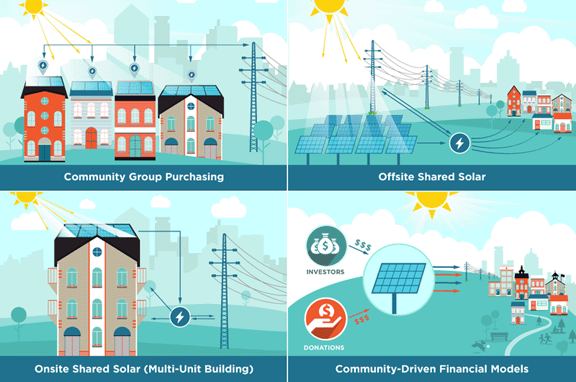
 Love solar power but got no rooftop? “Shared solar” is coming for you. Vox [excellent pictures] by David Roberts on March 24, 2016 To date, solar power has mostly been available to utilities (as big power plants) or individual home and business owners (as rooftop panels).
Left out has been … well, everyone else, those of us who are not utility executives and do not have the money, wherewithal, or suitable rooftops to install solar ourselves. That’s a lot of people who love solar power but have no way to get directly involved in it.
Here’s how shared solar fits into the larger energy picture, how it works, its benefits and drawbacks, and its future potential……There are two kinds of community-scale solar. The first is utility-owned, with power sold to utility customers — a traditional arrangement between a utility and a power plant developer, just on a smaller scale. Lots of smaller utilities, municipals, and co-ops are getting into this.
The other is shared solar, in which customers a) share ownership of a community-scale PV array, b) “subscribe” to the power output of such an array, or c) both.
Existing community-scale solar is split roughly half and half between those two types. Continue reading
Turnbull cuts climate research money – spends it on ‘wind farm health effects’
 ‘Quite disgraceful’: NHMRC doles out $3.3m to study windfarm effects on health, The Age, March 23, 2016 Peter Hannam Environment Editor, The Sydney Morning Herald Australia’s top medical research body has given two researchers $3.3 million to study the effects of wind farms on human health despite its own year-long study finding no “consistent evidence” that a problem exists.
The National Health and Medical Research Council (NHMRC) awarded Guy Marks, a professor at the University of NSW $1.94m, to study the health impacts of infrasound – sound waves typically inaudible to humans – generated by wind turbines.
Peter Catcheside, an associate professor at Flinders University, secured $1.36m to investigate whether wind farms disturb sleep compared with traffic noise.
The outcomes of these studies, promoted by a so-called targeted call for research, will assist in developing policy and public health recommendations regarding wind turbine development and operations, the council said.
The research call was criticised last year, with even NSW and Victorian health officials calling for the NHMRC “to make it clear that the total available evidence (parallel and direct) suggest[s] little health risk,” according to emails from these health officials seen by Fairfax Media.
Senior members of the Abbott government, including then Prime Minister Tony Abbott, made public their opposition to wind farms. Then Treasurer Joe Hockey also dubbed wind turbines as “utterly offensive” and “a blight on the landscape”.
Simon Chapman, an emeritus professor of public health at the University of Sydney, said there had been at least 25 reviews internationally – including by the NHMRC – that showed “very little evidence of direct effects” from wind farms.
Effects that did exist could be put down to psycho-social factors, such as pre-existing antipathy to wind farms, resentment by locals who had received no benefit from turbines in their region, and anxiety of perceived health impacts, Professor Chapman said.
“It’s really quite disgraceful – it’s money literally poured down the drain,” he said. “There is no health or medical agency in the world that would give any rational priority to wind farms and health. “Potentially hundreds of researchers who had just missed on funding research would be angry as the money is being spent on wind farm research.”
Fairfax Media has sought additional comment from the NHMRC.
Senator Kim Carr, shadow science minister, said the funding came at a time when the Turnbull government was taking the axe to hundreds of scientists – including climate researchers – at the CSIRO.”The Liberals cannot plead innocence in cutting climate and manufacturing research in the CSIRO…while handing out money for contentious research into things like the supposed health effects of wind farms,” he said.
“The Abbott-Turnbull Government is hell-bent on politicising Australian research,” he said. http://www.theage.com.au/environment/quite-disgraceful-nhmrc-doles-out-33m-to-study-windfarm-effects-on-health-20160321-gnnzhe.html#ixzz43wzQSmqb
Turnbull’s ‘climate of confusion’
 Turnbull’s election ‘trickery’ simply creates a climate of confusion Canberra Times March 26 2016 Richard Denniss “…….And then there’s climate change. No policy issue has generated more heat and less light than how best to reduce greenhouse gas emissions in Australia. Tony Abbott transformed a technocratic debate about the best way to design a carbon price into a culture war. It put him into The Lodge, but put Australia back a decade.
Climate change will provide the clearest test of whether Turnbull is running on Abbott’s platform or on his own. “Direct action” is very much Abbott’s policy. Indeed, Turnbull once said the best thing about it was that it was easy to repeal. But while unwinding the direct action policy might be administratively simple, it will not be politically simple. Abbott will make sure of that. So what is Turnbull to do?
Luckily for Turnbull, the Climate Change Authority was set up by the Gillard government to help advise the Parliament on both Australia’s emission-reduction targets and the best policy mechanisms to achieve them………
So two days before the date Turnbull says any double-dissolution election will be held, the Climate Change Authority must report on the most efficient ways for Australia to meet it emission-reduction goals. Given that everyone is more committed to climate action than Abbott, one would imagine that any new direction on climate policy could only be an improvement for Turnbull and Australia.
The false choice between a carbon tax and direct action delivered good politics for Abbott but a poor policy debate for Australia……..
Last year, federal Labor committed itself to a 50 per cent renewable energy target. Here in Canberra, the ACT Labor government has committed itself to a 100 per cent renewable energy target. Neither policy requires a carbon price to drive significant change. Both are popular in the electorate.
Turnbull has committed himself to “driving innovation” but, to date, he’s had to tiptoe around the link between supporting new renewable energy, electric cars and battery technologies for fear of enraging backbenchers like Abbott and Cory Bernardi. A carbon price, or a “penalty price” for firms who don’t undertake enough “direct action”, would allow him to fund a lot more innovation.
New energy-efficiency standards for cars and houses can just as easily be framed as solutions to declining air quality and rising energy costs as they can be called climate policy. Are policies to encourage energy efficiency “direct action” or are they “wasteful climate policy”? The answer is not just in the eye of the beholder, but in the tone of the salesperson.
While the timing of the election and the climate authority’s next report are now beyond Turnbull’s control, the shape and tone of his government’s climate policy is not. The Prime Minister has stumbled badly on tax policy and has abandoned control over the timing of his first election. He can’t afford to be pushed around by Abbott on climate policy if he is to retain the public’s respect. http://www.canberratimes.com.au/comment/turnbulls-election-trickery-simply-creates-a-climate-of-confusion-20160325-gnr23y.html
For hot climates, solar power makes most sense, above cooling systems (from coal etc)
Tropical sites need solar power, not free cooling, Data Center Dynamics 24 March 2016 By Paulo Cesar de Resende Pereira Free cooling can improve some measures of efficiency, but tropical countries may be better off looking at where their power comes from

The importance of data centers to the average citizen should not be underestimated. They are vital for even the most common daily function – from a simple internet search to a bank transaction. Their importance can even extend to, for example, the monitoring of the electricity delivered to one’s home.
But data centers are accused of being environmental villains due to their exorbitant consumption of energy, so reducing their environmental impact is vital. In this context, photovoltaic generation is an interesting alternative to free cooling, and especially suitable for tropical regions such as Brazil.
Using the wrong metric Continue reading
1 This month

of the week – Australians for War Powers Reform (AWPR)
To see nuclear-related stories in greater depth and intensity
 Antinuclear