Nuclear news excluded or downplayed in Australian media
 The terrorists’ initial aim to blow up Belgium’s nuclear reactors was explained on SBS World News, last night, but did not get a mention on ABC news. It was reported on Sydney Morning Herald, but that story appears to have been withdrawn.( – Brussels bombers considered nuclear site, changed their minds: report Sydney Morning Herald–24 Mar. 2016. )
I doubt that it was reported on the Murdoch dominated commercial media
Could Australia’s media be experiencing pressure to avoid uncomfortable nuclear topics, – heading in the self censorship direction now prevalent in Japan?
FAULTS EXPOSED WITH MULGA ROCK URANIUM PROPOSAL
 http://www.ccwa.org.au/faults_exposed_with_mulga_rock_uranium_proposal
The confirmation raises serious environmental concerns over land clearing, water consumption, waste management and impacts on rare and endangered species.
The public comment period for the proposal closed today with over 1100 individual submissions calling on the EPA to reject the mine proposal.
Vimy Resources’ proposal for a uranium project at Mulga Rock is in the Yellow Sandplain Priority Ecological Community, 250km north east of Kalgoorlie and upstream from the Queen Victoria Springs A Class Nature Reserve.
“Vimy want to take 15 million litres of underground water every day for their uranium operation,” said CCWA nuclear free campaigner Mia Pepper. “This ancient water is sustaining life and supporting this fragile desert ecosystem. Vimy would be voraciously consuming this precious water resource in a bid to extract a product that is unsafe, unnecessary and uneconomic.”
“Vimy are seeking to fast-track approvals for this project before next year’s state election even though the uranium price has flat-lined in the wake of Fukushima”.
The environment groups detailed submission has also identified deficiencies in the plans for the long term containment and management of radioactive mine tailings, including the presence of under reported seismic fault-lines in the proposed tailing dams region. Continue reading
Another USA State rejects a project for nuclear waste disposal
 This time, it’s North Dakota that sinks an experiment related to burying nuclear waste, Science,By Warren CornwallMar. 23, 2016 , The history of failed attempts to deal with U.S. nuclear waste gained another chapter this month, when local opposition prompted scientists to abandon tests of a new disposal technique in eastern North Dakota.
In early March, Battelle Memorial Institute, a large research nonprofit based in Columbus, quietly withdrew plans to drill two holes up to 5 kilometers deep into the granite bedrock beneath the rolling prairie there. Those were supposed to be the centerpiece of an $80 million, federally funded project to see whether the government could get rid of some highly radioactive waste by sticking it deep underground.
The retreat followed objections from residents of rural Pierce County, who feared the drilling would open the door to nuclear waste. It underscores the treacherous path facing any major effort tied to nuclear waste, even when federal officials insist the project was a test that would never involve radioactive material.
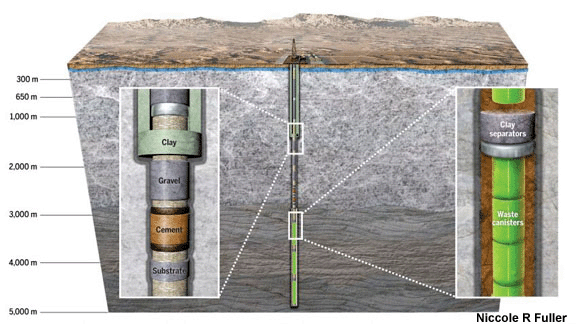
“If we would have allowed this, the next step we really feel would have been (nuclear waste) in our backyard,” says David Migler, chair of the Pierce County Commission, which voted unanimously to oppose the tests……..
Britain’s nuclear regulator warns of increasing terrorism threat
 Nuclear watchdog warns of terrorist threat to UK reactors As Hinkley Point hangs in balance, strategic plan acknowledges security risks Independent, Mark Leftly Associate business editor @MLeftly 26 March 2016
Britain’s nuclear industry is under threat from cyber-attacks, terrorism and state-sponsored espionage, regulators have warned.
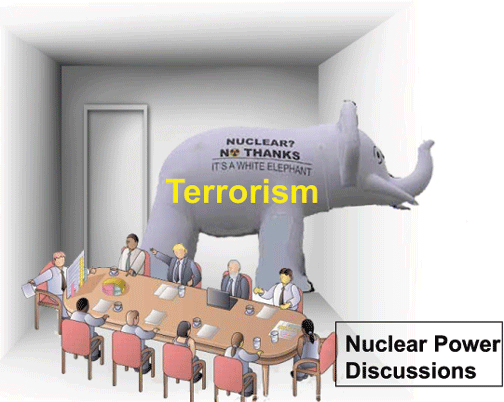
Buried in the Office for Nuclear Regulation’s 2016-20 strategic plan are bleak references to the growing threat of attack on Britain’s 15 operational reactors, which account for nearly a fifth of the country’s electricity. The Independent has established this is the first time that the ONR has explicitly acknowledged the growing terrorist threat to the nuclear industry. Continue reading
Pressure on the media in Japan
 Japanese journalists allege government pressure on media http://bigstory.ap.org/urn:publicid:ap.org:8b04d4cd11ec4f289c57a7c88c02e1ca By MARI YAMAGUCHI Mar. 24, 2016 TOKYO (AP) — Five Japanese journalists accused Prime Minister Shinzo Abe’s government on Thursday of pressuring broadcasters to reduce criticism of its policies, but also lamented what they called a failure by media to live up to their convictions.
They spoke at a news conference after Minister of Internal Affairs and Communications Sanae Takaichi warned broadcasters last month that their licenses could be revoked if they failed to be impartial in political coverage.
Japan’s broadcast law says programs must be “politically fair,” and Takaichi said several times in parliament that a station that repeatedly fails in this regard could have its license revoked. Continue reading
Tokyo: thousands protest government’s nuclear power plans
Over 30K people protest Japanese PM’s plan to restart nuclear reactors (VIDEO) Rt.com : 26 Mar, 2016 Over 30,000 people turned up for demonstrations in Tokyo to protest a plan being promoted by Japan’s prime minister to restart a number of nuclear power plants. On March 11, Japan marked the five-year anniversary of the devastating Fukushima disaster.
Ruptly footage captured people waving flags, carrying banners, and holding up placards while marching through popular Yoyogi Park on Friday. The activists say that restarting the nuclear reactors will create safety risks. Some banners read “To the Absence of a Nuclear Power Plant Future,” local media reported……..https://www.rt.com/news/337325-anti-nuclear-rally-tokyo/
Fatal shooting of Belgian nuclear security guard: his security badge stolen
 Guard at Belgian nuclear plant shot dead; his security badge was stolen. By Kellan Howell – The Washington Times – Saturday, March 26, 2016 Just two days after terrorists attacked the Brussels airport and subway system, a security guard for a Belgian nuclear facility was murdered and his security access badge was stolen, Belgian media reported Saturday.
The security guard’s badge was de-activated as soon as it was discovered it was stolen, according to French newspaper Derniere Heure.
He was shot dead in the Charleroi region of Belgium as he walked his dog, International Business Times reported. http://www.washingtontimes.com/news/2016/mar/26/belgian-nuclear-guard-shot-badge-stolen/
Queensland: Solar funding switch to hurt state
 ANNASTACIA Palaszczuk says large-scale solar projects across Queensland have been left in the dark under changes to two key climate funds…. (subscribers only)
http://www.couriermail.com.au/news/queensland/premier-says-solar-funding-switch-to-hit-regional-queensland-hardest/news-story/72d667016a059b3c5f16dd5fae9fa011
New world record in renewable energy investments
Renewable energy investments: Major milestones reached, new world record set For first time, developing world investments in renewables (up 19 percent in 2015) topped developed nations’ (down 8%); World record total of $286 billion invested in renewables last year, makes $2.3 trillion over 12 years, Science Daily March 24, 2016
- Source:
- United Nations Environment Programme
- Summary:
- Coal and gas-fired generation attracted less than half as much capacity investment as renewables last year; Renewables added more to global energy generation capacity than all other technologies combined; For first time, developing world investments in renewables (up 19 percent in 2015) topped developed nations’ (down 8 percent); and world record total of $286 billion invested in renewables last year; makes $2.3 trillion over 12 years.
- Coal and gas-fired electricity generation last year drew less than half the record investment made in solar, wind and other renewables capacity — one of several important firsts for green energy announced today in a UN-backed report.
Global Trends in Renewable Energy Investment 2016, the 10th edition of UNEP’s annual report, launched today by the Frankfurt School-UNEP Collaborating Centre for Climate & Sustainable Energy Finance and Bloomberg New Energy Finance (BNEF), says the annual global investment in new renewables capacity, at $266 billion, was more than double the estimated $130 billion invested in coal and gas power stations in 2015.
All investments in renewables, including early-stage technology and R&D as well as spending on new capacity, totalled $286 billion in 2015, some 3% higher than the previous record in 2011. Since 2004, the world has invested $2.3 trillion in renewable energy (unadjusted for inflation).
Just as significantly, developing world investments in renewables topped those of developed nations for the first time in 2015.
Helped by further falls in generating costs per megawatt-hour, particularly in solar photovoltaics, renewables excluding large hydro made up 54% of added gigawatt capacity of all technologies last year. It marks the first time new installed renewables have topped the capacity added from all conventional technologies.
The 134 gigawatts (GW) of renewable power added worldwide in 2015 compares to 106GW in 2014 and 87GW in 2013.
Were it not for renewables excluding large hydro, annual global CO2emissions would have been an estimated 1.5 gigatonnes higher in 2015 Continue reading
Over 1 million jobs in India’s solar power push
India Solar Power Push May Produce Over 1 Million Jobs http://cleantechnica.com/2016/03/23/india-solar-power-push-may-produce-over-1-million-jobs/ March 23rd, 2016 by Smiti Mittal Originally published on Sustainnovate. India’s massive solar power capacity addition target is expected to be a revolution in the Indian jobs market as well.
According to a report by the Natural Resources and Defense Council (NRDC), India may end up creating over a million new jobs in its endeavour to have 100 GW of operational solar power capacity by March 2022.
The report suggests that a massive army of engineers, construction, and maintenance workers shall be required set up the scores of solar power capacity planned by the central and state governments.

Around 210,800 site engineers and designers would be required to set the large-scale as well as rooftop solar power systems rolling. Around 624,600 semi-skilled workers would be needed for the construction and on-field execution of the projects. To monitor ongoing operations at the power plants and their maintenance, another 182,400 semi-skilled workers would be needed. Thus, a total of 1,017,800 jobs are expected be created if India indeed manages to set up a cumulative operational capacity of 100 GW by 2022.
Jobs creation and empowering youth is one of the major policies of the current government. The ‘Skill India’ program launched by the Indian government aims to provide employment to youth by providing them industrial training in the solar power sector. Several agencies across the country have already started such training programs.
Some state governments have also announced financial support to unemployed youth to set up rooftop solar power systems to help them generate a source of income.
America already switching to renewable energy power plants
If a Power Plant Is Built in U.S., It’s Likely to be Renewable [good graphs] http://www. climatecentral.org/news/if-a-power-plant-is-built-in-us-chances-are-its-renewable-20175
March 25th, 2016 If a new electric power plant is built in the U.S. these days, chances are it’s renewable — either wind or solar.
That’s the gist of a report the U.S. Department of Energy released this week showing that, together, wind and solar accounted for nearly two-thirds of all new electric power plants built in 2015. It’s a trend expected to continue through 2016, even with low natural gas prices likely to keep utilities building plenty of gas-fired power plants, too.
“Right now, it’s primarily a wind and solar market,” U.S. Energy Information Administration analyst Chris Namovicz said, adding that renewables have been thriving on an extension of wind and solar tax credits, though wind is becoming competitive with fossil fuels even without the help of a tax credit.
As global investments in renewable energy far outpace investments in fossil fuels for electric power, the expansion of wind, solar and other renewable energy sources is critical for the globe to uphold the Paris climate agreement, which aims to keep global warming to 2°C (3.6°F) above pre-industrial levels. Continue reading
Facts on Western Australia uranium mining proposals
Fact File: http://www.ccwa.org.au/faults_exposed_with_mulga_rock_uranium_proposal
- Since the WA Government lifted the ban on uranium over seven years ago not one uranium proposal has attained final approval to begin mine construction.
- The recent SA Nuclear Fuel Cycle Royal Commission preliminary findings found that “significant barriers to the viability of new uranium mine developments in South Australia” including the “current low price of uranium and uncertainty about the timing of any price increases” – a finding with direct relevance for WA
- Australian uranium production has been in decline since 2009
- In 2014-2015 the Australian uranium industry employed just 987 people nationally
- The uranium spot price is currently $32.15
- Nuclear energy contributes just 4.4% of the global energy mix
- Renewable energy contributes 6% of the global energy mix with a growth rate of
12%
- There are 62 reactors under construction worldwide – of these 47 are experiencing construction and commissioning delays.
- Globally over 130 reactors have operated for over 30 years – nearing their lifespan. 54 of those reactors have operated beyond their designed life span of 40 years. These reactors are required to be decommissioned and the industry will struggle to maintain its shrinking market share.
- There is no state bi-partisan political support for uranium mining in WA
World Meteorological Organization on State of the Climate
 WMO Press Release 21 March, 2016: State of the Climate: Record Heat and Weather Extremes
The year 2015 made history, with shattered temperature records, intense heatwaves, exceptional rainfall, devastating drought and unusual tropical cyclone activity, according to the World Meteorological Organization. That record-breaking trend has continued in 2016.
The WMO Statement on the Status of the Climate in 2015 gave details of the record land and sea surface temperatures, unabated ocean warming and sea level rise, shrinking sea ice extent, and extreme weather events around the world.
It was released to coincide with World Meteorological Day on 23 March, which has the theme “Hotter, drier, wetter. Face the Future.”
http://public.wmo.int/en/media/press-release/state-of-climate-record-heat-and-weather-extremes
(The key findings are listed here – and a link is provided to the Press Conference webcast)
WMO Press Release, 23 March 2016: World Meteorological Day. Hotter, Drier, Wetter. Face the Future
“The future is now,” said WMO Secretary-General Petteri Taalas
U.N. Secretary-General Ban Ki-moon has issued a rallying call on World Meteorological Day for decision-makers and all actors in society to “face the future now” and respond to the challenge of climate change and so avert its worst impacts and “lay the foundations for a world of peace, prosperity and opportunity for all.” …
On 21 March, WMO issued the full report on the Status of the Global Climate in 2015.
It also collaborated with Climate Central to reach out to television weather presenters, highlighting the main findings of the climate report, including with a package of high quality graphics.
http://public.wmo.int/en/media/news/world-meteorological-day-hotter-drier-wetter-face-future
Statement on the Status of the Global Climate in 2015
March 2016. The World Meteorological Organization (WMO) is the United Nations system’s authoritative voice on weather, climate and water. For over two decades, WMO has published annual assessments of the state of the global climate in the U.N.’s six official languages to inform governments about global climate trends and extreme and notable events at the national and regional levels. These assessments integrate and analyze information provided by leading climate data centers and by the world’s National Meteorological and Hydrological Services (NMHSs).
http://www.climatecentral.org/wmo-state-of-the-climate
(Read the Report Summary here – and note links provided to related videos, interactives, maps, images & other resources. The full 28-page report ‘WMO Statement on the status of the global climate in 2015’ can be downloaded here:http://library.wmo.int/pmb_ged/wmo_1167_en.pdf)
*******
Marshall Shepherd: 96% of American Meteorological Society members think climate change is happening.
March 24, 2016. You may have seen them. Media reports a few years ago claiming that a survey of the American Meteorological Society (AMS) refutes the consensus position regarding climate change. When I saw how that survey and the results were being twisted and distorted, I realized that people read things with an eye for what they want to believe, so-called confirmation bias. AMS Executive Director Dr. Keith Seitter even wrote on the AMS website clarifying the results andcondemning rampant distortion that was being spread. A full statement of the survey authors’ response to the horrific distortion of their findings can be found at this link. With such a mischaracterized response, the AMS felt that a new survey was needed. The preliminary results of that new report were released this week.
http://www.forbes.com/sites/marshallshepherd/2016/03/24/96-of-american-meteorological-society-members-think-climate-change-is-happening-says-new-report/#34f13dd13935 & http://www.environmentalhealthnews.org/t/5863920798415471994
Solar power saves money for the homeowner
 Saving Money With Solar Power http://mentalitch.com/saving-money-with-solar-power/The boundless financial benefits of solar power Having a solar energy system in your home puts you at a great advantage without being completely reliant on the electric grid and helping the environment. This is a great move to going green and living green. Another reason is that you may want to avoid paying astronomical electricity bills in the future by traditional energy companies. Hiring a solar power installation company will help you develop a solar energy, for whatever reasons that have driven you to need for such move.So why go green with having a solar power system for your home? There are a lot of good reasons to have solar energy for your property.
2) Reduction of electricity bill costs Having a solar energy system installed in your home will help you reduce the monthly bill that you have to pay for the electric company. Before installing a solar energy system its important to get the right one that meets your needs. Professionals will first have to determine your current electricity consumption and right size the system. You may want to forgo paying the bills to the electric company completely, or at least greatly reduce electricity bills by paying the company a fraction what your previous average monthly bill. In some cases, after installing a solar energy system, your electrical bill may be completely wiped out. Some electrical companies will ‘bank’ excess power from your system so your bill even in winter or less sunny times will not increase. Continue reading
Rockefeller to dump its Oil, Exxon Mobil holding because of ethics and economics
Rockefeller Dumps Oil, Exxon Mobil Charity linked to the founder of Exxon Mobil’s precursor says it will ditch its oil and gas holdings. http://www.usnews.com/news/articles/2016-03-24/in-a-changing-climate-rockefeller-fund-dumps-oil-exxon-mobil-holdings Alan NeuhauserMarch 24, 2016,Citing “morally reprehensible conduct on the part of Exxon Mobil,” the Rockefeller Family Foundation – whose namesake, John D. Rockefeller, founded Exxon’s precursor, Standard Oil – will dump its holdings in America’s largest oil conglomerate, plus coal and tar sands companies, the charity announced Wednesday.
The nonprofit pointed to both economics and ethics: Amid a huge surplus of oil and sluggish global demand, oil prices are in the middle of a 19-month slump, spurring hundreds of thousands of layoffsfrom the energy sector worldwide. Climate change, meanwhile, has created a moral imperative to decrease the planet’s reliance on fossil fuels like oil, the fund said. Continue reading
1 This month

of the week – Australians for War Powers Reform (AWPR)
To see nuclear-related stories in greater depth and intensity
 Antinuclear