Rural Indians lose USA lawsuit against coal power plant
 U.S. judge nixes lawsuit against World Bank over power plant in India BY SEBASTIEN MALO http://www.reuters.com/article/us-india-lawsuit-worldbank-idUSKCN0WW2H2 Mar 30, 2016
NEW YORK (Thomson Reuters Foundation) – A U.S. federal judge has dismissed a lawsuit filed by Indian fishermen and farmers who sued the World Bank over a loan for a power plant they claimed ravaged the environment.
The World Bank’s International Finance Corporation (IFC) is shielded by immunity and cannot be sued in the United States, the U.S. District Court judge ruled.
The IFC loaned $450 million to help build the coal-fueled Mundra power plant in India’s coastal region of Gujarat, which became fully operational in 2013.
The Indian company that carried out the project, Coastal Gujarat Power Limited, a subsidiary of Tata Power, said it would create jobs, benefit 16 million domestic consumers and provide competitively priced electricity to industry and agriculture.
But fishermen, farmers and others living near the plant said it took a huge toll on the environment.
Saltwater leaking from the plant made groundwater undrinkable and unfit for irrigation, hot water from the cooling system harmed the fish catch and air quality suffered, they said in the U.S. lawsuit filed last year in the District of Columbia.
Their way of life could be “fundamentally threatened or destroyed,” the complaint said, accusing the IFC of irresponsible and negligent conduct in financing and supervising its loan.
But U.S. District Court Judge John Bates in a ruling last week said under the International Organizations Immunities Act, the IFC is immune to prosecution in the United States.
The Indians plan to appeal, the U.S. nonprofit EarthRights International, which filed the lawsuit, told the Thomson Reuters Foundation.
“This is a fight for our lives and livelihood,” Gajendrasinh Jadeja, head of Navinal Panchayat, a village that is a party in the case, said in an email.
“We believe we will prevail,” Jadeja said.
An IFC spokeswoman said the organization would not comment on active legal matters.
A plan being implemented by Coastal Gujarat Power, however, includes what she called “mitigation measures,” she said, but she did not elaborate.
The World Bank and IFC have come under criticism by groups that contend their focus on big projects can disrupt the environment and displace people.
The IFC, with 184 member countries, is the “largest global development institution focused exclusively on the private sector in developing countries,” according to its website.
(Reporting by Sebastien Malo, Editing by Ellen Wulfhorst. Please credit the Thomson Reuters Foundation, the charitable arm of Thomson Reuters, that covers humanitarian news, women’s rights, trafficking, land rights and climate change. Visit news.trust.org)
UK govt condemned for dangerous transport of nuclear wastes across Atlantic ocean
“Nuclear waste should be dealt with as close to where it is produced as possible rather than risking transporting it in ships or planes. This waste will remain dangerous for tens of thousands of years. The consequences of an accident during transit would be horrific.”
the proposed shipment sent an “open invitation to terrorists keen to get their hands on this prime terrorist material”.

Campaigners condemn UK Government for playing transatlantic nuclear ping-pong,  Herald Scotland, MICHAEL SETTLE, 31 Mar 16 CAMPAIGNERS have denounced the UK Government’s decision to play “transatlantic nuclear ping-pong” by agreeing a deal to transport 700 kilograms of weapons-grade uranium fuel from Dounreay in Caithness to the US.
The SNP’s Paul Monaghan, the local MP, said he too was deeply concerned by the development and is to demand assurances from David Cameron about the safety of the transportation, which he believes will involve up to nine flights from Wick airport using huge American c-130 Galaxy aircraft.
“Wick airport is not built for that kind of aircraft. I’m very concerned about the prospect of the planes flying over the town,” declared the backbencher.
Mr Monaghan stressed that the highly-enriched uranium fuel, which he said had originated from the former soviet state of Georgia, could only be used for nuclear weapons.
Claiming the Prime Minister had “obfuscated” in his replies when asked previously about the planned shipment of nuclear fuel from Dounreay to the US, the Nationalist MP said the safety of local people was his “paramount concern” and that the UK Government, through its lack of clarity, was “abrogating its responsibility to the people of Scotland”.
Kevin Scarce buys expert pro nuclear opinions from Switzerland and Belgium
Swiss and Belgian experts to front nuclear commission as green light looms. by Simon Evans, Financial Review, 31 Mar 16 Experts from Switzerland and Belgium will give South Australia’s nuclear royal commission advice on whether nuclear waste can be safely stored underground in Australia.
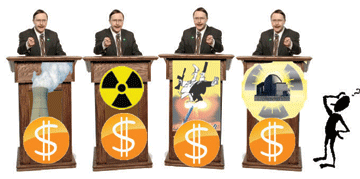
Royal commissioner Kevin Scarce has just visited both countries to scrutinise high-level waste disposal sites and their licensing regimes. All three places have similar soil, which means Swiss and Belgian experts should be able to give him detailed information about the danger of storing nuclear waste in the South Australian outback.
Mr Scarce said on Thursday his final report due on May 6 on whether the state should expand from just being a uranium miner and venture into nuclear waste storage was unlikely to differ greatly from his preliminary findings in mid-February.
He rejected suggestions that it was inevitable that South Australia would undertake some form of nuclear expansion……..
Mr Scarce said he had received 170 direct responses in the past few weeks to his tentative findings unveiled on February 15 in which he concluded that a nuclear waste storage facility housing spent nuclear fuel rods and other waste could deliver $5 billion in revenue annually over 30 years.
He said some of those submissions had accused him of exaggerating the economic benefits, but he said he was confident that his economic modelling had been robust and said he had taken a “conservative” approach.
Mr Scarce said he had visited Sweden and Finland earlier in his commission’s work but in the wake of the tentative findings had made a special visit to Belgium and Switzerland because they had similar sedimentary soil structures to South Australia………http://www.afr.com/news/policy/swiss-and-belgian-experts-to-front-nuclear-commission-as-green-light-looms-20160331-gnv15s
Anti-nuclear opinions don’t count for much with SA’s elitist Royal Commission
Comments today from Nuclear Royal Commissioner, Kevin Scarce, show that the elitist and dismissive  processes that dominated the Commission’s early days are still alive and well.
“Clearly the Commission doesn’t want to hear from ordinary South Australians. At the outset, they refused to accept submissions that weren’t sworn before a JP (including mine) and now they are devaluing submissions from concerned South Australians.”  said Greens SA Parliamentary Leader,
Mark Parnell MLC.
On radio today, Mr Scarce described 850 submissions to the Commission’s Tentative Findings as “computer-generated views” and “spam”. He also said “you can’t do anything with them because they’re expressing opinions as opposed to going with the tentative findings”.
“What the Commissioner conveniently ignores is that the ONLY rationale for an international nuclear waste dump in South Australia is its supposed economic advantages. The economic case for the dump is derived from the assumptions and opinions of consultants. However, if ordinary South Australians dare to present “opinions”, then the Royal Commission “can’t do anything with them”.
“Barely two weeks after the close of public submissions and six weeks before handing down its final report, the Royal Commissioner appears to have already locked himself into the waste dump idea saying, “I’m convinced it’s safe”.
“When it comes to economic criticism, the Commissioner appears to value the number of economists involved and the number of pages they write as key considerations. He promised to “take apart piece by piece” the economic analysis of The Australia Institute, whilst acknowledging that the Commission’s own economic analysis was based on assumptions because there is no equivalent operating facility to compare it with and after 50 – 60 years of nuclear waste, “no one has found a solution yet.”
“Commissioner Scarce has consistently emphasised the need for community support, yet seems oblivious to the elitist approach taken by the Commission which devalues those South Australians whose support is needed if any of the Commission’s ideas are to be taken seriously”, concluded Mark Parnell.
Scarce determined to recommend nuclear waste import and dump for South Australia
Scarce final report not for turning on nuclear dump, INDaily, Tom Richardson, 30 Mar 16 The former South Australian Governor and retired naval officer has flagged a conclusion largely in keeping with his tentative findings, which found a compelling business case for a high-level nuclear waste dump to be based in SA, arguing it would contribute billions of dollars annually to the state’s economy.
The assumptions underlying that conclusion were scoffed at in a response by left-wing think tank the Australia Institute last week, which believes the prognostications of wealth beyond measure are grossly exaggerated.
But Scarce says despite heated backlash since his initial report was published last month, “I don’t think I’ve changed my fundamental findings” in the subsequent community consultation……..
he insists: “I’m convinced that it’s safe.”
“I’ve been now to five countries, I’ve been to facilities, I’ve been to organisations that assure the communities of those countries that this is safe to do,” he said.
“What I always expected I had to do in the final report is explain how countries come to that conclusion that it’s safe to do over these long periods of time.”……
He denied the economic merits of his conclusions were predicated on providing “cheap, above-ground storage for nearly a century”.
“That’s not what the scenario is: we do put it in an interim storage site to collect the revenue to enable us to build the deep geological storage, but it’s not there for hundreds of years,” said Scarce.
He said he would “put more work [into] the financial analysis” for his final report, but added: “I don’t believe that will change the magnitude of the positive [impact] – you know, the revenue versus the cost.”……..http://indaily.com.au/news/local/2016/03/31/scarce-final-report-not-for-turning-on-nuclear-dump/
Australia’s home solar battery company launches new product
Australian company launches home solar storage battery to take on electronics giant Tesla With the number of depleted home solar batteries being thrown away tipped to rise over the coming years, one Australian company is taking on electronic giants such as Tesla and Panasonic with the launch of an easily recyclable power source.
http://www.abc.net.au/news/2016-03-30/recyclable-solar-storage-battaries-to-take-on-giants-tesla/7284518?section=environment
Australian designed ZCell home battery storage system to be available by midyear
AN Australian-designed battery system partly built in Adelaide will allow householders to use stored solar power during the night. But it will cost you.
http://www.adelaidenow.com.au/business/simon-hackettbacked-redflow-launches-zcell-home-battery-storage-system/news-story/c5cc9be96f517103b02c363adae6a6b5
It’s wrong to sell Australian uranium to critically unsafe Ukraine
The Zaporizhia nuclear facility is Europe’s largest and is only 200 kilometres from the conflict zone in eastern Ukraine. Some commentators have described nuclear plants in the region as pre-deployed nuclear targets and there have already been armed incursions during the recent conflict period.
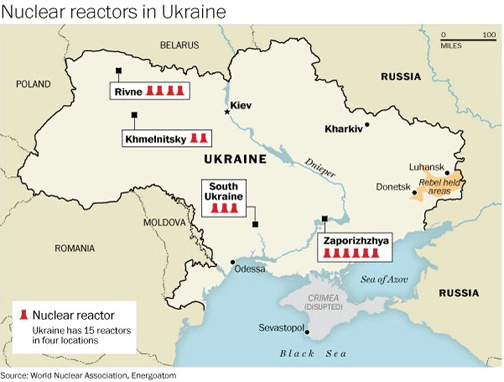
Australia shouldn’t sell its uranium to Ukraine http://www.smh.com.au/comment/australia-shouldnt-sell-its-uranium-to-ukraine-20160331-gnv0no.html, Dave Sweeney, 31 Mar 16 Foreign Affairs Minister Julie Bishop’s announcement this week to sell Australian uranium to Ukraine is an ill-advised and dangerous retreat from responsibility.
With timing and placement that a satirist could only dream of emulating – April Fool’s Day, the month of the 30th anniversary of the Chernobyl meltdown and while attending a nuclear security summit – Bishop is set to sign a uranium supply agreement this week with Ukrainian President Petro Poroshenko.
Australia, the country that directly fuelled Fukushima now plans to sell uranium to Ukraine, the country that gave the world Chernobyl – hardly a match made in heaven.
Thirty years ago the Chernobyl nuclear disaster spread fallout over large swathes of eastern and western Europe and five million people still live in contaminated areas in Belarus, Ukraine and Russia.
Serious containment and waste management issues remain at Chernobyl with a massive concrete shield now under construction in an attempt to enclose the stricken reactor complex and reduce the chances of further radioactive releases.
Against this backdrop there are deep concerns over those parts of the Ukrainian nuclear sector that are not yet infamous names, including very real security concerns about nuclear facilities being targeted in the current conflict with Russia. Continue reading
Nuclear security summit will overlook four dangers
Overlooked –
- Accidental explosions…..
- Many other nuclear thefts or sabotage……
- Military stocks of nuclear fuel plus civilian plutonium…..
- These efforts don’t include plutonium reprocessing
Four dangers the nuclear talks will overlook http://www.usatoday.com/story/news/world/2016/03/30/what-nuclear-summit-discuss-and-overlook-nuclear-terrorism/82436156/
Here are four nuclear security vulnerabilities they will discuss Thursday and Friday — and four that are not on the agenda:
1.TERRORISM AND DIRTY BOMBS
What they’ll discuss: The recent uptick in terrorist attacks in Europe have made world leaders more worried about terrorists using conventional bombs combined with nuclear material to explode radioactive “dirty bombs” that could cause injuries, panic and economic damage over a large area.
The leaders will discuss safeguards at facilities such as hospitals and research labs that use nuclear materials, ways to improve intelligence to better detect plots to use dirty bombs, and responses to a potential dirty-bomb attack, said Bruce Blair, co-founder of Global Zero, the international movement for eliminating nuclear weapons.
Overlooked: Accidental explosions. More recent nuclear weapons countries, such as India, Pakistan and North Korea, are decades behind the United States and Russia in terms of safeguarding their nuclear weapons in case of a mishap, Blair said. If a weapon falls from an aircraft that is crashing and is hit by an explosive force, “chances are there’d be a chain reaction and the weapons would explode,” he said.
Also, those countries along with China are moving toward a state of nuclear readiness that raises the risk of accidental nuclear launches and detonations. “That whole agenda is being ignored,” Blair said.
2. NUCLEAR THEFT
What they’ll discuss: The summit will address the possible theft of highly enriched uranium and plutonium in civilian facilities, such as research reactors, that can be used to fuel a nuclear device, Blair said.
Previous summits have focused on converting nuclear reactors to use less harmful low-enriched uranium or sending it back to Russia or the United States, where it would be more secure.
Overlooked: Many other nuclear thefts or sabotage, such as rogue military insiders working with outside groups to steal nuclear material or detonate a device, Blair said.
3. NUCLEAR MATERIAL UNDER CIVILIAN CONTROL
What they’ll discuss: The summit deals with highly enriched uranium and plutonium that are under civilian control, mainly nuclear power authorities around the world, but also some medical and research facilities. They oversee 2% of the world’s total stock of highly enriched uranium and plutonium — enough to produce 4,000 nuclear weapons.
Overlooked: Military stocks of nuclear fuel plus civilian plutonium, which represent 98% of the world’s supply of weapons-grade material. Ben Rhodes, Obama’s deputy national security adviser for strategic communication, told reporters that military programs will be discussed. But they can’t be specific because the United States is the only nuclear power that has declared the size of its nuclear stockpile. Plus, Russia, which has the world’s largest nuclear stockpile, is boycotting the summit because of displeasure over how the U.S. organizers prepared the agenda. “So how can they focus on it with any specificity?” Blair said.
4. NUCLEAR WATCHDOGS
What they’ll discuss: The White House says international attention has focused on improving institutions that deal with nuclear security around the world. This includes improving the capabilities of the U.N. nuclear watchdog, the International Atomic Energy Agency; the international law-enforcement agency, INTERPOL, which combats nuclear smuggling; and the Global Initiative to Combat Nuclear Terrorism, an 86-nation group. All have been reinvigorated in recent years.
“We will look for ways to enhance the global nuclear security architecture,” Rhodes said.
Overlooked: These efforts don’t include plutonium reprocessing, which countries use to recycle spent nuclear fuel. It can be used to produce fuel for nuclear weapons.
Japan now has 10 tons of civilian plutonium on its soil, enough to build 2,500 nuclear bombs, Blair said. But it’s not being discussed for diplomatic reasons.
Japan could convert that material into nuclear fuel and produce nuclear weapons if it decided it needed to deter North Korea, a nuclear state that repeatedly has threatened to launch nuclear missiles targeting Japan, South Korea and the United States. “We’re not talking to Japan about that because it’s a proliferation risk,” Blair said. To do so is too sensitive, he said. It “would be a clear statement of concern that Japan would go nuclear.”
Who will benefit from nuclear waste import scheme – international nuclear companies!
The Australia Institute’s chief economist, Richard Denniss, told a public meeting in Adelaide on Mar. 22 that the economic modeling used by the Royal Commission did not stack up and painted an unrealistic picture of the benefits, costs and risks. The assumed price was higher than anyone was paying, and it assumed South Australia would have a global monopoly.
“The price assumptions are optimistic. But the main problem is that it is based on above-ground storage for 20 years. If you had to build the hole (for underground storage) first, you’d never make it add up,” Denniss said on Adelaide radio station FIVEaa.
Denniss said the institute’s analysis showed the primary beneficiaries of a waste dump in South Australia would be international nuclear power companies.
Those opposing the dump include environmental organizations, traditional Aboriginal custodians of the land and the Australian Greens political party, with Greens Senator Robert Simms deriding the dump’s economics as “pure fantasy.”…….
Woomera contamination
Nuclear involvement in this part of Australia already has negative associations. Between 1953 and 1963, South Australia was the location for a series of British nuclear bomb tests, first at Emu Field and then at Maralinga, 800km northwest of the state capital Adelaide, in the vast military testing zone known as the Woomera Prohibited Area.
The Maralinga site was contaminated by radioactive material, and although clean-up work began in 1967, it was not completed until 2000. The traditional Aboriginal custodians of the land, the Maralinga Tjarutja people, were paid compensation for the damage in 1994. Some British and Australian service personnel involved in the tests and some Aboriginal inhabitants developed radiation-related illnesses.
Since 2010, Australian defense personnel involved in the tests have been eligible for compensation and healthcare benefits related to their medical conditions, but so far, only a handful of the 1,800 Australian veterans still alive have received compensation……
Once Commissioner Scarce delivers his final report on May 6, the state government will begin a process of extensive community engagement that will run into August. After that, Weatherill and his colleagues in cabinet will prepare a case to take to state parliament by the end of the year. Any move to set up a nuclear waste facility would require new legislation…….
In his interim report, Scarce said the commission’s key finding was that most aspects of the nuclear fuel cycle were economically unviable in South Australia for the next 10 to 20 years, apart from the storage and disposal of high-level waste from around the world.
He said such a facility would be “commercially viable” and the “highly profitable” storage component could be operational in the late 2020s.
According to an economic model prepared for the Royal Commission by Melbourne-based consultants Jacobs MCM, total project revenues would be A$257 billion, based on managing 138,000 metric tons of spent nuclear fuel from power stations (about 13% of the projected global total) over its lifespan, and 390,000 cubic meters of intermediate waste.
Jacobs MCM said “significant revenues” could commence 10 years from a decision to launch detailed investigations.
‘Pure fantasy’
Robert Simms, Australian Greens senator for South Australia, described the cash windfall depicted in the commission’s interim report as “pure fantasy.” He said it failed to adequately consider that making South Australia “the world’s largest nuclear waste dump would be a costly and dangerous burden for future generations.” He also said South Australia should be embracing renewable energy rather than getting further involved in a nuclear industry that “flatlined last century.”
A poll of 1,077 South Australian residents conducted in March for the left-leaning think tank The Australia Institute found 37% of voters supported an international nuclear waste dump, while 48.5% were opposed and 14% were undecided.
The institute’s chief economist, Richard Denniss, told a public meeting in Adelaide on Mar. 22 that the economic modeling used by the Royal Commission did not stack up and painted an unrealistic picture of the benefits, costs and risks. The assumed price was higher than anyone was paying, and it assumed South Australia would have a global monopoly.
“The price assumptions are optimistic. But the main problem is that it is based on above-ground storage for 20 years. If you had to build the hole (for underground storage) first, you’d never make it add up,” Denniss said on Adelaide radio station FIVEaa.
Denniss said the institute’s analysis showed the primary beneficiaries of a waste dump in South Australia would be international nuclear power companies.
Australian and Marshall Islander nuclear test survivors demand a ban on nuclear weapons
“Black Mist White Rain” Speaking Tour
4-7 April 2016
Four Indigenous women from South Australia and the Marshall Islands are touring four cities over four days to speak about how nuclear testing has impacted their lives, and why a treaty banning nuclear weapons is urgently needed.
Sue Coleman-Haseldine, Kokatha-Mula, and Abacca Anjain-Maddison, Republic of the Marshall Islands, spoke to over 150 governments at the Third Conference on the Humanitarian Impact of Nuclear Weapons in Vienna, December 2014. They are joining forces again to bring their personal stories to Adelaide, Melbourne, Sydney and Brisbane.
“The bombs have destroyed a large part of Australia and despite several attempts it will never be safe or clean. There are many Aboriginal people who cannot go back to their ancestral lands and their children and their children’s children and so on will never know the special religious places it contains.” Sue Coleman-Haseldine.
Coleman-Haseldine and Anjain-Maddison will be joined by Rosemary and Karina Lester, the daughters of Yankunytjatjara elder Yami Lester, who was blinded by the Totem 1 nuclear test at Emu Field in 1953. Speaking about the nuclear testing conducted in South Australia;
“Many people died immediately, but others are living with chronic health issues, cancers and disabilities. Not to mention depression, the painful loss and trauma suffered mentally, the psychological and social damage, and watching loved ones’ lives diminish. It has eroded our culture and further marginalised our people.” Rosemary Lester.
The United Kingdom conducted 12 major nuclear weapons tests in Australia between 1952 and 1963 at Monte Bello Islands, Emu Field and Maralinga. The United States conducted 67 nuclear tests in the Marshall Islands between 1946 and 1958, including the 15-megatonne “Castle Bravo” test at Bikini Atoll, which was 1000 times more powerful than the bomb dropped on Hiroshima, and exposed thousands of people to radioactive fallout.
“Marshallese people endured the loss of traditionally-held land and marine resources without negotiation or compensation; (and) were exposed to fallout contamination compromising the environmental health of individual and communities.” Abacca Anjain-Maddison.
In the wake of Three Conferences on the Humanitarian Impact of Nuclear Weapons, 127 nations have endorsed a Pledge to “fill the legal gap for the prohibition and elimination of nuclear weapons”. A UN-endorsed working group to take forward nuclear disarmament negotiations is meeting over three sessions during 2016, and is expected to lay the groundwork for negotiations to begin on a nuclear weapons ban treaty.
“While the Republic of the Marshall Islands is holding nuclear weapons states accountable in the International Court of Justice for their failure to disarm, the Australian government continues to justify the utility of the nuclear threat. The time is overdue for us to join the international majority in banning nuclear weapons”, said Gem Romuld, ICAN Australia.
The Tour Schedule:
Monday April 4 in Adelaide
Tuesday April 5 in Melbourne
Wednesday April 6 in Sydney
Thursday April 7 in Brisbane
More detail is available at: www.icanw.org/au/bmwr
1 This month
15 April – Zoom –Nuclear Power is Not the Solution
Apr 15, 2026 01:00 AM in Canberra, Melbourne, Sydney

Join the International Physicians for the Prevention of Nuclear War (IPPNW) on Tuesday, April 14th for a timely webinar exploring the risks associated with nuclear power and challenging the myth that it offers a simple, safe, carbon-free solution to the climate crisis
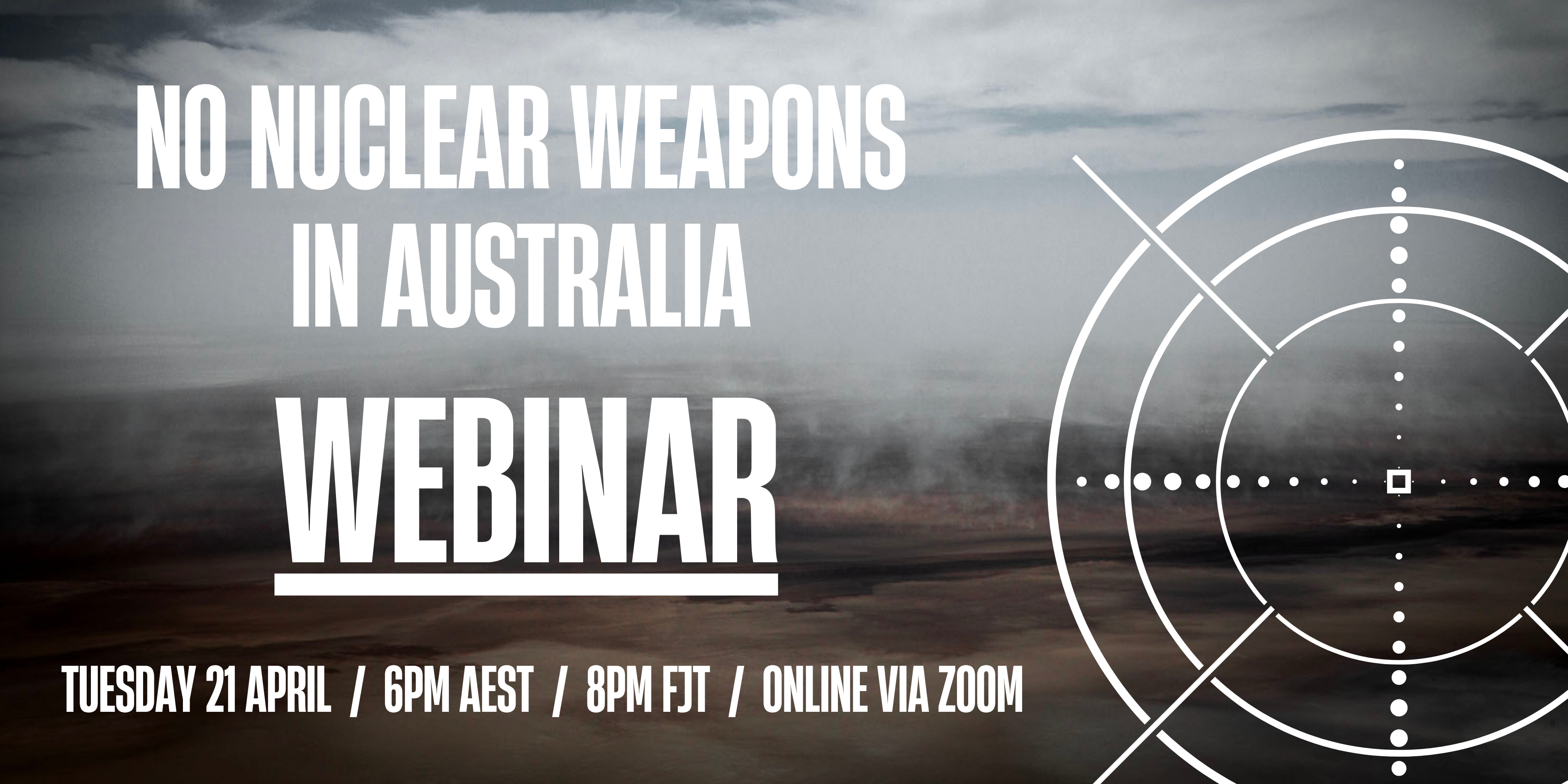
21 April Webinar: No Nuclear Weapons in Australia
Start: 2026-04-21 18:00:00 UTC Canberra, Melbourne, Sydney (GMT+10:00)
End: 2026-04-21 19:30:00 UTC Canberra, Melbourne, Sydney (GMT+10:00)
Event Type: Virtual
A virtual link will be communicated before the event.
Host Contact Info: australia@icanw.org

of the week – Australians for War Powers Reform (AWPR)
To see nuclear-related stories in greater depth and intensity
 Antinuclear