Traditional Owners Wangan and Jagalingou condemn Queensland’s decision to approve Carmichael coal mine
 QLD Mines Minister Lynham’s Adani mine approval shows gutless and morally bankrupt approach of Government to Traditional Owners’ rights Wangan & Jagalingou Family Council 3 April 06:
“Minister prefers Adani’s misleading and inflated jobs figures to respect for the law and human rights, say Wangan and Jagalingou people
The Wangan and Jagalingou (W&J) people today responded to the announcement by QLD Mines Minister Anthony Lynham that he is issuing mining leases to Adani for the Carmichael coal mine. The coal mine is the biggest proposed in Australian history and if built will permanently destroy the W&J’s vast traditional homelands in the Galilee Basin.

W&J spokesperson and traditional owner Adrian Burragubba said, “This is a disgraceful new low in the exercise of Government power at the expense of Traditional Owners’ rights. Minister Lynham and Premier Palaszczuk should hang their heads in shame. History will condemn them.
This is the wrong mine, at the wrong time, on the wrong side of history. Their actions are reckless and dishonourable. “In October 2015 Minister Lynham confirmed in a letter to our legal counsel that he would await the outcome of our Federal Court action against the mine before considering issuing the leases. Late last year and again this year he said he would wait for the matters before the courts to be resolved so as not to run the risk of having his decision invalidated.”
Mr Burragubba’s legal representative and human rights lawyer,
Benedict Coyne of law firm Boe Williams Anderson, said…http://wanganjagalingou.com.au/gutless/
Political terms versus environmental time-lines – the South Australian nuclear waste folly
Saving the Environment or Centralized Control of a Monopoly in Power (Electricity)? Pan Chemistry, Gareth Lewis 03/03/15 “………Political terms versus environmental time-lines 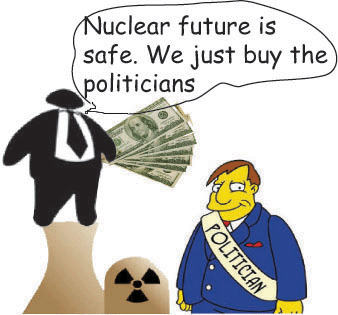 This section raises an important point with environmental issues or challenges: the short duration of political terms (often three to six years) limits the amount that can be done in the field of environmental protection. This means that global problems, such as air pollution and global warming that have no geographic boundaries and are likely to be long-term challenges may not be attempted. Even ‘smaller’ challenges like preserving the Great Barrier Reef and ensuring the viability of water supply and usage along the River Murray cannot be addressed in any one political term (nor have they been): there’s just insufficient time and funds to do so. Additionally, the political fallout from such ventures may not ensure the duration of the political term (a political paradox). A case could easily be argued that such issues should be written into Federal politics and once initiated they should go ahead regardless of the social and political climate.
The proposed nuclear industry and global radioactive nuclear waste dump in South Australia is similarly a complex issue and will affect many generations to come. However, given the comparatively simple challenge of managing water supply and usage along the Murray River how likely is it that a proposed nuclear industry would be managed efficiently? I am not being overly ‘emotive’ here, I’m simply saying this: any proposed nuclear industry will ‘outlive’ a Royal Commission, a State and Federal Government and all of us! So; very careful consideration is needed, not only for the current generation of Australians, but for future generations who will not have a say in the decision making process that will determine the cleanliness and viability of ‘their’ environment………
Is the notion of establishing a nuclear industry in South Australia really about centralized control in the creation and distribution of energy (electricity)?
A skeptic  could easily argue that the use of nuclear energy has nothing at all to do with ‘saving the environment:’ but that it’s really about centralized control in the production and sale of electricity in a monopoly system. After all, it’s easy to control a centralized supply and demand system, and it’s exactly what we have in place today in the world-wide production and sale of fossil fuels.
This notion of ‘centralized control’ is a whole topic in itself and is beyond the scope of the original question: ‘should a nuclear industry (uranium mining, sale of uranium and storage of global radioactive nuclear waste) be established in South Australia. My personal opinion (emphasis) and answer to this question at this time is no. I believe we have sufficient solar energy and land mass in Australia to develop and perfect the solar cell industry and such technology could then be licensed and sold overseas. Besides, the success of this approach has been clearly demonstrated in other countries, many of which have far less sunshine and land mass than Australia.
Additionally, the inherent risks of initiating what may be an untethered proliferation of nuclear (fission) power plants has also been demonstrated in the past at Chernobyl and Fukushima, with close calls in Long Island. However, what has not been demonstrated (thankfully) is what could happen to our environment (groundwater and surrounds) if global radioactive nuclear waste was compromised in transit or in storage by man-made or natural means. It remains to be seen whether the proposed Royal Commission will make the ‘right recommendation’ to the government in South Australia that will benefit and protect not only the current generation, but also of many future generations of Australians: so; fingers crossed :-\ 😉 http://www.gareth-panchem.com/347345675?pagenum=2
Queensland government takes an evil decision on Adani’s Carmichael coal mine
 Decision on coal mine ‘defies reason’ April 4, 2016 Tim Elliott Features and investigations journalist for The Sydney Morning Herald
The decision on Sunday to approve mining leases for Queensland’s Carmichael coal mine is akin to “evil”, according to one of the world’s foremost marine scientists.
“It defies reason,” said Dr Charlie Veron, former chief scientist at the Australian Institute of Marine Science. “I think there is no single action that could be as harmful to the Great Barrier Reef as the Carmichael coal mine.”
The $21.7 billion project, which involves mine, rail and port facilities, would allow Indian multinational Adani to extract 60 million tonnes of thermal coal a year from the Galilee Basin, in central Queensland. Adani claims the mine will generate 5000 jobs during construction and more than 4000 during operation, with construction to begin next year……..
conservationists say the mine is an environmental disaster waiting to happen, citing particular risks to the Great Barrier Reef.
 “It’s an extraordinary decision, especially coming at a time when the Great Barrier Reef is experiencing its worst ever coral bleaching event,” Australian Conservation Foundation chief executive Kelly O’Shanassy said. “We know the bleaching is because of global warming, and Carmichael will only make that worse.”
By Adani’s own figures, the mine and its coal will emit more than 4.6 billion tonnes of carbon dioxide over its lifetime. “The pollution from this mine is so big that it cancels the pollution cuts the Turnbull government committed to at the Paris Climate Summit,” Ms O’Shanassy said.
The impact of such emissions could be terminal to the reef, according to Dr Veron. “The reef is obviously in dire straights, irrespective of what anyone says, and that’s blindly obvious.
“There is extraordinary disconnect between science and the political action. Politicians think the mine is good because it’s good for economy, but we are selling out the next generation of Australians as fast as we can go.”
Dr Veron has devoted his life to studying coral reefs: he discovered more than 20 per cent of the world’s coral species, and has been likened by Sir David Attenborough to a modern day Charles Darwin.
“Roughly a third of marine species have parts of their life cycle in coral reefs,” Dr Veron said. “So if you take out coral reefs you have an ecological collapse of the oceans. It’s happened before, mass extinctions through ocean acidification, and the main driver of that is CO₂.”
Dr Veron recently travelled to Canberra to talk to government about the decline in the reef. “The politicians do listen to scientists, but that is the worst part of it,” he said. “If this was all done out of sheer ignorance, that is sort of understandable. It’s like child porn – you might say you don’t know it exists, but if you know it exists and you do everything to promote it, then that’s evil.”…….
Australian Institute of Marine Science principal research scientist Dr Frederieke Kroon has told the ABC that government policies designed to keep the reef on UNESCO’s World Heritage list are insufficient.
“Our review finds that current efforts are not sufficient to achieve the water quality targets set in the Reef 2050 Plan,” she said. http://www.smh.com.au/federal-politics/political-news/decision-on-coal-mine-defies-reason-20160403-gnxbc6.html#ixzz44p5A45Es
The global oil corruption scandal and Australia’s role in it
UNAOIL Why we Must Act , The Age, Nick McKenzie, 2 Apr 16 Australia is leagues behind the US when it comes to investigating corrupt multinational companies who bribe their way to success in third world countries.
This fact is even more concerning given that US prosecutors acknowledge that even they aren’t getting it right, and need to do more to send US corporate crooks to jail. If the US regime needs a jolt, Australia’s system needs a triple bypass.
Recently, when the CEO of the Australian Securities Exchange, Elmer Funke Kupper, stood down to deal with a police investigation over an alleged international bribery case, we even had the corporate cop saying what a “sad loss” it was.
Not a single Australian executive has been jailed for paying a bribe overseas, despite the introduction in 1999 of specific laws banning this practice…….
Unaoil is a Robin Hood in reverse. On steroids. It robs the poor of oil-rich nations such as Iraq, Libya, Angola and Iran. The citizens own the resources beneath their feet, but the money from exploiting them ends up lining the pockets of executives and crooked officials.
Among the Australian firms exposed in the leaked trove of documents is Leighton Offshore, the overseas arm of construction giant Leighton Holdings (since renamed CIMIC).
The emails show that Leighton Offshore promised to pay tens of millions of dollars in bribes in 2010 and 2011. These kickbacks were allocated by Unaoil to high-ranking Iraqi officials and politicians. In return, Leighton Offshore wanted these corrupt officials to help them win pipeline construction projects worth more than $1 billion.
This Australian-funded bribery is precisely the sort of illegal conduct the FBI’s McEachern says fuels inequality, anger and extremism…….
Both the US and UK have comprehensive anti-foreign bribery frameworks. Companies and whistle blowers have strong incentives to self-report corruption and co-operate with authorities – in the US, volunteering information can mean payments of millions of dollars to individual informers. High-quality inside knowledge makes it easier for authorities to hold the corrupt to account.
None of this applies in Australia. ra rahttp://www.theage.com.au/interactive/2016/the-bribe-factory/day-3/why-we-must-act.html
LET’S NOT LEAVE THE OIL INDUSTRY OUT OF OUR SCRUTINY
UNAOIL – The Company That Bribed The World The Age, HuffPost http://www.theage.com.au/interactive/2016/the-bribe-factory/day-1/the-company-that-bribed-the-world.html 31 Mar 16
 In the list of the world’s great companies, Unaoil is nowhere to be seen. But for the best part of the past two decades, the family business from Monaco has systematically corrupted the global oil industry, distributing many millions of dollars worth of bribes on behalf of corporate behemoths including Samsung, Rolls-Royce, Halliburton and Australia’s own Leighton Holdings.
Now a vast cache of leaked emails and documents has confirmed what many suspected about the oil industry, and has laid bare the activities of the world’s super-bagman as it has bought off officials and rigged contracts around the world.
A massive leak of confidential documents has for the first time exposed the true extent of corruption within the oil industry, implicating dozens of leading companies, bureaucrats and politicians in a sophisticated global web of bribery and graft.
After a six-month investigation across two continents, Fairfax Media andThe Huffington Post can reveal that billions of dollars of government contracts were awarded as the direct result of bribes paid on behalf of firms including British icon Rolls-Royce, US giant Halliburton, Australia’s Leighton Holdings and Korean heavyweights Samsung and Hyundai.
The investigation centres on a Monaco company called Unaoil, run by the jet-setting Ahsani clan. Following a coded ad in a French newspaper, a series of clandestine meetings and midnight phone calls led to our reporters obtaining hundreds of thousands of the Ahsanis’ leaked emails and documents.
The trove reveals how they rub shoulders with royalty, party in style, mock anti-corruption agencies and operate a secret network of fixers and middlemen throughout the world’s oil producing nations.
Corruption in oil production – one of the world’s richest industries and one that touches us all through our reliance on petrol – fuels inequality, robs people of their basic needs and causes social unrest in some of the world’s poorest countries. It was among the factors that prompted the Arab Spring.
Fairfax Media and The Huffington Post today reveal how Unaoil carved up portions of the Middle East oil industry for the benefit of Western companies between 2002 and 2012.
In part two we will turn to the impoverished former Russian states to reveal the extent of misbehaviour by multinational companiesincluding Halliburton. We will conclude the three-part investigation by showing how corrupt practices have extended deep into Asia and Africa……….
In continuing fallout from the joint Fairfax Media-Huffington Post investigation into corruption in the oil industry, the Monaco government revealed that it had raided the homes and offices of Unaoil’s principals, who ran the company exposed as the global bagman for the oil industry.
Advertisement
Unaoil executives “were also interviewed… in the presence of British officers in connection with a case of vast corruption with international ramifications that involves many foreign companies active in the petroleum sector,” the Monaco government’s statement said.
Fairfax Media revealed on Thursday that the British police had teamed up with the Australian Federal Police, the US Department of Justice and the FBI to investigate the vast cache of leaked Unaoil emails on which our stories have been based.
Unaoil was hired over almost two decades by large multinational firms, including the offshore arm of Australia’s Leighton Holdings, to pay bribes to top overseas officials in return for winning government funded contracts in oil-rich nations.
Police raids and more revelations: the fallout of the Unaoil scandal The Age, April 1, 2016 Nick McKenzie, Richard Baker, Michael Bachelard, Daniel Quinlan “……. In continuing fallout from the joint Fairfax Media-Huffington Post investigation into corruption in the oil industry, the Monaco government revealed that it had raided the homes and offices of Unaoil’s principals, who ran the company exposed as the global bagman for the oil industry.
Unaoil executives “were also interviewed… in the presence of British officers in connection with a case of vast corruption with international ramifications that involves many foreign companies active in the petroleum sector,” the Monaco government’s statement said.
Fairfax Media revealed on Thursday that the British police had teamed up with the Australian Federal Police, the US Department of Justice and the FBI to investigate the vast cache of leaked Unaoil emails on which our stories have been based.
Unaoil was hired over almost two decades by large multinational firms, including the offshore arm of Australia’s Leighton Holdings, to pay bribes to top overseas officials in return for winning government funded contracts in oil-rich nations……… http://www.theage.com.au/business/police-raids-and-more-revelations-the-fallout-of-the-unaoil-scandal-20160401-gnw9mx.html#ixzz44ZNjGbWg
Follow us: @theage on Twitter | theageAustralia on Facebook
We are becoming a dumping ground for dirty money
The Age, Nick McKenzie, 1 Apr 16
- Read the full day two expose here
- The dirty western executives
- Australia’s Leighton Offshore: dirty dealing in Iraq
- Big Oil’s bribe factory
Anti-corruption experts in the US and Europe have urged Australia to properly resource and empower its anti-bribery regime as Australia emerges as the “dumping ground” for dirty money from Asia.
Officials believe that under-resourcing, ineffective laws and competing priorities between the federal police and corporate watchdog ASIC are a factor in the failure to resolve many cases.
The call comes after Fairfax Media revealed Australian involvement in one of the biggest bribery scandals to ever hit – a scandal that has implicated a number of Australian firms and executives including the offshore arm of Leighton Holdings and WorleyParsons…….
The Coalition government has focused on fighting union corruption, but has been all but silent on the major gaps in Australia’s anti-corporate corruption regime.
Why take the risks of polluting South Australia with nuclear wastes?
 why take the risk(s)? Well, the short answer is that it would be worth taking the risk by the few and their families who would profit from the proposed venture in the short-term; but not the rest of us. Additionally, it will not be their families and their descendants that will suffer the consequences of a poor decision at this time since they will be able to afford to move elsewhere: the same may not be possible for future generations of Australians.
So, (hypothetically) what would Australia end up with should a nuclear industry go ahead in a self-promoting process? There would likely be many disused mining sites and disused nuclear reactors, the largest radioactive nuclear dump in the world, possibly a compromised water table and ecosystem and a few wealthy individuals (who may not be based in South Australia 😉
Saving the Environment or Centralized Control of a Monopoly in Power (Electricity)? Pan Chemistry, Gareth Lewis 03/03/15“……….Domestic and global transporting of nuclear waste is inherently risky and ocean, rail and road accidents do occur. Additionally, security in the transport of such waste would have to be assured to prevent the misuse of waste in our age of terrorism (would risks of nuclear weapons or dirty bombs increase in our attempt to curb global warming using nuclear energy?): such security would be complicated and expensive………
The Royal Commissioner commented that the notion of establishing a nuclear industry and waste dump in South Australia was ‘an emotive issue…’ Well, yes it is, and why shouldn’t it be based on the track records in Chernobyl, the Fukushimadisaster (with ongoing environmental pollution of the sea ecosystem) and a near miss in Long Island (there may be ‘other events’ that students could research).
What is also an issue is the destructive power of nuclear weapons and ‘dirty bombsthat can be manufactured from uranium and its radioactive waste products. Such devices could be made ‘anywhere’ in the world that may operate beyond the political term of any one local government that may initiate a nuclear industry in South Australia.
The Proposed South Australian Storage Depot
The grade and amount of waste will depend on the type of nuclear reactor. So, what then happens to radioactive waste? It would likely arrive in steel or
plastic drums and then be stored in geologically stable strata within
South Australia. The strata would have to be stable since radioactive nuclear waste takes thousands of years to reach safe levels (or levels that are unlikely to cause harm to
biota).
South Australia is well known for being one of the ‘driest places on the driest continent,’ but that’s not always been the case. We also get flooding events that may increase in intensity and severity as global weather pattern change, caused in part by our use of fossil fuels? Well, the vast majority of scientists seem to think so, and so do many politicians.
Let’s play ‘what if’ at this point, since it’s just a hypothesis or ‘one of those ideas.’ What if an extreme weather event caused massive flooding in the northern parts ofSouth Australia as often occurs in Queensland? That would mean that salts would be dissolved to create a hypersaline corrosive liquid. If this solution came into contact with the steel drums that contain radioactive waste they would begin to corrode. Alternatively, even plastic drums will deteriorate over time as their inner surfaces are bombarded by particles emitted from the
decaying radioactive waste. At that (hypothetical) stage, which may take thousands of years,
it would not be possible to move such a large mass of radioactive waste accumulated from throughout the world, it would simply be too risky. There is the argument that spent radioactive waste can be recycled and then reused, however the remaining residue (on reprocessing) will also provide another source of waste. Additionally, by that time other sources of energy (maybe even fusion) may provide economic benefits that far exceed the reclamation and reuse of fissionable material that has been accumulated over time and the original radioactive waste may simply remain where it was initially stored.
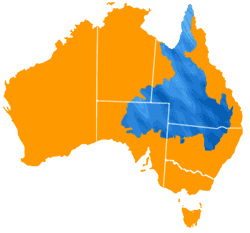 The northern parts of South Australia has a large Artesian Basin of fresh water deep beneath its surface which may then be put at risk from contamination by global radioactive nuclear waste that may have been stored over the millennia…….
why take the risk(s)? Well, the short answer is that it would be worth taking the risk by the few and their families who would profit from the proposed venture in the short-term; but not the rest of us. Additionally, it will not be their families and their descendants that will suffer the consequences of a poor decision at this time since they will be able to afford to move elsewhere: the same may not be possible for future generations of Australians.
So, (hypothetically) what would Australia end up with should a nuclear industry go ahead in a self-promoting process? There would likely be many disused mining sites and disused nuclear reactors, the largest radioactive nuclear dump in the world, possibly a compromised water table and ecosystem and a few wealthy individuals (who may not be based in South Australia ;-)……… http://www.gareth-panchem.com/347345675?pagenum=2
Australia had hottest March on record
 March temperatures sets record as hottest ever, Bureau of Meteorology says http://www.abc.net.au/news/2016-04-01/march-temperatures-sets-record-as-hottest-ever,-bom-says/7293500?section=environment By environment reporter Sara Phillips You could be forgiven for not noticing the end of summer — March was a hot one.
Information released by the Bureau of Meteorology (BoM) indicated it was the hottest March on record, reaching 1.7 degrees Celsius above the long-term average. This eclipsed the 1986 record of 1.67 degrees above the average, BoM said in its monthly climate report.
The unusual heat was particularly noticed in the Top End, where the failure of the monsoon allowed temperatures to creep up. This, coupled with a high pressure system off the east coast of Australia, caused a heatwave strong enough to prompt BoM to issue a special climate statement about the phenomenon.
March 2 became Australia’s hottest day on record.
Averaged across the country, it reached a top of 38 degrees Celsius. There was no relief overnight either with minimum overnight temperatures the warmest ever, smashing the 1983 record by 0.83 degrees.
The hot March came on the back of the hottest February globally, and the hottest year for 2015.
A strong El Nino weather pattern prevailed at the start of the year, which has traditionally been associated with hotter weather. Although the El Nino is weakening, the heat effects are expected to persist for a few more months.
Climate change is thought to be adding to the unusual heat. The scorching start to 2016 prompted Australia’s chief scientist Alan Finkel to warn that the world was “losing the battle” against climate change.
Impact of climate change on Victoria worse than previously thought
 Climate change fears worsen following University of Melbourne and CSIRO research April 1, 2016 CHRIS McLENNAN The Weekly Times THE impact of climate change on Victoria’s weather could be twice as bad as previously thought.
A team of University of Melbourne and CSIRO researchers believes popular computer predictions over-estimate the flow of rain run-off into rivers.
Victorian Government scientists believe the state faces a much warmer and drier future which could result in longer fire seasons, less rainfall in winter and spring south of the Great Dividing Range, and less rainfall in autumn, winter and spring in the north.
Scientists say climate change is already being felt across Victoria, with a rise in temperature and a drop in rainfall since 1950.
The university research found climate modelling failed to adequately cater for drought. Under prolonged dry conditions, modelling predicted twice as much run-off into rivers and catchments than was occurring,” Prof Andrew Western said……..http://www.weeklytimesnow.com.au/news/climate-change-fears-worsen-following-university-of-melbourne-and-csiro-research/news-story/cac037efb28f859f6f491d0fbc70ef46
USA cities rally to save Obama’s Clean Power Plan
Cities Speak Up to Save Obama’s Clean Power Plan, City Lab, A large coalition of U.S. mayors and local governments is coming to the EPA’s defense in the legal battle to cut carbon emissions from power plants. JULIAN SPECTOR @JulianSpector Mar 31, 2016
President Barack Obama’s flagship plan to fight climate change is getting a boost from city leaders across the country.
The National League of Cities, the U.S. Conference of Mayors, and a coalition of 54 local governments are filing arguments in federal court Friday morning in support of the Clean Power Plan, imploring the D.C. Circuit Court of Appeals to allow the Environmental Protection Agency to regulate greenhouse gases emitted from existing power plants.
The amicus brief, provided in advance to CityLab, argues that the EPA has a duty to protect the public from harmful pollution in ways laid out by the Clean Power Plan. Cities, meanwhile, are uniquely vulnerable to climate change and are already paying for its effects, they say.
These comments come days after the EPAoutlined its own arguments in defense of the plan, which is being challenged by 27 states and an assortment of coal and power industry groups. The rule would force changes in the power sector with a goal of cutting its emissions by 32 percent from 2005 levels by 2030. At stake is the scope of the EPA’s regulatory powers, but also the ability of the U.S. government to meet its commitments to fighting climate change, as agreed to in the Paris negotiations last December………
“President Obama’s Clean Power Plan is essential to reduce our nation’s greenhouse gas emissions,” Los Angeles Mayor Eric Garcetti writes to CityLab. “The Supreme Court must choose between helping cities fight climate change or standing squarely in their way.” http://www.citylab.com/politics/2016/03/epa-clean-power-plan-cities-supreme-court/476127/
Future Fund must not finance Adani’s Carmichael coal mine
Australia’s ‘future’ fund should not consider financing the energy projects of the past http://www.theguardian.com/commentisfree/2016/apr/01/australias-future-fund-should-not-consider-financing-the-energy-projects-of-the-past Stephen Bygrave
Australia can be a renewable energy superpower if it plays its investment cards right – we have to move on from our misguided fossilised past
It was all over the news in India. The Indian finance minister Arun Jaitleywould be meeting Future Fund chairman Peter Costello to discuss using the Fund to help finance Adani’s Carmichael coal mine. There was no announcement of the meeting in Australia, but the questions must be asked: how should Australia’s sovereign wealth fund be used, and should it, a “future” fund, be considering the energy projects of the past?
The prospect of Costello dedicating sovereign funds to the massive coal mine in the Galilee Basin is so misguided. Future energy investment lies in renewables, not coal, and this trend is already playing out worldwide. The Australian economy already runs a real risk of becoming fossilised, caught in the past and missing out on the huge investment market in renewable energy as the world inevitably decarbonises and shifts to a zero emissions economy.
This global transition to renewables is an unavoidable condition for containing global warming below 2C. The future is renewables, the past is coal, and the economic benefits are easy to highlight.
In this transition, Australia stands to attract a major portion of the $2.3tn annual trade value from emissions-intensive trade-exposed industries, like cement, steel, and aluminium. In this era, countries with abundant, cheap, high quality renewable energy will attract these industries.
The Renewable Energy Superpower report to be released in Sydney on Monday 4 April shows that Australia is consistently in the global top three of countries with economic wind and solar energy resources, whether based on energy production potential per square kilometre, energy production potential from total land area, energy production potential from un-utilised land area, or energy production potential from rural land area.
Under various scenarios developed by the International Energy Agency for their WorldEnergy Outlook, investment in renewables and energy efficiency will make up around half of the future investment in energy in the next two decades, with investment in coal only making up 1-2%.
Whichever scenario the IEA looks at, renewables and energy efficiency attracts more investment in the next two decades than coal, oil and gas combined. Some $28tn is expected to be invested globally in renewable energy and energy efficiency by 2035.
Investment in renewables and energy efficiency globally is already large – around US$390bn isestimated to have been invested in 2013 alone, according to the International Energy Agency. In order to contain global warming to the 2C, the IEA estimates the annual investment in this market to more than double by 2020 to around US$750bn annually, and then to grow exponentially to US$2,300bn annually by 2035.
It also estimates that the renewables dominated power sector and energy efficiency markets will be 20-40 times the value of future coal sector development. The other important point that is relevant to Australia is that power sector and energy efficiency investment is skewed towards Australia’s neighbours in the Asia-Pacific region (40%) compared to global fossil energy investment (25%).
So how large is Australia’s renewable energy resource? While it is widely accepted that the total renewable energy resource across Australia is significant, the Superpower report conservatively models only the solar and wind resource that is available within 10kms of Australia’s existing electricity grid and able to generate power at a price competitive with other new power stations.
This is the resource that is immediately available to the existing electricity grid. The results are staggering even when only this small portion of Australia’s total renewable energy resource is captured – it is equivalent to 5000 exajoules, enough to power the world for 10 years.
Put another way, this solar and wind resource is greater than Australia’s coal, oil, gas and nuclear resources combined. Many proponents of fossil fuels argue that there are enough fossil fuels to power the world for hundreds of years, that coal is cheaper and isgood for humanity. These arguments ignore the reality that burning fossil fuels is incompatible with meeting the globally agreed goal of limiting warming to 2C, that new renewables are cheaper than new coal and new gas, and that many developing countries want solar.
In the decarbonised world in which we are heading, Australia will be a renewable energy superpower if it plays its investment cards right. If we are serious about our Future Fund funding the future for all Australians, it is renewables – not coal – where the investments must be made.
Guardian Australia and the author sought comment from Future Fund before publication. Future Fund responded after publication with the statement that “Finance Minister Jaitley has never raised Adani with the Future Fund.”
North American Oil and Gas Workers Seek Transition to Renewable Sector
Amid Price Plunge, North American Oil and Gas Workers Seek Transition to Renewable Sector TruthOut, 03 April 2016 00:00By Candice Bernd, “…….after years of working in an industry that one top climate scientist has called “the biggest carbon bomb on the planet,” Hildebrand came to realize that he was not the only oil worker in Alberta who felt “guilty about developing the infrastructure that is creating climate change.”
Opportunity in the Oil Plunge
Last spring, when oil prices began to fall, Hildebrand banded together with like-minded coworkers and began building an oil and gas worker-led nonprofit called “Iron & Earth,” which officially launched this month during a press conference in Edmonton. Through the nonprofit, the oil sands workers hope to help others who have been laid off diversify their skill sets and facilitate the necessary training to transition them to the renewable energy sector. They also want to help incorporate renewable energy projects into oil sands workers’ current scope of work…….
“We are a group of workers who not only want to diversify our work scope based on job need, but also based on a values-based mission, to ensure that we’re creating and building a future that’s going to be sustainable,” Hildebrand told Truthout. “The drop in oil prices was certainly a catalyst to help amplify these conversations, and created the pressure to … create a catch-all organization that’s going to make projects happen and get workers’ hands on some renewable energy projects.”
Moreover, not every oil worker with experience in Alberta’s oil sands needs to retrain in order to transition to the renewable sector, according to Hildebrand, who says a lot of trades are “directly transferable.” Hildebrand has worked on several renewable energy projects himself, including a biomass plant and the wind farm weather station that inspired him during his apprenticeship. “I didn’t require any retraining for that. All I required was the blueprints and the steel, and the facility to build it,” he said.
From Oil Sands to “Solar Skills”
Iron & Earth’s first project is its “Solar Skills” campaign to facilitate the retraining of 1,000 laid-off electricians from Alberta’s oil industry, to help build 100 solar installations on public buildings throughout the province beginning this fall. In the future, as the group takes on different campaigns focused on geothermal, biomass, biofuel and wind energy, they hope to attract other kinds of oil and gas workers, such as pipefitters and iron workers, as well as workers from other building trades, to retrain in those sectors………http://www.truth-out.org/news/item/35477-amid-price-plunge-north-american-oil-and-gas-workers-seek-transition-to-renewable-sector
1 This month
15 April – Zoom –Nuclear Power is Not the Solution
Apr 15, 2026 01:00 AM in Canberra, Melbourne, Sydney

Join the International Physicians for the Prevention of Nuclear War (IPPNW) on Tuesday, April 14th for a timely webinar exploring the risks associated with nuclear power and challenging the myth that it offers a simple, safe, carbon-free solution to the climate crisis

21 April Webinar: No Nuclear Weapons in Australia
Start: 2026-04-21 18:00:00 UTC Canberra, Melbourne, Sydney (GMT+10:00)
End: 2026-04-21 19:30:00 UTC Canberra, Melbourne, Sydney (GMT+10:00)
Event Type: Virtual
A virtual link will be communicated before the event.
Host Contact Info: australia@icanw.org

of the week – Australians for War Powers Reform (AWPR)
To see nuclear-related stories in greater depth and intensity
 Antinuclear