Ice shelves collapsing in Antarctica at an alarming rate
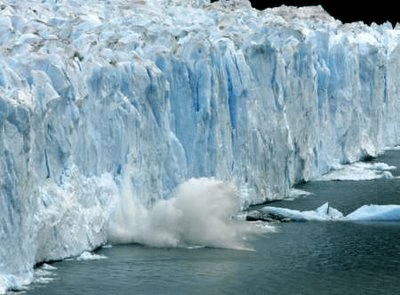 Scientists Are Watching in Horror as Ice Collapses Everything we learn about ice shows that it is disturbingly fragile, even in Antarctica. National Geographic, By Douglas Fox APRIL 12, 2016 “……..The catastrophic collapse of Larsen A and several other ice shelves along the Antarctic Peninsula has yielded important lessons about the vulnerability of Antarctica’s ice sheets to a warming climate. A new analysis of ice sheet instability, published March 31 in Nature, took the public by surprise when it projected that global sea level might rise six feet by 2100, and as much as 40 to 50 feet by the year 2500. (Read “Why the New Sea Level Alarm Can’t Be Ignored.”) That study seemed to double, overnight, the amount of sea level rise that can be expected. But many glacial scientists weren’t surprised. The new estimate is based on insights that have emerged slowly, over 20 years, in the aftermath of these ice shelf collapses.
The Aftermath of an Ice Shelf Collapse
Explore the fjords along the northeastern Antarctic Peninsula today, and it’s easy to find landscapes that look scarred even to the casual observer. …..
The glacier, now absent, had retreated several miles into its fjord. The fjord used to hold 2,000 feet (600 meters) of ice. Now it held 2,000 feet of seawater instead.
The aftermath of an ice shelf collapse is obvious in Sjögren’s fjord. When the ice shelf in front of Sjögren disintegrated in 1995, it removed the buttress that stabilized the glacier. The glacier started sliding into the sea at twice its original speed. Sjögren erupted in crevasses and thinned by several hundred feet as it stretched. After a few years, the glacier had retreated miles into its fjord as icebergs splintered off the glacier’s front faster than the ice could flow forward…….
Every ice shelf that disintegrated along the Antarctic Peninsula has shown the same pattern: summer melting of its top layers, winter refreezing of those top layers into icy crusts able to hold large melt ponds, and the re-exposure of long-buried crevasses.
For all of these ice shelves, the moment of death occurred suddenly. Each collapse began when water from the melt ponds drained into the crevasses. The weight of the water drove the cracks deeper—like a wedge, says Ted Scambos, a glaciologist with the National Snow and Ice Data Center at the University of Colorado in Boulder, who discovered the process. These fluid wedges eventually broke through the bottom of the ice shelf, calving off one iceberg, then another and another—a process called hydrofracturing that can devour an ice shelf nearly the size of Rhode Island in a matter of hours or days……..
Ice loss may have begun at a narrow beachhead in Antarctica, at the north end of the Antarctic Peninsula, but it has expanded on multiple fronts, as new regions of ice come into play every several years. As warm summer temperatures push farther south, so will the problems of melt ponding, ice shelf disintegration, and ice cliff collapse, which drive the rapid retreat of ice. (Read more about how calving causes mini-tsunamis daily in Antarctica.)
Scattered melt ponds already appear on some of the ice shelves that surround the Antarctic mainland, much farther south than any that have collapsed so far. The amount of ice lost each year from all of Antarctica’s ice shelves has increased 12-fold between 1994 and 2012.
Aside from warm air, the fringes of Antarctica’s ice are under assault from another source—warming ocean currents that melt the undersides of ice shelves. (Read more about research on what climate change will mean for whales.)……..http://news.nationalgeographic.com/2016/04/160412-ice-sheet-collapse-antarctica-sea-level-rise/
No comments yet.
1 This month

of the week – Australians for War Powers Reform (AWPR)
To see nuclear-related stories in greater depth and intensity
 Antinuclear
Leave a comment