Australia’s government completely beholden to fossil fuel industries

 The links between big polluters and politicians , The Saturday Paper, BILL MCKIBBEN, 16 Apr 16 “…….Despite the crisis unfolding around it, the current Australian government seems determined to ignore the role it has to play in preventing the planet from cooking.
Six months ago, Australia agreed to the Paris deal. Yet, since then, Australia has reapproved one of the world’s largest coalmines, opened a new research centre for the fossil fuel industry, cut funding for renewable energy, cut funding for climate research. The bewildering list goes on and on…..
Australia’s political system is …….becoming more and more American with each new donation. Until recently you had a prime minister who, between mouthfuls of onion, told the world that coal was good for humanity.
Granted, Malcolm Turnbull is no Tony Abbott. But Turnbull is also friendly with the fossil fuel industry. Just this week in Perth, he attended a dinner with the CEOs of Shell, Chevron and Woodside. Blocked by radical conservatives and wined and dined by the fossil fuel industry, Australia is now left adrift with a laughable climate strategy.
As the planet burns, Australia continues to dig up more fossil fuels. But it’s no surprise when you look at the amount of cash changing hands between your politicians and the big polluters.
In fact, for every $1 the fossil fuel industry has donated to Australia’s major political parties since your most recent federal election, they will be handsomely rewarded with $2000 worth of handouts in the upcoming federal budget. We have a similar crisis in the US. The more donations the industry gives to congress, the more they get back in subsidies. Recent research shows members of the US house of representatives who voted in favour of the Keystone Pipeline got 13 times more in donations from Big Oil than those who voted against. All up, five key refinery companies spent $58.8 million lobbying.
Like the US, the companies that donate most in Australia are those that have the most to lose from your government taking action on climate. They’re companies such as Australia’s biggest carbon polluter, AGL; or Origin, whose existence depends on throwing a wrecking ball through the solar and wind sector; and Chevron, from the same family of companies as Exxon, which knew about the climate damage we were setting ourselves up for yet pushed its dangerous product onto the world.
And then there’s the revolving door between your government and the mining industry. One of your chief negotiators on the Kyoto Protocol left public service to become the head of the Australian Coal Association. Australia’s former climate change minister is now an adviser to AGL and Santos. The deputy prime minister to John Howard left parliament to sit on the board of Whitehaven Coal. Heck, one of your richest coal barons is a sitting parliamentarian. And this is just the tip of the melting iceberg: it doesn’t consider the many staffers and unelected individuals who walk back and forth between parliament and the fossil fuel industry. This is why Prime Minister Turnbull has no climate plan. His government is full of climate deniers and fossil fuel fanatics whose political life depends upon blocking climate action. …..
Parliamentarians such as Cory Bernardi, who has spent his time in Canberra questioning the weather bureau and running “grassroots” campaigns to axe the carbon price. Or Angus Taylor, who describes human-induced climate change as “religion” devoid of facts. People such as former oil and gas executive, now senator, Gary Gray, who helped found one of the world’s most notorious climate denialist think tanks…….
The incoming federal election means politicians currently have their ear to the ground. Right now is a perfect opportunity to begin calling for an end to polluter handouts and donations – and real action on climate change.
It will take a movement to break the link between Australia’s politicians and the big polluters. But the foundations for a pollution-free politics, here in Australia and around the world, are building by the day. https://www.thesaturdaypaper.com.au/opinion/topic/2016/04/16/the-links-between-big-polluters-and-politicians/14607288003136
Japan has second, bigger, earthquake, in area not far from Sendai nuclear reactors

 Japan’s Kumamoto rocked by magnitude 7.3 earthquake 24 hours after first shock, SMH April 16, 2016 Tokyo: A magnitude 7.3 earthquake struck southern Japan early on Saturday, killing at least 11 people, injuring many more and bringing down buildings, media reported, just over a day after a quake killed nine people in the same region.
Authorities warned of damage over a wide area, as reports came in of scores of people trapped in collapsed buildings, fires and power outages.
Residents living near a dam were told to leave because of fears it might crumble, broadcaster NHK said…….
People still reeling from a magnitude 6.5 quake on Thursday poured onto the streets after the Saturday quake struck at 1.25 am……….
M7.0 earthquake in Japan – same area as yesterday’s foreshocks. https://t.co/eSYh0m7VMI. Hearts out to them pic.twitter.com/41M2BGRmRR……..
Japan is on the seismically active “ring of fire” around the Pacific Ocean and has building codes aimed at helping structures withstand earthquakes.
http://www.smh.com.au/world/japans-kumamoto-rocked-by-magnitude-74-earthquake-just-24-hours-after-first-shock-20160415-go7ucs.html#ixzz45xKID5Fc
Election: Liberal and Labor prefer to ignore Climate Change
 Climate change has dropped off the political radar (and this is a big problem) ABC THE DRUM, 14 APR 16 By Mike Steketee The aversion to talking about climate change during the election campaign reflects a wider problem: our concern for this issue has fallen even while it has become larger and more urgent, writes Mike Steketee.
How much of an issue will climate change be in this year’s election?
Not a major one, if Malcolm Turnbull gets his way. He has saddled himself with Tony Abbott’s policy as one of the costs of appeasing the conservatives in his ranks.
And while Bill Shorten will be arguing he has a superior policy – but also risking a fear campaign over re-introducing a carbon tax – Labor, too, believes it has bigger fish to fry, such as pushing forward its credentials on education and health. Continue reading
International effort could phase out fossil fuels in a decade
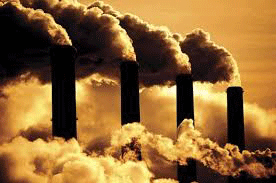 Fossil fuels could be phased out worldwide in a decade, says new study http://www.eurekalert.org/pub_releases/2016-04/uos-ffc041516.php UNIVERSITY OF SUSSEX The worldwide reliance on burning fossil fuels to create energy could be phased out in a decade, according to an article published by a major energy think tank in the UK.
Professor Benjamin Sovacool, Director of the Sussex Energy Group at the University of Sussex, believes that the next great energy revolution could take place in a fraction of the time of major changes in the past.
But it would take a collaborative, interdisciplinary, multi-scalar effort to get there, he warns. And that effort must learn from the trials and tribulations from previous energy systems and technology transitions. Continue reading
Victoria making coal mine owners pay for rehabilitation
Victoria’s coalmines forced to pay more towards site rehabilitation costs http://www.theguardian.com/australia-news/2016/apr/15/victorias-coalmines-forced-to-pay-more-towards-site-rehabilitation-costs The state’s premier says owners of Latrobe valley mines are profitable enough to absorb tens of millions of dollars in extra costs without cutting jobs Victoria’s coalmines are being ordered to hand over hundreds of millions of dollars more for the rehabilitation of their sites when mining ceases.Latrobe coalmines not paying enough for cleanup: Hazelwood fire inquiry

The state’s premier, Daniel Andrews, maintains the additional payments will not put jobs at risk.
The Victorian government announced on Friday the existing rehabilitation bonds would be increased in June from $15m or less to $34.25m for Yallourn, $36.7m for Hazelwood and $56m for Loy Yang.They will all then double again – to the current estimated rehabilitation liability for each mine – by January. On Thursday, the fourth and final report into the Hazelwood mine fireconcluded Latrobe valley mines were not making sufficient paymentsto cover rehabilitation costs.
It urged an immediately increase of tens of millions of dollars in the bonds until a review into the system was complete.
Andrews said on Friday the mines’ owners were profitable enough to absorb the additional costs. “We’ve had companies for too long that have been allowed to put aside just a fraction of what it costs to keep their mines safe and return those mine sites to the community … at the end of their useful life,” Andrews told reporters in Morwell.
“These are profitable companies. Let’s not have any of this talk that jobs are at risk – they are not at all.”
Great Barrier Reef will soon be unable to cope with global warming
Now the scientists have found that the coping mechanism barrier reef corals use to prepare themselves to face warm summer water is also under threat from global warming, and from human activities such as agriculture, shipping, and fishing.
“As temperature warms, the evidence is that this protective mechanism will no longer function
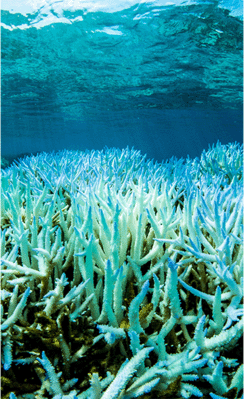 How the Great Barrier Reef is going from bad to worse Christian Science Monitor, 14 Apr 16 Though the corals of Australia’s Great Barrier Reef historically have managed to adjust to gradually warming seawater of the summer months, they will likely lose their defenses when the ocean warms overall in the near future, say scientists.
This was the latest finding from a team of American and Australian coral reef experts from James Cook University, the University of Queensland, and the US National Oceanic and Atmospheric Administration (NOAA).
These same scientists recently reported that their aerial surveys of some of the 3,000 coral reefs that make up this iconic natural wonder off Australia’s northeastern coast have showed that coral bleaching this year is the worst that has ever been observed. This is largely due to a recurring weather event known as El Niño, a storm system that is expected to become more frequent and more severe in the future.
I agree that El Niño is a natural variability; it’s a part of nature, but that variation in patterns and temperatures is superimposed upon a trend of warming,” Scott Heron, a NOAA coral reef scientist based in Australia, tells The Christian Science Monitor in an interview. “There are ups and downs, but now there are just higher ups than ever before, and the downs are not as low,” he says.
Coral bleaching happens when ocean temperatures rise to a point that zooxanthellae – tiny algae that live on corals and provide them with nutrients and their radiant colors – leave their coral homes, thereby rendering coral white or “bleached.” When corals go without zooxanthellae for too long, they die. This affects about a quarter of marine species that depend on coral reefs for shelter, and the humans who depend on those species for their livelihoods.
This year’s is the third major bleaching event in recent history for the 2,300-kilometer-long Great Barrier Reef, which is home to one of the most diverse ecosystems in the world. But this one is much worse than the bleaching events that occurred in 1998 and 2002, say scientists who recently found bleaching in almost 1,100 kilometers of northern barrier reef, from the island of New Guinea to the Australian coastal city of Cairns. The researchers estimate that 30 to 50 percent of the corals there are already be dead.
Now the scientists have found that the coping mechanism barrier reef corals use to prepare themselves to face warm summer water is also under threat from global warming, and from human activities such as agriculture, shipping, and fishing.
“As temperature warms, the evidence is that this protective mechanism will no longer function,” C. Mark Eakin, a scientist with NOAA Coral Reef Watch, tells the Monitor in an interview…….
The most viable immediate remedy, say paper authors, is to reduce the carbon emissions that cause warming and restrict other human activities near the reefs that add more stress, including runoff from agriculture, unsustainable fishing practices, and physical damage to the reef from ship groundings.
“These are all human stressors on reef that have to be minimized or eliminated for reefs to be able to bounce back from these bleaching events, even in a decade or two,” Eakin says.http://www.csmonitor.com/Science/2016/0414/How-the-Great-Barrier-Reef-is-going-from-bad-to-worse
Renewable energy target at risk
Projects have been delayed for want of long-term contracts….. (Subscribers only)
http://www.theaustralian.com.au/business/mining-energy/investment-stalemate-puts-renewable-energy-target-at-risk/news-story/80838e30c7be28be247eba9a38bbf009
1 This month

of the week – Australians for War Powers Reform (AWPR)
To see nuclear-related stories in greater depth and intensity
 Antinuclear