#NuclearCommissionSAust sets up a pro nuclear Committee for Adelaide overseas junket
Business SA chief Nigel McBride, who will join the tour, told InDaily the delegation would examine “what most people regard as a state-of-the-art piece of engineering [in terms of a] high-level waste repository”. “We don’t want to see people rely on fear and oozing-green Simpsons-cartoon-like imagery”
 SA leaders to tour key nuclear sites, Committee for Adelaide, 25 Apr 15 A high-powered delegation of South Australian business leaders and parliamentarians will jet off to Europe next month to visit key nuclear sites in a bid to facilitate a community debate on the merits of expanding the state’s role in the nuclear fuel cycle.
The trip was organised after consultation with Kevin Scarce’s Royal Commission, which last month handed down tentative findings outlining a multi-billion-dollar economic boon if SA established a high-level nuclear waste dump.
The delegation – to be capped at 10, plus prospective MPs and their staff – was organised by the Committee for Adelaide, an independent think-tank of community leaders, and will likely include representatives from environmental business consultants Golders, property group Knight Frank, engineering consultancy Mott MacDonald and Business SA, among others.

Committee for Adelaide general manager Matt Clemow told InDaily the tour would take in France, Finland, the UK and possibly Sweden, and was designed “to understand the issues and opportunities involved in the nuclear fuel cycle with specific focus on safety, alignment with agriculture and tourism, and associated industry regulations”.
The tour also aims “to create a cohort of SA people who have experienced the operations of the nuclear fuel cycle and will be able to contribute to the public discourse”.
The delegation – whose members will pay their own way – departs in late April, returning the day before Scarce hands down his final recommendations on May 6……
Minerals Council of Australia on the back foot with its pro uranium campaign
 Pro-uranium social media campaign’s #epicfail Why are some still championing nuclear power when renewable energy generation has doubled worldwide over the past decade? Jim Green, SBS, 25 Apr 2016 www.sbs.com.au/news/article/2016/04/25/comment-pro-uranium-social-media-campaigns-epicfail
The Minerals Council of Australia launched a pro-uranium social media campaign on Wednesday. By that afternoon the twitter hashtag #untappedpotential was trending but ‒ as an AAP piece picked up by SBS and others noted ‒ contributors were overwhelmingly critical.
Nearly all contributors offered thoughts such as these: “A week away from the #Chernobyl 30-year anniversary and Minerals Council begins propaganda trip on the #untappedpotential of uranium. Huh?!” said Twitter user Jemila Rushton.
“We need to better harness the #untappedpotential of solar power”, tweeted Upulie Divisekera.
“#untappedpotential to put more communities at risk of nuclear waste dumps,” Ace Collective said.
“We concur that uranium has much #untappedpotential … for disaster, cost and time blowouts and proliferation,” Anglesea After Coal said.
No doubt the Minerals Council anticipated the negative publicity and is working on the basis that all publicity is good publicity. But what the MCA didn’t anticipate is that in recent days the uranium price has fallen to an 11-year low. Mining.com noted in an April 20 article that the current low price hasn’t been seen since May 2005. The current price, under US26/lb, is well under half the price just before the 2011 Fukushima disaster, and under one-fifth of the 2007 peak of a bubble.
Mining.com quotes a Haywood Securities research note which points out that the spot uranium price “saw three years of back-to-back double-digit percentage losses from 2011-13, but none worse than what we’ve seen thus far in 2016, and at no point since Fukushima, did the average weekly spot price dip below $28 a pound.”
Mining.com notes that five years after the Fukushima disaster only two of Japan’s 50 nuclear reactors are back on line, and that in other developed markets nuclear power is also in retreat. The last reactor start-up in the U.S. was 20 years ago. The French Parliament legislated last year to reduce the country’s reliance on nuclear power by one-third. Germany is phasing out nuclear power. The European Commission recently released a report predicting that the EU’s nuclear power retreat ‒ down 14% over the past decade ‒ will continue.
China is a growth market but has amassed a “staggering” stockpile of yellowcake according to Macquarie Bank. India’s nuclear power program is in a “deep freeze” according to the Hindustan Times (unfortunately the same cannot be said about its nuclear weapons program), while India’s energy minister Piyush Goyal said on April 20 that India is not in a “tearing hurry” to expand nuclear power since there are unresolved questions about pricing, safety and liability waivers sought by foreign companies.
Even if all of Japan’s 50 reactors are included in the count, the number of power reactors operating worldwide is the same now as it was a decade ago. Zero growth despite the endless rhetoric about a nuclear renaissance.
A decision on two planned reactors in the UK could be announced in the next fortnight and the price-tag for the reactors explains why nuclear power is stagnant worldwide and why the Minerals Council is talking about uranium’s ‘potential’ rather than its current contribution to export revenue and employment. The total price-tag for the two planned reactors is A$45 billion. If the project proceeds, the industry will be hoping it doesn’t go three times over budget, as reactor projects in France and Finland have.
South Australian academic Richard Leaver has neatly summed up the uranium industry’s tiresome rhetoric: “‘Potential’ is one of the most powerful chemicals available to the political alchemist. Any individual, firm or sector deemed to have potential is relieved of a massive and perpetual burden − the need to account for past and present achievements (or, more probably, the lack of them). The history of Australian involvement in the civil uranium industry offers an excellent example of this alchemy at work.”
Whatever the future potential of the uranium industry, it contributes next to nothing to the economy at the moment: <0.2 percent of national export revenue and <0.01 percent of all jobs in Australia. And those figures will fade further into irrelevance with the end of mining and the gradual winding down of processing at the Ranger uranium mine in the NT.
The stagnation and cost escalation of nuclear power contrast sharply with the trajectory of renewables. Driven by sharp cost reductions, renewable energy generation has doubled worldwide over the past decade and renewables now produce more than twice the amount of electricity as nuclear power. The gap is widening every day. Dr Jim Green is the national nuclear campaigner with Friends of the Earth, Australia.
Chernobyl nuclear ruin – a danger for thousands of years
Ruined Chernobyl nuclear plant will remain a threat for 3,000 years @mattschodcnews BY MATTHEW SCHOFIELD mschofield@mcclatchydc.com , Miami Herald, 24 Apr 16,
- 30 years since Chernobyl may seem like a long time, but it’s really just the start
- Below reactor’s ruins is a 2,000-ton radioactive mass that can’t be removed
- How do you protect a site for as long a time as Western civilization has existed?
….It will be 30 years ago on 26 April that Pripyat and the nearby Chernobyl nuclear plant became synonymous with nuclear disaster, that the word Chernobyl came to mean more than just a little village in rural Ukraine, and this place became more than just another spot in the shadowy Soviet Union.
Even 30 years later – 25 years after the country that built it ceased to exist – the full damage of that day is still argued.
Death toll estimates run from hundreds to millions. The area near the reactor is both a teeming wildlife refuge and an irradiated ghost-scape. Much of eastern and central Europe continues to deal with fallout aftermath. The infamous Reactor Number 4 remains a problem that is neither solved nor solvable………..
All told, about 4,000 people would eventually die from the accident, according to a report by the World Health Organization and the International Atomic Energy Agency.
Others say those numbers are wildly low. Alexey Yablokov, a former environment adviser to Russian President Boris Yeltsin, estimated the global death toll to be 1.44 million. Other reports placed the cancer death totals at 30,000 to 60,000. Belarusian physicist Georgiy Lepin, a vice president of the association of liquidators of Chernobyl, the men brought in to fight the fire and clean up, estimated that within a few years, 13,000 rescue workers had died and another 70,000 were left unfit for work. The official number of disabled Chernobyl rescue workers today in Ukraine is 106,000.
A United Nations study says that “5 million people currently live in areas of Belarus, Russia and Ukraine that are contaminated with radionuclides due to the accident; about 100,000 of them live in areas classified in the past by government authorities as areas of ‘strict control.’ ”……….
What they figured out was the worst nuclear-energy disaster in human history, far worse than the explosion at Kyshtym nuclear complex in 1957 in what was then the Soviet Union, which released 70 tons of radioactive material into the air, or the 1957 fire at the Windscale Nuclear Reactor in northwestern England, which forced a ban on milk sales for a month, or the Three Mile Island disaster in Pennsylvania on March 29, 1979, where a cooling malfunction led to a partial meltdown.
All of central and eastern Europe was at risk. Even today, in Bavaria in southern Germany, wildlife officials warn hunters not to eat the meat of wild boars, which continue to show high levels of radiation contamination……..http://www.miamiherald.com/news/nation-world/world/article73405857.html
Australia’s unrecognised nuclear test veterans – sailors on HMAS Murchison 1952
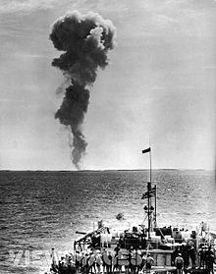 HMAS Murchison conscripts still seeking recognition as nuclear participants, SMH, Lucy Cormack April 24, 2016 – Ken Palmer remembers standing on the upper deck of the HMAS Murchison in 1952. Dressed with his fellow national serviceman in “shorts and sandals,” he remembers the mushroom cloud, formed from the explosion of Britain’s first atomic bomb at the Monte Bello archipelago, off Western Australia.
“They said, don’t face the blast and when I tell you, you can turn around. We had just left our mother’s breast, we didn’t think much about it,” said Mr Palmer, now in his 80s.
“When we got to Monte Bello it was a complete surprise to us. Nobody ever told us we were there . . . circling [to keep] everybody else out of the road until the climate was right to explode this atomic bomb in the bowels of the H.M.S. Plym.”
Mr Palmer is one of 23 surviving national serviceman of the 62 that were conscripted to serve on the Murchison in October 1952.
This Anzac Day Mr Palmer is hoping to reignite a long-running campaign of the surviving servicemen, seeking recognition as “Australian Participants” in the British government’s nuclear tests at the Monte Bello archipelago.The campaign was launched around eight years ago by the late Michael Rowe, who also served on the Murchison. He believed many of the cancers and illnesses suffered by his shipmate were related to nuclear radiation, following their time on the Murchison.
Mr Rowe began the campaign after a 2006 decision to award health care assistance to participants in Britain’s atomic bomb tests, with the exclusion of all serviceman on the Murchison, on grounds they were not close enough to the blast site.
Radiation exposure claims not accepted
A Department of Veterans’ Affairs spokesperson said Defence Force members who served on the Murchison could claim compensation and benefits under the Safety, Rehabilitation and Compensation Act for any condition, however any claim based on radiation exposure “would not be accepted.”………
Another national serviceman, Col Crawford, said “there was no denying we were there,” adding that he had given up the fight long ago, as it had become “complete and utter bureaucratic nonsense”.
Sandy Godfrey, who has assisted Mr Palmer and his fellow serviceman with their campaign over the years, said he cannot understand the “arbitrary” barriers being put up by the government.”The way the nuclear test participant has been defined in the Veterans Entitlement Act gives an arbitrary 10 kilometre radius, which excludes an enormous number of people that actually participated in the testing in the 50s,” he said.
“From our point of view it appears the government are waiting for them to die, so the issue will disappear.” http://www.smh.com.au/national/hmas-murchison-conscripts-still-seeking-recognition-as-nuclear-participants-20160422-gocy6r.html
Nuclear waste problems – USA waste management facility’s future in limbo
the DOE and Idaho Treatment Group have run into recent problems. A New Mexico waste repository where much of the waste needs to be sent remains closed after an accident last year. That means about
 20,000 ready-to-ship containers of waste have stacked up, with nowhere to go.
Looming deadline for nuclear waste plant, future in limbo , WT, By LUKE RAMSETH – Associated Press , April 24, 2016 IDAHO FALLS, Idaho (AP) – A darkened central control room with more than 25 computer screens watches over nearly everything occurring inside this radioactive waste treatment plant west of Idaho Falls.
The room is where employees at the Advanced Mixed Waste Treatment Project, or AMWTP, monitor and manipulate the facility’s dangerous waste treatment process from afar. Continue reading
Denmark once again breaks world record for wind power
 Denmark just broke its own wind power record for the second year in a row http://inhabitat.com/denmark-breaks-its-own-wind-power-production-record-two-years-in-a-row/ by Cat DiStasio, 18 Apr 16, VIEW SLIDESHOW
Australian govt might have to back down on its cuts to CSIRO climate research
 CSIRO eyes alternative plan to climate job cuts as Chairman Thodey faces inquiry, The Age, April 24, 2016 Peter Hannam Environment Editor, The Sydney Morning Herald CSIRO is expected to offer an alternative to deep cuts of its climate science program as soon as this week in a bid to defuse criticism as a Senate committee prepares to widen its inquiry to include chairman David Thodey.
Mr Thodey is scheduled to address the committee in Canberra on Wednesday. Unusually, the chairman has asked the session be held in camera and that he not be joined by CSIRO management, Fairfax Media has been told.
Speculation of a resolution was fanned by Environment Minister Greg Hunt last week breaking his silence on the cuts, which originally targeted as many as 110 of the 140 staff in the key Oceans & Atmosphere division……..
Instead, senior CSIRO staff now expect the agency to pare back the planned cuts and offer a “face-saving” alternative of a special climate unit, possibly headquartered in Hobart……http://www.theage.com.au/environment/climate-change/csiro-eyes-alternative-plan-to-climate-job-cuts-as-chairman-thodey-faces-inquiry-20160424-godtal.html.
Export industry potential for Victorian solar energy project, backed by Australian Renewable Energy Agency
 Victorian solar project wins government grant to take its technology to world, The Age, April 24, 2016 –Tom Arup A Victorian technology company striving to produce more efficient and cheaper solar power has won financial backing from the national renewable energy agency to expand its plans.
RayGen Resources, based in Melbourne, will receive a new $2.9 million government grant to help it commercialise what the company says is ground-breaking solar technology that has already received overseas interest.
The technology involves laying out a large array of mirrors that tracks the sun throughout the day and creates a concentrated light beam onto a highly efficient solar photovoltaic receiver sitting on top of a central tower.
In March last year, RayGen opened a 200-kilowatt pilot plant at Newbridge, near Bendigo, to showcase the technology, which the company has dubbed “PV Ultra”. The pilot was built with support from the Australian Renewable Energy Agency, also called ARENA.
The company has now won another ARENA grant, to be announced on Monday, to upgrade the Newbridge project with later versions of the technology and to bolster its solar receiver manufacturing operations at its Blackburn headquarters.
All up it is expected to cost $5.8 million and be completed by December.
RayGen chief executive Alex Wyatt said the expansion would help the company deliver its solar receivers to overseas buyers, including solar-concentrating projects in China.
The RayGen solar PV receivers use a compound called gallium arsenide, commonly used in satellites and space stations, instead of the more typical silicon-based technology. While gallium arsenide is more expensive than silicon, it is also more efficient and when enough sunlight is concentrated it can become cost effective to use, particularly in very sunny areas.
RayGen and ARENA were also partly involved in a 2014 project at the University of NSW, called Power Cube, which set a world record for converting sunlight into power for a solar PV system……
The Turnbull government recently announced it would retain ARENA, dropping Abbott-era plans to axe the agency. But it is seeking to slash the $1.3 billion that ARENA was still due to receive in coming years to help foster new renewable energy development. http://www.theage.com.au/environment/victorian-solar-project-wins-government-grant-to-take-its-technology-to-world-20160422-god18z.html
Canadian hospital’s large array of solar panels

 Port Alberni hospital has Vancouver Island’s largest array of solar power Solar power could help with high hydro rates during peak hours on hot days By Liam Britten, CBC News Apr 23, 2016
Who loves the sun? — turns out West Coast General Hospital in Port Alberni does. That building is home to 400 solar panels — the largest power-generating array on Vancouver Island, in fact.
The panels will be doing their work in the weeks and months ahead to see how much money Island Health Authority can save by using the power of the sun.
- Thompson Rivers University puts energy into solar powered walkway
- Vancouver roofing company starts offering solar panel installation
- Nelson’s ‘community solar garden’ starts leasing panels
“When it’s really hot and sunny and we’re using a lot of power to keep the hospital cool, the rates get very high with BC Hydro,” Deanna Fourt, director of energy efficiency and conservation with Island Health Authority told All Points West host Robyn Burns.
“So it’s going to work very nicely with the solar. This is what we’re thinking, because it’s going to be offsetting those really high-rate days or high-rate times.”……..http://www.cbc.ca/news/canada/british-columbia/vancouver-island-solar-power-1.3550022
Malcolm Turnbull – fine words, but actually retreating on climate action
 ‘Walking in the other direction’: Malcolm Turnbull’s broad retreat on climate, The Age April 22, 2016 Peter Hannam Environment Editor, The Sydney Morning Herald When Prime Minister Malcolm Turnbull rose to address the United Nations Climate Change Conference in Paris late last year, he told the world Australia would meet the challenges of global warming “with confidence and optimism”.
You don’t turn off R&D spending when there’s a revolution under wayAndrew Blakers, Centre for Sustainable Energy Systems, ANU
Australia’s carbon emissions target – slicing 2000 levels by about 19 per cent by 2030 – would halve pollution on a per capita basis, “one of the biggest reductions” of any G20 nation, Turnbull said. The government would also double “clean energy innovation” investment over the next five years, and carve out $1 billion from the existing aid budget to help threatened Pacific neighbours build “climate resilience” and cut emissions……….
The pact, which the government plans to ratify later this year if re-elected, aims to limit global temperature increases to between 1.5 and 2 degrees of pre-industrial levels – even if current national offers fall far short of the greenhouse gas reductions needed.
But in the four months since Turnbull’s speech, climate news from abroad and at home has been anything but positive………..
For policy areas directly under Turnbull’s control, it’s been a dismal few months for climate action, not least CSIRO’s assault on climate science launched on February 4 that will see dozens of leading researchers sacked among as many as 450 jobs to go.
Despite pleas of budget penury, the government somehow managed to find $15.4 million a couple of weeks later for a new Oil, Gas and Energy Resources Growth Centre to, among other things, “foster community support” for non-renewables, including coal and nuclear energy.
It is also forked out $3.3 million to two researchers to examine the effects of wind farms on health. Just four researchers made submissions for the cash, a remarkably small number, according to Sydney University public health expert, Simon Chapman.
Taken for granted
And a fresh concern surfaced this week with 61 leading scientists writing to Turnbull decrying the government’s decision last month to end grants from the Australian Renewable Energy Agency (ARENA).
Set up by the Rudd-Gillard government, the agency still had $1.3 billion in funding to disperse by 2022.
Instead, it will now work with the Clean Energy Finance Corp to offer $100 million in loans annually for 10 years to foster “clean and renewable energy”. ARENA still has $130 million to be allocated, with “high interest” from potential proponents, Hunt says.
The proposed end of ARENA’s grant funding removes “an essential component of technology innovation”, the mostly solar researchers said in the letter obtained by Fairfax Media.
Forty years of such grants over had allowed Australia to contribute “very far above its weight” in renewable energy. By contrast, reliance on equity returns “have rarely been effective” in advancing early-stage research, the scientists said.
Richard Corkish, chief operating officer of UNSW-based Australian Centre for Advanced Photovoltaics, said his facility faced “an existential threat” if the $4 million in annual ARENA funds ended. The school continues to spawn world-leading technology, including new types of solar cells using abundant, non-toxic materials.
“ARENA is our major funding source,” Corkish says.
Andrew Blakers, who led development of the solar PV technology being adopted by the world’s largest producers, said all new electricity investment in Australia over the past five years had been in solar or wind energy.
“This is incredible”, says Blakers, who heads the Centre for Sustainable Energy Systems at the Australian National University. “You don’t turn off R&D spending when there’s a revolution under way.”
………Greens deputy leader Larissa Waters said there’s “an obvious disconnect between the Prime Minster’s rhetoric in Paris last year and his actions in Canberra”.
“Presiding over cuts to CSIRO’s world-leading climate research and gutting renewable technology research is stupid on so many levels.
“The government is tipping new money into fossil fuel research so that the big mining companies profiting off the world’s warming don’t have to pay for research themselves,” Waters says……..http://www.theage.com.au/environment/climate-change/walking-in-the-wrong-direction-malcolm-turnbulls-broad-retreat-on-climate-20160420-goat2p.html
Australia needs action, not just Turnbull’s words, to save the Great Barrier Reef
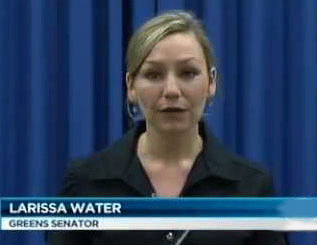 Climate deal won’t stop Great Barrier Reef from getting ‘cooked’, say Greens, Guardian, 23 Apr 16 Australia’s lack of action on pollution reduction targets has made the country a laughing stock on the international stage, according to senator Larissa Waters Australia’s lack of follow-through on climate change will leave the Great Barrier Reef “completely cooked” despite it signing the Paris climate deal, the Greens say…….
“Unfortunately, minister Hunt likes to bandy about some figures but Australia has been a laughing stock on the international stage,” she said.
“Our pollution reduction targets are so far below the science and people know that our policies aren’t even getting us towards those very low targets.”
Senator Waters rejected the government’s commitment of a further $11m on projects to continue improving water quality on the Great Barrier Reeffollowing a study this week showing 93% of the reef was bleached.
She pointed to the Queensland and federal government’s backing of the Adani coal mine, which critics say will further imperil the reef. “We need to really have a change of policy when it comes to approving every coal mine anyone ever thinks of and instead really fund and support the transition and speed it up to clean-energy,” Senator Waters said. http://www.theguardian.com/environment/2016/apr/23/climate-deal-wont-stop-great-barrier-reef-from-getting-cooked-say-greens
Solar-power plane flies across Pacific, arrives in California
Solar-powered plane reaches California after journey across Pacific Mashable Australia, BY THE ASSOCIATED PRESS , 24 Apr 16, MOUNTAIN VIEW, Calif. — A solar-powered airplane landed in California on Saturday, completing a risky, three-day flight across the Pacific Ocean as part of its journey around the world.
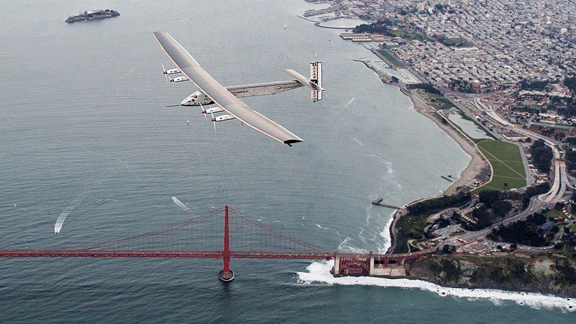
Pilot Bertrand Piccard landed the Solar Impulse 2 in Mountain View, south of San Francisco, at 11:45 p.m. local time following a 62-hour, nonstop solo flight without fuel. The plane taxied into a huge tent erected on Moffett Airfield where Piccard was greeted by project’s team……..
The trans-Pacific leg was the riskiest part of the plane’s global travels because of the lack of emergency landing sites…….http://mashable.com/2016/04/24/solar-impulse-2-california/#gwzcbJ_OIkq3
IN USA Republicans are turning to renewable energy
 Republicans Are Warming Up to Renewable Energy , Bloomberg, Joe Ryan April 21, 2016
- Some Republicans embrace renewables as Paris accord signed
-
They argue that jobs and cost cuts make renewables attractive
-
“……..The leading Republican candidates for president, Donald Trump and Sen. Ted Cruz, reject any role of humans in global warming, as do most party leaders. But a small and growing number of once-skeptical Republicans is embracing wind and solar. They see the clean energy sources delivering cheap electricity, bolstering America’s energy independence and fueling economic development in impoverished rural areas.
-
In turn, renewables are adding jobs in North Carolina, Georgia and Texas and other conservative states, creating a formidable clean-energy constituency in a party whose energy mantra was “drill, baby drill.”…..
- Past Support
Support for clean energy is not new for all U.S. Republicans. Some conservative state lawmakers in Iowa, Texas and elsewhere have long promoted it. When he was governor of Texas, George W. Bush pushed through legislation requiring utilities to buy renewable power, leading to widespread development of wind farms.
Republican enthusiasm is based largely on economics, not climate science, and does not necessarily translate into support for the Paris agreement or other efforts to curb greenhouse gases. Continue reading
Wind Power Investment in USA Economy More Than $128 Billion
 By staying on track to supply 20 percent of U.S. electricity by 2030, wind energy could support 380,000 well-paying jobs, according to the U.S. Department of Energy. That number could grow to 600,000 by supplying 35 percent by 2050
More Than $128 Billion Dollars Invested in U.S. Economy by New Wind Power Projects, Wind Systems, 25 Apr 16 Building new wind farms in the U.S. added $13 billion per year on average to the American economy over the past five years, according to information recently released by the American Wind Energy Association (AWEA).
“By building new wind farms across the country throughout the past decade, wind companies have invested $128 billion into the U.S. economy,” said Tom Kiernan, CEO of AWEA. “Over this time, wind has rapidly scaled-up. Now, there is enough wind power installed to reliably produce electricity for more than 19 million American homes. Continuing to invest in world-class wind resources here at home will help keep our lights on, grow state economies, and keep more money in the pockets of homeowners and businesses.” Continue reading
India’s highly ambitious solar energy targets
India Sets Target Of 48 GW Solar Power Capacity By March 2019, Clean Technica April 23rd, 2016 by Saurabh Mahapatra Originally published on PlanetSave.
Highly ambitious annual solar power capacity addition targets have been announced by the Indian Ministry of New & Renewable Energy.
With a target to have an operational solar power capacity of 100 GW by March 2022, the Indian government has announced annual capacity addition targets for the next few years. The Ministry of New & Renewable Energy (MNRE) plans to add 15 GW and 16 GW solar power capacity in the financial years 2017-18 and 2018-19, respectively.
In the current financial year, the government targets an addition of 12 GW solar power capacity. If this target is achieved, India’s installed solar power capacity will cross 17 GW by the end of March 2017. By early March this year more than 5.7 GW of solar power capacity was operational in India…….
India is also in talks with development banks like the Asian Development Bank, International Finance Corporation, KfW, the Japan International Cooperation Agency, and the New Development Bank to access cheap debt finance for setting up solar power projects. https://cleantechnica.com/2016/04/23/101231/
1 This month
Chernobyl: The Lost Tapes – A good documentary on Chernobyl on SBS available On Demand for the next 3 weeks– https://www.sbs.com.au/ondemand/tv-program/chernobyl-the-lost-tapes/2352741955560
15 April – Zoom –Nuclear Power is Not the Solution
Apr 15, 2026 01:00 AM in Canberra, Melbourne, Sydney

Join the International Physicians for the Prevention of Nuclear War (IPPNW) on Tuesday, April 14th for a timely webinar exploring the risks associated with nuclear power and challenging the myth that it offers a simple, safe, carbon-free solution to the climate crisis

21 April Webinar: No Nuclear Weapons in Australia
Start: 2026-04-21 18:00:00 UTC Canberra, Melbourne, Sydney (GMT+10:00)
End: 2026-04-21 19:30:00 UTC Canberra, Melbourne, Sydney (GMT+10:00)
Event Type: Virtual
A virtual link will be communicated before the event.
Host Contact Info: australia@icanw.org

of the week – Australians for War Powers Reform (AWPR)
To see nuclear-related stories in greater depth and intensity
 Antinuclear