30th Anniversary of Chernobyl – Time for South Australia to think about our future
 26th April 2016 “As South Australians toy with the idea of further entrenching ourselves in the nuclear industry, the 30th anniversary of the Chernobyl nuclear disaster is a stark and sobering reminder of the dangers inherent in this industry,” says Mark Parnell MLC, Parliamentary Leader of the Greens SA.
Today is the 30th anniversary of the disaster at the Chernobyl nuclear power plant in Ukraine. This remains one of the worst nuclear accidents in history and three decades later, is still unresolved.
According to the International Atomic Energy Agency (IAEA), the accident released approximately 400 times more radioactive fallout than that of the atomic bomb dropped on Hiroshima, Japan, in 1945.
In 2011, the United Nations Scientific Committee on the Effects of Atomic Radiation (UNSCEAR) published a report entitled “Health effects due to radiation from the Chernobyl accident”. According to this report, the Chernobyl accident caused a number of severe radiation effects almost immediately and the effects are ongoing.
The magnitude of this disaster:
•Of the 600 workers present on the site during the early morning of 26 April 1986, 134 received very high doses of radiation and suffered from acute radiation sickness. Of those, 28 workers died in the first three months.
•350,000 people have been relocated away from the reactor site.
•4.5 million people still live on contaminated land.
•600,000 registered recovery operation workers have been engaged in firefighting, burying radioactive waste, constructing a “sarcophagus” around the plant to contain radiation and other related tasks.
•The original “sarcophagus” is failing and a new “safe confinement” structure costing $3 Billion is being built. That too will eventually need to be replaced.
•The World Health Organisation reports increased rates of thyroid cancer & leukaemia in affected communities.
“As we remember the victims of Chernobyl, it is timely to consider South Australia’s future involvement in this dangerous industry.
“With the Royal Commission’s final report due next week, South Australians should ask themselves whether the best our State can aspire to is becoming the world’s nuclear waste dump?” asks Mr Parnell.
Australia’s new submarines a liability
 Everything wrong about Malcolm Turnbull’s submarine decision, AFR Apr 26 16 French to build Australia’s new submarines, by Brian Toohey The choice of a French-designed submarine is fine in principle, even if a German one could have been better.
Other than that, everything is wrong about the Turnbull government’s decision to build 12 extremely large submarines in Adelaide.
The decision embraces a long-discredited protectionist industry policy that will add billions of dollars to the cost. The government’s refusal to go with an off-the-shelf design will cost more billions, because the first of new submarines won’t be operational until after 2030 and the last until almost 2060.
This means the decrepit Collins class submarines will have to be kept going for more than 20 years beyond their planned 2025 retirement date – necessitating new capital spending and very high maintenance and operating costs that will soon pass $1 billion a year.
The Collins Class submarine is due to be retired by 2030. supplied
Bizarrely, the Turnbull government has decided that the Adelaide shipyard, which built the six Collins submarines, will now build 12 much bigger submarines and nine frigates that will be far larger than the existing Anzac class, which has served the nation well.
The new frigates will be even bigger than the three air warfare destroyers that the shipyard is building now. These are late and over budget, yet the government trusts this shipyard to build submarines costing $50 billion and frigates about $35 billion.
Where were Scott Morrison and Mathias Cormann when this decision was taken? The government’s estimates of the added costs of local construction shows it will take more than $20 billion more simply to try to win a couple of Coalition seats in Adelaide.
CHEAPER WAYS TO WIN VOTES There are much cheaper ways to win votes, yet the Treasurer and the Finance Minister stress their dedication to cutting spending….
If there is some other advantage in buying submarines that will be double the size of proven off-the-shelf options, the massive extra cost needs to be assessed against the marginal increment, if any, in overall capability.
EASIER TO DETECT The recently retired US Navy Chief Admiral Jonathan Greenert has warned repeatedly that rapid advances in computing power and sensors make it easier to detect and destroy big submarines and frigates that will cost Australia $85 billion – without cost blowouts or delays.
US Defence Secretary Ashton Carter outlined recently US developments in sub-surface drones that are particularly important for shallow water in Australia’s region. China is doing likewise. Australia’s new submarines won’t be fully operational until long after their size becomes a liability.
Defence is the only large department that is effectively exempt from Treasury and Finance scrutiny, even though taxpayers would benefit greatly from sharper cost-effectiveness studies.
The 2003 Kinnaird procurement review recommended Finance in particular should play a bigger part. It hasn’t done so, yet there is probably no other big budget item than defence where spending is such a poor indicator of outcomes…….http://www.afr.com/news/politics/election/everything-is-wrong-about-malcolm-turnbulls-submarine-decision-20160426-goez6s?&utm_source=social&utm_medium=twitter&utm_campaign=nc&eid=socialn:twi-14omn0047-optim-nnn:nonpaid-27062014-social_traffic-all-organicpost-nnn-drive-o&campaign_code=nocode&promote_channel=social_twitter
Radioactivity has seriously harmed wildlife at Chernobyl and Fukushima
 At Chernobyl and Fukushima, radioactivity has seriously harmed wildlife, The Conversation, Timothy A. Mousseau April 25, 2016 “…..Radioactive cesium from Chernobyl can still be detected in some food products today. And in parts of central, eastern and northern Europe many animals, plants and mushrooms still contain so much radioactivity that they are unsafe for human consumption…….
Our studies provide new fundamental insights about consequences of chronic, multigenerational exposure to low-dose ionizing radiation. Most importantly, we have found that individual organisms are injured by radiation in a variety of ways. The cumulative effects of these injuries result in lower population sizes and reduced biodiversity in high-radiation areas.
Broad impacts at Chernobyl
Radiation exposure has caused genetic damage and increased mutation rates in many organisms in the Chernobyl region. So far, we have found little convincing evidence that many organisms there are evolving to become more resistant to radiation.
Organisms’ evolutionary history may play a large role in determining how vulnerable they are to radiation. In our studies, species that have historically shown high mutation rates, such as the barn swallow (Hirundo rustica), the icterine warbler (Hippolais icterina) and the Eurasian blackcap (Sylvia atricapilla), are among the most likely to show population declinesin Chernobyl. Our hypothesis is that species differ in their ability to repair DNA, and this affects both DNA substitution rates and susceptibility to radiation from Chernobyl.
Much like human survivors of the Hiroshima and Nagasaki atomic bombs, birds and mammals at Chernobyl have cataracts in their eyes andsmaller brains. These are direct consequences of exposure to ionizing radiation in air, water and food. Like some cancer patients undergoing radiation therapy, many of the birds have malformed sperm. In the most radioactive areas, up to 40 percent of male birds are completely sterile, with no sperm or just a few dead sperm in their reproductive tracts during the breeding season.
Tumors, presumably cancerous, are obvious on some birds in high-radiation areas. So are developmental abnormalities in some plants and insects.
Given overwhelming evidence of genetic damage and injury to individuals, it is not surprising that populations of many organisms in highly contaminated areas have shrunk. In Chernobyl, all major groups of animals that we surveyed were less abundant in more radioactive areas. This includes birds, butterflies, dragonflies, bees, grasshoppers, spiders and large and small mammals.
Not every species shows the same pattern of decline. Many species, including wolves, show no effects of radiation on their population density. A few species of birds appear to be more abundant in more radioactive areas. In both cases, higher numbers may reflect the fact that there are fewer competitors or predators for these species in highly radioactive areas.
Moreover, vast areas of the Chernobyl Exclusion Zone are not presently heavily contaminated, and appear to provide a refuge for many species. One report published in 2015 described game animals such as wild boar and elk as thriving in the Chernobyl ecosystem. But nearly all documented consequences of radiation in Chernobyl and Fukushima have found that individual organisms exposed to radiation suffer serious harm.
There may be exceptions. For example, substances called antioxidants can defend against the damage to DNA, proteins and lipids caused by ionizing radiation. The levels of antioxidants that individuals have available in their bodies may play an important role in reducing the damage caused by radiation. There is evidence that some birds may have adapted to radiation by changing the way they use antioxidants in their bodies.
Parallels at Fukushima
Recently we have tested the validity of our Chernobyl studies by repeating them in Fukushima, Japan. The 2011 power loss and core meltdown at three nuclear reactors there released about one-tenth as much radioactive material as the Chernobyl disaster.
Overall, we have found similar patterns of declines in abundance and diversity of birds, although some species are more sensitive to radiation than others. We have also found declines in some insects, such as butterflies, which may reflect the accumulation of harmful mutationsover multiple generations.
Our most recent studies at Fukushima have benefited from more sophisticated analyses of radiation doses received by animals. In our most recent paper, we teamed up with radioecologists to reconstruct the doses received by about 7,000 birds. The parallels we have found between Chernobyl and Fukushima provide strong evidence that radiation is the underlying cause of the effects we have observed in both locations.
Some members of the radiation regulatory community have been slow to acknowledge how nuclear accidents have harmed wildlife. For example, the U.N.-sponsored Chernobyl Forum instigated the notion that the accident has had a positive impact on living organisms in the exclusion zone because of the lack of human activities. A more recent report of the United Nations Scientific Committee on the Effects of Atomic Radiation predicts minimal consequences for the biota animal and plant life of the Fukushima region.
Unfortunately these official assessments were largely based on predictions from theoretical models, not on direct empirical observations of the plants and animals living in these regions. Based on our research, and that of others, it is now known that animals living under the full range of stresses in nature are far more sensitive to the effects of radiation than previously believed. Although field studies sometimes lack the controlled settings needed for precise scientific experimentation, they make up for this with a more realistic description of natural processes.
Our emphasis on documenting radiation effects under “natural” conditions using wild organisms has provided many discoveries that will help us to prepare for the next nuclear accident or act of nuclear terrorism. This information is absolutely needed if we are to protect the environment not just for man, but also for the living organisms and ecosystem services that sustain all life on this planet……https://theconversation.com/at-chernobyl-and-fukushima-radioactivity-has-seriously-harmed-wildlife-57030
Indoor playgrounds give relief to Fukushima families, in irradiated areas.
Fukushima Parents Find Relief From Radiation At Indoor Playgrounds http://voices.nationalgeographic.com/2016/04/25/fukushima-parents-find-relief-from-radiation-at-indoor-playgrounds/ by Ari Beser in Fulbright National Geographic Stories on April 25, 2016 FUKUSHIMA, Japan—One of the biggest health problems facing Fukushima after the 2011 nuclear disaster are not directly caused by radiation exposure.
Instead, it’s the fear of exposure that has driven rates of childhood obesity in the past five years, according to the Director of Internal Medicine, Dr. Sae Ochi, M.D. who has spent the last five years researching the social impact of the nuclear disaster.
Parents who are worried about their children being exposed to radiation have discouraged them from playing outside, which has led to more sedentary activities among Fukushima youth.
Their fears are not unfounded. For one, radiation levels have decreased in the prefecture, but not disappeared entirely, according to safecast, the citizen science radiation monitoringprogram.
And children are most susceptible to radiation exposure, according to the American Thyroid Association. It can cause underactive thyroids, thyroid nodules, and even cancer in kids.
“Its not that the parents shouldn’t fear radiation,” says Ochi, “it’s just that radiation concerns have led to unhealthy practices, when it should be the opposite. People living in areas where radiation lingers should take steps to eat healthier, to move more to combat their exposure. Instead we are seeing the opposite. In lieu of eating vegetables, even vegetables from outside Fukushima, people are eating processed junk food, and fast foods, and staying at home at developing sedentary lifestyles.”
Though radiation-related problems may take years to manifest in children, the consequences of a lack of exercise and physical exertion are immediate.
Enter PEP Kids Koriyama, a free, publicly funded indoor playground 40 miles (64 kilometers) west of the crippled nuclear reactor in the city of Koriyama, where parents can let their kids loose without the threat of radiation. Continue reading
South Australia’s pro nuclear tourists picked a bad day to visit Finland.
Protesters break into Finnish-Russian nuclear site, Reuters, 26 Apr 16, Anti-nuclear protesters broke in to a construction site on Tuesday for a nuclear reactor to be supplied by Russia’s state-owned nuclear firm Rosatom, choosing the 30th anniversary of the Chernobyl disaster for their demonstration…….
 with anyone with that kind of history,” Venla Simonen from the Stop Fennovoima protest group told Reuters by telephone…….
The Chernobyl disaster increased radiation levels in Finland, putting nuclear Finnish plant projects on ice for a decade.
This latest project has raised concerns and resistance from many Finns as the plant is set to forge deeper energy ties between EU state Finland and its former ruler Russia despite East-West tensions over the Ukraine crisis.
Rosatom has a 34 percent stake in the 7 billion euro ($7.9 billion) project. It will supply the reactor and also handle the project’s financing.
Fennovoima struggled to find local investors to fulfill an ownership condition set by the Finnish government, but utility Fortum last year signed up in a surprise move, prompting questions of political pressure from both countries involved…….http://www.reuters.com/article/us-finland-fennovoima-protests-idUSKCN0XN1TH
Nuclear lesson: ‘If you can’t bring the community with you, don’t bother‘ IN DAILY 26 Apr 16 A high-powered delegation of the state’s business and political leaders has been given a crash course in the science of nuclear storage in Finland, and the biggest single message it has learned is the value of keeping the community onside. Tom Richardson InDaily revealed last month that the self-funded working party would undertake a tour of nuclear sites across Europe ahead of nuclear fuel cycle royal commissioner Kevin Scarce’s final report next month.
They touched down in Finland over the long weekend and toured the Olkiluoto Nuclear Power Plant overnight, Australian time, along with the adjoining Onkalo spent nuclear fuel repository being constructed nearby.
Business SA chief executive Nigel McBride told InDaily the tour group was taken 60 metres underground into the bedrock of the existing low to medium waste facility and viewed a model of the planned high-level repository – which will be 420 metres deep………
Matt Clemow, general manager of the Committee for Adelaide, who organised the delegation, said the first day of the tour gave him “a great deal of confidence” that it was a worthwhile exercise.
“We’ve had the joint venture partners present to us this morning… they consider the community’s acceptance of the nuclear fuel industry to be an everyday exercise – and an ongoing exercise – to ensure that people continue to have that community acceptance that it’s safe and provides economic benefits,” he said……
McBride noted a cultural distinction, given the Finns “believe that because they use nuclear power it’s their responsibility to deal with the waste”.
“They’ve changed the law so they can no longer export nuclear waste – they believe it’s their duty to deal with it,” he said…….http://indaily.com.au/news/2016/04/26/nuclear-lesson-if-you-cant-bring-the-community-with-you-dont-bother/ @tomrichardson
UKraine cannot afford massive costs of containing shattered Chernobyl nuclear reactor
Nuclear comeback: Funding fears for hi-tech lid on Chernobyl, The Australian NATHAN HODGE THE WALL STREET JOURNAL APRIL 26, 2016″………A workforce of about 2500 people is finishing a massive steel enclosure that will cover Chernobyl’s reactor 4, where the radioactive innards of the nuclear plant are encased in a concrete sarcophagus hastily built after the disaster. The zone is now aglow with the reflective safety vests of construction workers.
If all goes to plan, the new structure — an arch 260m wide, 165m long and 110m high — will be slid into place late next year over the damaged reactor and its nuclear fuel, creating a leak-tight barrier designed to contain radioactive substances for at least the next 100 years.
The project, known as the New Safe Confinement, is a feat of engineering. It will take two or three days to slide the 36,000- tonne structure into place. The arch, which looks something like a dirigible hangar, is large enough to cover a dozen football fields.
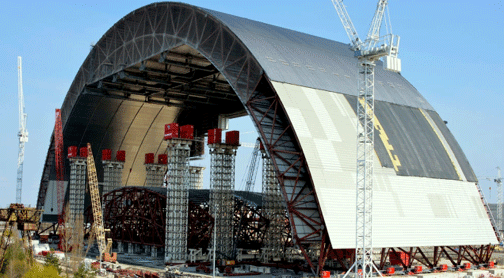
“You could put Wembley Stadium underneath here, with all the car parks,” said David Driscoll, the chief safety officer for the French consortium running the construction site.
- …….
Nicolas Caille, project director for Novarka, the consortium of Vinci and Bouygues, the French contractors running the project, said about 1000 people worked on a typical shift at the construction site, keeping to a schedule of 15 days in and 15 out.
The €2.15 billion ($3.1bn) shelter installation plan has been funded by international donors and the European Bank for Reconstruction and Development, a non-profit lending institution. But the Chernobyl clean-up faces a shortfall: €100 million is needed to finish a storage facility for highly radioactive spent nuclear fuel from the other three reactors, all now offline
The EBRD’s spent fuel facility contract is with a US-based energy technology firm. When the dollar-denominated contract was signed, the euro was stronger against the greenback; with the two currencies approaching parity, the bank faces a shortfall.
“This has dug a huge euro hole,” said Vince Novak, director of the nuclear safety department for the EBRD. “Our income is in euros.”
Mr Novak said donors would meet by the end of this month to discuss financing to finish the project, which is financed separately from the Chernobyl shelter fund.
Spent fuel rods are stored in an ageing facility.
Completion of the project, Mr Novak said, “has always been somehow in the shadow of the New Safe Confinement because it is not as attractive, not as sexy. But it is equally important in terms of nuclear safety.
Even if donors plug the gap, Chernobyl will continue to pose a financial challenge for Ukraine.
More than 40 countries and the EBRD have contributed to the Chernobyl containment work, and international donors say it will be years before the Kiev government can take on the larger share of the burden. http://www.theaustralian.com.au/business/wall-street-journal/nuclear-comeback-funding-fears-for-hitech-lid-on-chernobyl/news-story/1df7b13de774a981f1063ac3c62e9a36
Australian govt continues to ignore indigenous calls for safety review of uranium industry
30 years after Chernobyl, Australia still hasn’t learned to leave uranium in the ground, Guardian, 26 Apr 16 Josephine Vallentine
When they visited Australia in 1997, Chernobyl victims were left in no doubt Indigenous communities wanted uranium left safely in the ground – but the government continues to sign deals to dig it up “……In 1997, two people from the Chernobyl affected area came to Australia for a 55-day pilgrimage, visiting Indigenous communities, proposed uranium mine sites and operating uranium mines. The interaction between people who had suffered the effects of the nuclear industry and those whose lands are rich in uranium, but who don’t want it to hurt people in other places, was poignant.
It was very moving to witness the sadness felt by Indigenous Australians, when pictures drawn by children depicting scenes before and after “the event” were shown..
Our Russian friends were left in no doubt that Aboriginal communities wanted the uranium to stay safely in the ground, undisturbed. And pilgrims from various countries were left in no doubt that the poison fire emanating from Chernobyl’s stricken reactors, would continue to wreak its havoc for untold years to come.
Now, 30 years later, it is deeply disappointing to note that the foreign affairs minister has signed a deal to sell uranium to Ukraine. The Ukraine nuclear reactors are reaching the end of their designed life, adding to the already high level of risk. In the ongoing political tensions between Russia and Ukraine, Australia has been playing favourites with uranium supplies – first banning uranium sales to Russia then quickly opening negotiations for a uranium supply deal with Ukraine.
Last month at the Nuclear Security Summit in Washington DC, terrorism threats and nuclear weapons were the major focus, but this summit was snubbed by nuclear weapons countries Russia and Pakistan. Whether it be from reactors or bombs, or a total absence of being able to deal with contaminated waste, or the use of so-called “depleted uranium” in war zones, the nuclear industry poses an enormous risk. Rather than pausing to reflect on Australia’s role in this toxic trade we have seen deal after deal to supply uranium, often criticised by experts.
The Australian government has consistently ignored such calls for a review of the safety and compliance and costs of this sector. Instead, Australia has pushed ahead – against advice from senior Australian bureaucrats – to sign a uranium supply deal with India, a country that has a nuclear weapons program and is not a signatory to the Nuclear Non-Proliferation Treaty.
Australia has also signed a deal to supply uranium to the United Arab Emirates. For an industry that is in the doldrums with its product worth less than US$30 per pound, with unsafe reactors getting old and more dangerous, with new reactors on hold due to cost blowouts and time delays, it is unwarranted that the Australian government should give it so much support. http://www.theguardian.com/commentisfree/2016/apr/26/30-years-after-chernobyl-australia-still-hasnt-learned-to-leave-uranium-in-the-ground
Chernobyl’s legacy and Australia’s uranium
That was then, this is now: Chernobyl’s legacy and Australia’s uranium, Online Opinion,
| By Dave Sweeney 26 April 2016 |
It is now thirty years since radiation monitoring stations in Sweden detected a massive surge in airborne contaminants and Western intelligence satellite images showed something unusual happening at a Ukrainian nuclear complex.
Not long after an ashen faced Michal Gorbachev, the President of an increasingly disunited Soviet Union, introduced the world to a new name with confirmation of an uncontrolled fire, nuclear meltdown and massive radiation release at Chernobyl.
Without a hint of irony the Australian government is marking this anniversary with a plan to open up uranium sales to the country that hosted this continuing warning about the dangers of the nuclear industry……..
A detailed new report prepared to mark the thirtieth anniversary highlights increased thyroid cancers, leukaemia and solid cancers among clean-up workers and others and elevated levels of nervous system birth defects. Five million people in Belarus, Ukraine and Russia still live in highly contaminated areas with a further 400 million living in regions with a continuing radioactive fingerprint.
Extensive construction and confinement work continues at Chernobyl today. The centre-piece of these efforts is around a massive new concrete shield to replace the current embrittled ‘sarcophagus’ erected over the failed reactor to stop further radioactive release.
Against this backdrop ‘adventure tourists’, independent journalists and radiation monitoring teams in the exclusion zone witness the visible return of animals and vegetation and monitor the silent continuation of radioactive contamination.
The thirtieth anniversary has also seen increased international attention on the current parlous state of Ukraine’s nuclear sector – an issue of great relevance to Australia as Foreign Minster Julie Bishop inked a deal to supply uranium to Ukraine earlier this month.
The country that fuelled Fukushima supplying uranium to the land that gave the world Chernobyl is hardly a match made in heaven and deserves far more scrutiny.
There are serious and unresolved safety, security, governance and performance issues facing Ukraine’s nuclear sector.
Ukraine has fifteen nuclear reactors – four are currently running past their design lifetime while six more reach this date in 2020. So two thirds of the Ukraine’s aging nuclear fleet will be past its use by date in four short years, with all the increased risk this involves. Civil society groups and neighbouring nations have expressed deep concerns over plans to extend the reactors operations and Ukraine’s approach has seen the nation in breach of international agreements regarding transboundary environmental impact assessment.
The recent G7 foreign ministers meeting in Japan identified the conflict in Ukraine as one of the key reasons for increased global nuclear insecurity and tension. There have been armed incursions by pro-Russian militia forces into Ukrainian nuclear facilities and these have been described by some commentators as pre-deployed nuclear targets.
Two years ago Australia prudently suspended uranium sales to Russia because of this conflict. It makes scant sense now to fuel further nuclear instability in this troubled region by starting sales to Ukraine.
The thirtieth anniversary of Chernobyl is an important reminder of the risks and dangers of the nuclear sector. It is not a time to ignore important lessons in a bid to advance risky and radioactive uranium sales. http://www.onlineopinion.com.au/view.asp?article=18189&page=0
1 This month
7 April – WEBINAR – Australia and the Doomsday Clock – Preventing nuclear war through NoFirstUse and other policies
Online | Tuesday April 7, 4:00-5:30pm, Australian Eastern Time / 8:00-9:30am Central Europe Time
– Access the registration link
15 April – Zoom –Nuclear Power is Not the Solution
Apr 15, 2026 01:00 AM in Canberra, Melbourne, Sydney

Join the International Physicians for the Prevention of Nuclear War (IPPNW) on Tuesday, April 14th for a timely webinar exploring the risks associated with nuclear power and challenging the myth that it offers a simple, safe, carbon-free solution to the climate crisis

21 April Webinar: No Nuclear Weapons in Australia
Start: 2026-04-21 18:00:00 UTC Canberra, Melbourne, Sydney (GMT+10:00)
End: 2026-04-21 19:30:00 UTC Canberra, Melbourne, Sydney (GMT+10:00)
Event Type: Virtual
A virtual link will be communicated before the event.
Host Contact Info: australia@icanw.org

of the week – Australians for War Powers Reform (AWPR)
To see nuclear-related stories in greater depth and intensity
 Antinuclear