Australia – free of coal-fired electricity by 2030 – it can be done
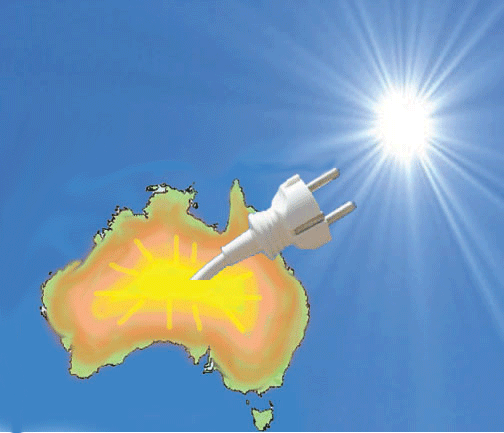 How Australia can eliminate coal-fired electricity by 203 0 Canberra Times, May 26 2016 Andrew Blakers Australia has agreed to limit global temperature rise to “well below” 2 degrees Celsius. The replacement of fossil fuels with renewable energy sources will be much easier, quicker and cheaper than many people realise because the technologies required – solar photovoltaics (PV), wind power and pumped hydro energy storage (PHES) – are affordable and are already deployed on a large scale.
PV and wind energy are price competitive with new-build fossil and nuclear power in most parts of the world, and price reductions continue. PV and wind constitute all new electrical generation capacity installed in Australia, and half of new generation capacity installed each year worldwide, more than fossil, nuclear and hydro power combined.
PV and wind are being installed at 20 times the annual rate worldwide of all other non-hydro renewables combined. Other low emission energy technologies will require heroic technical breakthroughs and growth rates to catch up.
However, PV and wind are variable energy sources, depending upon the wind and the sun. Fortunately, an electricity grid dominated by PV and wind will still be reliable. For example, South Australia has no coal or hydro-electric generation, and soon will derive 50 per cent of its annual electricity from PV and wind. It is connected to Victoria with cables of limited capacity, and yet retains grid stability.
The variability of PV and wind can be readily managed. Firstly, the combined output of millions of PV and wind generators is predictable. Secondly, wind and PV often produce under different weather conditions: storms favour wind while calm conditions are often sunny. Thirdly, dispersion of millions of PV and wind generators across Australia reduces the effect of local weather systems. Rapid improvements in high voltage DC transmission (HVDC) allows gigawatts of power to be transmitted over many thousands of kilometres at modest cost with losses of only 10 per cent.
In addition, load management allows interruptible loads such as water heating to be moved from nighttime to daytime. Plus, existing hydro and gas generators, operating for only a small fraction of the year, can fill remaining gaps in supply………
PV, wind, HVDC and PHES are energy solutions that allow rapid and deep greenhouse gas emission reductions while retaining grid stability. Because they are already in large-scale deployment globally, no heroic growth projections or technical breakthroughs are required. A simple doubling of the current deployment rate of PV and wind would allow Australia to eliminate coal and reach 80 per cent renewable electricity by 2030, yet retain grid stability.
Andrew Blakers is professor of engineering at the Australian National University, specialising in photovoltaics and renewable energy integration. http://www.canberratimes.com.au/comment/how-australia-can-eliminate-coalfired-electricity-by-2030-20160524-gp2j3k.html
No comments yet.
1 This month
7 April – WEBINAR – Australia and the Doomsday Clock – Preventing nuclear war through NoFirstUse and other policies
Online | Tuesday April 7, 4:00-5:30pm, Australian Eastern Time / 8:00-9:30am Central Europe Time
– Access the registration link
15 April – Zoom –Nuclear Power is Not the Solution
Apr 15, 2026 01:00 AM in Canberra, Melbourne, Sydney

Join the International Physicians for the Prevention of Nuclear War (IPPNW) on Tuesday, April 14th for a timely webinar exploring the risks associated with nuclear power and challenging the myth that it offers a simple, safe, carbon-free solution to the climate crisis

21 April Webinar: No Nuclear Weapons in Australia
Start: 2026-04-21 18:00:00 UTC Canberra, Melbourne, Sydney (GMT+10:00)
End: 2026-04-21 19:30:00 UTC Canberra, Melbourne, Sydney (GMT+10:00)
Event Type: Virtual
A virtual link will be communicated before the event.
Host Contact Info: australia@icanw.org

of the week – Australians for War Powers Reform (AWPR)
To see nuclear-related stories in greater depth and intensity
 Antinuclear
Leave a comment