Rum Jungle still polluted 45 years after uranium mine was closed
Rum Jungle uranium mine in NT polluting environment 45 years after closure, ABC Radio The World Today By Sara Everingham Traditional owner Kathy Mills finds every visit to site of the old Rum Jungle uranium mine upsetting.
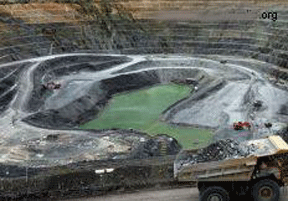
The site, 100 kilometres south of Darwin, is overrun with scrubby weeds, there are two abandoned mining pits, large mounds of waste rock and the water in a diverted channel of the Finniss River is tinged orange and brown from contamination.
But the great-grandmother wants to show people around in the hope it will help her family’s long battle to have the site rehabilitated.
“It has just been lingering on and on and on and many of my people have passed on and I am almost the last man standing in that people who fought for recognition of this land,” she said.
Ms Mills wants the Commonwealth to “hurry up” and rehabilitate the Rum Jungle mine — a Commonwealth-backed venture that produced uranium for the nuclear weapons programs of the US and British governments.
The mine closed 45 years ago but acid and metals are draining into the environment and the site remains off limits to the public including traditional owners.
This month’s federal budget had $11 million for the NT Government to put the finishing touches on a plan for rehabilitation.
Ms Mills said she was running out of time to see Rum Jungle fixed.
Mine took away ‘aspect of land’s importance’
When Rum Jungle was developed traditional owners had no say in it.
One mining pit was dug into a sacred women’s site on the east branch of the Finniss River and the flow of the river was diverted for one kilometre. Ms Mills vividly remembers the anger of one of her older relatives when he saw for the first time how the mine had transformed the land.
“It took away the whole aspect of the importance of that land,” she said.
But in the early 1950s the Commonwealth saw uranium as an opportunity to develop the north.
At the time, Rum Jungle was a major industrial development in northern Australia.
The then prime minister Robert Menzies came to the Top End to open it.
Notorious for environmental problems
When mining finished at Rum Jungle in 1971, no rehabilitation was done and the site became notorious for its environmental problems.
In the early 1980s, the Rum Jungle site could not be handed over to traditional owners as part of the successful Finniss River Land claim in case they became liable for the environmental problems.
The Commonwealth spent $18 million on rehabilitation in the 1980s but some of the work did not last.
At Rum Jungle, scientists from the NT Government are monitoring contamination in the Finniss River…….http://www.abc.net.au/news/2016-05-30/rum-jungle-uranium-mine-in-nt-polluting-environment-45-years-on/7460666
Australian Conservation Foundation’s environment election scorecard
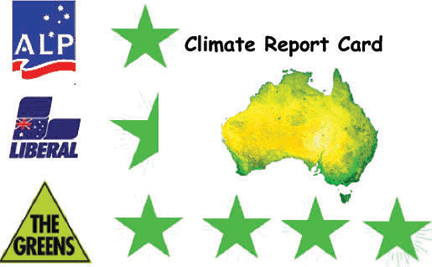 Environment scorecard rates Coalition’s policies ‘woefully inadequate’, Guardian, Gareth Hutchens, 31 May 2016 The Australian Conservation Foundation’s assessment of the parties’ policies awards the Coalition 11 points out of 100, Labor 53 and the Greens 77
The Australian Conservation Foundation has described the Coalition’s environmental policies as “woefully inadequate” in its traditional election scorecard.
It gave the Coalition 11 points out of a possible 100, Labor 53 and the Greens 77.
The ACF’s chief executive, Kelly O’Shanassy, said: “The politicians who want to lead the country must have real plans to protect people, rivers, reefs, forests and wildlife for the future.”
“The Coalition’s 11 out of 100 on the environment is woefully inadequate. If they are not prepared to lead on climate and nature, they are not fit to lead the country.
“It’s not as if conservatives can’t be good conservationists – Liberal cabinet minister Garfield Barwick was ACF’s first president; Robert Menzies signed the first Antarctic Treaty; Malcolm Fraser made Kakadu a national park; John Howard established the national greenhouse inventory and the national water initiative,” she said.
The scores were calculated by measuring the parties’ policies on clean energy, pollution reduction, and environmental protection, and comparing them with the 40 tests set out in ACF’s national agenda for 2016.
Those tests include setting stronger pollution targets to help limit global warming to less than 1.5C above pre-industrial temperatures; stopping uranium mining and export; delivering on the Murray-Darling Basin Plan; and shifting to 100% renewable energy by 2050.
The ACF decides how many marks to award for each party policy on the basis of how completely it fulfils the ACF’s tests. Where a policy unwinds existing environmental protection, the ACF awards negative marks.
An ACF spokesman said the organisation had been in contact with all three major parties this year to tell them how their policies would likely rate in its election scorecard with its policies as they stand…….
A recent poll showed climate change is one of the top four issues for voters at this election. http://www.theguardian.com/australia-news/2016/may/31/environment-scorecard-rates-coalitions-policies-woefully-inadequate
Transition to renewable energy favoured by most voters
 Most voters support transition to 100% renewable energy, says Australia Institute
Polling indicates 71% would be more likely to vote for a party that supported distributed small-scale solar and storage, Guardian, http://www.theguardian.com/sustainable-business/2016/may/31/most-voters-support-transition-to-100-renewable-energy-says-australia-institute
Max Opray, 31 May 16, Battery storage technology has the potential to reshape not just the energy and transport sectors but also the upcoming Australian federal election, according to a new report.
The Australia Institute report Securing Renewables: How Batteries Solve the Problem of Clean Electricity includes polling indicating that 71% of Australians would be more likely to vote for a party that supported distributed small-scale solar and storage.
Based on a national opinion poll of 1,412 people undertaken between February and March 2016, the study also found 63% of respondents would be more likely to support a party that aims to transition to 100% renewable energy by 2030 and that 45% would be more likely to support a party that attempts to accelerate the uptake of electric vehicles.
“The combination of batteries paired with variable renewable energy such as solar and wind can now provide security of electricity supply, with zero emissions,” says the author of the report, Australia Institute strategist Dan Cass.
The report found that one in four Australians wish to create and store power in order to unplug from the grid and that 80% of the 1.5m Australian households to have already invested in rooftop solar are considering the purchase of batteries.
It also noted that the predicted boom in electric cars could see households using such vehicles when parked and plugged in as storage providers for the wider energy network.
Podcast: Radioactive racism of the proposed national nuclear waste dump
 Earth Matters, 3CR Radio: S.A. too good to waste – the radioactive racism of the proposed national nuclear waste dump 29 May 2016. It’s a story that involves stolen country, stolen generations, and the threat of a stolen future — the fight against a national nuclear waste dump in South Australia.
Just one site has been ‘shortlisted’ for a national nuclear waste dump. Wallerberdina, at the foot of the Flinders Ranges in South Australia.
The proposed site is on the lands of the Adnyamathanha people, and they don’t want any nuclear waste on their country.
Guests: Vivianne and Regina McKenzie (Adnyamathanha, SA); Dr Margie Beavis (Medical Association for Prevention of War); Dr Jim Green (Friends of the Earth)
Podcast (30 min) at: http://www.3cr.org.au/earthmatters/episode-201605291100/sa-too-good-waste-radioactive-racism-proposed-national-nuclear
Economic future for the nuclear industry just getting worse
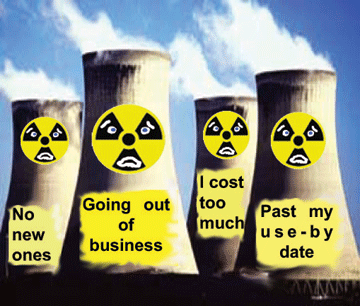
 Nuclear power in more trouble than oil Utilities shutting down plants earlier than expected Houston Chronicle , By Chris Tomlinson , 31 May 16 If you think folks in the oil and gas business have it tough, talk to someone in the nuclear power industry where 20 percent of the reactors operating today may shut down early.
The last time the United States opened a new nuclear reactor was 30 years ago, when state commissions set the price for electricity and a generator could rely on steady, reliable profits for the lifetime of the plant. But since then, states have deregulated electricity markets and have forced generators to compete to sell the cheapest electricity by the 15 minute interval.
That’s a problem a nuclear power plant, which requires a huge investment to build and a huge amount of cash to decommission. The electricity may be marginally cheap, but what experts call the levelized cost of electricity that includes all the expenses is actually quite high.
That’s why the Nuclear Energy Institute reports that 15 to 20 of the nation’s 99 commercial reactors are at risk of premature closure in the coming years. If they have to compete solely on the spot-market price for electricity, keeping them going doesn’t make economic sense…….http://www.houstonchronicle.com/business/outside-the-boardroom/article/Nuclear-power-in-more-trouble-than-oil-7943174.php?t=2d6e26d409&cmpid=twitter-premium
May 25, 2016
 |
Click here to Reply or Forward
|
ACTION!!!!! Please do this!!!! Write a Letter to your Labor Member….
Now more than ever Labor’s position on uranium is important in the campaign to stop uranium mining. There has been some good strong public statements from Labor over the years about their position against uranium mining, a position that is not only environmentally responsible but is also economically sound given the very low uranium price. They are under constant pressure to change their position – a letter from you saying that you are anti uranium mining and asking them to tell you their position on uranium will help. Please write and send a letter to your local WA Labor members electorate address. http://www.parliament.wa.gov.au/parliament/memblist.nsf/wallmembers
TAKE ACTION: Sign the Uranium Free Charter
 Western Australians face a choice about uranium mining. The current push to allow uranium mining is a direct threat to workers’ safety and the long term health of our environment and communities. Uranium mining does not make good economic sense and leaves behind a radioactive legacy.
http://www.ccwa.org.au/uraniumfreecharter
America can’t give up its dream folly of endless nuclear power
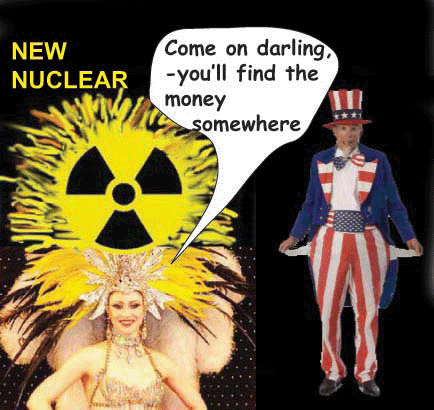
America’s long fever dream of boundless nuclear power: What’s a country to do? Environmental Leader, 31 May 16, America’s relationship with civilian nuclear power is curious: it’s like the story of the aging playboy who can’t let go of his alluring but high-maintenance showgirl. The two love each other, dreaming of what might have been and what might be. They can’t quite make the relationship work, but can’t let go either……..
Next generation nuclear power might take many forms. Those behind the technologies they are working on – the small, modular, passively safe nuclear reactor; the traveling wave rector Bill Gates and others are backing, and other advanced concepts, which a Senate Energy and Natural Resources Committee hearing learned about from experts last week – seem aware they may never see the fruit of their labors in their lifetime. They talk of initial developments by 2030 or 2035 and beyond.
They talk of public-private partnerships aimed at solving supply chain problems, of resolving technical and licensing challenges, and addressing technical and economic questions at the demonstration phase. After 60-some years of commercial nuclear power, we’re still trying to profit from what we’ve learned and determine what yet we need to do. It’s conceptual, patient work. It seems we’re willing to keep the industry alive, but just barely. DOE’s Gateway for Accelerated Innovation in Nuclear (GAIN) initiative will be funded at a modest $80 million over several years……
Jobs in plenty in the renewabl energy industry
The Community Power Agency – which specialises in supporting community groups to set up a  community owned renewable energy (CORE) project – is directly working with the 70 community energy groups across Australia.
Looking towards the election, the Community Power Agency is calling on all political parties to put in place robust policy to support the growth of community energy innovation in Australia.
“In terms of the focus for the election… the ALP and the Greens have both come out with excellent renewable energy policy and have been talking about it quite a lot. They could be talking about it more. But certainly the ALP has committed $28.7 million to support community energy projects across Australia and they have also committed to a 50 per cent renewables target by 2030, so there is some good policy basis there, we are yet to see any kind of announcement on this type of thing from the Coalition which is very disappointing.
Renewable Energy is a Jobs Rich Industry http://probonoaustralia.com.au/news/2016/05/renewable-energy-jobs-rich-industry/ A Not for Profit organisation dedicated to growing the community energy sector in Australia has claimed renewable energy is a jobs rich industry.

The Community Power Agency said Australian regions and towns can maximise employment in renewable energy with community-owned projects.
It comes after a new global report released by the International Renewable Energy Agency (IRENA) showed that renewable energy jobs were on the rise, with community-owned projects to benefit most.
More than 8.1 million people around the world are now employed in renewable energy, up 5 per cent on last year.
Nicky Ison Community Power Agency director said renewable energy was a jobs-rich industry and when such projects were community-owned that created even more employment.
“The research from the US – because there are a lot more community energy programs in the US than here – shows that if you have a community ownership stake in a larger renewables project, like owning a couple of wind turbines in a larger wind farm, the economic benefit to that local community in terms of jobs, investment, money circulating in the local economy, the economic benefit is 1.5 to 3.5 times greater,” Ison told Pro Bono Australia News. Continue reading
Greg Hunt’s gaffe over UNESCO and the Great Barrier Reef
 How Greg Hunt and his department turned good news into an international scandal
The full draft of the Unesco report on climate change reveals many mentions of Australia were actually positive, Guardian, Michael Slezak, 31 May 2016 Greg Hunt has conducted one of the strangest manoeuvres of his already rather gymnastic career, over the erasure of Australia from a United Nations report on climate change.
Guardian Australia had broken the story that all mentions of Australia and the Great Barrier Reef had been scrubbed from the report at the request of the environment department.
Hunt first denied knowing about it but then justified the move with reasons that went beyond those provided by the department.
In fact the full draft report, obtained exclusively by Guardian Australia, reveals many of the mentions of Australia were positive – but their removal turned what would have been a relatively good news story into an international scandal. Continue reading
1 This month

of the week – Australians for War Powers Reform (AWPR)
To see nuclear-related stories in greater depth and intensity
 Antinuclear