Vanessa Guthrie new Chair of Minerals Council of Australia
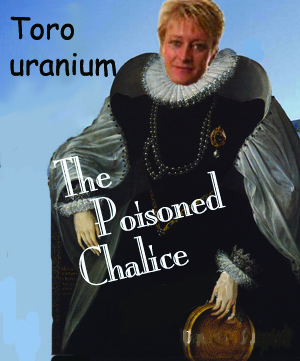 NEW CHAIR OF MINERALS COUNCIL OF AUSTRALIA (FED)
The Board of Directors of the Minerals Council of Australia today elected Dr Vanessa Guthrie to chair the organisation for the next two years. Dr Guthrie is Chief Executive of Toro Energy which is developing uranium operations in Western Australia. Dr Guthrie is the first woman to chair the mining industry representative body in its 40 year history.
Uneconomic nuclear plants closing – Exelon wants taxpayer subsidy
Exelon to Close 2 Nuclear Sites; Still Pushing for Subsidies http://abcnews.go.com/Politics/wireStory/exelon-close-illinois-nuclear-plants-39555124 By JOHN O’CONNOR, AP POLITICAL WRITER SPRINGFIELD, Ill. — Jun 2, 2016 Exelon Corp. says it will shut two Illinois nuclear plants because of legislative inaction on state financial support, but the company is still lobbying for the plan.
An email obtained by The Associated Press that Exelon President and CEO Chris Crane sent to employees about Thursday’s decision also urged them to call a telephone number and record a message in favor of the legislators to be played for lawmakers and Gov. Bruce Rauner.
Exelon announced earlier Thursday it would close unprofitable plants in Clinton and the Quad Cities by 2018 after lawmakers adjourned without approving a plan for Exelon to share in state subsidies for carbon-free electric generation.
The telephone number’s greeting encourages employees to say immediate legislative action could save the plants.
Exelon spokesman Paul Adams confirmed the closure decision is not irreversible.
Climate Council reports on Australia’s top solar states and suburbs
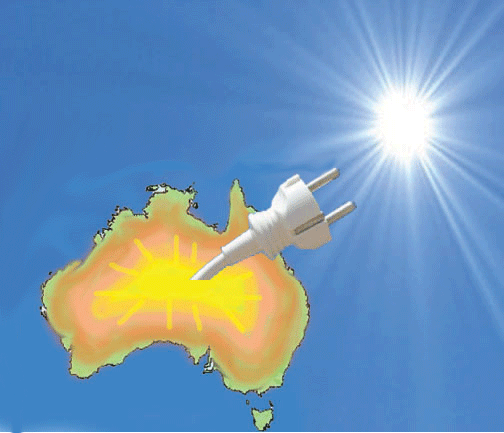 Australia’s top solar states and suburbs http://onestepoffthegrid.com.au/australias-top-solar-states-and-suburbs/ By Sophie Vorrath on May 25, 2016
Rooftop solar is becoming as “common as insulation” in some parts of Australia, a new report has found, with 14 suburbs now recording penetration above 50 per cent, and many others recording uptake far above their state’s average, sometimes as high as 65 per cent.
The report is the Climate Council’s latest round-up of data on the performance of renewable energy in Australia’s states and territories. . As you can see in the table below, at the state and territory level, South Australia, Queensland, and Western Australia all have a higher share of Australia’s solar PV installations than their share of the population [Table 3 on original]
But in terms of the percentage of households with solar PV, South Australia and Queensland are still leading the country, with PV penetration levels fast approaching one-third of all households. Western Australia comes in at third place, with solar PV panels on one in five households.
In the suburbs of Australia, the data tells a slightly different story, with some postcodes charting a solar PV penetration rate much higher than the average of the state or territory they are located in. Continue reading
Despite our solar resources, Australia way behind Britain in solar energy
Australia 10th in global solar capacity as industry looks ahead to sunnier times http://www.smh.com.au/environment/climate-change/australia-10th-in-global-solar-capacity-as-industry-looks-ahead-to-sunnier-times-20160531-gp83t6.html June 1, 201 Peter Hannam Environment Editor, The Sydney Morning Herald Australia installed almost 1 gigawatt of new solar capacity last year but was easily eclipsed by cloudy nations such as the United Kingdom, which installed about four times as much, according to the REN21 Global Status report on renewable energy.
Investment in new renewable energy and energy efficiency programs rose to a record $US286 billion ($396 billion) even as prices for most technologies, such as solar and wind energy, fell. Growth also came despite falling prices for rival fuel sources, such as coal and oil.
“Renewables are now cost-competitive with fossil fuels in many markets and are established around the world as mainstream sources of energy,” Arthouros Zervos, chairman of REN21, said in the report.
Globally solar PV capacity added 50 gigawatts to reach 227 GW of capacity. New wind power capacity rose even more, adding 63 GW of new capacity to reach 433 GW.
Australia added 900 MW of new solar PV last year – the eighth-most in the world – to reach 5.1 GW of capacity.
That total, though, ranked Australia 10th in the world, trailing nations not known for their sunshine, such as the UK, South Korea and Germany. The UK added 3.7 GW alone last year to reach 9.1 GW of capacity, or almost twice Australia’s tally.
Kane Thornton, chief executive of the Clean Energy Council, said it was “obviously disappointing that the UK had almost twice as much solar power as Australia by the end of 2015, given we have some of the strongest sunshine in the world.” Continue reading
How batteries solve the problem of clean electricity
Securing renewables: how batteries solve the problem of clean electricity Dan Cass31 May 2016 Source: The Australia Institute
Summary
Critics put forward two key arguments against widespread adoption of renewable energy: price and intermittency. Solar and wind costs have fallen so rapidly over the past decade that they are now competitive with fossil fuels, so the price argument is losing traction.
Battery and other forms of storage technology are rapidly overcoming the variability argument. As batteries become more widespread, this will answer the final objection to vigorously developing our clean energy resources. Format:
Chile’s solar power: renewable energy in overdrive
Chile Has So Much Solar Energy It’s Giving It Away for Free , Bloomberg, 2 June 16
-
Spot prices reached zero for 113 days this year through April
-
Solar power on Chile’s central grid quadrupled since 2013
-
Chile’s solar industry has expanded so quickly that it’s giving electricity away for free.
Spot prices reached zero in parts of the country on 113 days through April, a number that’s on track to beat last year’s total of 192 days, according to Chile’s central grid operator. While that may be good for consumers, it’s bad news for companies that own power plants struggling to generate revenue and developers seeking financing for new facilities.
Chile’s increasing energy demand, pushed by booming mining production and economic growth, has helped spur development of 29 solar farms supplying the central grid, with another 15 planned. Further north, in the heart of the mining district, even more have been built. Now, economic growth is slowing as copper output stagnates amid a global glut, energy prices are slumping and those power plants are oversupplying regions that lack transmission lines to distribute the electricity elsewhere………
-
Inadequate Infrastructure Continue reading
1 This month
15 April – Zoom –Nuclear Power is Not the Solution
Apr 15, 2026 01:00 AM in Canberra, Melbourne, Sydney

Join the International Physicians for the Prevention of Nuclear War (IPPNW) on Tuesday, April 14th for a timely webinar exploring the risks associated with nuclear power and challenging the myth that it offers a simple, safe, carbon-free solution to the climate crisis

of the week – Australians for War Powers Reform (AWPR)
To see nuclear-related stories in greater depth and intensity
 Antinuclear