Once again, Australian government wages nuclear war on Aboriginal people
The plan to turn South Australia into the world’s nuclear waste dump has been met with near-unanimous opposition from Aboriginal people.
The Royal Commission acknowledged strong Aboriginal opposition to its nuclear waste proposal in its final report – but it treats that opposition not as a red light but as an obstacle to be circumvented.
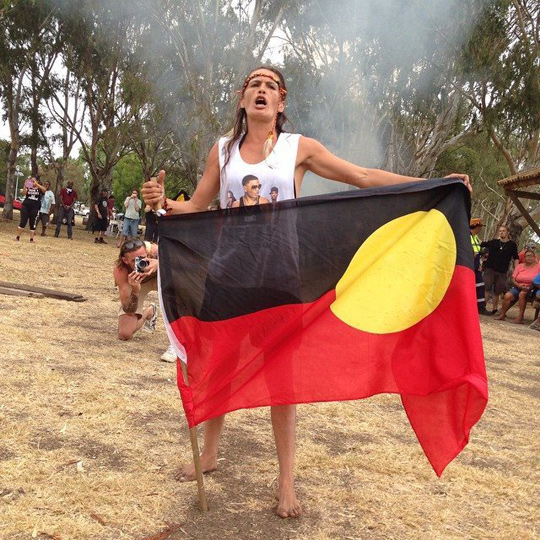

 Radioactive waste and the nuclear war on Australia’s Aboriginal people, Ecologist Jim Green 1st July 2016
Australia’s nuclear industry has a shameful history of ‘radioactive racism’ that dates from the British bomb tests in the 1950s, writes Jim Green. The same attitudes persist today with plans to dump over half a million tonnes of high and intermediate level nuclear waste on Aboriginal land, and open new uranium mines. But now Aboriginal peoples and traditional land owners are fighting back!
Then the government tried to impose a dump on Aboriginal land in the Northern Territory, but that also failed.
Now the government has embarked on its third attempt and once again it is trying to impose a dump on Aboriginal land despite clear opposition from Traditional Owners. The latest proposal is for a dump in the spectacular Flinders Ranges, 400 km north of Adelaide in South Australia, on the land of the Adnyamathanha Traditional Owners.
The government says that no group will have a right of veto, which is coded racism: it means that the dump may go ahead despite the government’s acknowledgement that “almost all Indigenous community members surveyed are strongly opposed to the site continuing.”
The proposed dump site was nominated by former Liberal Party politician Grant Chapman but he has precious little connection to the land. Conversely, the land has been precious to Adnyamathanha Traditional Owners for millennia.
It was like somebody ripped my heart out’
The site is adjacent to the Yappala Indigenous Protected Area (IPA). “The IPA is right on the fence – there’s a waterhole that is shared by both properties”, said Yappala Station resident and Adnyamathanha Traditional Owner Regina McKenzie.
The waterhole – a traditional women’s site and healing place – is one of many archeological and culturally significant sites in the area that Traditional Owners have registered with the South Australian government over the past six years. Two Adnyamathanha associations – Viliwarinha Aboriginal Corporation and the Anggumathanha Camp Law Mob – wrote in November 2015 statement:
“Adnyamathanha land in the Flinders Ranges has been short-listed for a national nuclear waste dump. The land was nominated by former Liberal Party Senator Grant Chapman. Adnyamathanha Traditional Owners weren’t consulted. Even Traditional Owners who live next to the proposed dump site at Yappala Station weren’t consulted. This is an insult.
“The whole area is Adnyamathanha land. It is Arngurla Yarta (spiritual land). The proposed dump site has springs. It also has ancient mound springs. It has countless thousands of Aboriginal artefects. Our ancestors are buried there.
“Hookina creek that runs along the nominated site is a significant women’s site. It is a registered heritage site and must be preserved and protected. We are responsible for this area, the land and animals.
“We don’t want a nuclear waste dump here on our country and worry that if the waste comes here it will harm our environment and muda (our lore, our creation, our everything). We call on the federal government to withdraw the nomination of the site and to show more respect in future.”
Regina McKenzie describes getting the news that the Flinders Ranges site had been chosen from a short-list of six sites across Australia: “We were devastated, it was like somebody had rang us up and told us somebody had passed away. My niece rang me crying … it was like somebody ripped my heart out.”
McKenzie said on ABC television: “Almost every waste dump is near an Aboriginal community. It’s like, yeah, they’re only a bunch of blacks, they’re only a bunch of Abos, so we’ll put it there. Don’t you think that’s a little bit confronting for us when it happens to us all the time? Can’t they just leave my people alone?”
Adnyamathanha Traditional Owner Dr Jillian Marsh said in an April 2016 statement:
“The First Nations people of Australia have been bullied and pushed around, forcibly removed from their families and their country, denied access and the right to care for their own land for over 200 years. Our health and wellbeing compares with third world countries, our people crowd the jails. Nobody wants toxic waste in their back yard, this is true the world over. We stand in solidarity with people across this country and across the globe who want sustainable futures for communities, we will not be moved.”
The battle over the proposed dump site in the Flinders Ranges will probably be resolved over the next 12 months. If the government fails in its third attempt to impose a dump against the wishes of Aboriginal Traditional Owners, we can only assume on past form that a fourth attempt will ensue……
Now Aboriginal people in South Australia face the imposition of a national nuclear waste dump as well as a plan to import 138,000 tonnes of high-level nuclear waste and 390,000 cubic metres of intermediate level waste for storage and disposal as a commercial venture.
The plan is being driven by the South Australian government, which last year established a Royal Commission to provide a fig-leaf of independent supporting advice. The Royal Commissioner is a nuclear advocate and the majority of the members of the Expert Advisory Committee are strident nuclear advocates.
Indeed it seems as if the Royal Commissioner sought out the dopiest nuclear advocates he could find to put on the Expert Advisory Committee: one thinks nuclear power is safer than solar, another thinks that nuclear power doesn’t pose a weapons proliferation risk, and a third was insisting that there was no credible risk of a serious accident at Fukushima even as nuclear meltdown was in full swing.
Announcing the establishment of the Royal Commission in March 2015, South Australian Premier Jay Weatherill said: “We have a specific mandate to consult with Aboriginal communities and there are great sensitivities here. I mean we’ve had the use and abuse of the lands of the Maralinga Tjarutja people by the British when they tested their atomic weapons.”
Yet the South Australian government’s handling of the Royal Commission process systematically disenfranchised Aboriginal people. The truncated timeline for providing feedback on draft Terms of Reference disadvantaged people in remote regions, people with little or no access to email and internet, and people for whom English is a second language. There was no translation of the draft Terms of Reference, and a regional communications and engagement strategy was not developed or implemented.
Aboriginal people repeatedly expressed frustration with the Royal Commission process. One example (of many) is the submission of the Anggumathanha Camp Law Mob (who are also fighting against the plan for a national nuclear waste dump on their land):
“Why we are not satisfied with the way this Royal Commission has been conducted:
Yaiinidlha Udnyu ngawarla wanggaanggu, wanhanga Yura Ngawarla wanggaanggu? – always in English, where’s the Yura Ngawarla (our first language)?
“The issues of engagement are many. To date we have found the process of engagement used by the Royal Commission to be very off putting as it’s been run in a real Udnyu (whitefella) way. Timelines are short, information is hard to access, there is no interpreter service available, and the meetings have been very poorly advertised. …
“A closed and secretive approach makes engagement difficult for the average person on the street, and near impossible for Aboriginal people to participate.”
The plan to turn South Australia into the world’s nuclear waste dump has been met with near-unanimous opposition from Aboriginal people. The Aboriginal Congress of South Australia, comprising people from many Aboriginal groups across the state, endorsed the following resolution at an August 2015 meeting:
“We, as native title representatives of lands and waters of South Australia, stand firmly in opposition to nuclear developments on our country, including all plans to expand uranium mining, and implement nuclear reactors and nuclear waste dumps on our land. … Many of us suffer to this day the devastating effects of the nuclear industry and continue to be subject to it through extensive uranium mining on our lands and country that has been contaminated.
“We view any further expansion of industry as an imposition on our country, our people, our environment, our culture and our history. We also view it as a blatant disregard for our rights under various legislative instruments, including the founding principles of this state.”
The Royal Commission acknowledged strong Aboriginal opposition to its nuclear waste proposal in its final report – but it treats that opposition not as a red light but as an obstacle to be circumvented.http://www.theecologist.org/News/news_analysis/2987853/radioactive_waste_and_the_nuclear_war_on_australias_aboriginal_people.html
Blockade continues at Olympic Dam uranium mine: anti nuclear protestors dig in
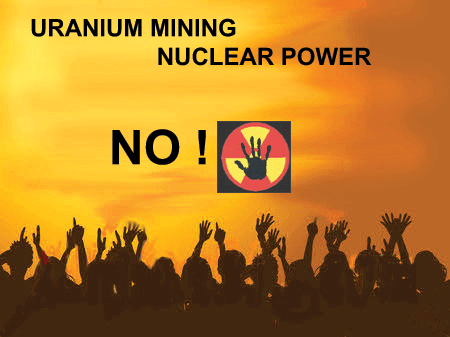 Anti-nuclear protest continues in SA , 9 News South Australia 3 July 16 Anti-nuclear activists are maintaining a blockade of the Olympic Dam uranium mine in South Australia’s north after confrontations with police.
The action, which included blocking the main road to the mine, continued into the night on Sunday.
It involved a bonfire as well as singing and chanting early in the day, but escalated later to a clash with a strong police presence in when protesters attempted to move a large block of fake uranium onto the road……..Sunday’s action was part of a planned three-day protest at the mine site which began on Friday. http://www.9news.com.au/national/2016/07/03/17/03/protest-blocks-road-to-sa-uranium-mine#QVjz4bk9ZQoSHEHq.99
Australian uranium mining is polluting the Antarctic
Climate scientists: Australian uranium mining pollutes Antarctic http://phys.org/news/2016-06-climate-scientists-australian-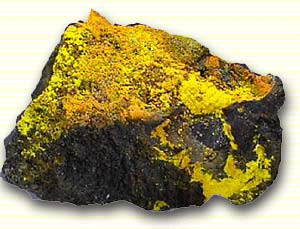 uranium-pollutes.html June 30, 2016 by Beth Staples Uranium mining in Australia is polluting the Antarctic, about 6,000 nautical miles away. University of Maine climate scientists made the discovery during the first high-resolution continuous examination of a northern Antarctic Peninsula ice core.
Ice core data reveal a significant increase in uranium concentration that coincides with open pit mining in the Southern Hemisphere, most notably Australia, says lead researcher Mariusz Potocki, a doctoral candidate and research assistant with the Climate Change Institute.
“The Southern Hemisphere is impacted by human activities more than we thought,” says Potocki.
Understanding airborne distribution of uranium is important because exposure to the radioactive element can result in kidney toxicity, genetic mutations, mental development challenges and cancer.
Uranium concentrations in the ice core increased by as much as 102 between the 1980s and 2000s, accompanied by increased variability in recent years, says Potocki, a glaciochemist.
Until World War II, most of the uranium input to the atmosphere was from natural sources, says the research team.
But since 1945, increases in Southern Hemisphere uranium levels have been attributed to industrial sources, including uranium mining in Australia, South Africa and Namibia. Since other land-source dust elements don’t show similar large increases in the ice core, and since the increased uranium concentrations are enriched above levels in the Earth’s crust, the source of uranium is attributed to human activities rather atmospheric circulation changes.
In 2007, a Brazilian-Chilean-U.S. team retrieved the ice core from the Detroit Plateau on the northern Antarctic Peninsula, which is one of the most rapidly changing regions on Earth.
More information: Mariusz Potocki et al. Recent increase in Antarctic Peninsula ice core uranium concentrations, Atmospheric Environment (2016). DOI: 10.1016/j.atmosenv.2016.06.010 Journal reference:Atmospheric Environment  Provided by: University of Maine
Climate Change – a Crime Against Humanity
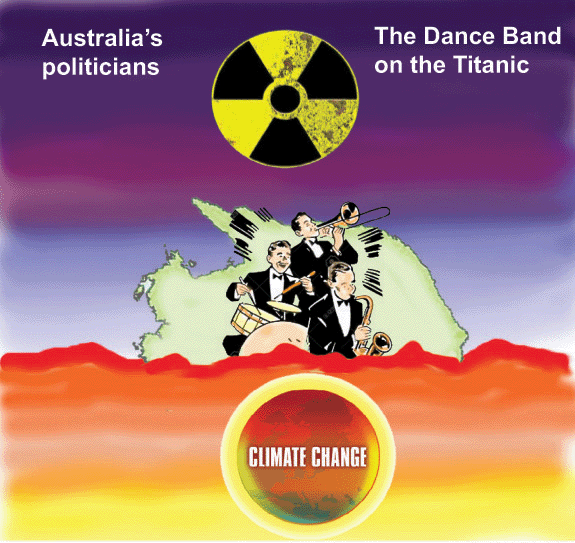 The climate Titanic And The Melting Icebergs, COUNTER CURRENTS.org by Andrew Glikson — June 30, 2016
“In a time of universal deceit telling the truth is a revolutionary act” –George Orwell
March 2016 set a new record temperature for that time of year, according to NASA’s Goddard Institute for Space Studies. The global temperature was 2.30 °F (1.28 °C) warmer than the average for March from 1951 to 1980, which is used as a baseline. http://climate.nasa.gov/news/2432/
In total, CO2 levels have risen from ~280 to ~407 ppm since the 18th century, currently rising at a rate of ~3 to 4 ppm/year as measured at Mouna Loa observatory, Hawaiihttp://www.esrl.noaa.gov/gmd/ccgg/trends/
Little mention is made of the existential threats posed by the climate and nuclear issues in the context of the current elections in the US and Australia. Continue reading
Anniversary: The Atomic Tests at Bikini Atoll, July 1946
70th Anniversary of OperationCrossroads Atomic Tests in Bikini Atoll, July 1946
EXCELLENT VIDEOS and PHOTOS, National Security Archive Government Films and Photographs Depict Test “Able” on 1 July 1946
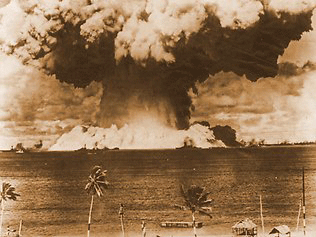
Removal of 167 Bikinians from the Atoll Preceded the Atomic Tests
National Security Archive Electronic Briefing Book No. 553 July 1, 2016 Edited by William Burr with Stav Geffner For more iThe Atomic Tests at Bikini Atoll, July 1946nformation contact: William Burr at 202/994-7000 or nsarchiv@gwu.edu.
The Atomic Tests at Bikini Atoll, July 1946 Washington, D.C., July 1, 2016 – Seventy years ago this month a joint U.S Army-Navy task force staged two atomic weapons tests at Bikini atoll in the Marshall Islands, the first atomic explosions since the bombings of Japan in August 1945. Worried about its survival in an atomic war, the Navy sought the tests in order to measure the effects of atomic explosions on warships and other military targets. The test series was named Operation Crossroads by the task force’s director, Rear Admiral William Blandy. The first test, Able, took place on 1 July 1946. Of the two tests, the second, Baker, on 25 July 1946, was the most dangerous and spectacular, producing iconic images of nuclear explosions. A third test was scheduled, but canceled. Photographs and videos posted today by the National Security Archive document Crossroads, focusing on the Able test.
Also documented is the U.S. Navy’s removal, in early March 1946, of 167 Pacific islanders from Bikini, their ancestral home, so that the Navy and the Army could prepare for the tests. The Bikinians had the impression that the relocation would be temporary but the islands remain uninhabitable due to subsequent nuclear testing in the atoll……….
Video gallery
Strategy on Climate Change: Cook Islands, Kiribati, Marshall Islands, Nauru, Palau and Tuvalu
 Small Island States adopt new climate change strategy http://www.radionz.co.nz/international/pacific-news/307877/small-island-states-adopt-new-climate-change-strategy The Forum Secretariat’s Alfred Schuster, 4 July 16 The Small Island States of the Pacific Islands Forum have adopted a new climate change strategy to ensure their vulnerabilities are addressed as part of the regional policy agenda.
The strategy was agreed to by leaders from the Cook Islands, Kiribati, Marshall Islands, Nauru, Palau and Tuvalu at a meeting last week in Palau.
The Forum Secretariat’s Development Co-operation Advisor, Alfred Schuster, says addressing climate change is one of the top priorities of the strategy.
He says the Small Island States want to band together when applying for climate change mitigation funding from the United Nations.
“It’ll be a new approach, from what we understand a joint proposal of countries and governments hasn’t yet been brought to the attention of the Green Climate Fund. But we’d like to think it’s a much more strategic way in light of the administrative burden and administrative requirements of the Green Climate Fund to generate the sort of revenue that’s required by the SIS.”
Kiribati Island doomed by climate change
A Remote Pacific Nation,Threatened by Rising Seas
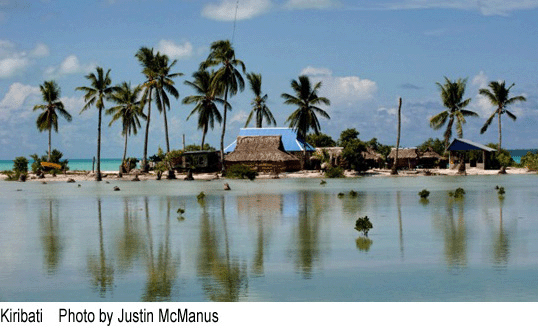
Text by MIKE IVES Photographs and video by JOSH HANERJULY 2, 2016“…..For years, scientists have been predicting that much of Kiribati may become uninhabitable within decades because of an onslaught of environmental problems linked to climate change. And for just as long, many here have paid little heed. But while scientists are reluctant to attribute any specific weather or tidal event to rising sea levels, the tidal surge last winter, known as a king tide, was a chilling wake-up call.
Pacific island nations are among the world’s most physically and economically vulnerable to climate change and extreme weather events like floods, earthquakes and tropical cyclones, the World Bank said in a 2013 report. While world powers have summit meetings to negotiate treaties on how to reduce and mitigate carbon emissions, residents of tiny Kiribati, a former British colony with 110,000 people, are debating how to respond before it is too late.
Much of Kiribati, a collection of 33 coral atolls and reef islands scattered across a swath of the Pacific Ocean about twice the size of Alaska, lies no higher than six feet above sea level. The latest climate models predict that the world’s oceans could rise five to six feet by 2100. The prospects of rising seas and intensifying storms “threaten the very existence and livelihoods of large segments of the population,” the government told the United Nations in a report last year. Half of the 6,500-person village of Bikenibeu, for instance, could be inundated by 2050 by sea-level rises and storm surges,according to a World Bank study.
The study lays out Kiribati’s future in apocalyptic detail. ……
a 2011 government-commissioned report cast doubt on whether the World Bank project helped Kiribati prepare for climate change. And while the mangroves and water management plans have helped, a 2014 study said the first round of sea walls, made of sandbags, had proved counterproductive and caused more erosion.
“Adaptation is just this long, ugly, hard slog,” said the study’s lead author, Simon Donner, a professor of geography at the University of British Columbia in Vancouver. “The idea that an outside organization can just come in with money, expertise and ideas and implement something easily is naïve. What you need is consistent, long-term funding — the type of stuff that’s hard to pull off with development aid.”….
migration may become increasingly important. Mr. Tong said he hoped to prepare his people to move with job-training programs that would meet standards recognized in Australia and New Zealand. “The science of climate change is not 100 percent precise,” he said in the interview. “But we know without any argument that, in time, our people will have to relocate unless there are very, very significant resources committed to maintain the integrity of the land…..”http://www.nytimes.com/2016/07/03/world/asia/climate-NYT, change-kiribati.html?
French Polynesia Resolution is adopted by U.N. Decolonization Committee
 U.N. Decolonization Committee adopts French Polynesia Resolution,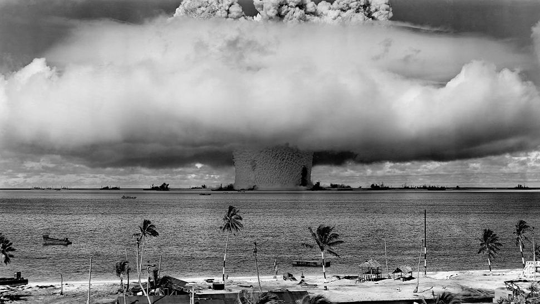
Overseas Territories Review, 3 July 16
Highlights of the U.N. Resolution:
Reaffirmed the inalienable rights of the people of French Polynesia to the ownership, control and disposal of their natural resources, including marine resources and undersea minerals, and the permanent sovereignty of the people to those resources.
Attempts to dump nuclear waste on South Australia 1998-2004
The Kungkas wrote in an open letter: “People said that you can’t win against the Government. Just a few women. We just kept talking and telling them to get their ears out of their pockets and listen. We never said we were going to give up. Government has big money to buy their way out but we never gave up.”
Radioactive waste and the nuclear war on Australia’s Aboriginal people, Ecologist Jim Green 1st July 2016 “………Dumping on South Australia, 1998-2004
This isn’t the first time that Aboriginal people in South Australia have faced the imposition of a national nuclear waste dump. In 1998, the federal government announced its intention to build a dump near the rocket and missile testing range at Woomera.
The proposed dump generated such controversy in South Australia that the federal government hired a public relations company. Correspondence between the company and the government was released under Freedom of Information laws. Continue reading
Australian Greens face uncertain result in federal election

 Greens face prospect that election result will not lead to gains https://www.theguardian.com/australia-news/2016/jul/03/greens-ponder-australian-election-vote-which-will-probably-not-lead-to-gains Melbourne MP Adam Bandt was re-elected, while in the Senate a loss in South Australia could be balance by gain in Queensland Melissa Davey The Greens are struggling to pick up extra lower house seats targeted in Sydney and Melbourne where supporters were hoping for an upset and look set to return to parliament with the same number of senators the party had in the previous term.
Melbourne MP Adam Bandt was comfortably elected for a third time but as it stands he remains the lone Green in the House of Representatives, while in the Senate, the party has lost Robert Simms in South Australia but looks to gain a Senator in Queensland.
But Greens leader Richard Di Natale was high-spirited on Sunday, saying the party maintained hopes for taking the Victorian seats of Melbourne Ports and Batman from Labor, which remain too close to call. The party stood candidates in all 150 lower house seats across the country, with party sources claiming there has been a national swing towards them of around 2%.
However, Australian Electoral Commission figures have the party with 9.9% of the lower house vote, representing a swing towards them of 1.3%.
“We have had an extraordinary result in terms of the Greens vote across the country and certainly here in Victoria in some key seats,” Di Natale said.
“What we’ve seen in some states like Victoria is a swing higher than our national average. Victoria clearly is a powerhouse for the Australian Greens right now.”
Di Natale said early on in the election campaign he believes the seats that will turn to the Greens within the next decade include Batman, Wills, Kooyong, Melbourne Ports, and the Liberal seat of Higgins in Victoria, Grayndler, Wentworth, Sydney, and Richmond in NSW, and Fremantle in Western Australia.
France’s EDF workers demand delay in building super costly Hinkley nuclear station
 EDF workers’ committee expected to demand that nuclear power plant at Hinkley Point in Somerset is delayed http://www.thisismoney.co.uk/money/markets/article-3672592/EDF-workers-committee-expected-demand-nuclear-power-plant-Hinkley-Point-Somerset-delayed.html By CITY & FINANCE REPORTER FOR THE DAILY MAIL, 4 July 2016 EDF’S workers’ committee is expected to demand today that a nuclear power plant at Hinkley, Somerset, is delayed.
The energy firm has yet to make a decision on how to raise £18bn of funds needed for the power station, and has put off deciding until September to allow time to consult the unions.
The unions are obliged to deliver their opinion today on whether Hinkley should go ahead. But three of them issued a statement last week to say that Britain’s vote to leave the European Union added new elements of uncertainty.
It follows a legal action launched earlier this month in French courts by EDF’s Works Council, who asked for the project to be put off.
It is feared that if the unions do not support the project it could further delay Hinkley, which was due to be completed in 2017 but is currently expected to be finished by 2025.
Australia’s big banks lending to fossil fuels 6 times more than to renewables
Climate change: big four banks’ lending to Australian renewables projects falls, Guardian, Michael Slezak, 4 July 16 Market Forces finds only two financing deals closed in first half of 2016 despite banks’ purported support for sector Australia’s big four banks’ lending for Australian renewable energy projects has tumbled in the first half of 2016, despite all of them spruiking their continuing support for the sector.
Based on public announcements from the banks and their customers, the activist group Market Forces has found only two financing deals were closed this year in the Australian renewables sector.
The National Australia Bank lent money to a windfarm in South Australia and both NAB and Westpac helped finance one in New South Wales.
Although more financing could be revealed in the second half of the year, the figures seem to show the banks have slowed their flow of money to the renewables sector in Australia.
“This is what you see when you have years of stagnation and cutting into renewable energy policy,” said Julien Vincent from Market Forces.
The group has been collecting the data on financing for Australian renewable energy projects for the past eight years.
The first six months of 2016 have seen the big four banks lend only $162m to renewable projects. That is less than half the average amount loaned in all previous six-month periods since 2008 and the fifth-worst half-yearly figure in the dataset.
So far this year, according to public announcements, both the Commonwealth Bank and ANZ have not closed any deals for renewable energy projects in Australia.
Market Forces data previously showed the big four banks lent $5.5bn to the Australian fossil-fuel sector in 2015 and that the amount lent to the fossil-fuel sector was six times more than lent to the renewables sector since 2008. One bank had a ratio of 13 to one, favouring lending to fossil fuels over renewables……….https://www.theguardian.com/environment/2016/jul/04/climate-change-big-four-banks-lending-to-australian-renewables-projects-falls
Botched clean-up of the Maralinga nuclear test site
 Radioactive waste and the nuclear war on Australia’s Aboriginal people, Ecologist Jim Green 1st July 2016 “……..The 1998-2004 debate over nuclear waste dumping in South Australia overlapped with a controversy over a botched clean-up of the Maralinga nuclear weapons test site in the same state.
The British government conducted 12 nuclear bomb tests in Australia in the 1950s, most of them at Maralinga. The 1985 Royal Commission found that regard for Aboriginal safety during the weapons tests was characterised by “ignorance, incompetence and cynicism”.
The Australian government’s clean-up of Maralinga in the late 1990s was just as bad. It was done on the cheap and many tonnes of plutonium-contaminated waste remain buried in shallow, unlined pits in totally unsuitable geology.
Nuclear engineer and whistleblower Alan Parkinson said of the clean-up: “What was done at Maralinga was a cheap and nasty solution that wouldn’t be adopted on white-fellas land.”
Dr Geoff Williams, an officer with the Commonwealth nuclear regulator, the Australian Radiation Protection and Nuclear Safety Agency, said in a leaked email that the clean-up was beset by a “host of indiscretions, short-cuts and cover-ups”.
Nuclear physicist Prof. Peter Johnston noted that there were “very large expenditures and significant hazards resulting from the deficient management of the project”.
Prof. Johnston (and others) noted in a conference paper that Traditional Owners were excluded from any meaningful input into decision-making concerning the clean-up. Traditional Owners were represented on a consultative committee but key decisions – such as abandoning vitrification of plutonium-contaminated waste in favour of shallow burial in unlined trenches – were taken without consultation with the consultative committee or any separate discussions with Traditional Owners.
Federal government minister Senator Nick Minchin said in a May 2000 media release that the Maralinga Tjarutja Traditional Owners “have agreed that deep burial of plutonium is a safe way of handling this waste.” But the burial of plutonium-contaminated waste was not deep and the Maralinga Tjarutja Traditional Owners did not agree to waste burial in unlined trenches – in fact they wrote to the Minister explicitly dissociating themselves from the decision.
Barely a decade after the Maralinga clean-up, a survey revealed that 19 of the 85 contaminated waste pits have been subject to erosion or subsidence.
Despite the residual radioactive contamination, the Australian government off-loaded responsibility for the contaminated land onto the Maralinga Tjarutja Traditional Owners. The government portrayed this land transfer as an act of reconciliation. But it wasn’t an act of reconciliation – it was deeply cynical. The real agenda was spelt out in a 1996 government document which said that the clean-up was “aimed at reducing Commonwealth liability arising from residual contamination.”……http://www.theecologist.org/News/news_analysis/2987853/radioactive_waste_and_the_nuclear_war_on_australias_aboriginal_people.html
1 This month

of the week – Australians for War Powers Reform (AWPR)
To see nuclear-related stories in greater depth and intensity
 Antinuclear