Latest nuclear and climate news
 CLIMATE – ho hum – according to the mainstream media, well, climate just wasn’t an issue in the recent election. We face the prospect of another Liberal government toeing the line of its vehement climate denialist members. Australia takes quite a part of the blame in the disgraceful global web of climate denialism.
NUCLEAR – a South Australian special. The Weatherill Labor government organised 4 days of a so-called “Citizens’ Jury”. It was run by small South Australianall-female firm DemocracyCo. They probably shouldn’t have taken the job on, seeing that it was firmly set that this would not be any kind of a real jury. The job of the Citizens’ Jury was to make no verdict, no recommendations, but just to produce a summary of the Nuclear Fuel Cycle Royal Commission’s recommendations .
Which they did. Premier Weatherill is now touting their report as if it were the decisions of the Citizens’ Jury. The Jury people were intelligent, kept to their narrow brief, and produced this report.
DemocracyCo ran the Citizens’ Jury in a competent, well organised and fair manner. Because of the particular brief – it seemed natural that Royal Commission (RC) personnel were all about, and that most witnesses tended to be closely aligned with the nuclear lobby.
So – as it turned out, the Citizens’ Jury was fed nonsense about ionising radiation, and some pretty dubious stuff about safety and economics.
The good side of all this, is that South Australian citizens are becoming aware of this nuclear con job. There are critical comments all over the place, and especially sent to the RC’s own website. The Aborigines are not impressed.
There’ll be another Nuclear Citizens’ Jury in November. It will be interesting to see how that one works out, and what effect will result from South Australia’s coming nuclear propaganda avalanche.
Indigenous opposition to the international waste dump plan
 Nuclear waste dump case unravels, World News Report, 13 July 16 , Green Left By Renfrey Clarke “……..Yankunytjatjara Native Title Aboriginal Corporation chairperson Karina Lester told a packed venue at a June 16 meeting: “The overwhelming majority of traditional owners … continue to speak out against establishing an international waste dump.”
Indigenous spokespeople have condemned the project since it was first mooted. In May last year, soon after the royal commission on South Australian involvement in the nuclear cycle began its work, representatives of 12 Aboriginal peoples met in Port Augusta.
 The gathering issued a statement that said: “South Australian Traditional Owners say NO! We oppose plans for uranium mining, nuclear reactors and nuclear waste dumps on our lands.
“We call on the Australian population to support us in our campaign to prevent dirty and dangerous nuclear projects being imposed on our lands and our lives and future generations.”
The prime site for the long-term waste repository is on the lands of the Kokatha people, near the towns of Woomera and Roxby Downs.
The Transcontinental Railway crosses the region and, as the Australian explained on June 27, the ancient rocks of the underlying Stuart Shelf are “considered by experts to have the best geological conditions for a nuclear dump”.
Early this year Dr Tim Johnson of the nuclear industry consulting firm Jacobs MCM told the royal commission his company envisaged a new port being built on the South Australian coastline to service the project. An interim storage facility nearby would hold newly-arrived wastes above ground for some decades, until they had cooled sufficiently to be transported by rail to the permanent dumpsite.
The only practical location for the port and above-ground repository would be on the western shore of Spencer Gulf, south of the city of Whyalla. Spencer Gulf is a shallow, confined inlet whose waters mix only slowly with those of the Southern Ocean. Any accident that released substantial quantities of radioactive material into the gulf would be catastrophic for the marine environment. Profitable fishing, fish-farming and oyster-growing industries would be wiped out, and the recreational fishing that is a favourite pastime of local residents would become impossible.
To connect the above-ground repository to the rail network, a new line would need to be built from the present railhead at Whyalla. Taking wastes north for permanent storage, trains would pass by the outskirts of Whyalla and Port Augusta.
Initially, the materials transported would be large quantities of low and intermediate-level waste, also planned for importation and burial. But after several decades, transport of high-level wastes would begin and would continue for another 70 years.
Awareness is growing in the Spencer Gulf region of the dangers posed by the nuclear industry. On June 24 in Port Augusta about 80 people took part in a protest against the federal plans to site a separate dump, for Australian-derived low-level radioactive wastes, near the Flinders Ranges’ tourist area………..https://world.einnews.com/article/334731841/OM4SBscz5Dp42697
South Australia Nuclear Energy Systems in talks with govt on a different nuclear waste import plan
 Mr Hundertmark said his firm’s plans were quite advanced and had already included talks with state and federal governments.
Push for high-level nuclear waste storage at Maralinga, former British atom bomb test site PAUL STARICK, CHIEF REPORTER, The Advertiser February 16, 2016 DUMPING imported high-level nuclear waste at Maralinga after shipping it through a deepwater port south of Whyalla is being pushed by a high-powered company.
In a multibillion-dollar plan similar to that recommended by the Nuclear Fuel Cycle Royal Commission, radioactive waste would be taken by rail to the former British atomic bomb test site.
SA Nuclear Energy Systems is proposing to bury the waste in giant pits, where soil and equipment contaminated during the British tests was stored in the 1990s, while the Royal Commission recommends underground storage.
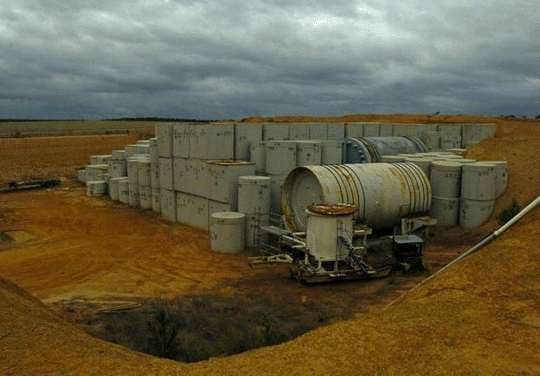
But the site criteria, such as its arid location free from seismic activity, is similar to that proposed by the Royal Commission, as is a dedicated port.
Where could a site go?
The company’s board includes former Premier’s Department chief Ian Kowalick, two Adelaide  University scientists and a former US nuclear industry executive. It is chaired by businessman Bruce Hundertmark……..In a submission to the Nuclear Fuel Cycle Royal Commission, Mr Hundertmark also highlights the fully operational air strip at Maralinga which is capable of receiving the heaviest transport aircraft……
Mr Hundertmark said his firm’s plans were quite advanced and had already included talks with state and federal governments, along with the area’s Aboriginal people, but would require state and federal legislative change.
He said his company’s plan could start far sooner than the late 2020s, because of the existing infrastructure, but did not specify a precise time frame…….http://www.couriermail.com.au/news/national/push-for-highlevel-nuclear-waste-storage-at-maralinga-former-british-atom-bomb-test-site/news-story/65d14a0d7c2f0daf90d7a5ef89da5e9f
“Stranded nuclear waste” – a problem for USA State of Connecticut
 Could this happen to South Australia?
Connecticut lawmaker pushes nuclear waste bill http://wtnh.com/2016/07/12/connecticut-lawmaker-pushes-nuclear-waste-bill/ By Keith Kountz July 12, 2016 New Haven, Conn. (WTNH)– Connecticut congressman Joe Courtney is part of a bi-partisan group of house lawmakers to introduce a bill to help communities that are struggling with the cost of storing what’s known as ‘stranded nuclear waste’.
The legislation is important to people in Courtney’s district, which includes the former home of the Connecticut Yankee nuclear power plant.
The Stranded Nuclear Waste Accountability act of 2016 would help communities cover any losses they’ve racked up associated with the storage of nuclear waste.
In a statement, Courtney says in part that ‘we cannot allow small communities and municipalities across this country to fall into financial distress because of the congressional gridlock which is holding up the establishment of a federal nuclear waste storage facility’.
Australia’s prominent role in USA’s web of climate denial

 US Senators detail a climate science “web of denial” but the impacts go well beyond their borders Australians have been both helpers and victims of the fossil fuelled web of climate science denial being detailed in the U.S Senate, Guardian, Graham Readfearn, 12 July 16, By the middle of this week, about 20 Democratic Senators in the US will have stood up before their congress to talk about the fossil fuelled machinery of climate science denial.
The Senators are naming the fossil fuel funders, describing the machinery and calling out the characters that make up a “web of denial”……
Australia has been a consumer, a contributor and a victim of the web of climate science denial.Australia has long provided personnel and contributors to the efforts of several of the key groups being named in the US Senate.
The late Dr Robert Carter, once of James Cook University, was an advisor and active contributor to several of the groups, including the Heartland Institute and the Science and Public Policy Institute (SPPI).
Malcolm Roberts (the wannabe One Nation Australian Senator) and bloggers JoNova and her husband David Evans have all written reports for the SPPI that claim human-caused climate change is some sort of elaborate hoax.
Retired Australian meteorologist William Kininmonth is also an SPPI science advisor.
Australian politicians have flown over to the United States to speak at conferences for climate science denialists hosted by the Heartland Institute – the group that once compared the acceptance of human-caused climate science to the values of terrorist and mass murderer Ted “Unabomber” Kaczynski.
Former Family First Senator Steve Fielding, current Liberal Senator Cory Bernardi and the current Nationals MP George Christensen have all spoken at Heartland’s conferences. The conferences themselves have been enthusiastically sponsored by several Australian groups over the years.
Australia’s role in the web of denial has been running since the 1990s, when groups like the CEI flew staff to Australia to firm up opposition to greenhouse gas regulations around the world.
Partnerships were formed with groups like the Melbourne-based Institute of Public Affairs, which has hosted and supported many visits from US-based climate science denialists.
Once here, those speakers will write columns for newspapers, do radio and television interviews and travel around the country to give talks.
In 2011 when the Gillard Government was trying to introduce laws to put a price on greenhouse gas emissions, the stopgillardscarbontax.com enlisted Pat Michaels, of the Cato Institute, as a science advisor. Cato is another member of the web of denial. Michaels once estimated that about 40 per cent of his funding came from the petroleum industry.
The impact of all this on the Australian public and the way the media covers climate science is clear.
There remains a split among Australians about the cause of climate change, despite multiple studies showing that more than 90 per cent of climate scientists are in agreement that it’s the burning of fossil fuels that’s driving up temperatures, fuelling weather extremes, raising sea levels, melting ice sheets and killing corals (and that’s just a few of the impacts).
The public becomes doubtful and the media, so often looking for controversy and conflict, has been a conduit for the fossil fuelled messages.
The fossil fuel companies, meanwhile, retain a grip on their so-called “social licence to operate.”
When Senator Whitehouse said the web of denial is “so big, because it has so much to protect” we might also think that we have so much to lose.
In failing to unravel the web of denial and by allowing our public discourse to be polluted by fossil fuelled PR outfits, ideologues and pseudo-science, who knows how much time we may have lost.
Twenty five years? https://www.theguardian.com/environment/planet-oz/2016/jul/12/us-senators-detail-a-climate-science-web-of-denial-but-the-impacts-go-well-beyond-their-borders
Record hottest 9 years in a row
 We just broke the record for hottest year, nine straight times http://www.skepticalscience.com/broke-hottest-year-record-9-straight-times.html 11 July 2016 by dana1981
2014 and 2015 each set the record for hottest calendar year since we began measuringsurface temperatures over 150 years ago, and 2016 is almost certain to break the record once again. It will be without precedent: the first time that we’ve seen three consecutive record-breaking hot years.
But it’s just happenstance that the calendar year begins in January, and so it’s also informative to compare all yearlong periods. In doing so, it becomes clear that we’re living in astonishingly hot times.
June 2015 through May 2016 was the hottest 12-month period on record. That was also true of May 2015 through April 2016, and the 12 months ending in March 2016. In fact, it’s true for every 12 months going all the way back to the period ending in September 2015, according to global surface temperature data compiled by Kevin Cowtan and Robert Way. We just set the record for hottest year in each of the past 9 months.
These record temperatures have been assisted by a very strong El Niño event, which brought warm water to the ocean surface, temporarily warming global surface temperatures. But today’s temperatures are only record-setting because the El Niño was superimposed on top of human-caused global warming.
For comparison, 1997–1998 saw a very similar monster El Niño event. And similarly, the 12-month hottest temperature record was set in each month from October 1997 through August 1998. That was likewise a case of El Niño and global warming teaming up to shatter previous temperature records.
The difference is that while September 1997–August 1998 was the hottest 12-month period on record at the time; it’s now in 60th place. It’s been surpassed by yearlong periods in 2005, 2006, 2007, 2009, 2010, 2014, 2015, and 2016. Many of those years weren’t even aided by El Niño events; unassisted global warming made them hotter than 1998.
Global surface temperatures are now more than 0.3°C hotter than they were in 1997–1998. That’s a remarkable rise over just 18 years, in comparison to the 1°C the Earth’s average surface temperatures have risen since the Industrial Revolution began.
This has all happened during a time when ‘no significant warming in 18 years’ has been one of the rallying cries of climate denial. In reality, when we compare apples to apples – El Niño years to El Niño years – we’ve seen more than 0.3°C global surface warming over the past 18 years, which is in line with climate model predictions. ‘Climate models are wrong’ has been another now-debunked climate denial rallying cry.
Now that the past year’s El Niño event is over, the streak of record-breaking yearlong periods appears to have ended. Nevertheless, 2016 remains on track to break that record for the hottest calendar year, for an unprecedented third consecutive year, following record years in 2010 and 2005 as well.
With the Earth warming dangerously rapidly, at a rate 20–50 times faster than the fastest rate of natural global warming, one can’t help but wonder when the influence of the small minority of disproportionately powerful climate denial groups will wane.
195 countries pledged to curb their carbon pollution in the tremendously successful Parisclimate negotiations, but climate denial is still predominant in one of America’s two political parties, and may be gaining foothold in other regions of the Anglosphere like the UK and Australia. Fortunately, many other countries like China, India, and Canada seem to be moving in the right direction with their climate and energy policies.
South Australian Labor’s push for nuclear waste importing is unravelling already
The case presented by the nuclear dumpsters is dissolving. Outspoken opposition from traditional owners is exposing, as a racist charade, the government’s attempts to manufacture “consent”.
The people of the upper Spencer Gulf cities will not be reconciled to having trainloads of lethal wastes rumbling past their doors for the next century. And the economic case for the dump scheme would merit an “F” in any respectable business course.
 Nuclear waste dump case unravels, World News Report, 13 July 16 , Green Left By Renfrey Clarke Armed with the findings of the Nuclear Fuel Cycle Royal Commission, South Australian Labor Premier Jay Weatherill is pressing ahead with plans to import as much as a third of the world’s high-level nuclear reactor waste and store it in the state’s outback.
There are compelling reasons to reject it. The project, it now emerges, could go ahead only over resistance from Indigenous traditional landowners, some of whom took part in the Lizard Bites Back convergence in early July.
There are serious environmental dangers in unloading the wastes, maintaining them above ground for decades while they cool and transporting them for final burial. Tens of thousands of people would be at risk.
Several devastating critiques have also shown that the economic case for the scheme is largely guesswork. Conceivably, the project would run at a loss — while burdening South Australians with the costs and dangers of tending to the world’s greatest single radiation hazard, effectively forever…….
Consultation?
Another element of the pro-nuclear “educational process” is to be the work of a “Nuclear Consultation and Response Agency” that will visit “all major regional centres, more than 50 remote towns and all Aboriginal communities” in a “dedicated program to ensure all South Australians can have their say about the state’s future involvement in the nuclear industry”.
There is no guarantee, however, that the massaging will work. For all the loot promised by the Advertiser, public opinion for and against the waste dump plan seems evenly split and active resistance is growing.
In mid-May Indigenous, health, union, faith and conservation groups joined in setting up a No Dump Alliance. On June 25, some 80 protestors heckled Weatherill as he arrived to address the opening session of his first “citizens’ jury”.
A 200-strong July protest at Roxby Downs, Lizard Bites Back, also condemned the government’s plan for a nuclear waste dump on Indigenous land. Spokesperson Nectaria Calan said the convergence was focused on the connections between uranium mining and nuclear waste. “A responsible approach to managing nuclear waste would begin with stopping its production”, she said.
The case presented by the nuclear dumpsters is dissolving. Outspoken opposition from traditional owners is exposing, as a racist charade, the government’s attempts to manufacture “consent”.
The people of the upper Spencer Gulf cities will not be reconciled to having trainloads of lethal wastes rumbling past their doors for the next century. And the economic case for the dump scheme would merit an “F” in any respectable business course. https://world.einnews.com/article/334731841/OM4SBscz5Dp42697
Uranium price slump further reduces ERA sales
 ERA uranium output slumps THE AUSTRALIAN JULY 13, 2016 Mill maintenance sharply reduced June quarter production by Ranger uranium miner Energy Resources of Australia.
Production for the period, characterised by a further fall in the already depressed spot price for uranium to $US26.40 a pound, slumped 18 per cent to 489 tonnes.
The 68 per cent-owned Rio Tinto subsidiary had been reduced to treating stockpiled material and was accumulating cash to cover the estimated rehabilitation cost of the mine, inside Kakadu, of more than $500 million.
Recently it reported it was holding cash of $433m, prompting Rio to offer a $100m credit facility to ensure rehabilitation costs were met…….
ERA had been planning to extend its mine life by developing the Ranger 3 Deeps deposit, but Rio and the traditional owners did not support the plan, meaning ERA’s existing Ranger authority to operate is set to end in 2021.
ERA has nevertheless preserved the option of an eventual development of Ranger 3 Deeps by committing to spending about $4m annually on care and maintenance of the exploration decline and related infrastructure.
The option was the key finding of the group’s strategic review, released in May, after it was clear the support of Rio and the traditional owners was not forthcoming.
Rio’s no-interest rehabilitation credit facility came with the condition that ERA did not seek to extend production at Ranger beyond 2020 by developing the Ranger 3 Deeps.
ERA previously said that while it expected to fully fund the rehabilitation, it might have to draw on the Rio funding in some situations…..http://www.theaustralian.com.au/business/companies/era-uranium-output-slumps/news-story/08e7df8b9a063dc6c8baa203d471f0ff
Indigenous rangers partner with scientists in researching coral bleaching
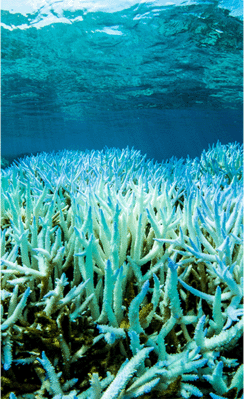 Indigenous rangers on the frontline of coral bleaching in remote Australia, ABC News By the National Reporting Team’s Kate Wild, 12 July 16 [Excellent pictures and video] In April this year Indigenous rangers from the Crocodile Islands received an alarming photograph of a coral reef off the coast of Arnhem Land. Leonard Bowaynu, who has fished the same reef since he was teenager, had seen small scattered patches of white coral before — but never anything this extensive.
“We used to go out, catch fish from the reefs. I never seen coral turning to white, like around the island or reef,” he said. Concerned by the image, rangers travelled to the area with a drone and GoPro camera to collect further evidence.
Michael Mungula said it was the first time Yolgnu people had seen the coral bleached white at that reef.
“At Murrangga [Island] we never seen white coral there before, during the 50s, 60s and 70s. But we seen it now, 2016.” “We need scientists to come here and do research in the Crocodile Islands,” Mr Mungula said. Meanwhile, 300 kilometres south-east, in waters around Groote Eylandt, Indigenous Rangers were watching giant clams turn white as well.
Anindilyakwa Rangers on Groote Eylandt began trialling the cultivation of giant blue-lipped clams (Tridacna squamosa) five years ago.
But in April the rangers noticed a number of the clams had turned white. Rick Taylor, the ranger manager, sent underwater footage of the clams to the ABC. He said it was first time he had seen the clams bleach since the trial was established in 2011.
With the two ranger groups’ permission, the ABC sent images of the Crocodile Islands coral and clams from Groote Eylandt to marine scientist Andrew Heyward at the Australian Institute of Marine Science.
Dr Heyward said the aerial photograph from the Crocodile Islands provided the first confirmation of a bleaching event in Arnhem Land. “It appears that in those areas checked it was severe,” he said. He said the photograph Crocodile Islands Rangers had received was confirmation of a massive bleaching event over the reef.
“The comments by the local rangers that they have never seen it [like this] before in their country is particularly telling that things are unprecedented, at least in human generational time frames,” Dr Heyward told the ABC……..
Skilled observers a precious commodity Dr Heyward said Indigenous rangers were able monitor environmental shifts in parts of the country most people cannot reach, and said he was keen for scientists and rangers to work together……Ranger groups have expressed enthusiasm for equal partnerships with scientists. http://www.abc.net.au/news/2016-07-11/indigenous-rangers-on-the-frontline-of-coral-bleaching/7557646
Enice Marsh at the Nuclear Citizens’ Jury – about the Federal nuclear waste dump
 “……..JUROR: Enice, you are representing all of the Adnyamathanha people.
Nuclear Waste Business Plan from Hell – South Australia

Blandy conveyed his objections to the royal commission — which substantially ignored them. Instead, the commission continued putting its trust in Jacobs MCM, which it had engaged to perform its financial modelling.
Jacobs, The Australia Institute notes, “consult extensively to the nuclear industry and have an interest in its expansion and continuation”
Nuclear waste dump case unravels, World News Report, 13 July 16 , Green Left By Renfrey Clarke “…….That the environmental and health risks posed by the international waste scheme are alarming and the economics could well be prohibitive are being ignored by the scheme’s supporters.
In its February “tentative findings” and in its May 9 final report, the state government’s royal commission set the hucksters drooling with its view that a high-level waste dump “could generate more than $100 billion income in excess of expenditure over the 120-year life of the project”.
Even this sum was too modest for the Murdoch-owned Adelaide Advertiser as it sought to herd public opinion behind the government’s plans. Working only from revenues and ignoring costs, the newspaper declared on February 17 that “a gigantic $445 billion would be pumped into the state’s finances over at least 70 years”.
The truth is that the economic case for the project rests on such wild assumptions that any competent entrepreneur would view it as a business plan from hell.
Hopes of a monster pay-out were savaged during March when The Australia Institute published a detailed analysis of the waste dump scheme.
Retired professor of economics Richard Blandy, the economic commentator for the Independent Daily, exploded the royal commission’s guesswork still more definitively on June 7.
The figure for net income of $100 billion, Blandy explained, was based on a completely fanciful estimate of the price that South Australia could expect to obtain for storing spent reactor fuel.
To obtain this estimate, of $1.75 million per tonne of heavy metal, the commission had assumed that the South Australian authorities of the future would have perfect knowledge of the maximum price that potential customers were willing to pay and that the state would face no competitors in the waste storage market-place.
The reality, as Blandy pointed out, is that India and China — to name just two countries — have extensive nuclear power industries and are highly likely to create their own waste repositories.
For these countries to add extra capacity to accommodate international customers would be relatively cheap — and much cheaper than could be managed by an Australian dump relying exclusively on imported waste.
The “$100 billion” figure also reflected an estimate that 37 countries that now have nuclear power industries — or that might someday set them up — would contract with South Australia to store 50% of their reactor waste.
But what if this estimate was grossly inflated?
If South Australia’s dump attracted only a quarter of the wastes targeted, Blandy calculated, and if the price received equalled the costs of building storage capacity in Sweden or Finland (costs, we must assume, that would be high compared to those in India or China) then the South Australian dump would lose money.
Blandy conveyed his objections to the royal commission — which substantially ignored them. Instead, the commission continued putting its trust in Jacobs MCM, which it had engaged to perform its financial modelling.
Jacobs, The Australia Institute notes, “consult extensively to the nuclear industry and have an interest in its expansion and continuation”…… plans.https://world.einnews.com/article/334731841/OM4SBscz5Dp42697
Another defeat for nuclear lobby as Japanese court blocks nuclear reactors’ restart

 Japan court again blocks restart of 2 nuclear reactors, Nikkei Asian Review, 13 July 16 OSAKA — Handed another defeat by a Japanese court on Tuesday, Kansai Electric Power likely will not be able to run any of its nuclear power plants for at least six months, a major setback for a utility facing intense competition from industry newcomers.
The Otsu District Court in Shiga Prefecture rejected the company’s objection to an injunction issued in March that suspended operation of the Nos. 3 and 4 reactors at the Takahama nuclear plant in neighboring Fukui Prefecture. The presiding judge was the same as when the injunction was issued.
The Osaka-based company had been banking on the restart of nuclear power stations for an earnings recovery. Its medium-term business plan released in April set a pretax profit target of 300 billion yen ($2.87 billion) on the assumption that most of its nuclear reactors will be back online by fiscal 2025.
Assuming that its earnings would improve by about 10 billion yen a month if the two Takahama reactors went back onstream, Kansai Electric had intended to lower its power rates to compete on a better footing with newcomers expected to enter the market following deregulation in April. But it was forced to scrap its plan to cut rates after the court ordered the two reactors — reactivated in January and February — shut down in March.
Since April, Kansai Electric has lost more than 200,000 customers to Osaka Gasand other power providers. ……..http://asia.nikkei.com/Business/Companies/Japan-court-again-blocks-restart-of-2-nuclear-reactors
1 This month

of the week – Australians for War Powers Reform (AWPR)
To see nuclear-related stories in greater depth and intensity
 Antinuclear