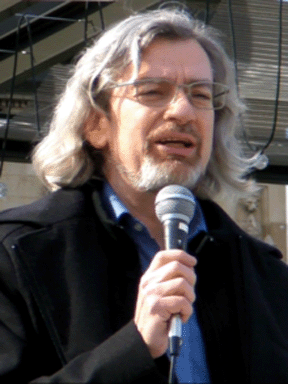
David Noonan at Parliamentary Nuclear Committee- “waste plan is based on misleading assumptions”
 JOINT COMMITTEE ON THE FINDINGS OF THE NUCLEAR FUEL CYCLE ROYAL COMMISSION
If I could make a key point of guidance for the committee’s consideration and due deliberations and any recommendations that you would make, I draw your attention to the objects of the Nuclear Waste Storage Facility (Prohibition) Act 2000 which states:
…”to protect the health, safety and welfare of the people of South Australia and to protect the environment in which they live”…
The act then goes on to prohibit certain classes of nuclear waste storage and disposal facilities. I think that recommendation, those objects to protect the health, safety and welfare of the people of South Australia and the environment in which they live, should be the overriding guidance that this committee considers in how you address the findings of the nuclear royal commission and the business case as presented by the Jacobs Consultancy which is I think the primary matter that lies behind the nuclear commission’s findings and final report.
In my opinion, the nuclear commission, the findings and the final report, and the Jacobs Consultancy on which it is heavily reliant, present a number of assumptions which effectively mislead the public.
The project is projected to be at an inflated scale which has significant consequences both for the reality of the project but also for the claimed revenues. The revenues in this matter are a tonnage-based revenue multiplier. By Jacobs proposing that the world’s largest ever nuclear waste project in the world—the Yucca Mountain project in the USA, a project which failed and was cancelled by President Obama in 2009—could be doubled in scale has a significant question as to whether that is remotely reasonable, realistic, and whether that is a matter that effectively doubles the claimed revenues for the project. If this project had started with a proposal to equal the world’s largest ever proposed nuclear waste project, then the revenues would be half what they are presented in the report—half the numbers that are presented in the report—just on that step alone, that reality test of not exceeding what has ever been envisaged before in terms of scale of nuclear waste projects around the world. The project essentially also maximises aboveground storage, and I believe that compromises safety and it is an unnecessary step.
I believe that in a more realistic scenario, in more realistic time lines where this national matter—a matter that has no mandate to proceed—a matter that would not just realise bipartisan political support at state and federal level, it also needs to realise independent oversight and federal regulation. I believe it would have to be federal regulation and not state regulation. The state could be seen to have a significant conflict of interest in attempting to regulate this matter. Overseas players, whether it is the IAEA, client countries, and the public expectations in those countries, would reasonably expect as do the international conventions that such matters of highlevel nuclear waste be managed by a federal government and a federal authority, not by state.
I think that it is reasonable to project that that independent oversight would require a number of key steps and different time lines and different decision point assumptions than what are presented in the Jacobs report and the nuclear commission findings. The key one of those, I think, is that as an absolute minimum independent oversight would require that Australia not accept high-level nuclear waste prior to having an agreed licensed site for the potential geological disposal of that waste. That is a really key fundamental step that I believe public confidence, public consent, political support and independent oversight would rely on, not just in Australia but overseas through all the levels from consent of the state at a national and international level.
That one step alone—and I would consider that a four-year safety margin in the project that proposed imports could not be envisaged to be credible prior to what the project says is year 15 where they might first realise an agreed licensed site. That four-year safety margin actually realises a 40 per cent reduction in the claimed net present value of the project. A very small step, a very small initial step, in change of time line takes off 40 per cent of the claimed net present value the project is supposed to realise for South Australia………See: http://www.parliament.sa.gov.au/Committees/Pages/Committees.aspx?CTId=2&CId=333
No comments yet.
1 This month
7 April – WEBINAR – Australia and the Doomsday Clock – Preventing nuclear war through NoFirstUse and other policies
Online | Tuesday April 7, 4:00-5:30pm, Australian Eastern Time / 8:00-9:30am Central Europe Time
– Access the registration link
15 April – Zoom –Nuclear Power is Not the Solution
Apr 15, 2026 01:00 AM in Canberra, Melbourne, Sydney

Join the International Physicians for the Prevention of Nuclear War (IPPNW) on Tuesday, April 14th for a timely webinar exploring the risks associated with nuclear power and challenging the myth that it offers a simple, safe, carbon-free solution to the climate crisis

21 April Webinar: No Nuclear Weapons in Australia
Start: 2026-04-21 18:00:00 UTC Canberra, Melbourne, Sydney (GMT+10:00)
End: 2026-04-21 19:30:00 UTC Canberra, Melbourne, Sydney (GMT+10:00)
Event Type: Virtual
A virtual link will be communicated before the event.
Host Contact Info: australia@icanw.org

of the week – Australians for War Powers Reform (AWPR)
To see nuclear-related stories in greater depth and intensity
 Antinuclear
Leave a comment