El Nino is Basically Over — But this Global Coral Bleaching Event Just Won’t End

Back in 2014, an unsuspecting world was on the verge of a major global temperature increase. But despite warnings from scientists like Dr. Kevin Trenberth that deep ocean warming had sped up and would eventually result in rapid surface warming, the big media meme at the time was that global warming had ‘paused.’ Originating in The Economist, and swiftly spreading to numerous other news outlets, this particular blast of bad information fed the public a big helping of false sense of security.
In 2014 through 2016, maximum global temperatures jumped from around 0.65 degrees Celsius to around 1 C above the 20th-century average. In just three years’ time, the whole of the Earth’s surface had warmed by about 0.35 C. This is like cramming all of the warming from 1880 to 1980 into the three-year 2014-to-2016 period. Never before in all of the global climate record starting in the late…
View original post 795 more words
The week in Australian nuclear and climate news
 It’s not too late to comment on this appalling nuclear lobby plan to make South Australia the world’s nuclear toilet. Yes, the South Australian govt will probably ignore you. However, as with Facebook, Twitter, and comments all over the place – the pro nuclear shills are active on this site, too – at http://nuclear.yoursay.sa.gov.au/discussions/nuclear-community-conversation-share-your-initial-thoughts-on-the-royal-commission-s-final-report
CLIMATE and NUCLEAR.
Federal Politics Prime Minister Malcolm Turnbull wasted no time in gifting to the nuclear and coal industries – the new Minister For Environment and Energy – Josh Frydenberg. Australia rates rather poorly on UN Sustainable Development Goals. Turnbull govt still backing Trans Pacific Partnership. Warning to Australia against being USA ‘deputy sheriff’ near China.
South Australia holding Parliamentary Inquiry in the nuclear waste importing plan. No report so far, but evidence was given by Craig Wilkins (Conservation Council Of South Australia), and by independent campaigner David Noonan.
Premier Jay Weatherill is launching a pro nuclear extravaganza. The tax-payers of this cash-strapped State are forking out at least $13 million this campaign to blanket the State with nuclear propaganda. First the Royal Commission fed them with a biased report recommending nuclear waste importing. Then a Citizens’ Jury was fed very dubious economic, health and safety information on this.
The Nuclear Fuel Cycle Royal Commission Consultation and Response Agency, (made up of nameless people) are sending out teams to 101 cities and towns to carry the pro nuclear message to the population.
Renewable energy. In South Australia the Liberal Coalition opposition appears to be behind the feeding of misinformation on wind energy, to the Murdoch media. In other States, the Coalition attacks renewable energy, and Murdoch media continues to publicise this. Nick Xenophon wants inquiry in South Australia’s renewable energy issues.
South Australia is set to get world’s biggest solar + storage project. Canberra’s solar farms with sun- tracking technology. Victoria to get record-breaking wind farm. Queensland: Catholic schools recognised by Vatican for solar energy success.
Let’s talk nuclear waste economics, the only argument that governments find persuasive
If storing nuclear waste is so lucrative how come those countries who produce it aren’t doing so?
If nuclear waste can be stored safely and effectively, won’t other countries get on board and then under-cut South Australia because they can cut out shipping costs to the other side of the world?
If spent nuclear fuel is so safe how come those countries who produce it aren’t storing it?
If the technology to store nuclear waste safely doesn’t exist, how come South Australia thinks it can do so safely?
Why does it seem to be a good idea to store this nuclear waste in volume and concentration unheard of in the history of the planet? Surely ‘spreading the risk’ by each country that produces the waste making their own arrangements is better for the health of the planet.
World markets are volatile – how can any economist predict how much countries will be willing or able to afford to pay for transport and storage of this waste in 10, 20, 50 or 100 years’ time?
Taking on this toxic waste and storing it safely becomes South Australia’s problem for hundreds of thousands of years – how can anyone guarantee that level of safety or the untold billions of dollars that it will take to keep this storage facility safe [from geological, meteorological and even ideological [terrorist] events]?
Nuclear fuel was seen as ‘the next big thing’ 40 years ago and yet the technology and the take-up of this fuel has NOT advanced in the way predicted. Why would anyone believe these ‘next generation’ reactors are just around the corner? Even the Royal Commission itself found that nuclear production of energy is unviable for the state. As it is unviable, less money will be spent in research and development and there’s less chance that ‘clean’ solutions to this poison will ever be found. Meanwhile, SA is left with the world’s largest pile of toxic waste to maintain for perpetuity.
How much will it COST to build a storage facility?
How much will it COST to maintain this facility in perpetuity?
I believe these are very valid concerns which have not adequately been answered by the Royal Commission. However, I believe the ethical considerations have much more weight.
The State Government will lose all credibility on Indigenous matters if it goes ahead with this nuclear facility. Both the state and the federal government are treating the outback as ‘terra nullis’ – an empty expanse full of ‘nothing’ where this waste can be stored out of sight and out of mind. They pay lip service to Aboriginal concerns but do not truly grasp the idea of connection to country. All of us, as human beings, are connected to country in a very real way. We can’t exist if our air and our ground and our water is polluted.
To quote EF Schumacher: The nuclear lobby “is a transgression against life itself, a transgression infinitely more serious than any crime ever perpetrated by man. The idea that a civilisation could sustain itself on the basis of such a transgression is an ethical, spiritual, and metaphysical monstrosity.” Why? Because nuclear fission [and it’s waste] “represents an incredible, incomparable, and unique hazard for human life” which “does not enter any calculation and is never mentioned.”
Like Midas, the Royal Commission is seduced by the idea of untold riches and it lacks the ethical, spiritual and metaphysical back bone to resist the nuclear lobby.

Turnbull’s gift to the nuclear and coal industries – Minister Josh Frydenberg
It’s time the Turnbull Cabinet came clean on energy http://www.sbs.com.au/news/article/2016/07/21/comment-its-time-turnbull-cabinet-came-clean-energy Forget 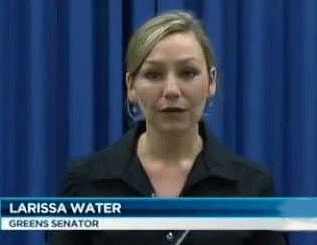 merging the environment and energy portfolios – we need Minister for the Environment and for Clean Energy, writes Senator Larissa Waters.
21 JUL 2016 – In an ideal world, combining the federal environment portfolio with the federal energy portfolio, as Malcolm Turnbull has just done in his Cabinet reshuffle, would make perfect sense.
But in today’s political context, which sees big mining companies pour mega donations into the two big parties, it’s a troubling move, especially as the responsibility for the merged ministry falls to Josh Frydenberg.
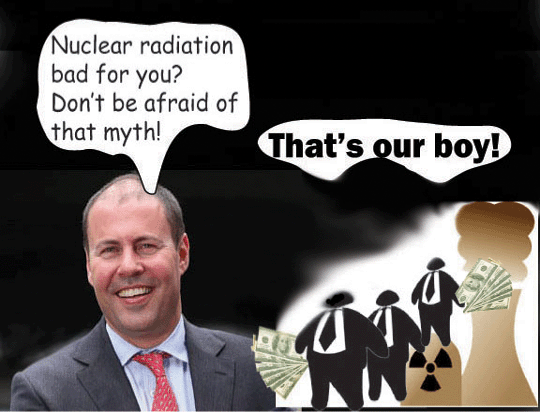
Minister Frydenberg is a well-known coal supporter who has argued for nuclear power from his first speech in the Parliament. Alarmingly, Frydenberg’s appointment could signal Malcolm Turnbull’s support for nuclear is growing since he left uranium mining, processing and storage ‘on the table’ late last year, even though nuclear power is a dangerous, expensive and slow-off-the-ground distraction from job-rich renewable energy.
As Resources Minister, Frydenberg pushed ahead with a proposed nuclear waste dump in South Australia that stands to financially benefit a landholder who happens to be a retired Liberal politician, despite opposition from Traditional Owners.
Championed by Andrew Bolt as ‘Mr Coal’, the former Resources Minister believes there is a “moral case” for the Adani mega-coal mine. He argues that the coal mine will lift people in India out of energy poverty, ignoring the fact that four out of five people without electricity in India are not connected to an electricity grid so can’t access coal-fired power.
The solution to energy poverty in India is localised renewable energy. Unlike coal, clean energy doesn’t cause millions of premature deaths every year through air pollution a year or pollute local water supplies.
Given Minister Frydenberg’s track record, his approach to his role as Environment and Energy Minister threatens to be very different from what is required to save our Great Barrier Reef and safeguard our very way of life from global warming.
To give the Reef a chance and to protect our Pacific neighbours from sea-level rise, the title really should be Minister for the Environment and for Clean Energy. We need an ambitious, rapid transition to clean energy that embraces storage technology for reliability, provides assistance to communities affected by the end of fossil fuels, and helps workers with training to benefit from this job-rich 21st century industry.
Malcolm Turnbull’s Cabinet re-shuffle gives no indication that his government is up for the task of leading this necessary national transition from dirty to clean energy. Mr Turnbull has announced the largest Cabinet team in 40 years but despite the size and the breadth of issues covered in his colleagues’ titles, climate change has been completely ignored.
Climate change is the biggest economic challenge we face and a stand-alone Minister and Department would provide a serious advantage in meeting it.
Instead climate change has been completely forgotten and environment has been relegated to a part-time role for a known coal-loving, nuclear fan.
No wonder the fossil fuel lobby is happy.
Shortly after Minister Frydenberg’s appointment was announced, The Australian Petroleum Production and Exploration Association put out a glowing media release. The Qld Resources Council executive Michael Roche said the sector had “won the trifecta”, in energy and environment and with Matt Canavan, who questions climate science while cheering on coal, taking over from Frydenberg as Resources Minister.
Some environment groups carefully expressed qualified hope that the merger of environment and energy could assist in the economic transition we so desperately need toward clean energy.
I’d love nothing more than for that to be true. However, the environment movement’s caution is well warranted, given the control fossil fuel companies exert over both the old parties.
As political donations are not disclosed in real time, we’ll have to wait for at least half a year to find out which big mining companies have donated with the aim of holding on to the polluting status quo.
From the looks of Malcolm Turnbull’s Cabinet reshuffle though, the dirty donations continue to be more than enough to keep the Prime Minister forgetting about the once-genuine concern he seemed to have for future generations surviving global warming.
Queensland Senator Larissa Waters is the Australian Greens Deputy Leader and climate change spokesperson.
Investors run from Australian uranium company, debt-laden Paladin Energy
 Paladin sold down despite $US200m in deals Peter Klinger – The West Australian on July 21, 2016 Investors have failed to applaud news from debt-laden Paladin Energy that it had struck almost $US200 million worth of deals, including offloading a big slice of its flagship Langer Heinrich uranium mine.
The news also includes a plan to sell 75 per cent of the undeveloped Manyingee uranium project east of Onslow to Chinese-backed, ASX listed tin miner MGT Resources for up to $US30 million. The Manyingee deal does not include the Carley Bore deposit.
The proposed sale of a 24 per cent stake of Langer Heinrich, in Namibia, to an unnamed party for $US175 million is the main plank of Paladin’s long-awaited debt reduction plan.
The Perth company, which remains one of the world’s few pure-play uranium producers but is fighting to remain viable because of the nuclear fuel’s long-term depressed price, has $US212 million in convertible bonds due in April next year.
Paladin is refusing to name the “major participant in the global nuclear power industry” which will buy the stake, which will cut Paladin’s interest in its only operating asset to 51 per cent.
But analysts will be focusing on China National Nuclear Corporation, which bought 25 per cent of Langer Heinrich for $US190 million two years ago.
The lack of clarity or certainty around the Langer Heinrich sale saw Paladin shares fall 2.5 cents, or 10.42 per cent, to 21.5 cents at noon on solid turnover this morning.
“The parties are using their best endeavours to prepare definitive documentation for formal execution, including (a) sale and purchase agreement, shareholders agreement, and documentation for the uranium off-take arrangements,” Paladin said.
“Paladin is working towards a formal close of the transaction in the fourth quarter (of this year). Other than set out in this announcement, the other key terms of this proposed transaction remain confidential, including the identity of the counterparty.” https://au.news.yahoo.com/thewest/wa/a/32114763/paladin-sold-down-despite-us200m-in-deals/#page1
Wind down for the “dirtiest industry” – uranium mining in Africa
 Uranium is the dirty underbelly of nuclear – scientist , Engineering News, BY: NEWS24WIRE, 21 july 16 Anti nuclear sentiment tends to focus on nuclear waste or operational risks, but more focus should be on the “dirty underbelly” of uranium mining, according to a science adviser.
“Whenever people get excited about nuclear power stations, they kind of forget where the actual uranium comes from,”Dr Stefan Cramer, science adviser for environmentalist groupSafcei, told Fin24 in an interview recently.
“Nuclear is a fallacy, both economically and environmentally,” Cramer, who was born in Germany but not now lives in Graaff-Reinet, claimed. “Uranium mining is the dirty underbelly of this whole nuclearcycle,” he said. “It’s where it all starts.”
“One must stop nuclear industries in (their) tracks because it leaves future generations with an immeasurable task and legacy,” he said. “The best point to start is at the source, where the whole cycle of nuclear technology begins, and that is at uranium mining.
“Uranium mining is very much the dirtiest part of the entire industry.” Anti-uranium mining boost
Cramer’s focus on anti-uranium mining was given a boost this month when Australian company Tasman Pacific Minerals Limited said it is downsizing its mining application in South Africa by almost 90%.
“Overall, the area covered by Tasman’s new and existing mining right and prospecting right applications in the Western and Eastern Cape will reduce by almost 300 000 ha to approximately 465 000 ha,” it said…… http://www.engineeringnews.co.za/article/uranium-is-the-dirty-underbelly-of-nuclear-scientist-2016-07-21
Canberra’s solar farms with sun- tracking technology
Mr Han says the ACT’s solar projects are small, but internationally the industry is indebted to Australia.
“In China scales are much bigger, ultimately the solar voltaic cell is actually Australian technology that was originally developed out of the University of NSW,” Mr Han said. “That technology was commercialised in China as well as Europe. A lot of the technology and breakthroughs we still owe to Australia research and development.”
The proponents say the ACT is Australia’s front -runner in solar projects.
“The long term off-take agreements, or power purchase agreements, mean it has a reliable and predictable revenue stream for owners and investors, ” Mr Crockett said.
 “The ACT has proved how efficient, effective and cheap it is to transition your electricity sector, you are seeing now the Victorian Government is going to do something very similar,” Mr Crockett said.
Mugga Lane and Williamsdale solar farms to begin tracking sun by year’s end http://www.canberratimes.com.au/business/energy/mugga-lane-and-williamsdale-solar-farms-to-begin-tracking-sun-by-years-end-20160718-gq8lrg.html July 21 2016 John Thistleton
A GPS-guided pile-driver sinking steel posts into the ground is swiftly changing the landscape in South Canberra for a new solar farm. Continue reading
Hotter Temperatures Threaten Southeast Asian Economies
Hotter Temperatures Threaten Southeast Asian Economies: Chart http://www.bloomberg.com/news/articles/2016-07-19/too-hot-to-work, Jessica Shankleman July 19, 2016 Rising global temperatures may cost global economies more than $2 trillion by 2030, restricting working hours in some of the poorest parts of the world, according to United Nations research published Tuesday. As many as 43 countries, especially those in Southeast Asia, will experience declines in their economies because of heat stress, says Tord Kjellstrom, a director at the Health and Environment International Trust, based in Nelson, New Zealand.“With heat stress, you cannot keep up the same intensity of work, and we’ll see reduced speed of work and more rest in labor-intensive industries,” he said.

Australia rates rather poorly on UN Sustainable Development Goals
 Australia ranks 20th on progress towards the Sustainable Development Goals, The Conversation, John Thwaites July 21, 2016 Australia may be home to some of the world’s most liveable cities, but we have a long way to go to meet the world’s Sustainable Development Goals (SDGs).
Australia ranks 20th in the world – well behind Canada and many European countries but ahead of the United States – according to a new index that compares different nations’ performance on the SDGs, which were adopted last September.
Launched at this week’s United Nations SDG talks in New York, the index marks each country’s performance towards the 17 goals. These aim to put the world on a more sustainable economic, social and environmental path, and feature 169 targets to be met over the next 15 years in areas such as health, economic growth and climate action.
The ranking, called the SDG Index and Dashboard and prepared by the UN Sustainable Development Solutions Network and the German think tank Bertelsmann Stiftung, ranks countries’ performance using a set of 77 indicators.
Australia: good water, bad energy
Australia, with some of the world’s highest carbon emissions per person, rates poorly on the clean energy and climate change goals. It also falls down on the environmental goals, with high levels of solid waste and land clearing as well as loss of biodiversity…….
The SDG Index will be updated regularly to improve its quality and coverage and allow people around the world to measure progress against the goals. Australia’s plan for implementing the SDGs within Australia is not yet clear and this will be an important item on the agenda for the re-elected Turnbull government. https://theconversation.com/australia-ranks-20th-on-progress-towards-the-sustainable-development-goals-62820
United Nations Sustainable Development Goals report 2016
The Sustainable Development Goals report 2016 http://apo.org.au/resource/sustainable-development-goals-report-2016 Department of Economic and Social Affairs (United Nations)20 July 2016
This agenda is a road map for people and the planet that will build on the success of the Millennium Development Goals and ensure sustainable social and economic progress worldwide. It seeks not only to eradicate extreme poverty, but also to integrate and balance the three dimensions of sustainable development—economic, social and environmental—in a comprehensive global vision.
Bendigo proposal for waste to energy generation
Bendigo councillor wants to turn waste to energy, Bendigo Advertiser, Joseph Hinchliffe@joe_hinchliffe Council will discuss a plan to build central Victoria’s first waste-to-energy incinerator on Wednesday night. 18 July 16
At this week’s council meeting, a notice of motion will be tabled by councillor Helen Leach that the City of Greater Bendigo investigate the establishment of a regional high intensity incinerator facility to dispose of and process non-organic and non-recyclable household and commercial waste to produce energy……
Cr Leach has invited the managing director of Phoenix Energy, Peter Dyson, to speak to councillors and city staff in August about the possibilities for a waste-to-energy incinerator in the region.http://www.bendigoadvertiser.com.au/story/4038251/plan-to-turn-waste-to-energy/
2 million new jobs in developing world – potential for solar-LED lighting
 Modern off-grid lighting could create 2 million new jobs in developing world, Eureka Alert, 20 July 16 Berkeley Lab study assesses employment impact of widespread conversion to solar-LED lighting in developing countries DOE/LAWRENCE BERKELEY NATIONAL LABORATORY Many households in impoverished regions around the world are starting to shift away from inefficient and polluting fuel-based lighting–such as candles, firewood, and kerosene lanterns–to solar-LED systems. While this trend has tremendous environmental benefits, a new study by Lawrence Berkeley National Laboratory (Berkeley Lab) has found that it spurs economic development as well, to the tune of 2 million potential new jobs.
Berkeley Lab researcher Evan Mills, who has been studying lighting in the developing world for more than two decades, has conducted the first global analysis of how the transition to solar-LED lighting will impact employment and job creation. His study was recently published in the journal Energy for Sustainable Development in a paper titled, “Job creation and energy savings through a transition to modern off-grid lighting.”
“People like to talk about making jobs with solar energy, but it’s rare that the flip side of the question is asked–how many people will lose jobs who are selling the fuels that solar will replace?,” said Mills. “We set out to quantify the net job creation. The good news is, we found that we will see many more jobs created than we lose.” Continue reading
Nuclear-free New Zealand – sound law, sound policy
Nuclear-free has ‘served us well’ – Geoffrey Palmer, Radio New Zealand, 22 July 16 An architect of New Zealand’s once contentious anti-nuclear law says it remains the right approach for the country.
The law is in the spotlight as preparations begin for the first visit by an American warship since the landmark legislation was passed in 1987.
Under the law, the Prime Minister must make an assessment of whether the ship will breach New Zealand’s ban on nuclear weapons and nuclear power.
The US has not sent a naval ship since 1983, as it refuses to say whether its ships are nuclear-armed, as required by New Zealand’s nuclear-free law.
The deputy prime minister at the time the nuclear-free law was passed, Sir Geoffrey Palmer, told Morning Report the policy, and the law behind it, was sound…….http://www.radionz.co.nz/news/national/309192/nuclear-free-has-‘served-us-well’-geoffrey-palmer
1 This month
7 April – WEBINAR – Australia and the Doomsday Clock – Preventing nuclear war through NoFirstUse and other policies
Online | Tuesday April 7, 4:00-5:30pm, Australian Eastern Time / 8:00-9:30am Central Europe Time
– Access the registration link
15 April – Zoom –Nuclear Power is Not the Solution
Apr 15, 2026 01:00 AM in Canberra, Melbourne, Sydney

Join the International Physicians for the Prevention of Nuclear War (IPPNW) on Tuesday, April 14th for a timely webinar exploring the risks associated with nuclear power and challenging the myth that it offers a simple, safe, carbon-free solution to the climate crisis

21 April Webinar: No Nuclear Weapons in Australia
Start: 2026-04-21 18:00:00 UTC Canberra, Melbourne, Sydney (GMT+10:00)
End: 2026-04-21 19:30:00 UTC Canberra, Melbourne, Sydney (GMT+10:00)
Event Type: Virtual
A virtual link will be communicated before the event.
Host Contact Info: australia@icanw.org

of the week – Australians for War Powers Reform (AWPR)
To see nuclear-related stories in greater depth and intensity
 Antinuclear
South Australian government’s YOUR SAY website, Megan Riley 22 Jul 2016 Let’s talk economics, the only argument that governments find persuasive: