South Australia is targeted for five nuclear dumps and high level waste processing
 SA is targeted for five nuclear dumps and high level waste processing
Brief by David Noonan, Independent Environment Campaigner
The Nuclear Royal Commission recommended SA pursue nuclear waste storage and disposal “as soon as possible” – requiring five waste dumps and a high level nuclear waste encapsulation processing facility.
The Final Report Ch.5 “nuclear waste” and the Findings Report (p.16-20) are reliant on a consultancy “Radioactive waste storage and disposal facilities in SA” by Jacobs MCM, summarised in Appendix J.
SA is targeted for above ground high level nuclear waste storage, without a capacity to dispose of wastes, exposing our society to the risk of profound adverse impacts, potential terrorism and ongoing liabilities.
The State government is in denial on the importance of nuclear waste dump siting by claiming social consent could be granted before we know what’s involved in siting up to five nuclear dumps across SA.
Affected regions and waste transport routes are fundamental pre-requisites to transparency and to an informed public debate on potential consent to take any further steps in this nuclear waste agenda.
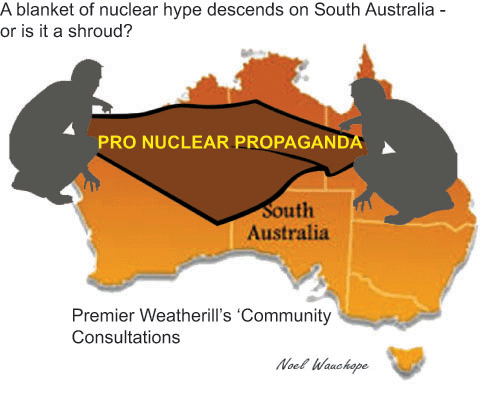
First: a dedicated new deep sea Nuclear port is to receive waste ships every 24 to 30 days for decades, to store high level waste on site following each shipment, and to operate for up to 70 years.
The coastal region south of Whyalla and north of Tumby Bay is the likely location for this Nuclear port.
South Australia is targeted for a globally unprecedented scale of high level nuclear waste shipments. Some 400 waste shipments totalling 90 000 tonnes of high level waste and requiring 9 000 transport casks are to be brought into SA in the first 30 year period of proposed Nuclear port operations.
This is in excess of the global total of 80 000 tonnes of high level nuclear waste shipped around the world in the 45 year period from 1971 to 2015, according to the World Nuclear Association report “Transport of Radioactive Materials” (Sept 2015) and the Jacobs MCM consultancy (Feb 2016, p.152).
Second: an above ground nuclear waste Storage facility is to take on approx. 50 000 tonnes high level waste before a Disposal facility could first start to operate in Project Year 28 (Jacobs p.5 Fig.3).
SA is proposed to import high level waste at 3 000 tonnes a year, twice the claimed rate of waste disposal (Jacobs p.114), with storage to increase to 70 000 tonnes. The Store is to operate for up to 100 years.
The Nuclear Commission budgeted to locate the waste Storage facility 5 to 10 km from the Nuclear port.
The Nuclear port and above ground waste Storage facility are to be approved in Project Year 5, ahead of pre-commitment contracts for 15 500 tonnes high level waste in Year 6 and waste imports in Year 11.
South Australia needs to know the proposed region for siting the Nuclear port AND whether the nuclear waste Store is to be adjacent to the port (likely on Eyre Peninsula) or sited in the north of SA.
Third: a Low Level Waste Repository for burial of radioactive wastes derived from all operations including final decommissioning of all nuclear facilities is proposed to be located in north SA. This Repository has a nominal waste burial capacity of 80 000 m3 of radioactive wastes (Jacobs p.144). This is some eight times the total scale of the proposed National Radioactive Waste Repository.
Black people are disproportionally harmed by global warming and fossil fuel pollution
 ‘World can’t afford to silence us’: black church leaders address climate
  change
One of the largest and oldest black churches in the US warns that black people are disproportionally harmed by global warming and fossil fuel pollution, Guardian, Oliver Milman, 24 July 16, African American religious leaders have added their weight to calls for action on climate change, with one of the largest and oldest black churches in the US warning that black people are disproportionally harmed by global warming and fossil fuel pollution.
The African Methodist Episcopal church has passed its first resolution in its 200-year history devoted to climate change, calling for a swift transition to renewable energy.
“We can move away from the dirty fuels that make us sick and shift toward safe, clean energy like wind and solar that help make every breath our neighbors and families take a healthy one,” states the resolution, which also points to research showing that black children are four times as likely as white children to die from asthma.
“Damage to our climate puts the health of children, elderly, and those with chronic illnesses at greater risk and disproportionately impacts African Americans. We believe it is our duty to commit to taking action and promoting solutions that will help make our families and communities healthier and stronger,” stated Bishop John White, president of the council of bishops of the AME church.
The resolution follows an open letter sent by African American clergy last year that called for political leaders to take “bold action to address climate change”……..
Dupont-Walker said that the church’s voter mobilization campaign will work throughout the 2016 election cycle to question candidates on climate change. Local officials and landlords will also be put under pressure over inadequate housing and infrastructure that helps spread pollution to black communities.
According to the NAACP, African Americans emit far less carbon dioxide per person compared with white people and yet will bear the brunt of heat-related deaths, due to the concentration of black people in cities…….https://www.theguardian.com/environment/2016/jul/24/african-methodist-episcopal-church-climate-change-letter
Questions about Senator Sean Edwards’ nuclear waste proposal
 Nuclear Fuel Cycle Watch, Andrew Allison July 21 Rumour has it that once of the anonymous countries that Sean Edwards will not name is South Korea. One might speculate about where the money for Sean Edwards’ very glossy submission to the NFCRC came from? ….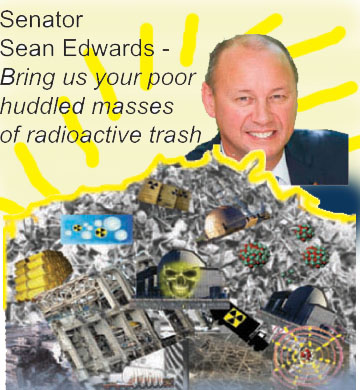
I have many reservations about Sean Edwards’ proposal, but two obvious questions come to mind:
1/ If the deep-underground storage of nuclear waste is a “solved” problem and South Australia can supposedly acquire and implement the technology at low cost (leading to high profits…) then why can’t South Korea do that?
2/ If the generation IV reactors are going to solve the waste storage problem then why can’t an advanced technological country like South Korea do that? https://www.facebook.com/groups/1021186047913052/
Nick XenophonTeam backs 40pc renewables
Xenophon party backs renewables but wants Senate electricity inquiry The Australian July 25, 2016
NXT federal MP Rebekha Sharkie, who won the Adelaide Hills seat of Mayo from Liberal Jamie Briggs, said the party was committed to the renewables target, but NXT wanted a Senate inquiry into electricity prices “so we can get the arguments on the table and look to a solution”.
Ms Sharkie believed a second interconnector between South Australia and the eastern states could help the situation, though it had been discussed for 15 years without action…….http://www.theaustralian.com.au/news/nation/xenophon-party-backs-renewables-but-wants-senate-electricity-inquiry/news-story/3a2920c0274a22994f377395acb6b5bc
Solar and battery mini grid hits the suburbs

Australian Mini-Suburb ‘Tesla Town’ Project with Powerwalls gives a glimpse into future sustainable communities, Electrek, Nathaniel Kobza, 15 July 16 Near Melbourne, Australia lies an incredible suburban project underway dubbed Yarrabend. This development is currently home to 60 houses and is planned to eventually hit around 2500. What is unique about this venture is not only the art, food or shopping that will be near it, but that all of the houses will come standard with Tesla Powerwalls and solar panels. Via the Heidelberg Leader, Nick Marinakis, sales and marketing manager of the Glenvill development team for Yarrabend, states that the suburb…
will achieve the highest possible ESD rating under the UDIA (Urban Development Institute of Australia) Envirodevelopment scheme, a first for an infill development site in Melbourne.
UDIA’s chief executive, Danni Addison, said that a big reason that this will receive the highest rating is because it will “be one of the most environmentally sustainable developments in Australia.” Further, Ms. Addison goes on to explain:
Some areas that are a standout include water reduction of 43 per cent, landfill reduced by 80 per cent and the potential to reduce energy use by 34 per cent. The Powerwalls, combined with solar panels, will mean that future residents will be able to benefit in a variety of ways, including dramatically smaller power bills and knowing that the majority of their energy usage is coming from a clean and renewable source…….http://electrek.co/2016/07/15/australian-mini-suburb-tesla-town-project-with-powerwalls-gives-a-glimpse-into-future-sustainable-communities/
USA nuclear weapons base in Turkey – a target for terrorism
Coup attempt in Turkey raises a nuclear concern at US air base. Incirlik Air Base was an operational centre of the attempted coup. It is also America’s largest foreign stockpile of nuclear weapons. South China Morning Post, 24 July, 2016 A little more than 100 miles from the territory held by Islamic State, there is a little piece of Americana. It has an eight-lane swimming pool, a baseball diamond and housing tracts built on carefully manicured cul-de-sacs.
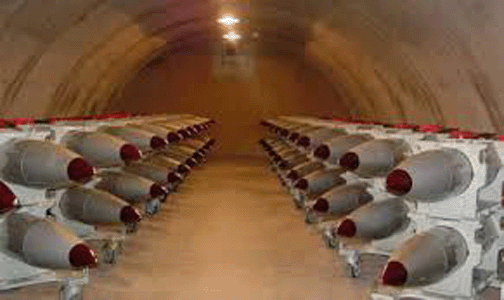
The Incirlik Air Force Base in Turkey has some other American assets: several dozen B61 thermonuclear warheads. The base has been a linchpin in Nato’s southern flank for more than half a century, the staging ground for US anti-terrorism missions and the fight against Islamic State. Continue reading
New Zealand sticks to its anti-nuclear resolve
NZ’s nuclear resolve, Otago Daily Times, 25 Jul 2016 “……In 1987, Labour passed the New Zealand Nuclear Free Zone, Disarmament and Arms Control Act, meeting an election promise.
In a largely symbolic response, the US Congress retaliated with the Broomfield Act, downgrading New Zealand’s status from ally to friend.
Former prime minister David Lange said if the security alliance was the price New Zealand must pay to remain nuclear-free, it was the price the country was prepared to pay.
In 1989, 52% of New Zealanders indicated they would rather break defence ties than admit nuclear-armed ships. By 1990, National had signed up to the anti-nuclear stance.
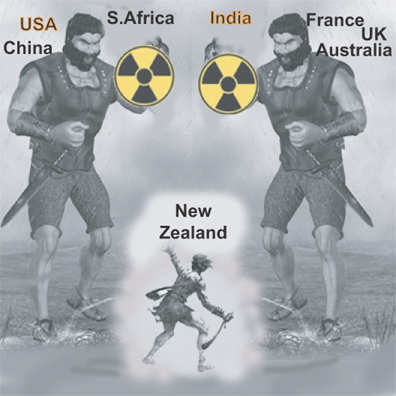
There the situation has remained until Mr Biden accepted an invitation for the US to send a ship to the Royal New Zealand Navy’s 75th birthday in November……..
New Zealand is consistently said to have made a difference in peace-keeping activities around the world, being an independent thinker when it comes to solving complex security issues.
New Zealand is part of the Five Eyes intelligence sharing network.
Although New Zealand is not seen as reliable as Australia as an ally, it does have qualities which it can bring to any situation.
So despite the urging of Mr Key, the return to New Zealand waters by a US ship in November cannot be taken lightly. It is a win for the resolve of Kiwis to keep this country nuclear free.
It is not known if the US ship will be a warship or something tamer.
Under New Zealand’s law, Mr Key has to sign a declaration he is satisfied the ship complies with New Zealand law, something he says he has done about 40 times since he became prime minister.
Publicly available information will make it possible for watchers of maritime issues to identify if the ship is nuclear-armed or nuclear-powered……..http://www.odt.co.nz/opinion/editorial/391403/nz-s-nuclear-resolve
1 This month
Chernobyl: The Lost Tapes – A good documentary on Chernobyl on SBS available On Demand for the next 3 weeks– https://www.sbs.com.au/ondemand/tv-program/chernobyl-the-lost-tapes/2352741955560
15 April – Zoom –Nuclear Power is Not the Solution
Apr 15, 2026 01:00 AM in Canberra, Melbourne, Sydney

Join the International Physicians for the Prevention of Nuclear War (IPPNW) on Tuesday, April 14th for a timely webinar exploring the risks associated with nuclear power and challenging the myth that it offers a simple, safe, carbon-free solution to the climate crisis

21 April Webinar: No Nuclear Weapons in Australia
Start: 2026-04-21 18:00:00 UTC Canberra, Melbourne, Sydney (GMT+10:00)
End: 2026-04-21 19:30:00 UTC Canberra, Melbourne, Sydney (GMT+10:00)
Event Type: Virtual
A virtual link will be communicated before the event.
Host Contact Info: australia@icanw.org

of the week – Australians for War Powers Reform (AWPR)
To see nuclear-related stories in greater depth and intensity
 Antinuclear