The week in Australian nuclear and climate news
 I’m having a little trouble, concentrating this week. It’s bad enough that Australia is ignoring the nuclear threat, and the climate change threat. These are national, global matters – at least we will, as Tom Lehrer said “all go together when we go”. However, the news on how this country, this government, supports utter cruelty to children, especially Aboriginal children, and to refugees, – this personal barbarism to individuals – how on earth can Australians ignore this?
AUSTRALIA
Independent inquiry finds that the ABC is not biased.
BHP Billiton’s costs for Brazil mine disaster – $3 billion and rising.
Back at the nuclear/climate front –
CLIMATE. Well, our new coal/nuclear enthusiast Resources Minister Josh Frydenberg has been making some pro renewable energy noises. I could almost feel sorry for him, although I can’t stand him, because he’ll be under attack now from the incumbent energy industry. The Turnbull government is unlikely to stand up to the coal and nuclear lobbies, and their bought friends in Parliament. Complete ecosystem collapse in sections of Great Barrier Reef.
NUCLEAR. Taxpayers left with the bill for cleaning up uranium mines. Australian uranium miner Paladin questioned by Australian Securities Exchange.
As usual it’s all about SOUTH AUSTRALIA. They’re having Parliamentary Inquiry into nuclear waste importing. No need to get excited about this – the Committee members include 5 pro nuclear MPs and one anti-nuclear (Mark Parnell of The Greens). Global nuclear industry promoters influencing SA nuclear waste plan.
Meanwhile the government has launched its nuclear publicity juggernaut – this very day. Fortunately South Australian Greens prevented a law that would give full rein to taxpayer funded nuclear promotion.
The Nuclear Fuel Chain Royal Commission is promoting the nuclear waste import plan to TAFE students, in what is looking like a very biased session.
South Australian Nuclear Royal Commission Did Not Give The Citizens’ Jury The Full Picture . Meanwhile, Nuclear Weathervane Weatherill wavers on his anti – referendum stance.
RENEWABLE ENERGY.
- Wind and solar are NOT responsible for the doubling of wholesale energy prices in South Australia.
- Canberra solar project co-located with wind farm.
- Queensland’s Mt Emerald wind farm – construction to start in December.
- Tough new guidelines for New South Wales wind farms.
- Nick XenophonTeam backs 40% renewables.
- Solar and battery mini grid hits Melbourne suburbs.
Wakaya Traditional Aboriginal Owners steadfast against fracked gas pipeline
 NT Traditional Owners walk out on fracked gas pipeline deal Lock The Gate Alliance, July 28, 2016 Northern Territory Traditional Owners whose land is being targeted for the proposed new gas pipeline between Tennant Creek and Mt Isa have yesterday afternoon walked out of a joint Central and Northern Land Council meeting, pushing against a planned access route deal for Jemena’s Northern Gas Pipeline, due to concerns about the impacts of fracking gasfields.
A Land Council notice for the meeting asked, ‘are you ready to say yes or no to the pipeline?’ (see here). But the concerns and objections raised by Traditional Owners about the rushed consultation process and the proposed pipeline’s reliance on fracked gas has now meant the decision meeting is postponed until late September……
A final investment decision on the pipeline is due in December 2016 but Wakaya Traditional Owners say they will not back down and allow the project to proceed on their land. Continue reading
Do you support Australia as world’s nuclear dump? Tell The Advertiser!
 Robyn for the Nuclear Free SA Coalition, 29 July 16
 The Advertiser is asking a number of questions about whether you support the nuclear dumps or not. I encourage you to fill it in if you can.

Nuclear Weathervane Weatherill wavers on his anti – referendum stance
 SA nuclear waste dump referendum vote still possible, Premier Jay Weatherill says http://www.abc.net.au/news/2016-07-28/referendum-on-sa-nuclear-waste-dump-still-possible/7668412 By political reporter Nick Harmsen The South Australian Government may not be in a position to make a final decision on whether to pursue an international high-level nuclear waste dump this year, Premier Jay Weatherill has said.
The Premier has previously said the Government’s plans to make a decision clear to parliament in November.
But Mr Weatherill today told a budget estimates committee any decision this year was likely to be just the first step. “I’d like to be in a position to make a decision about whether we’re able to pass the first threshold,” he said.
“And there is an important go/no-go threshold that needs to be considered by the parliament.”
The Government has assembled a series of citizens’ juries to help inform its decision.
Mr Weatherill told the committee he would not rule out holding a referendum on the nuclear issue.
But he said a referendum would not provide the level of nuance required. “In particular, some green groups are calling for a referendum,” he said.
“Of course they’re the same green groups that don’t want a referendum on gay marriage. But leaving aside that little internal inconsistency for the moment, I think I [a referendum] tends to close down debate rather than allow it to be developed.”
Philip White reports onNuclear Royal Commission’s presentation to TAFE students
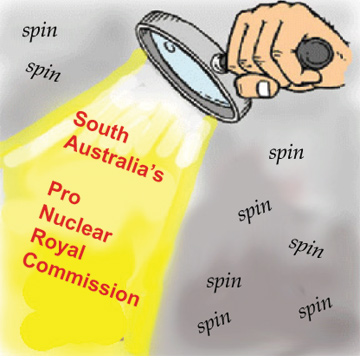 Philip White, 28 July 16 A video consultation session for TAFE staff and students was held on July 28 from 12-1pm. Below is a brief report.
The session started with a 15 minutes Scarce presentation video. I think it was from the press conference for the release of the RC report, but am not sure. One thing that struck me was how Scarce used words like ‘trace’ to imply that the amount of radionuclides after 1,000 years would be negligible.
John Phelan of the Nuclear Fuel Cycle Royal Commission Consultation and Response Agency (CARA) followed up with comments about process.
I was one of only two knowledgeable participants, the other being a nuclear proponent who wanted the dump to go ahead quickly and thought the costs were exaggerated. He thought in a few years we would need nuclear reactors.
A couple of regional TAFE lecturers complained about the lack of notice (meaning they hadn’t read the email sent to all staff and students) and lack of information (meaning they hadn’t been picked up in the RC’s regional propaganda tours). One lecturer confused this with the Commonwealth dump, thinking it would be located near her property in Quorn. John Phelan clarified that this consultation was just about an international dump.
2. Process
I made the following points about process:
(1) These consultations (and also the educational materials they apparently plan to provide to schools) should include presentations both for and against the proposal. Without that the public does not have a basis for thinking critically.
(2) The first Citizens’ Jury was flawed because it was inappropriate for it to be tasked with summarising the RC report.
(3) Referring to the forthcoming second “Citizens Jury”, a 350 person group should not be called a Citizens Jury.
Re (2), Phelan had said in his initial presentation that summarising the RC report was a (the) role of the first Citizens Jury, encouraging people to read this wonderful synopsis.
Members on this email list may recall that I have previously pointed out this flaw of the first citizens jury. I went to the trouble of ringing Iain Walker of NewDemocracy about this. He said the jurors were told to “prioritise” not to “summarise”. I then pointed out that the first sentence of their report says “summarise”. Walker said it was not the organisers’ role to change what the jury wrote, implying that the jury members had misinterpreted their role. But in today’s video conference Phelan was completely clear that they were asked to “summarise”. In my view, asking a Citizens Jury to summarise (or even prioritise) an official document is an abuse of the Citizens Jury method. Citizens Juries are a method of gaining incite into the judgements of informed citizens. They should not be used to help the government (or the Royal Commission) communicate its message.
Re (1), Phelan showed no interest in taking on board my suggestion that all consultations should include presentations from both pro and con perspectives. He responded that they were trying to present facts not opinions, claiming that the RC report was factual. I pointed out that the RC report was not a factual document. It is a selection of facts and perspectives, that there were lots of facts and perspectives that were left out, and that the report reflected the biases in the makeup of the RC.
I suspect that there is some confusion in the government about what it is trying to do with this public consultation process—whether it is trying to stimulate an informed debate, or whether it is just trying to persuade the public to let it build the international nuclear waste dump that it already knows it wants.
It is counter-intuitive for governments and bureaucracies to promote critical thinking among the public, but I suggest we challenge them to give equal time to critics and proponents. When they refuse, then we can call them out. We will have proof that their process was a sham. In the unlikely event that they agree to this demand, we should accept it in the confidence that we can win this argument. Of course, it would be difficult for critics to resource such a project, but we can cross that bridge when we come to it.
3. Waste dump
I pointed out that cost estimates for nuclear projects are generally gross underestimates and that SA would be left with a huge financial and nuclear burden if the costs end up exceeding the revenues. There would be no way of sending the waste back to the countries of origin.
Is South Australia so desperate that it would become the world’s nuclear toilet?
The Royal Commission did say most of the really dangerous stuff will have dissipated in 500 years. So South Australia should be relatively OK somewhere around 2600.
if this state is known for anything globally, it will likely be as “that place that takes all the world’s dangerous crap’’
Should South Australia be home to the world’s largest nuclear waste dump?
IS there any greater sign that we have given up as a state than to volunteer to become a receptacle for some of the most dangerous material on the planet? Is there anything that says “We have completely run out of ideas” quite like becoming the place where nuclear waste fuel rods spend their retirement years?
There is a famous quote on the Statue of Liberty that proclaims “Give me your tired, your poor, your huddled masses yearning to breathe free’’. Perhaps we could put something similar on the Mall’s Balls.
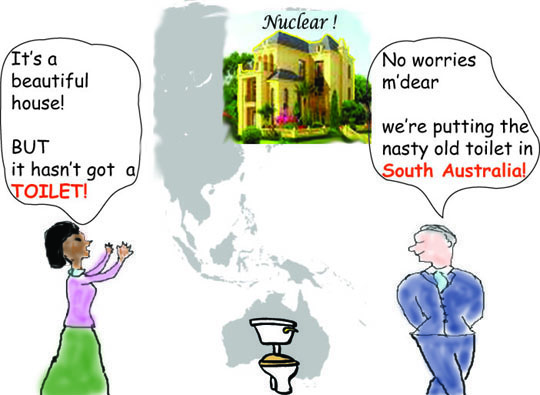
“Give me your poison, your chemicals, your radioactivity, we’ll breathe them for you.’’ Continue reading
UK’s Hinkley nuclear white elephant- triumph of politics over economic reality
Areva, the French state-owned company which makes the reactors, is being taken over by EDF but it is being investigated by France’s Nuclear Safety Authority over “irregularities” in 400 parts. Areva also faces a state aid investigation.
Even many of the staff inside EDF think Hinkley is a colossal white elephant. The company’s unions, who are represented on the board, fear the project will sink the company and have started legal action to delay the decision, while its finance director resigned in March.
For Hinkley, as with Brexit itself, political chicanery has triumphed over economic reality.
 Hinkley’s nuclear plant fails all tests – bar the politics https://www.theguardian.com/environment/damian-carrington-blog/2016/jul/28/hinkley-point-c-nuclear-plant-fails-all-tests-bar-the-politics
Huge, expensive and difficult to build, Hinkley is a throwback to the last century, just as the world is embracing the smart energy systems of the future, Guardian, Damian Carrington, 29 July 16 The new nuclear reactors now given the go-ahead at Hinkley Point have failed every test bar the one that finally mattered – political expediency.
The plant, to be paid for by UK energy customers, could cost them £37bn and is a leading contender for the most expensive object ever built on the face of the Earth. A former Conservative energy secretary calls it “one of the worst deals ever” for Britain.
It faces formidable commercial, technical and legal obstacles to getting built remotely on time or budget, or indeed at all. And while the rest of the world is accelerating ahead with the smart energy systems of the 21st century, Hinkley is a throwback to the nuclear age of the 20th.

But the French government, which majority-owns Hinkley’s builders EDF, wants to preserve its national nuclear industry. The UK government, blinded by the dazzle of a mega-project, is happy to let its citizens pick up the bill. Continue reading
Climate models accurately predicting ocean and global warming,
since 1992, the models have been within 3 % of the measurements. In my mind, this agreement is the strongest vindication of the models ever found, and in fact, in our study we suggest that matches between climate models and ocean warming should be a major test of the models
 Climate models are accurately predicting ocean and global warming, Skeptical Science 27 July 2016 by John Abraham
For those of us who are concerned about global warming, two of the most critical questions we ask are, “how fast is the Earth warming?” and “how much will it warm in the future?
The first question can be answered in a number of ways. For instance, we can actually measure the rate of energy increase in the Earth’s system (primarily through measuring changing ocean temperatures). Alternatively, we can measure changes in the net inflow ofheat at the top of the atmosphere using satellites. We can also measure the rate of sea-level rise to get an estimate of the warming rate.
Since much of sea-level rise is caused by thermal expansion of water, knowledge of the water-level rise allows us to deduce the warming rate. We can also use climate models (which are sophisticated computer calculations of the Earth’s climate) or our knowledge from Earth’s past (paleoclimatology).
Many studies use combinations of these study methods to attain estimates and typically the estimates are that the planet is warming at a rate of perhaps 0.5 to 1 Watt per square meter of Earth’s surface area. However, there is some discrepancy among the actual numbers.
So assuming we know how much heat is being accumulated by the Earth, how can we predict what the future climate will be? The main tool for this is climate models (although there are other independent ways we can study the future). With climate models, we can play “what-if scenarios” and input either current conditions or hypothetical conditions and watch the Earth’s climate evolve within the simulation. Continue reading
BHP Billiton’s costs for Brazil mine disaster – $3 billion and rising
 BHP Billiton’s Samarco costs top $3 billion, ABC News By business reporter Stephen Letts, 28 July 16, Mining giant BHP Billiton has doubled its provisions for the Samarco mine disaster in Brazil to well in excess of $3 billion.
BHP said it will recognise another provision in the range of $US1.1 to $US1.3 billion ($1.5 to $1.7 billion) on top of $US1.2 billion ($1.6 billion) charge already announced in its half-yearly results in February.
That charge, along with several other asset write-downs, caused BHP to report a record $7.8 billion interim loss.
In a statement to the ASX, BHP said the new provision is approximately equivalent to its 50 per cent share of the current estimate of the Samarco compensation deal struck with Brazilian federal, state and municipal authorities in March.
However, that funding agreement – which was intended to restore and repatriate the community and environment affected by the tailings dam collapse – remains in limbo, having being suspended by Brazil’s Supreme Court last month.
The BHP statement noted the provision reflected the ongoing uncertainty surrounding the nature and timing of a potential restart of the Samarco operations.
The charge will be recognised as an exceptional item in the forthcoming results, together with direct costs of around $US100 million ($133 million)…….http://www.abc.net.au/news/2016-07-28/bhp-billiton-samarco-costs-top-3-billion-dollars/7668832
Josh Frydenberg talks renewable energy – but no action from this government
Coal fan Frydenberg’s figleaf fluttering in the wind
Environment and Energy minister Josh Frydenberg is claiming to be a convert to the cause of renewables but the grim truth is that this government has no interest in meaningful climate action., Crikey, Bernard Keane Alarmed at the criticism of his appointment as combined energy and environment minister, Josh Frydenberg has launched a media campaign to overhaul his image as that of the man who recently insisted there was a “strong moral case” for burning more coal and starting economically unviable new coal mines like Adani’s Carmichael project (not to mention his loathing of environmental groups).,… (subscribers only) https://www.crikey.com.au/2016/07/28/frydenberg-on-renewables-and-coal-but-no-real-action/
Renewables not to blame for South Australia’s electricity papers – says Energy Minister Josh Frydenberg
 Frydenberg says renewables not to blame for South Australia energy “crisis”, REneweconomy By Giles Parkinson on 28 July 2016 Josh Frydenberg, the minister newly elevated to the combined energy and environment portfolio, says that renewable energy was not to blame for the recent energy “crisis” in South Australia, although he did deliver some mixed messages about how the government proposes to move forward.
Frydenberg delivered a series of interviews on Wednesday, the first since he was appointed to the new position in a reshuffle by the re-elected Turnbull government, and this included a “chat” with ABC personality Annabel Crabb at a dinner function at the Clean Energy Summit.
Asked about the recent electricity spikes in South Australia, Frydenberg said it was a “complex picture” that included a reduced capacity on the inter-connector, a cold snap that spiked demand, a big shift in gas prices, and the “intermittency issue about wind and solar.”
But he also noted that in 2008, as RenewEconomy has reported, the price of wholesale electricity in South Australia peaked above $5,000/MWh more than 50 times. That was before wind and solar were in that state, he said, and noted there had only been three such peaks so far this year.
“People have to understand that this volatility is not a new thing. It was back there in 2008 …. so to say that (this price spike) is the fault of renewables is not an accurate assessment,” Frydenberg said, to the applause of the audience of around 400 people.
This, however, was not how The Australian interpreted events, who attributed Frydenberg’s comments about the crises in South Australia and Tasmania as a “wake-up” call about the problems created by wind and solar.
Tasmania, it should be remembered, suffered the highest wholesale prices in Australia last financial year because its electricity supply was restricted by the loss of the Basslink cable and much of its hydro capacity due to drought. Most analysts say it was its lack of investment in wind and solar that forced it to rely heavily on expensive back-up gas and diesel…….
Frydenberg appeared well briefed, non-confrontational, and recognised the growing role of technologies such as wind, solar and battery storage whose costs had fallen quickly and would continue to do so. He also appeared to be listening, people said.
The role of coal, Frydenberg accepted, is declining, and the transition to clean energy is inevitable. But he was reluctant to put any time frames on the inevitable move to zero emissions technology, apart from saying that a shift to 100 per cent renewable energy was not going to happen overnight.
But while his comments were soothing for an industry just regaining its confidence after being battered and bruised by the first term of the Abbott-Turnbull government and the key policy decisions of Frydenberg’s good friend, the previous environment minister Greg Hunt, his next moves will be scrutinised intensely.
There is great concern about a push by the incumbent energy industry, such as the Energy Supply Council to force state governments to abandon their individual state targets, a move that will be strongly resisted by South Australia, Victoria, Queensland and the ACT……..http://reneweconomy.com.au/2016/frydenberg-says-renewables-not-to-blame-for-south-australia-energy-crisis-75546
Wind and solar are NOT responsible for the doubling of wholesale energy prices in South Australia
South Australia’s ‘absurd’ electricity prices: renewables are not to blame, Guardian
Tristan Edis, 28 July 16
Wind and solar are not responsible for the doubling of wholesale energy prices in SA – that’s just part of the spin that says renewables are expensive. Reading many of the newspapers over the past few weeks you’d think South Australia had become a horrible case study in the dangers of too much renewable energy……
Politicians are now responding, with Liberal Senator Chris Back calling for a ban on new wind farms until after a review by the Productivity Commission. Meanwhile Senator Nick Xenophon’s party are backing a Senate inquiry.
Yet everyone has missed the main cause of a doubling in SA power price rises – a doubling in gas prices.
What makes it all especially worrying is the blame attributed to renewable energy appears to have originated from a public relations campaign initiated by the lobby group for the big power generators………
wholesale market data suggests renewable energy has actually been depressing power prices, not increasing them. In the months before and after the Northern Coal Power Station was taken off-line, South Australia’s wind farms, without exception, bid their entire available output into the market for a price less than a single dollar. Meanwhile rooftop solar doesn’t even bid into the market, with its output just reducing the demand for generators that do bid into the wholesale market.
This is not to suggest renewable energy imposes no costs. It is certainly true that wind and solar require a subsidy, but its cost is distributed equally across all electricity consumption around the nation via the federal RenewableEnergy Target scheme. It isn’t allocated to states depending on how many wind farms or solar panels they have installed.
The idea that renewables are to blame for the doubling in South Australian wholesale prices is an idea the Australian Energy Council, which represents big power companies, have been pushing since late last year. This campaign has sought to paint South Australia as an “accidental experiment” in the dangers of too much renewable energy.
If you scratch the surface they actually acknowledge renewable energy is depressing wholesale power prices. But they claim it pushes prices so low that, rather strangely, it is apparently increasing prices……..
It was only with the addition of wind and solar to the existing mix of coal plus the interconnector that gas could be driven down to less than a third of the electricity market. This acted to substantially shield SA from power price rises, not induce them.
So it is LNG plants, not wind and solar, that are responsible for South Australia’s “absurd” electricity prices. https://www.theguardian.com/commentisfree/2016/jul/27/south-australias-absurd-electricity-prices-renewables-are-not-to-blame
Large-scale solar the next wave of renewable energy
Jul 27 2016. The federal government has allocated more than $600 million to help large-scale solar projects get off the ground, as utility solar photovoltaic projects become the next wave of renewable energy to be embedded into the national electricity market…...(subscribers only)
http://www.afr.com/news/politics/largescale-solar-the-next-wave-of-renewable-energy-20160727-gqeo4k
Queensland’s Mt Emerald wind farm – construction to start in December
Construction Mt Emerald wind farm expected to start in December The Cairns Post July 28, 2016 CONSTRUCTION on the Tablelands’ Mt Emerald wind farm is expected to start in December, following the selection of preferred contractors for the $360 million project.
Developer Ratch Australia has awarded its wind farm contract to Dutch manufacturers Vestas and the Sydney-based Downer Group.
Vestas and Downer will share responsibility for the entire 180MW project, including supply and construction of more than 50 turbines, a substation, cabling to the grid, civil and electrical works, and wind monitoring equipment.
The announcement follows Ergon Energy’s decision to purchase all of the electricity generated by the wind farm through to the end of 2030……..http://www.cairnspost.com.au/news/cairns/construction-mt-emerald-wind-farm-expected-to-start-in-december/news-story/09b600f1c8d9b6e2a4eb929d34b27768
Tough new guidelines for New South Wales wind farms
 Tilting against windmills? Industry doubts NSW support for wind farms, SMH, Peter Hannam, 28 July 16 New wind farm guidelines are expected to impose tough requirements on developers to limit their visual impact in a move that proponents say will put NSW at a disadvantage to other states.
The proposed guidelines, requiring developers to prepare visual impact assessments according to the height of turbines, were disclosed by the planning department to a select group of prospective wind energy developers on the sidelines of a two-day clean energy summit in Sydney on Thursday. Continue reading
1 This month
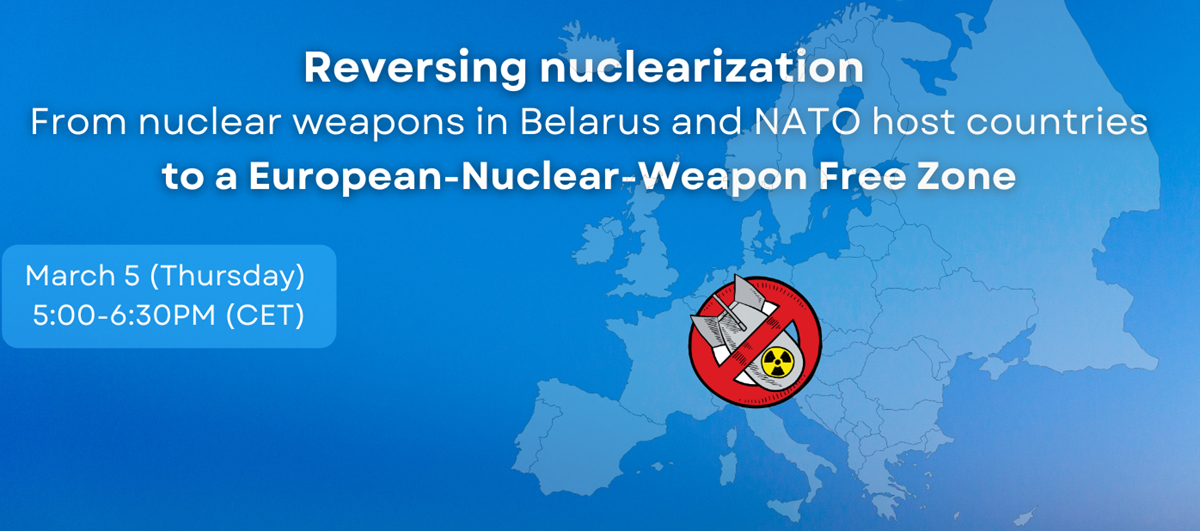
6 March -Online – Reversing nuclearization:
From nuclear weapons in Belarus and NATO host countries to a European-Nuclear-Weapon Free Zone
Mar 6, 2026 03:00 AM in Canberra, Melbourne, Sydney

of the week – Australians for War Powers Reform (AWPR)
To see nuclear-related stories in greater depth and intensity
 Antinuclear