Philip White reports onNuclear Royal Commission’s presentation to TAFE students
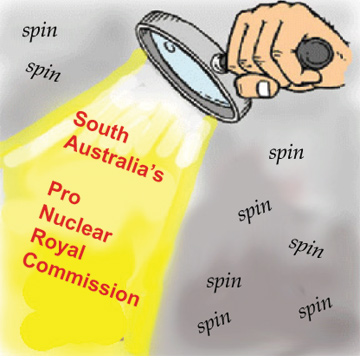 Philip White, 28 July 16 A video consultation session for TAFE staff and students was held on July 28 from 12-1pm. Below is a brief report.
The session started with a 15 minutes Scarce presentation video. I think it was from the press conference for the release of the RC report, but am not sure. One thing that struck me was how Scarce used words like ‘trace’ to imply that the amount of radionuclides after 1,000 years would be negligible.
John Phelan of the Nuclear Fuel Cycle Royal Commission Consultation and Response Agency (CARA) followed up with comments about process.
I was one of only two knowledgeable participants, the other being a nuclear proponent who wanted the dump to go ahead quickly and thought the costs were exaggerated. He thought in a few years we would need nuclear reactors.
A couple of regional TAFE lecturers complained about the lack of notice (meaning they hadn’t read the email sent to all staff and students) and lack of information (meaning they hadn’t been picked up in the RC’s regional propaganda tours). One lecturer confused this with the Commonwealth dump, thinking it would be located near her property in Quorn. John Phelan clarified that this consultation was just about an international dump.
2. Process
I made the following points about process:
(1) These consultations (and also the educational materials they apparently plan to provide to schools) should include presentations both for and against the proposal. Without that the public does not have a basis for thinking critically.
(2) The first Citizens’ Jury was flawed because it was inappropriate for it to be tasked with summarising the RC report.
(3) Referring to the forthcoming second “Citizens Jury”, a 350 person group should not be called a Citizens Jury.
Re (2), Phelan had said in his initial presentation that summarising the RC report was a (the) role of the first Citizens Jury, encouraging people to read this wonderful synopsis.
Members on this email list may recall that I have previously pointed out this flaw of the first citizens jury. I went to the trouble of ringing Iain Walker of NewDemocracy about this. He said the jurors were told to “prioritise” not to “summarise”. I then pointed out that the first sentence of their report says “summarise”. Walker said it was not the organisers’ role to change what the jury wrote, implying that the jury members had misinterpreted their role. But in today’s video conference Phelan was completely clear that they were asked to “summarise”. In my view, asking a Citizens Jury to summarise (or even prioritise) an official document is an abuse of the Citizens Jury method. Citizens Juries are a method of gaining incite into the judgements of informed citizens. They should not be used to help the government (or the Royal Commission) communicate its message.
Re (1), Phelan showed no interest in taking on board my suggestion that all consultations should include presentations from both pro and con perspectives. He responded that they were trying to present facts not opinions, claiming that the RC report was factual. I pointed out that the RC report was not a factual document. It is a selection of facts and perspectives, that there were lots of facts and perspectives that were left out, and that the report reflected the biases in the makeup of the RC.
I suspect that there is some confusion in the government about what it is trying to do with this public consultation process—whether it is trying to stimulate an informed debate, or whether it is just trying to persuade the public to let it build the international nuclear waste dump that it already knows it wants.
It is counter-intuitive for governments and bureaucracies to promote critical thinking among the public, but I suggest we challenge them to give equal time to critics and proponents. When they refuse, then we can call them out. We will have proof that their process was a sham. In the unlikely event that they agree to this demand, we should accept it in the confidence that we can win this argument. Of course, it would be difficult for critics to resource such a project, but we can cross that bridge when we come to it.
3. Waste dump
I pointed out that cost estimates for nuclear projects are generally gross underestimates and that SA would be left with a huge financial and nuclear burden if the costs end up exceeding the revenues. There would be no way of sending the waste back to the countries of origin.
No comments yet.
1 This month

of the week – Australians for War Powers Reform (AWPR)
To see nuclear-related stories in greater depth and intensity
 Antinuclear
Leave a comment