Nick Xenophon – only a referendum is adequate to resolve South Australia’s nuclear waste decision
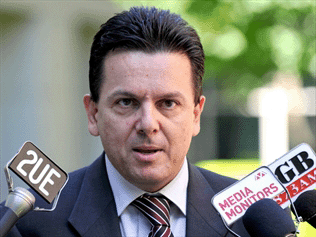 South Australian Premier Jay Weatherill says a final decision on a nuclear waste dump is still years away. SBS World News, AAP 29 JUL 2016
The state government on Friday launched a three-month community consultation program on the recommendations rising from a Royal Commission into the Nuclear Fuel Cycle…….Mr Weatherill says whatever the outcome of that process, a final decision on the dump is still some way off, and will be proceeded by a series of “gated decisions” to move ahead cautiously…….
But South Australian independent Senator Nick Xenophon said only a referendum of all South Australian voters would be adequate for such a momentous decision.

“Because once we have a nuclear dump, that’s it. We will be known as the nuclear dump capital of the world,” he said.
South Australian Greens MP Mark Parnell also criticised the consultation process which he said had ignored the history of failures, cost overruns and risks associated with waste storage.
“The government says it wants South Australians to have the facts, but it has chosen just some of the facts to present,” he said. http://www.sbs.com.au/news/article/2016/07/29/sa-dump-decision-years-away-says-premier
WALKATJURRA WALKABOUT continue the fight to stop uranium mining
 Walkatjurra Walkabout – Walking for Country https://walkingforcountry.com/walkatjurra-walkabout/walkatjurra-walkabout-about-us-2/
will be lead by the
Walkatjurra Rangers https://walkatjurra.com/rangers/
in partnership with
Footprints for Peace https://www.facebook.com/FootPrintsforPeace
Western Australian Nuclear Free Alliance (WANFA) https://nuclearfree.wordpress.com/
the Anti Nuclear Alliance of Western Australia (ANAWA) http://www.anawa.org.au/ and
the Conservation Council of Western Australia (CCWA) http://www.ccwa.org.au/
Wiluna to Leonora from August 7th – September 7th 2016
https://walkingforcountry.com/walkatjurra-walkabout/
 ‘WALKATJURRA WALKABOUT is a celebration of Wangkatja country, a testament to the
strength of the community who have fought to stop uranium mining at Yeelirrie for over forty years, and a chance to come together to continue share our commitment to a sustainable future without nuclear.
It is a chance to reconnect with the land, and to revive the tradition of walking for country.’
‘We invite all people, from all places, to come together to walk with us, to send a clear message
that we want the environment here, and our sacred places left alone.’ Kado Muir, Traditional Owner, Yeelirrie
Three jeers to Today Tonight Adelaide reporter, Hendrik Gout
100% Renewables for SA Three jeers to Today Tonight Adelaide reporter, Hendrik Gout, turning the people he interviewed – fans of solar power in to seeming solar dislikers. Never let the truth get in the way of good fear-mongering story?
Could Mr Gout’s former job have something to do with it?

On Monday, the Adelaide branch of the Seven Network’s daily current affairs program, Today Tonight, ran with a similar anti-renewables slant, as it has done before. And, like much of the Murdoch media’s reporting, its chock full of errors.
The program opened by recalling South Australia’s November 2015 black-outs – a predictable starting point for a renewables witch hunt, considering that was the reaction of the mainstream media back when the outages occurred.
According to Today Tonight Adelaide reporter, Hendrik Gout, “the November night the lights went out” happened because of the “state’s reliance on ‘unreliant’ energy”.
Never mind that this is simply not true. As we reported at the time, “there was only one technology that abandoned its post on Sunday evening, and that was the massive transmission line linking Victoria and South Australia.”
And, as the Australian Energy Market Operator later concluded in a report, the black-out caused by a switch failure lasted much longer than needed because a gas-fired generator failed to follow instructions, causing the system to trip again. The blackout had nothing to do with renewables at all.
That claim should not be a surprise coming from Gout, who was a former senior staffer for South Australia Liberal David Ridgway, the party’s leader in the upper house.
The Coalition in South Australia is notoriously anti-wind, feeding rubbish data to The Australian last week that had to be retracted. Ridgway is also the instigator of an ongoing upper house inquiry into wind energy.
Gout’s program went on to interview two different South Australian business operators: one a farmer/irrigator in the Riverland region who complained – not without reason – that the state’s high power prices had made his business less competitive; and one a micro-brewer on the Murray, who similarly seemed to suggest that power supply difficulties had restricted the growth of the business.
But something didn’t quite gel with these interviews, so we decided to talk to the people ourselves……….
When we asked Beavis why the 30kW PV system wasn’t mentioned in the Today Tonight report, he told us in an emailed statement: “Our solar project was one of the main points I was aiming to get across. But from viewing the piece, it seemed to get lost in the edit.”
Beavis also told us that the solar system offsets 100 per cent of the brewery and houseboats’ power consumption……..http://reneweconomy.com.au/2016/today-tonights-misleading-report-renewables-south-australia-85014
Hillary Clinton and Democrats pledge huge mobilisation on climate action, if elected
Hillary Clinton will mobilise a global effort on a scale not seen since the second world war to tackle climate change, if elected US president in November.
Gov. Jerry Brown: ‘Climate change is the existential threat of our time
That became official Democrat policy on Wednesday at the party’s national convention in Philadelphia.
Within 100 days of assuming office, Clinton promises to bring together engineers, scientists, policy experts and activists “to chart a course to solve the global climate crisis”. The party called for a clean energy revolution and a federal investigation into fossil fuel companies accused of misleading the public about the risks of climate change.
It did not embrace all the most climate hawkish proposals, rejecting a carbon tax, fracking ban and climate test for new energy infrastructure.
California governor Jerry Brown used his speech to drive home the divide between Clinton and Republican nominee Donald Trump on global warming. “Combating climate change, the existential threat of our time, will take heroic efforts,” he said. “You would not know it to listen to Donald Trump.”
Trump did not mention climate change once in his 76-minute speech to last week’s Republican convention and recently denied that California was experiencing a drought, Brown noted: “Trump lies.”
Brown also rejected the idea there is a trade-off between economic growth and green policies, pointing out California is outpacing the US economy while embracing carbon cutting plans.
USA Democratic Convention – over 10,000 climate protesters demand action

 Over 10,000 Climate Protesters March in Philadelphia on Day Before Democratic National Convention DeSmog Blog By Sharon Kelly • Monday, July 25, 2016 Thousands of climate activists, public health advocates and others arrived in the streets before the first day of the Democratic National Convention, despite blazing heat that was just one degree shy of the hottest July 24 on record in Philadelphia. With temperatures in the mid-90s, a crowd that organizers estimated included over 10,000 marchers converged on Independence Mall near the home of the Liberty Bell.
“We’ve just wrapped up a Republican National Convention filled with climate denial and extreme energy talking points. Tomorrow we start the Democratic Convention, and the question to all these leaders and politicians is: Are you willing to take the action that science demands, or are you just another kind of climate denier?” said Drew Hudson, Director of Environmental Action. “Science tells us we need to keep 80% or more of fossil fuels in the ground: that means a ban on fracking, a halt to dirty trade deals like the TPP, and no more use of eminent domain for polluter gain. I’m marching today to tell all elected officials, if you’re not down to #KeepItInTheGround, you’re just another climate denier.”
Many of the protesters were local — noteworthy in a city long regarded as a Democratic stronghold. ……..
The protests in Philadelphia were already larger than those that confronted Trump and the Republican party in Ohio, according to those who attended both events. No arrests were reported on Sunday in Philadelphia, though one person was transported by ambulance to receive medical care for heat exhaustion.
At one point, the crowd of marchers nearly stretched the full length of the route between City Hall and Independence Mall.
“Our elected leaders must listen to the people,” said Wenonah Hauter, Executive Director of Food & Water Watch, one of the main organizers of the protest, “which is why over a thousand groups from all 50 states endorsed the March for a Clean Energy Revolution and called for the need to keep fossil fuels in the ground and focus on renewable energy options that will create jobs, not destroy lives.” http://www.desmogblog.com/2016/07/25/over-10-000-climate-protesters-march-philadelphia-day-democratic-national-convention
World’s Largest Nuclear Station – UK’s Hinkley C plans stalled!

 Plans to Build World’s Largest Nuclear Plant on Hold, EcoWatch, Climate News Network 29 July 16 The British government astonished the nuclear industry late last night by refusing to go ahead with plans to build the world’s largest nuclear plant until it has reviewed every aspect of the project.
The decision was announced hours after a bruising meeting of the board of the giant French energy company EDF, at which directors decided by 10 votes to seven to go ahead with the building of two 1,600 megawatt reactors at Hinkley Point in Somerset, southwest England………
critics of the controversial project were delighted. John Sauven, the executive director of Greenpeace, said: “Theresa May now has the chance to stop this radioactive white elephant in its tracks.”
“She should look at the evidence and see that this deal would be a monumental disaster for the taxpayers and the bill payers. Countless experts have warned that for British families this power station will be terrible value for money, Sauven added.”
Until last night, the UK was the most positive country in Europe about nuclear power and planned to build a total of 10 nuclear power plants, Hinkley Point being the first of them. This was despite the fact that nuclear costs continue to escalate while its main competitors—renewables of all kinds—fall in price.
The Hinkley Point project is now more expensive than offshore wind power, which is the most expensive renewable and is far more costly than solar and onshore wind. Biogas and small-scale hydro projects in Britain, all so far underdeveloped, are also cheaper than nuclear…….
Safety Fears
The price of all renewables is going down as they develop, while the price rises for nuclear power, with safety fears and threats from terrorism pushing costs up.
It is also argued, even by the UK’s national electricity grid, that the day of the large power plant is over, to be replaced by small local generators providing electricity near to homes and factories—something that renewables are ideally suited for.
Even France, which has 58 reactors and is building a Hinkley prototype at Flamanville in Normandy, has no plans to build any more. All its new energy projects are renewables and it has plentiful supplies of untapped wind and solar power, which are cheaper……..http://www.ecowatch.com/plans-to-build-worlds-largest-nuclear-plant-on-hold-1949913505.html
Effect of global warming on Antarctic could be amplifying climate change
Earth’s ability to absorb CO2 reduced by global warming, Antarctic study finds http://www.abc.net.au/news/2016-07-29/global-warming-reduces-earth-co2-absorption-arctic-study/7673032 By Stephanie Smail Global warming reduces the amount of carbon dioxide the earth can absorb, which could amplify climate change, landmark research in Antarctica has revealed.
CSIRO researchers extracted ice bubbles in pre-industrial polar ice to measure the planet’s sensitivity to changes in temperature.
They found that for every degree Celsius of global temperature rise, the equivalent of 20 parts per million less CO2 is stored by the land biosphere.
CSIRO principle research scientist Dr David Etheridge said the research confirmed the relationship for the first time and revealed how it impacted the cycles of carbon between land, ocean, and the atmosphere.
“That’s useful to know. It’s a bit concerning because it’s going to amplify the climate change, but it’s good news in a way because it can be used in modelling.”
The research team used ice core samples from the Australian Antarctic Program’s unique Law Dome site, together with ice cores from the British Antarctic Survey.
The study focused on CO2 changes preserved in ice before, during, and after a naturally-cool period known as the Little Ice Age (1500 to 1750 AD).
“It gives global planners something to work with, to help estimate what CO2 emissions are allowable to limit global warming to one and a half or two degrees Celsius,” Dr Etheridge said.
The finding is a result of a collaboration between CSIRO, the Seconda Universita di Napoli, University of Melbourne, British Antarctic Survey, University of East Anglia, Australian Antarctic Division, University of Tasmania, and the Australian Nuclear Science and Technology Organisation.
Electricity industry in a panic about renewable energy’s success
Disruptive power, The Age, Richard Denniss , 29 July 16 The Productivity Commission is  criticising the Trans Pacific Partnership, the head of the Australian Competition and Consumer Commission is criticising privatisation, and the electricity industry is worried that competition from renewables might deliver lower prices to consumers. What on earth is happening to the Neo-liberal “agenda”?
We are witnessing a watershed moment in Australia’s economic and political debate. The grand narrative of “market good-government bad” is dead. Killed by the rent seekers and vested interests that couldn’t resist overselling the benefits to the same consumers and taxpayers they were busy gouging.
The mining industry can’t help asking for taxpayers to subsidise their rail lines…….
It’s hard to maintain the argument that government spending is bad for the economy when even the Institute of Public Affairs supports taxpayer funding for dams and coal railway lines in far northern Australia…….
The PC, which now refers to so-called “free trade agreements” as “preferential trade agreements”, recently said that the TPP includes provisions of “questionable benefit” to Australia. It was once heresy to suggest that a document called a ”free trade agreement” could do anything other than facilitate trade, but now the Lefties at the PC are encourage us to scrutinise the detail. Rules matter…….
the banks, the mining companies and the media moguls that shouted the loudest about “free markets” have always spent up big on lobbyists to ensure they got the rules they wanted. But now the cat is out of the bag. …….
As more and more batteries are installed in homes and businesses the peak load on the transmission network will be reduced, meaning that we will be able to save billions of dollars on line upgrades within and between towns and cities. Should that windfall accrue to those with an obligation to maintain the network, to the people who install the batteries, or be shared in some way? Rules matter……..
South Australia has cheaper electricity today than it had in 2007. There were no black outs during the so-called “crisis” and the vast majority of residential and industrial customers who are on long-term contracts didn’t even notice the five-minute surges in the wholesale spot price. When the interconnector upgrade is complete, and if a new interconnector with NSW is built, not only will SA be able to rely on more power from other states when the wind is calm, but SA will be able to export a lot more cheap energy when the wind does what it usually does in SA which is blow hard.
The fear that SA may soon be an even bigger exporter of cheap wind power is what is behind the recent “debate”. Their best chance to protect their profits is to ensure that the “market regulations” restrict the growth prospects for their main competitors. Rules matter. After years of getting the rules they wanted by arguing that they simply wanted “free markets” Australian rent seekers are now forced to win public debates about why we should give them the rules they want. It’s not going well for them.
Richard Denniss is the chief economist for The Australia Institute. http://www.theage.com.au/comment/disruptive-power-20160728-gqgazk.html
Desperate coal industry sponsors attacks on wind farms
 Coal is behind the attacks on wind turbines. It’s fighting for its life, The Age, Peter Martin, 27 July 16
First they were supposed to be destroying birds, then sleep. Now wind turbines are being blamed for destroying the Australian electricity market and pushing prices as high as $14,000 per megawatt hour.
As Victoria gives the green light for a massive $650 million wind farm with up to 104 turbines at Dundonnell, 200 kilometres west of Melbourne, and with talk of more wind farms in NSW a Liberal senator has been calling for a moratorium on new turbines until the Productivity Commission examines what they are doing to prices.
“There should be no further subsidies paid for an intermittent and unreliable power source that can be seen as as proven failure,” Senator Chris Back is quoted as saying, in an apparent attempt to prejudge the inquiry he is calling for.
On the face of it, it’s an odd idea: that adding a new and very cheap source of power should push up prices (wind turbines cost next to nothing to operate). And for the record, it’s not true. South Australia has more wind turbines than any other state. They supply more than one-third of its power. Yet a graph prepared by the Australian National University’s Hugh Saddler shows that South Australia’s average electricity price was much higher when they only provided 10 per cent.
The complaint is about spot prices, those instant short-lived prices the big industrial users have to pay if they haven’t insured against sudden movements, as a lot have not………
With fewer coal-fired plants, and with wind plants scattered throughout the nation, the system has the potential to work surprisingly well. Energy analyst David Leitch points out that in South Australia most of the wind turbines fire up at the same time, but if they were also placed in northern NSW and Tasmania (where the wind blows at very different times) each would fill the other’s gaps.
South Australia and Tasmania overlap only 10 per cent of the time. At other times, the gap would be filled by storage: either batteries or water storage as wind power pumps water up to the top of mountains while the wind’s abundant and lets it drop through hydro plants when it’s not.
Wind needn’t be a problem, regardless of what you’ve been told. But it does leave very little role for coal, which supplies base load power for which a wind-dominated system would have little use.
With fewer coal-fired plants, and with wind plants scattered throughout the nation, the system has the potential to work surprisingly well. Energy analyst David Leitch points out that in South Australia most of the wind turbines fire up at the same time, but if they were also placed in northern NSW and Tasmania (where the wind blows at very different times) each would fill the other’s gaps.
South Australia and Tasmania overlap only 10 per cent of the time. At other times, the gap would be filled by storage: either batteries or water storage as wind power pumps water up to the top of mountains while the wind’s abundant and lets it drop through hydro plants when it’s not.
Wind needn’t be a problem, regardless of what you’ve been told. But it does leave very little role for coal, which supplies base load power for which a wind-dominated system would have little use. http://linkis.com/www.theage.com.au/co/1H46Y
Cosmic radiation increases heart disease risk to stronauts
 Cosmic radiation: Apollo astronauts 5 times more likely to die from heart disease, says study Rt.com 29 Jul, 2016 The first study of Apollo astronauts – the only people to have traveled beyond Earth’s protective magnetic shield – has found that those who ventured to the moon are five times more likely to die from heart disease.
The NASA and Florida State University study revealed its findings on Thursday. They state that so far three Apollo astronauts, including Neil Armstrong, the first person to walk on the moon, have died from cardiovascular disease, apparently as a result of the extreme cosmic radiation they were exposed to during their missions. The researchers concentrated on a small group for the study: 42 astronauts who flew in space, seven of whom were Apollo veterans, the other 35 being non-flight astronauts.
The study, published in the Scientific Reports journal, found that Apollo astronauts are four to five times more likely to die from cardiovascular disease death than astronauts who either never entered space or only flew on low-altitude missions.
“These data suggest that human travel into deep space may be more hazardous to cardiovascular health than previously estimated,” it said. https://www.rt.com/usa/353865-apollo-study-heart-disease/#.V5smTINhh9Q.facebook
The influence of mining companies on governments, especially Queensland
Greasing The Wheels: Report Lays Bare Extraordinary Govt Access For Queensland Miners, New Matilda By Hannah Aulby on July 29, 2016 There’s something rotten in the state of Queensland, and it smells a lot like gas and mining. Hannah Aulby explains.
There is little doubt that the mining industry enjoys a higher level of access and influence over government in Australia than the average citizen. It’s often difficult to measure exactly how far that influence extends, but at other times it becomes glaringly obvious.
A report released today by The Australia Institute and the Australian Conservation Foundation shows that the influence of the mining industry on government in Queensland is systematic and ongoing.
The report, ‘Greasing the Wheels: the systematic weaknesses that allow undue influence of mining companies on government, a Queensland case study’, provides six case studies of mining companies using political donations, high level political access, gifts and the ‘revolving door’ to influence legislation in their favour.
It shows that Beach Energy, Sibelco, Karreman, New Hope, Adani and Linc Energy have all received favourable treatment from government including retrospective mining project approvals, revocation of environmental protections and reversals of party mining policies.
These case-studies are just the tip of the iceberg. In recent days Linc Energy and QRC have provided fresh insights into a frightening trend…… https://newmatilda.com/2016/07/29/greasing-the-wheels-report-lays-bare-extraordinary-govt-access-for-queensland-miners/
India’s troubled nuclear power programme – a bonanza for USA business?
A study by the U.S.-based Institute for Energy Economics and Financial Analysis, that was released recently by the A.P.-Telangana-based voluntary organisation Human Rights Forum, warns India that GE-Hitachi and Westinghouse nuclear reactors are neither cost-effective nor power-efficient and that they have a huge risk factor.
This time round, the CPI(M) has decided to take up the cause in a big way. Senior party leader Prakash Karat visited Kovvada and other villages to interact with fishermen and farmers and addressed a public meeting there on July 16. The CPI(M) has given a call for a broad-based struggle against the nuclear plant at Kovvada, which Karat said would be a white elephant considering its steep projected cost. “This project is a bonanza for American business


The coast isn’t clear for India’s nuclear power quest, THE HINDU, K. VENKATESHWARLU , 28 July 16 A cluster of plants promises to turn coastal Andhra Pradesh into the country’s nuclear energy hub, but at what cost? At Kovvada, first off the blocks, K. Venkateshwarlu discovers some uneasy answers Continue reading
1 This month

of the week – Australians for War Powers Reform (AWPR)
To see nuclear-related stories in greater depth and intensity
 Antinuclear