The Nuclear Royal Commission’s sums don’t add up, but the danger is real
 SA’s nuclear debate: The sums don’t add up but the danger is very real, argues Craig Wilkins Craig Wilkins, Conservation Council SA, The Advertiser July 28, 2016 NUCLEAR DOSSIER SPECIAL REPORT: Everything you need to know about SA’s nuclear debate
LET’S be clear: the Nuclear Royal Commission is pushing a plan to make money by importing into our state high-level radioactive waste from overseas nuclear reactors.
Most people think it’s about burying this waste deep in the SA Outback.
- That’s not the half of it. Before then, waste cargo ships will enter our waters at least once a month for the next 70 years.
- After unloading, the waste will be stored above ground a few kilometres inland from our coastline for the next 80 years.
- Fifty thousand tonnes will be stockpiled in this above-ground site for around 20 years even before we know the underground dump will work.
The scale in creating the world’s largest nuclear dump site is staggering. So are the risks. It will change our state forever.
Central to the Royal Commission’s grand waste plan is an eye-popping revenue number.
However, Commissioner Scarce’s numbers are so huge it raises an equally big question: if there is so much profit in taking the world’s nuclear waste, why aren’t other countries or states rushing to do it?
Something just doesn’t add up. Either the money’s not there, or it’s a hell of a lot harder to do safely. The answer is: it’s both.
As there is no international market for high-level nuclear waste, any revenue or profit modelling is simply guesswork and assumption.
The Conservation Council of SA commissioned leading economic think tank The Australia Institute to take a deeper look at the numbers.
Far from making a motza, they found it could actually end up costing us money. Their view is backed by Professor Dick Blandy, respected Professor of Economics at the UniSA Business School.
The nuclear industry is notorious for massive cost over-runs. There are huge doubts about how much other countries are willing to pay, and how much demand there will be in the future. Also unknown is the economic impact on our other vital industries like food, wine and tourism. And taxpayers will need to spend hundreds of millions of dollars even before we know if it will proceed.
We are being told there are super-safe options for storage. We are also being told we can make enormous windfall profits.
The problem is, the gold standard level of safety the SA public rightly expects will take decades to achieve, and be ridiculously expensive, if it can be done at all.
We can try for the highest standard of safety, or we can make money, but we can’t have both.
There is no doubt there is a great deal of concern in our state about our economy and jobs for our children. But a decision for us to become the world’s nuclear waste dump should not be made in fear or desperation.
A nuclear dump is not our only choice. If we are willing to invest billions, there are many better options worth exploring, with far lower risks and many more jobs.
Taking the world’s nuclear waste is a forever decision – once we decide to do it there is no going back. We can’t change our minds or send it somewhere else. Neither can future generations of South Australians. As a proud state we can do much better. Craig Wilkins is the Conservation Council SA’s chief executive
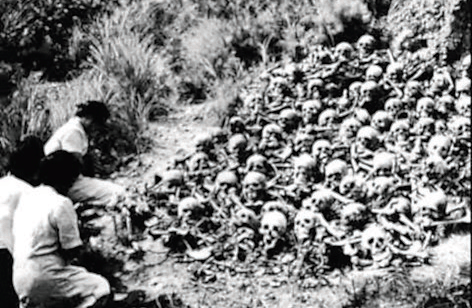
What happened in Hiroshima and Nagasaki 71 years ago
 A look at first ever use of nuclear weapons in wartime http://tinyurl.com/zjmex46 Jul 31, 2016 On August 6, 1945, the US dropped the first ever nuclear bomb on Hiroshima.
Here are a few facts about the first ever use of nuclear weapons in wartime: The uranium gun-type atomic bomb dropped on Hiroshima was called Little Boy and Nagasaki was nuked by a plutonium implosion-type bomb called Fat Man. In order to make Little Boy, the US used 141 pounds of uranium, basically all of the processed uranium that was then in existence. The US dropped about 49 practice bombs nicknamed “pumpkin bombs” that killed 400 and injured 1,200, before nuking Hiroshima and Nagasaki.
Japan has burned the Flame of Peace in Hiroshima, since 1964, in honour of the victims; it will be extinguished only when all nuclear weapons are removed from the world and the earth is free from nuclear threat.
(SOURCE: HISTORY.COM,FACTSLIDES.COM)
South Australians unlikely to support nuclear dump plan, as global anti nuclear sentiment grows
 Valdis Dunis Nuclear Fuel Cycle Watch South Australia https://www.facebook.com/groups/1021186047913052/ 1 August 16
 Given polling for just nuclear reactors is so negative now worldwide, the chances of the majority in SA bucking the trend and supporting something nuclear is low I suggest, especially for something more negatively perceived than just a reactor – the world’s biggest high-level nuclear waste dump.
“”Eight of these countries were also polled in 2005 by GlobeScan about their views, and the results suggest that there has been a sharp increase in opposition to nuclear power in five of them.
The proportion opposing the building of new nuclear power stations has grown to near-unanimity in Germany (from 73% to 90%), but also increased significantly in Mexico (51% to 82%), Japan (76% to 84%), France (66% to 83%), and Russia (from 61% to 80%)
In contrast, while still a minority view, support for building new nuclear plants has grown in the UK (from 33% to 37%), is stable in the USA (40% to 39%), and is also high in China (42%) and Pakistan (39%). These countries thus emerge as the most pro-nuclear of the countries surveyed with current nuclear plants, by some distance. Among the countries polled that do not have active nuclear plants, support for building them is highest in Nigeria (41%), Ghana (33%), and Egypt (31%).
The poll also indicates that the belief that conservation and renewable energy can fill the gap left, if there is a move away from fossil fuels and nuclear energy, is now the consensus view. Respondents were asked to say whether they thought that their country “could almost entirely replace coal and nuclear energy within 20 years by becoming highly energy-efficient and focusing on generating energy from the sun and wind,” and more than seven in ten (71%) agree that it could.”
http://www.globescan.com/…/127-opposition-to-nuclear…
Wildfires approach Hanford nuclear reservation
 Large fire burning toward Hanford nuclear reservation A fire burning on the Yakima Training Center near Moxee, shown here, has spread into Benton County near the Hanford nuclear reservation. Ronnie Butler Yakima Herald Republic Tri-City Herald,Yakima Herald-Republic and Walla Walla Union-Bulletin, 1 August 16 A large wildfire was burning toward the Hanford nuclear reservation Sunday after spreading from Grant and Yakima counties into Benton County overnight Saturday.
It was one of at least five wildfires burning Sunday in eastern Washington and Oregon, including a 1,000-acre fire that had residents evacuating a rural area near Prosser Sunday evening.
The larger Benton County fire burning toward Hanford, called the Range 12 Fire, was estimated to have burned 60,000 acres or about 94 square miles by early Sunday evening.
Sunday afternoon it was spreading across an unpopulated area between Highways 240 and 241, according to Benton County Emergency Services.
Firefighters were working to stop the fire before it reached the large wildland security zone maintained around the contaminated portion of the nuclear reservation. The security zone, which includes the peak of Rattlesnake Mountain, is part of the Hanford Reach National Monument………http://www.tri-cityherald.com/news/local/hanford/article92931342.html
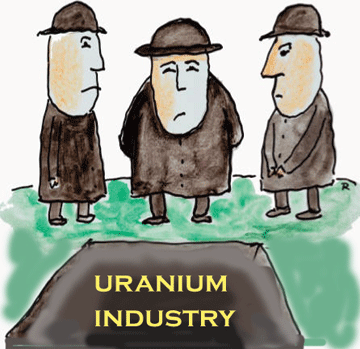
Gloom in uranium industry as global glut deepens
The price of uranium has slumped to $25 a pound, its lowest level since April 2005.
It is the worst-performing mined commodity this year. Other natural resources such as copper, coal and iron ore have gained year to date.
 Japan Nuclear-Power Jitters Weigh on Global Uranium Market Antinuclear sentiment in Japan, weak U.S. demand, rising Chinese stockpiles depress price of nuclear fuel http://www.wsj.com/articles/japan-nuclear-power-jitters-weigh-on-global-uranium-market-1469990663 By RHIANNON HOYLE and MAYUMI NEGISHI July 31, 2016
Five years ago, meltdowns at the Fukushima Daiichi power plant in Japan sparked what would become a prolonged slide in prices for uranium nuclear fuel. Today, the world’s worst nuclear disaster in a quarter-century is depressing prices again.
Antinuclear sentiment is gaining momentum in Japan with the election three weeks ago of an antinuclear governor in the only Japanese prefecture with an operating nuclear-power plant, and the likelihood that a court injunction will halt the next reactor slated to go online in August. Continue reading
Australia’s potentially powerful political constituency – solar power home-owners
Regardless of what the industry’s lobbyists and media barrackers say, renewables are cutting the cost of power and making it more reliable….
The next big threat to the old business model, however, is storage
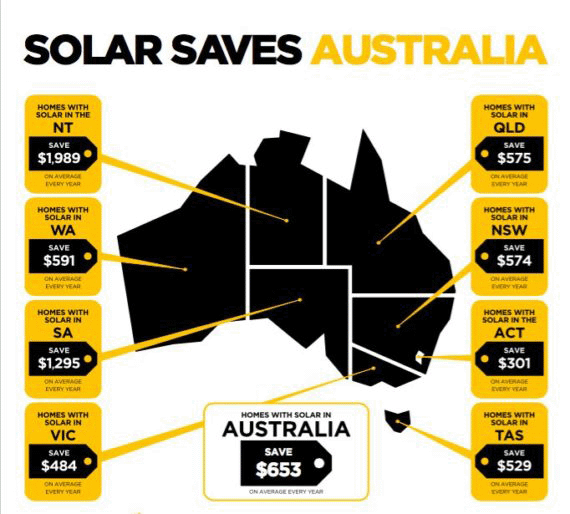
According to figures compiled by the environment group Solar Citizens before the recent election, just 2352 of the 90,000-odd voters in Frydenberg’s affluent inner Melbourne electorate of Kooyong had solar panels on their roofs.
That placed Kooyong 132nd of 150 federal electorates for rooftop solar. Kooyong is typical of what Solar Citizens found in their study of rooftop solar. More affluent electorates tend to have lower take-up rates……
out in the ’burbs, and in the rural and regional areas, rooftop solar is big. The seat of Dawson, for example, based on Mackay in North Queensland, has more than 10 times as many houses with rooftop solar as Frydenberg’s electorate. Yet voters there just returned George Christensen, a climate change denier who sits on the extreme right wing of the Nationals. Ipswich, home town of Pauline Hanson, has even more solar panels up.
Dickson in Brisbane, held by another arch-conservative, Peter Dutton, has more than 35,000 solar roofs, and the eighth-highest penetration of solar in the country. And the number one electorate for rooftop solar is the huge rural South Australian seat of Grey. There, according to Solar Citizens, some 41,000 constituents have invested $140 million to install more than 80,000 kilowatts of solar, resulting in an annual abatement of 54,000 tonnes of the main greenhouse gas, carbon dioxide. The seat is held by Rowan Ramsey for the Liberals, although he was given a nasty scare from the Nick Xenophon Team at the election. Continue reading
Savannah River Board formally rejects taking in German nuclear spent fuel casks

 Savannah River board votes to officially oppose accepting German spent
 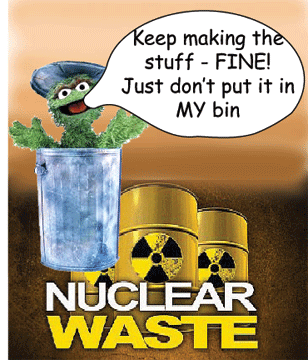 nuclear fuel, Augusta Chronicle By John Boyette NEW ELLENTON — The Savannah River Site Citizens Advisory Board is not in favor of accepting spent nuclear fuel from Germany. In two separate votes Tuesday, the group voted down a draft recommendation to accept the spent fuel and endorsed a draft position statement that opposes receiving the spent fuel for treatment and storage in the U.S.
The spent fuel, which comes from two German reactors that have ceased operations, originated in the U.S. It takes the form of about one million graphite spheres that contain uranium and thorium and are currently stored in 455 casks……. Continue reading
Britain stalls its planned nuclear white elephant – Hinkley C project
Nuclear “white elephant” on hold Independent Australia 30 July 16 Britain’s shock decision to put nuclear power station Hinkley Point C on hold, is consistent with the advice of countless experts. Paul Brown from Climate News Network reports.
THE BRITISH GOVERNMENT astonished the nuclear industry on Thursday, by refusing to go ahead with plans to build the world’s largest nuclear plant until it has reviewed every aspect of the project…….

So certain were EDF that a signing ceremony with the British government would take place today to provide the company with 35 years of subsidies for their electricity, that they had hired marquees, invited the world’s press and laid in stocks of Champagne to toast the agreement…….
EDF chief executive Vincent de Rivaz, who had pushed for the deal, cancelled a trip to Britain on hearing the government announcement.
Britain’s new prime minister, Theresa May, who had never publicly endorsed the project like her predecessor David Cameron, has clearly heeded the myriad voices outside the nuclear industry that say this is a bad deal for British consumers……https://independentaustralia.net/politics/politics-display/nuclear-white-elephant-on-hold,9300
Turkish troops have sealed off NATO’s stockpile of nuclear weapons
Reports Turkish troops have sealed off Incirlik US/NATO nuclear air base, news.com.au AUGUST 1, 2016 TURKISH citizens and police have ‘surrounded’ the Incirlik air base it operates with the United States — and where a large stockpile of NATO nuclear weapons is held — ahead of a visit by a senior US official tomorrow.
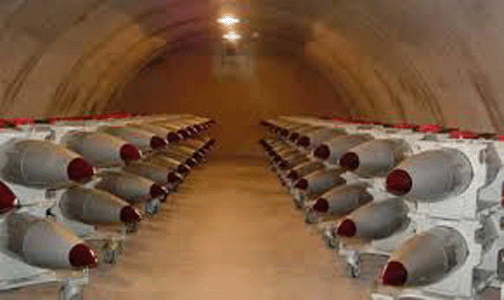
Reports out of Turkey suggest all entrances to the air base have been blocked by heavy vehicles and police sent to secure its perimeter.
The unusual nigh-time move sparked rumours of a second coup attempt on Turkish social media, with concerned citizens rushing to the air base to join the blockade.
The move comes less than a week after a top US Army general was accused by Turkish media of ‘leading’ the uprising against President Recep Tayyip Erdogan earlier this month.
But Turkish Minister for European Affairs has since reportedly sought to reassure local media, stating the mission was just a “safety inspection”…….
The air base has been a central facility in US and NATO efforts against Islamic State. It also houses a stockpile of nuclear weapons as part of NATO’s deterrence force…….http://www.news.com.au/world/reports-turkish-troops-have-sealed-off-incirlik-usnato-nuclear-air-base/news-story/4d7bb16e4e86842218b5b0d7d70f582b
South Australia’s dysfunctional National Electricity Market (NEM)
Dennis Matthews, 1 August 16 Once again, South Australia’s electricity supply is in trouble. The transition to solar and wind electricity has not been well managed, but this has as much to do with the National Electricity Market (NEM) and privatisation as it has to do with the technology.
The basic issue is one of supply and demand. Previously there was a surge in demand during heat waves, recently we had a plunge in supply. The summer surge in demand was met by gas-fired peaking power stations. A privatised electricity industry operating in an electricity market meant that these suppliers were in a monopoly position; they could and did command exorbitant wholesale prices, typically 100 times the average. Because of the NEM rules, these prices then automatically flowed on to all suppliers in the NEM.
The recent winter plunge in supply was met, under political pressure, by gas-fired power stations. Once again, the suppliers were in a monopoly position and commanded exorbitant wholesale prices.
South Australia is being held to ransom by socially irresponsible companies operating in a dysfunctional market.
Sorry Bill Gates, You Are Wrong on Renewable Energy
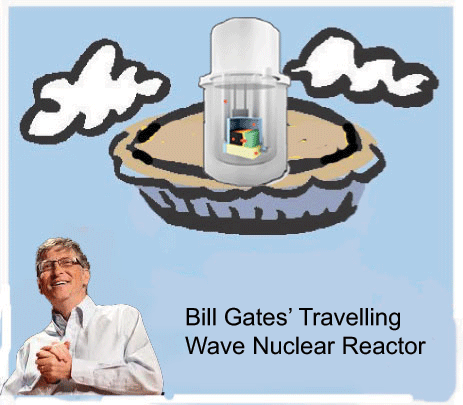 Jigar Shah rebuts Bill Gates’ fossil fuel vision for energy access in developing countries. GreenTech Media by Jigar Shah August 22, 2014 “……In 2012, I wrote in the Huffington Post that Bill Gates had zero qualifications to understand energy and its costs. I also acknowledged that I am not qualified to run a global software company.
So, Bill Gates doesn’t know much about energy outside of his vested interests in nuclear power, and I don’t know much about running a software company outside of my bumbling with my Android apps. I say this about myself even though I have helped with smart metering and oversaw the global implementation for monitoring solar systems worldwide for SunEdison.
But Bill Gates has more money and power than I, as well as a powerful — and wonderful — charity. In this instance, however, his charity is misguided. And nothing is more dangerous than misguided charity.
Gates’ misguided path starts with the fact that he cited a notorious climate confusionist, Bjorn Lomborg. Lomborg has stubbornly refused to acknowledge the fact that renewable energy is cost-competitive with fossil fuels as an energy source.
Given Gates’ stature, framing energy poverty as a climate issue reveals a depth of ignorance that poses a serious problem. So here is reality.
Ending energy poverty requires the right tool for the job: distributed energy
The truth is that an over-reliance on centralized grid extension and large-scale power plants will keep a billion people in the dark. It is time to recognize what even the IEA says is overwhelmingly necessary, but dramatically under-invested in: distributed renewable energy for those living beyond the grid.
To understand why this is so important, take a step back and consider the reaction if Gates wrote a blog suggesting that Mark Zuckerberg is a fool and that the solution for universal internet access around the world is connecting every home around the world via physical fiber-optic cable. The reaction would be riotous laughter. In emerging markets, they are busy ripping out copper and everyone is using wireless. Yet that’s exactly analogous to what Gates is proposing for energy.
No expert on energy access is paying any attention to Gates’ folly on energy for the poor…… When it comes to energy poverty, Gates is arguing for outdated and ineffective solutions that will keep people energy-poor. It is time that we deploy our 21st century energy solutions and put power directly in the hands of the impoverished. http://www.greentechmedia.com/articles/read/sorry-bill-gates-you-are-wrong-on-clean-energy
Nuclear proponent Bill Gates dismisses value of solar power
Bill Gates Again Dismisses Solar’s Value In Africa, Clean Technica July 22nd, 2016 by Joshua S Hill Bill Gates, delivering the 14th Nelson Mandela Annual Lecture on the eve of Mandela Day, has again dismissed the potential global role of solar, and in particular the value it could have in solving energy crises in Africa. Continue reading
Cutback in solar payments: smart meters might help
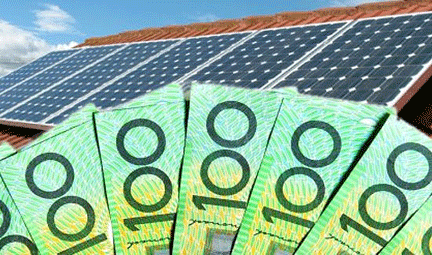 From solar boom to bill shock: Australians face loss of rooftop payments
About 275,000 people across the country will have their solar energy payments reduced by up to 80% over the next six months, Guardian, Michael Slezak 31 July 16 “……. more than 275,000 people across Australia who will see the subsidised payments they receive for their solar energy disappear over the next six months, replaced with rates up to 80% lower.
The solar boom in Australia, which has led to 1.5m households generating their own electricity from the sun, was accelerated by subsidised payments for people who sell solar-generated electricity back to the grid.
In some cases, like Shaw’s, solar customers were able to receive more than twice the money for the electricity they put in the grid, compared with what they paid for electricity they took out of it.
But for a lot of homes and businesses, those schemes are coming to an end over the next six months and, if they’re not prepared, they will be heading towards some serious bill shock.
Customers in New South Wales, who got the most generous rate, will be in for the biggest hit and will need to do the most to adapt to the changes…….
While about 150,000 homes and business will be kicked off these schemes in NSW on 1 January 2017, the party is ending for about 130,000 customers inVictoria and South Australia too.
(Others are on schemes that will continue for years to come. So if people are confused about their own feed-in tariffs, they should ask their retailer what’s happening with them.)…….
Smart meters
The issue of what kind of meter to get is a minefield right now, with different issues affecting consumers depending on where they are, and options are changing rapidly.
One thing that can help anyone make the most of their solar electricity is a smart meter, says Claire O’Rourke, national director of Solar Citizens, a group that lobbies on behalf of solar customers.
A smart meter can be read remotely, and can tell when the most power is being drawn, helping maximise the benefits. They can also open up services such as time-of-use tariffs, providing savings for people who avoid using energy during periods of high demand.
“You’re probably better off with a smart meter but they do have an increased cost,” says O’Rourke.
Some retailers are offering discounts for smart meters in return for fixed-term contracts. “It is really in the interest of consumers to shop around,” she says.
For many people right now a smart meter could be overkill. The smart meter will either be paid upfront, or in the case of free meters offered by retailers, will be paid for through increased tariffs, says Moyse. Whether the meter will allow consumers to recoup that cost is unclear.
For people outside NSW, the lowest-cost option is to keep their current meter, at least until it’s clear a smart meter is worth it. Outside NSW, the current meter will work fine on the new deals.
Unfortunately, for most people on the NSW solar bonus scheme, their meters will need to be replaced……..
the loss of generous feed-in tariffs is driving interest in battery storage, says Chris Cooper, chief executive of Suncrowd, a company using group purchasing power to get cheaper prices for batteries.
“It’s a bit of a trigger point for people to look at new technology,” Cooper says. So far Suncrowd has run its first round in Newcastle, and had about 200 homes join together and buy batteries at discount rates.
He says lots of the customers who have been approaching Suncrowd have been people coming off the NSW solar bonus scheme. Having a battery added to an existing solar system can significantly increase “solar self-sufficiency”, Cooper says, a measure of how much the customer relies on solar rather than electricity from the grid. “With an appropriately sized battery you can boost it from 20% to about 60 or 70% self-sufficiency,” he says. Cooper says Suncrowd is building an online tool to help people calculate their solar self-sufficiency and have been showing it to people at events they’ve been holding. “People are really motivated by seeing the numbers go up,” he says…….https://www.theguardian.com/environment/2016/jul/31/australia-residents-solar-rooftop-lose-payments
Germany’s PIMBYs (Please, in my backyard)
From swords to solar, a German town takes control of its energy, National Observer, By Audrea Lim in News, Energy | July 28th 2016 The German town of Saerbeck is a swords to solar panels story. Above this former German military ammunition camp, perched atop a metal stem like an oversized stalk of wheat, giant blades rotate in the sky, given life by an invisible breeze.
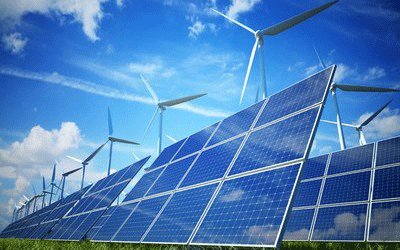
The wind turbine could be the icon for the Saerbeck “Climate Community,” a champion of energy democracy that was twice awarded the European Energy Award, and received the German Sustainability Prize in 2013. This town of 7,200, in the industrial heartland of Germany, is a thriving example of the nation’s much-lauded transition toward renewable energy. The energiewendeincludes a total phase-out of nuclear power by 2022 , and has catalyzed a tenfold increase in the share of clean electricity since 1990. By 2015, 32.5 per cent of Germany’s electricity was renewable.
In 2009, Saerbeck decided to shift its electricity entirely to renewable sources by 2030. Within just five years, they were generating 3.5 times more renewable electricity than the town consumed, not only with the installation of solar panels on private roofs, but through a 90-hectare, 70-million-euro Bioenergy Park that now houses seven wind turbines, a biogas plant, and a sprawling array of solar panels on the roofs of former military bunkers.
These camouflaged bunkers look like charming rows of grass-hatted hobbit holes, but were built to house tank ammunition and grenades. Today they provide the physical foundation for achieving local energy security and self-sufficiency—since 2012, Saerbeck’s entire electric grid has been owned by the community—as well as a canvas for the psychedelic shadowplay cast by the rotating turbine blades.
The key to Saerbeck’s success, explained Mayor Wilfried Roos, is the grassroots nature of these projects, which were conceptualized at weekly community meetings, and have brought in revenue for the town and local investors, as excess energy is sold back into the grid……..
A bunch of PIMBYs (Please, in my backyard)
At the center of the town’s transformation is the local energy cooperative Energy for Saerbeck, co-founded by Roos, which owns the solar plant and a turbine in the Bioenergy Park. By investing in the cooperative (the minimum amount is 1,000 EUR), local townspeople become voting members and earn profits. Since its founding in 2009, the cooperative’s membership has expanded from an original nine members to 384 today. More residents are eager to join—if only the coop could keep pace with enough new projects.
Wallraven credits the opportunity to invest and participate for the townspeople’s embrace of the transition, which some scholars describe with the cringe-worthy acronym “PIMBY”—“Please, In My Backyard”—or, in corporate jargon, as the achievement of “social acceptance.” “The cooperative has been a very important strategic instrument to get the people on board,” said Wallraven………
In Germany, the energiewende has largely been fueled by small and mid-sized investors. Citizen participation accounted for 46 per cent of the nation’s renewable energy capacity in 2012, and there were 973 electricity cooperatives running by 2015.
‘Death spiral’ facing our energy future
THE Turnbull Government’s economic advisory arm has warned an ‘equity’ issue for lower-income households is looming as more households turn to solar and battery storage…. (registered readers only)
http://www.couriermail.com.au/news/queensland/major-issues-facing-energy-providers-as-electricity-bills-increase/news-story/e73325e8ffa1f1b043325090e366e4df
1 This month

of the week – Australians for War Powers Reform (AWPR)
To see nuclear-related stories in greater depth and intensity
 Antinuclear