Australia’s potentially powerful political constituency – solar power home-owners
Regardless of what the industry’s lobbyists and media barrackers say, renewables are cutting the cost of power and making it more reliable….
The next big threat to the old business model, however, is storage
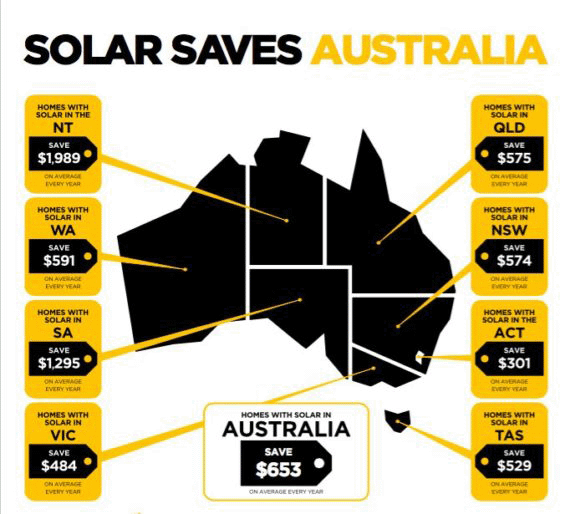
According to figures compiled by the environment group Solar Citizens before the recent election, just 2352 of the 90,000-odd voters in Frydenberg’s affluent inner Melbourne electorate of Kooyong had solar panels on their roofs.
That placed Kooyong 132nd of 150 federal electorates for rooftop solar. Kooyong is typical of what Solar Citizens found in their study of rooftop solar. More affluent electorates tend to have lower take-up rates……
out in the ’burbs, and in the rural and regional areas, rooftop solar is big. The seat of Dawson, for example, based on Mackay in North Queensland, has more than 10 times as many houses with rooftop solar as Frydenberg’s electorate. Yet voters there just returned George Christensen, a climate change denier who sits on the extreme right wing of the Nationals. Ipswich, home town of Pauline Hanson, has even more solar panels up.
Dickson in Brisbane, held by another arch-conservative, Peter Dutton, has more than 35,000 solar roofs, and the eighth-highest penetration of solar in the country. And the number one electorate for rooftop solar is the huge rural South Australian seat of Grey. There, according to Solar Citizens, some 41,000 constituents have invested $140 million to install more than 80,000 kilowatts of solar, resulting in an annual abatement of 54,000 tonnes of the main greenhouse gas, carbon dioxide. The seat is held by Rowan Ramsey for the Liberals, although he was given a nasty scare from the Nick Xenophon Team at the election.
The reality of rooftop solar is counterintuitive. Climate change is so often portrayed as being principally a concern of young, educated, wealthy, urban lefties. Yet those doing the most about it at a personal level are the demographic opposite. They are older, less educated, poorer, non-urban and often otherwise conservative.
And that makes them problematic in a political sense – a potentially very powerful, unclaimed political constituency………
Hip-pocket issues
Unlike many environmental causes, the campaign for more solar photovoltaic generation does not rely entirely on altruism. It is also a significant hip-pocket issue. A major reason that Australia is the world leader in the installation of small-scale solar power is that governments have offered financial incentives for doing it. People who generate their own power also avoid – at least to some extent – the inflated prices charged by power companies. In the case of Grey, for example, Solar Citizens calculated that rooftop panels saved a total of $27.9 million a year on energy bills.
This probably best explains why solar is more popular in the suburbs and regions. People on Struggle Street appreciate the savings more than the rich folk in Kooyong or Wentworth.
Financial self-interest also encourages environmental altruism, says O’Rourke: “Once people take up the technology, they become more engaged with the way it helps the environment as well. So they might come to it for a hip-pocket reason, but our surveys show it also drives environmental engagement.”
But money is still the most powerful driver. Perhaps the best illustration of this comes from Western Australia where, in its 2013 budget, the Liberal government of Colin Barnett moved to cut the state’s solar feed-in tariff……
Regardless of what the industry’s lobbyists and media barrackers say, renewables are cutting the cost of power and making it more reliable….
The next big threat to the old business model, however, is storage. Once power can be generated when the sun shines and the wind blows, there will be no justification for price spikes. Increases in demand won’t require high-cost ancillary generation to be sporadically brought online. Domestic battery storage is one option. It’s still expensive, but prices are coming down fast
Such a “distributed” system of storage, says Hugh Saddler, honorary associate professor at the Crawford School at the Australian National University, would bring “huge savings on network capacity”.
Distributed storage allows for more even power flow, so the network does not have to be built to accommodate spikes……..https://www.thesaturdaypaper.com.au/news/politics/2016/07/30/how-rooftop-solar-energy-became-political-issue/14698008003554
No comments yet.
1 This month

of the week – Australians for War Powers Reform (AWPR)
To see nuclear-related stories in greater depth and intensity
 Antinuclear
Leave a comment