World’s largest ‘virtual power plant’- 1000 battery systems for solar energy in Adelaide
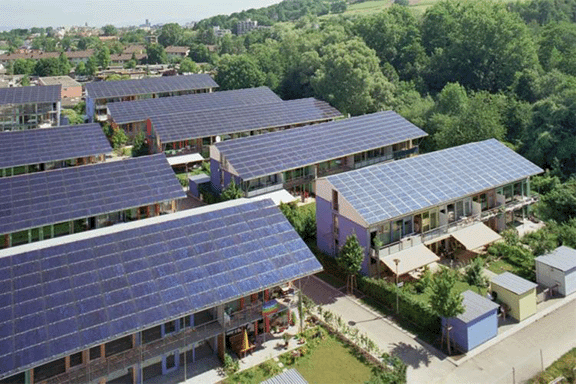 Adelaide charges ahead with world’s largest ‘virtual power plant’ AGL project to roll out 1,000 battery systems to homes and businesses will operate like a 5MW plant, and optimise energy produced from solar panels, Guardian, Michael Slezak, 5 Aug 16, Adelaide will be home to the world’s largest “virtual power plant” – AGL is rolling out 1,000 battery systems to homes and businesses, with backing from the Australian Renewable Energy Agency (Arena).
AGL and Arena say the project will improve network security and dampen a volatile wholesale electricity price in South Australia. However, an energy expert says that at the current size, the system will have a minimal impact on network security or wholesale prices, but might pose a challenge to the revenues of companies that own the poles and wires.
Offered to homes and businesses with solar systems, the $20m AGL project, backed with $5m from Arena, will operate like a 5MW peaking power plant, providing power to homes and businesses during periods at optimal times.
The chief executive of AGL, Andy Vesey, told Guardian Australia: “The beauty of the project is it’s being done over 1,000 batteries, and that’s how we deliver an aggregate benefit to the grid itself.
“But for the consumer, it will have the value of the battery. And it’s being priced at a way that a good investment decision could be made. We’re viewing that the average savings for someone who has rooftop solar right now would be $500 a year. It’s really a way of optimising the energy produced out of their solar panel.”
The system will cost $3,500, and AGL estimates it will take about seven years for solar customers to recover the costs.
Arena’s chief executive, Ivor Frischknecht, said the project would boost grid stability, reduce power price volatility and support the expansion of renewable energy……..
As a demonstration of something that could be bigger, McConnell said one of the biggest impacts of the business model could be on how the networks recover the costs of the poles and wires.
About half the cost of a home energy bill is linked to the network’s cost recovery of its poles and wires. McConnell said that meant a lot of the money being saved by consumers was actually done by avoiding paying the network costs. And that’s what AGL is relying on for its business model.
But this “virtual power plant” isn’t moving people off the grid. Instead, it’s relying on the grid, while avoiding the charges the distributors use to pay for the grid…….https://www.theguardian.com/environment/2016/aug/05/adelaide-charges-ahead-with-worlds-largest-virtual-power-plant
No comments yet.
1 This month

of the week – Australians for War Powers Reform (AWPR)
To see nuclear-related stories in greater depth and intensity
 Antinuclear
Leave a comment