“An Australian gift from one atomic survivor community to another.
 Indigenous Australia’s Shared Legacy With Nagasaki’s Atomic History
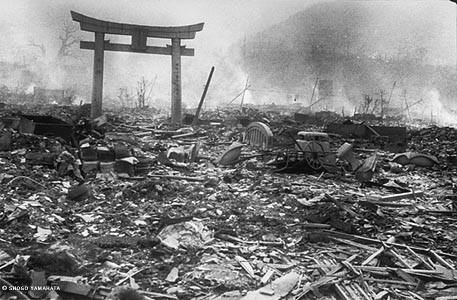
“An Australian gift from one atomic survivor community to another.”http://www.huffingtonpost.com.au/2016/08/08/indigenous-australias-shared-legacy-with-nagasakis-atomic-hist/ On August 9, 1945, Nagasaki became the second city in the world to be targeted by atomic bombs in warfare, killing 80,000 people. Over the next 70 years, thousands more would die from the effects of the bombing alone.
In the 1950s British nuclear testing saw nine atomic bombs tested on Australian soil in the Maralinga and Emu fields of South Australia. This forced the migration of the Pitjantjatjara Anangu community away from their traditional land into Yatala. For the Indigenous people of Maralinga, they were unable to return to their land and hunt because of contamination.
To mark not only the 71st anniversary of the Nagasaki bomb, but also International Day of the World’s Indigenous Peoples, this short documentary Peace Gift to Nagasaki unites both communities in their efforts to promote peace and expose the legacy of the atomic age through creative arts.
Until now, Australia has not been one of those countries. In Peace Gift to Nagasaki, the Yatala Aboriginal community present a sculpture called ‘The Tree of Life’ to the Japanese community, a sculpture made of wood and cast in bronze so it can survive many hundreds of years.
“The Yatala sculpture will be an Australian gift from one atomic survivor community to another,” the narrator of the documentary explains.
To find out more about this project you can head to the Nuclear Futures page over here.
Chinese nuclear waste project suspended after public protest
 Chinese town suspends nuclear waste project, DW, 10 Aug 16 A city in the eastern part of China has said it’s suspending preliminary work on a nuclear waste processing plant after days of protests by local residents over health concerns. No final decision has been made yet. The Chinese city of Lianyungang in the eastern province of Jiangsu announced Wednesday it would suspend preparations for a possible Sino-French nuclear waste processing project after thousands of local residents had taken to the streets to protest the plan.
The protesters had called for the project to be canceled altogether on health grounds, clashing with police.
French nuclear fuel group Areva agreed in 2012 to cooperate with state-run China National Nuclear Group (CNNC) to build a reprocessing facility in China, without stating any specific location…….
The $12.05-billion (10.81-billion-euro) waste processing project had been scheduled to get off the ground in 2020 to be completed by 2030, but its future is now unclear.
The project had been opposed by US authorities saying it would harm efforts to limit the spread of materials that could be used in weapons.
The Lianyungang protests highlighted local opposition to nuclear projects across China, which is increasing its atomic power capacity on a huge scale and encouraging state-run firms to build plants abroad.……http://www.dw.com/en/chinese-town-suspends-nuclear-waste-project/a-19462414
USA paying big bucks in advance for nuclear facilities that never come into use – (sounds like the South Australian plan)
 Customers Could Pay $2.5 Billion for Nuclear Plants That Never Get Built http://www.bloomberg.com/news/articles/2016-08-08/customers-could-pay-2-5-billion-for-nukes-that-never-get-built, Mark Chediak markchediak August 9, 2016 —
-
Only two of 18 plants proposed since 2007 under construction
-
At least seven states allow billing before building starts
-
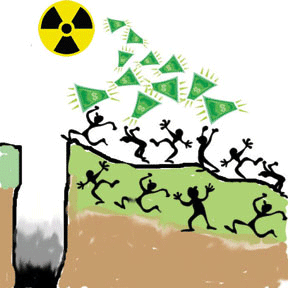
U.S. electricity consumers could end up paying more than $2.5 billion for nuclear plants that never get built.
Utilities including Duke Energy Corp., Dominion Resources Inc. and NextEra Energy Inc. are being allowed by regulators to charge $1.7 billion for reactors that exist only on paper, according to company disclosures and regulatory filings. Duke and Dominion could seek approval to have ratepayers pony up at least another $839 million, the filings show.
The practice comes as power-plant operators are increasingly turning to cheaper natural gas and carbon-free renewables as their fuels of choice. The growth of these alternatives is sparking a backlash from consumers and environmentalists who are challenging the need for more nuclear power in arguments that have spilled into courtrooms, regulatory proceedings and legislative agendas.
“Anything that hasn’t gotten off the ground yet isn’t getting built,” said Greg Gordon, a utility analyst at Evercore ISI, a New York-based investment advisory firm. “There is no economic rationale for it.” Continue reading
South Korea considers nuclear arms. Australia lines up new sanctions against North Korea
South Korea eyes nuclear weapons over North Korea bomb fears, SMH, Peter Hartcher , 9 Aug 16 South Korea will arm itself with nuclear weapons if its rogue neighbour, North Korea, continues to develop the bomb.
This would be a revolutionary step, overturning half a century of opposition to nuclear capability. South Korea has committed to the Nuclear Non-Proliferation Treaty. “It will become a domino effect and even South Korea will become concerned and develop nuclear weapons, and maybe Japan as well,” according to a senior official in the Seoul government.
“This will all lead to a big security threat,” the director-general for reunification policy in the Ministry of Unification, Lee Duk-haeng, told Fairfax Media……..
The policy of the South Korean government is opposed to the development of nuclear arms, but the matter is now under lively debate as North Korea persists in its illegal plans.
Like other US allies including Japan and Australia, South Korea enjoys the protection of the US nuclear arsenal, so-called extended nuclear deterrent.
But the US Republican presidential candidate Donald Trump has called this into question.
Mr Trump has said that he is prepared to walk away from the long-standing US alliances with Tokyo and Seoul unless they pay more towards the cost of the US bases on their soil.
He has also said that it might not be a bad thing for South Korea and Japan to develop the bomb, directly contradicting half a century of US non-proliferation policy………
Mr Lee called on all regional governments, including Australia’s, to take a “stern” approach to isolate North Korea over its nuclear development.
Australia has taken recent new sanctions against Pyongyang. And the acting Foreign Affairs Minister, George Brandis, this week announced that “Australia stands ready to list additional individuals and entities associated with the regime’s weapons and missile technology activities”.
In February, South Korea responded to the persistent North Korean nuclear development by opening discussions with the US to install an American missile interception system.
China has reacted furiously to Seoul’s decision to deploy the so-called Terminal High Altitude Area Defence or THAAD………http://www.smh.com.au/world/south-korea-eyes-nuclear-weapons-over-north-korea-bomb-fears-20160809-gqor8m.html
Community energy projects take off: Climate Council urges leadership for rural areas
 Climate Council urges bigger push towards renewables as community energy projects take off, ABC Radio AM By regional affairs reporter Lucy Barbour The Climate Council says a growing trend of rural communities setting up their own wind and solar farms could generate thousands of jobs in regional Australia.
Key points:
- Community projects will benefit local investors
- Twenty community energy projects are already operating in Australia
- Many communities are working towards 100 per cent renewable energy
The council’s latest report, on the impact of climate change on rural Australia, says rural communities will continue to be affected by worsening extreme weather events such as bushfires and drought.
But the report’s co-author, Will Steffen, said community-owned energy was one way to adapt.
“You have to have some leaders in your community that can actually get on top of the issue and say, ‘look, forget about federal politics or whatever side you’re on, this is good for our community’,” he said.
There are currently 20 community energy projects operating across the country, but Peter Fraser from Goulburn in southern New South Wales, said there was the potential for many more.
Mr Fraser is part of a group trying to build a $2.6 million community solar farm which, he said, would provide investors with a 5 per cent return on investment.
“It will be 1.2 MW. It will have about 4,000 panels of solar voltaic and it will generate enough electricity to power perhaps 300 to 400 homes in Goulburn,” he said.
Mr Fraser said investors would buy the solar equipment, pay for the connections to the grid and then sell the electricity to those who want it……….
The Climate Council’s report points out that many regional communities are working towards 100 per cent renewable energy goals, and estimates 28,000 jobs could be created if half of Australia’s energy came from renewables by 2030.
Professor Steffen said more than half of those would be in regional areas…….http://www.abc.net.au/news/2016-08-09/climate-council-says-community-renewable-energy-on-rise/7702866?section=environment
South Australia: Electricity market’s unstoppable move away from coal-fired “base-load generation”
 South Australia signalling the death of base-load generation, REneweconomy,By Giles Parkinson on 8 August 2016 Tuesday marks the three-month anniversary of the closure of the last coal-fired “base-load generator” in the South Australia electricity market, and despite the best efforts of many in the Coalition and the Murdoch media, there is nothing to suggest that other states will not follow suit, in time.
The fossil fuel industry predicted – and possibly hoped for – “armageddon” from the closure of the last coal plant. But all it got was a big jump in wholesale electricity prices, caused not by renewable energy, as federal and local energy ministers have made clear, but by the soaring cost of gas and constraints on the interconnecter.
If anything, the events of the last few weeks have reinforced the point that the electricity market is in the early stages of an unstoppable transition. Coal-fired plants will soon be a thing of the past, and the role of gas-fired generators may all diminish as battery storage and other renewables take more central roles.
The announcement by AGL on Friday of its plans – supported by the South Australian government and the Australian Renewable Energy Agency – for an array of 1,000 batteries in homes and businesses to create a “virtual power plant” to address demand peaks and grid stability, is a foretaste of what is to come.
Indeed, South Australia’s experiment – as premier Jay Weatherill has described it – in pursuing the world’ highest level of wind and solar generation is rapidly evolving into a whole bunch of world-leading projects.
These include AGL’s (described the world’s biggest virtual power plant), South Australia Power Networks’ commitment to a second “world leading” battery storage project that will likely reduce the need for grid investment, and various proposals for large-scale solar with storage (from SolarReserve,Lyon Infrastructure and others) and the creation of suburban and remote town micro-grids that will reduce the need for centralised power and distribution.
The withdrawal of base-load coal generation from the South Australian grid has sparked predictions of economic collapse and soaring prices, but these have simply replicated what used to happen when the state relied entirely on gas for the balance on power, even before the arrival of wind and solar. Continue reading
“Clexit” – the rejection of the science of climate change
 In 2007, the US Supreme Court ruled that the State of Massachusetts had legal standing to sue the EPA for its refusal to regulate greenhouse gases, specifically because Massachusetts showed that it was being harmed by global warming via sea level rise encroaching on its shores. In that case, the Supreme Court ruled that carbon dioxide is a pollutant.
In response to the Supreme Court decision, the EPA issued an endangerment finding concluding that, based on the available scientific evidence, carbon dioxide endangers public health and welfare, and must therefore be regulated as a pollutant.
The Clexiters deny that vast body of scientific evidence.
Rejection of experts spreads from Brexit to climate change with ‘Clexit’ http://www.skepticalscience.com/rejection-experts-from-brexit-to-clexit.html August 2016 by dana1981
Brexit support and climate denial have many similarities. Many Brexit Leave campaignleaders also deny the dangers of human-caused climate change. Older generations were more likely to vote for the UK to leave the EU and are more likely to oppose taking action on climate change; younger generations disagree, and will be forced to live with the consequences of those decisions. On both issues there’s also a dangerous strain of anti-intellectualism, in which campaigners mock experts and dismiss their evidence and conclusions.
With Brexit, the Leave campaign won the vote, and the UK economy is already feeling the consequences. As Graham Readfearn reported, a new group called “Clexit” (Climate Exit) has formed in an effort to similarly withdraw countries from the successful internationalclimate treaty forged last year in Paris. As
As the group describes itself:
Brexit was Britain’s answer to the growing over-reach of EU bureaucracies. Clexit is our answer to the push for global control through climate hysteria.
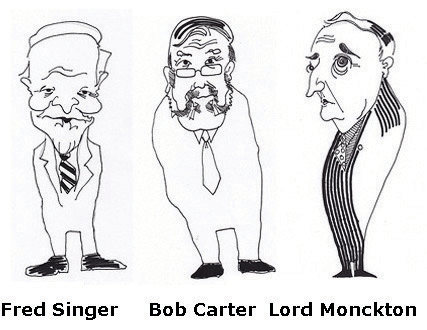
Clexit leaders are heavily involved in tobacco and fossil fuel-funded organizations, in what’s become known as “the web of denial.” The group’s president is Christopher Monckton, whose extensive misunderstanding of basic climate science was revealed in a thorough debunking by John Abraham, and who insists that President Obama was born in Kenya, among his many controversial and conspiratorial public statements. Continue reading
1 This month

of the week – Australians for War Powers Reform (AWPR)
To see nuclear-related stories in greater depth and intensity
 Antinuclear