South Australian Parliament’s Joint Committee on Findings of the Nuclear Fuel Cycle Royal Commission.
This Parliamentary Inquiry is still going on. Transcripts of hearings and submissions can be read at
http://www.parliament.sa.gov.au/Committees/Pages/Committees.aspx?CTId=2&CId=333.
The opinions of those submitting to this Committee are overwhelmingly opposed to the nuclear waste import plan.
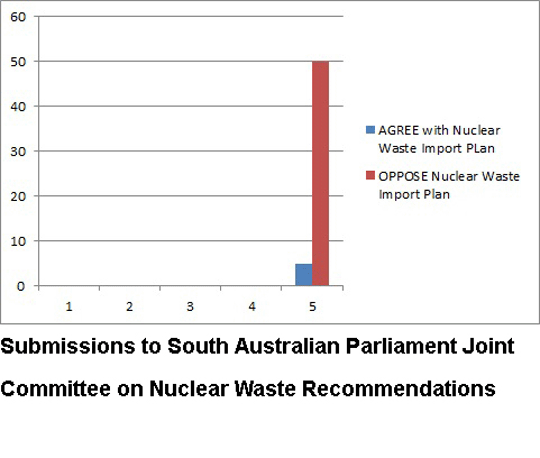
However,the Committee itself is hardly neutral:
August 13, 2016
Posted by Christina Macpherson |
politics, South Australia, wastes |
1 Comment
 Native title win in WA’s remote desert https://au.news.yahoo.com/thewest/a/32304974/native-title-win-in-was-remote-desert/#page1 AAP on August 11, 2016,
A native title claim for a 20,000sq km area in a remote part of the Great Sandy Desert in Western Australia has been won by the Ngurra Kayanta people.
They first applied for native title over the land, which straddles the Shire of East Pilbara and the Shire of Halls Creek, in December 2012.
Federal Court of Australia Justice Michael Barker said none of the claimants now lived permanently in the area but continued to adhere to traditional laws and customs by visiting and maintaining a physical association with the country, and passing on traditional songs, stories and knowledge of sites to children and grandchildren.
“The claimants have maintained a presence in the determination area since the acquisition of British sovereignty,” Justice Barker said. “In addition, evidence of the continuing physical or spiritual involvement of the claimants in the determination area is accepted to conclude that this connection has not been severed.
“Ultimately, the state is satisfied that the material presented is sufficient to evidence the maintenance of connection according to traditional laws and customs.”
August 13, 2016
Posted by Christina Macpherson |
aboriginal issues, Western Australia |
Leave a comment

And for 2020 Olympic Games, what about the nuclear radiation risk, too – close to Fukushima’s continuing disaster?
 Climate change puts heat on future Games venues http://www.nzherald.co.nz/climate-change/news/article.cfm?c_id=26&objectid=11692866 Ben Hill 13 Aug 16 Climate change is set to make it too hot to host the Olympics in the world’s biggest cities, according to a university study.
University of Auckland collaborative research found about 90 per cent of the Northern Hemisphere’s most populous cities will become too hot and humid over the next 70 years to safely hold the Games.
Professor Alistair Woodward said the study focused on whether cities in the Northern Hemisphere would be able to stage the marathon without posing a significant risk to athletes.
“Only three cities in North America, two in Asia and none in Africa will fall in the low risk category,” he said.
“Projections suggest the last cities with low-risk summer conditions will be Belfast, Dublin, Edinburgh and Glasgow.
“Increasing restrictions on when, where, and how the Games can be held owing to extreme heat are a sign of a much bigger problem,” Woodward said.
“If the world’s most elite athletes need to be protected from climate change, what about the rest of us?”
The study has been published in British medical journal the Lancet.
August 13, 2016
Posted by Christina Macpherson |
Uncategorized |
Leave a comment
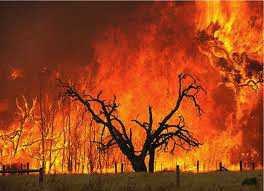 Threat of wildfires expected to increase as global temperatures rise http://www.enn.com/wildlife/article/49892The United Nations Office for Disaster Risk Reduction (UNISDR) has warned that wildfires could become more frequent and more destructive as global temperatures rise and drought conditions plague many regions of the world.
“Last year was the hottest year on record and was above average for the number of reported major droughts and heatwaves. This year we are seeing a similar pattern with new temperature records being set on a monthly basis,” UNISDR chief Robert Glasser said yesterday in a news release issued by the Office.
He noted that a number of risk factors, such as lack of forest management, growth of urban areas in proximity to forests and human induced fires need to be addressed by disaster management authorities.
“The most frightening scenario is when major towns are threatened as we have seen this week in the case of Funchal and Marseille,” the senior UN official added.
Continue reading at UN News Centre
August 13, 2016
Posted by Christina Macpherson |
Uncategorized |
Leave a comment
Instead of waiting for problems to arise, the NRC and the Energy Department need to develop a transparent and comprehensive road map identifying the key elements of—and especially the unknowns associated with—interim storage, transportation, repackaging, and final disposal of all nuclear fuel, including the high-burnup variety.

Nuclear power plant? Or storage dump for hot radioactive waste?, Bulletin of the Atomic 
 Scientists Robert Alvarez, 11 AUGUST 2016
 In addition to generating electricity,
US nuclear power plants are now major radioactive waste management operations, storing concentrations of radioactivity that dwarf those generated by the country’s nuclear weapons program. Because the proposed Yucca Mountain nuclear waste repository remains in limbo, and other permanent storage plans are in their infancy, these wastes are likely to remain in interim storage at commercial reactor sites for the indefinite future. This reality raises one issue of particular concern—how to store the high-burnup nuclear fuel used by most US utilities. An Energy Department expert panel has raised questions that suggest neither government regulators nor the utilities operating commercial nuclear power plants understand the potential impact of used high-burnup fuel on storage and transport of used nuclear fuel, and, ultimately, on the cost of nuclear waste management.
Continue reading →
August 13, 2016
Posted by Christina Macpherson |
Uncategorized |
1 Comment
“Many business leaders have clearly thrown in the towel on nuclear and are instead openly lobbying for Japan to vault to global leadership in renewables, efficiency and smart infrastructure.”
 Japan’s big ‘nuclear restart’ overtaken by conservation and renewables, Ecologist , ,12th August 2016 For all Japan’s talk of 43 ‘operable’ nuclear reactors, only two are actually running, writes Jim Green, as renewables and a 12% fall in demand eat into the power market. And while Japan’s ‘nuclear village’ defends safety standards, the IAEA, tasked with promoting nuclear power worldwide, has expressed deep concerns over the country’s weak and ‘fragmented’ safety regulation.
According to theWorld Nuclear Association, Japan has 43 ‘operable’ power reactors (they are ‘operational’ according to the IAEA), three under construction, nine ‘on order or planned’, and three ‘proposed’.
The numbers suggest that Japan’s nuclear industry is finally getting back on its feet after the Fukushima disaster – but nothing could be further from the truth. Continue reading →
August 13, 2016
Posted by Christina Macpherson |
Uncategorized |
Leave a comment
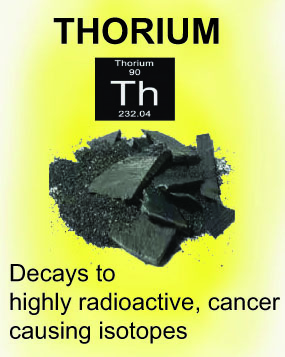 Thorium: new and improved nuclear energy? https://www.wiseinternational.org/nuclear-energy/thorium-new-and-improved-nuclear-energy
There is quite some – sometimes tiresome – rhetoric of thorium enthusiasts. Let’s call them thor-bores. Their arguments have little merit but they refuse to go away.
Here are some facts:
- There is no “thorium reactor.” There is a proposal to use thorium as a fuel in various reactor designs including light-water reactors–as well as fast breeder reactors.
- You still need uranium – or even plutonium – in a reactor using thorium. Thorium is not a fissile material and cannot either start or sustain a chain reaction. Therefore, a reactor using thorium would also need either enriched uranium or plutonium to initiate the chain reaction and sustain it until enough of the thorium has converted to fissile uranium (U-233) to sustain it.
- Using plutonium sets up proliferation risks. To make a “thorium reactor” work, one must (a) mix the thorium with plutonium that has been stripped of the highly radioactive fission products; (b) use the mixed-oxide thorium-plutonium fuel in a reactor, whereby the plutonium atoms fission and produce power while the thorium atoms absorb neutrons and are turned into uranium-233 (a man-made isotope of uranium that has never existed in nature); (c) strip the fission products from the uranium-233 and mix THAT with thorium in order to continue the “cycle”. In this phase, the U-233 atoms fission and produce power while the thorium atoms absorb neutrons and generate MORE uranium-233. And so the cycle continues, generating more and more fission product wastes.
- Uranium-233 is also excellent weapons-grade material. Unlike any other type of uranium fuel, uranium-233 is 100 percent enriched from the outset and thus is an excellent weapons-grade material and as effective as plutonium-239 for making nuclear bombs. This makes it very proliferation-prone and a tempting target for theft by criminal and terrorist organizations and for use by national governments in creating nuclear weapons. Continue reading →
August 13, 2016
Posted by Christina Macpherson |
Uncategorized |
Leave a comment
 WHAT LEGACY DO WE WANT FOR SOUTH AFRICA? http://safcei.org/what-legacy-do-we-want-for-south-africa/ by SAFCEI on August 2, 2016 In July we were excited to receive the news of a large-scale withdrawal of the uranium mining developers Australian Tasman Pacific Minerals Limited and Lukisa JVCo in the Karoo.
On 6 July they announced that they would withdraw their current uranium mining application and reapply for a much smaller area – in essence only 12% of the original application – and start the process at the beginning again. This we celebrated as an important step towards stopping uranium mining in its tracks, as well as nuclear down the line.
For, as Dr Stefan Cramer, who was instrumental in lifting the veil of silence on this new threat to the Karoo, points out, uranium mining is the dirty underbelly of the nuclear industry and where it all begins.
One must stop nuclear industries in (their) tracks because it leaves future generations with an immeasurable task and legacy. The best point to start is at the source, where the whole cycle of nuclear technology begins, and that is at uranium mining. Uranium mining is very much the dirtiest part of the entire industry,” he says.
Kim Kruyshaar writes on Green Audits that choosing between renewable energy and nuclear is about much more than just an energy option. Instead it is “a choice between two divergent socio-economic opportunities and the consequent legacies.” This rings even more true when one looks at the building blocks of nuclear energy.
Uranium mining will leave us with our iconic Karoo damaged for centuries to come and many people without a future or income as the jobs gained through uranium mining would in no way compensate for those lost in the agricultural, tourism and renewable industry businesses.
Mining will also deplete the already scarce water reserves of the Karoo and present serious health problems to all living beings there, as the radioactive dust can be carried for kilometres by winds.
Renewable energy in contrast presents us with a far brighter future that, very importantly, doesn’t contain a radioactive legacy. Far more jobs are created in the renewable energy industry than the nuclear industry ever can.
The speed in which renewable energy projects can be installed and the lower investment costs also make it highly attractive to a country like South Africa, where many people need access to energy now, not in 15 years time when a nuclear reactor would only come online.
Decentralising the power from Eskom and putting it into the hands of individuals and local companies would also only serve to empower South Africans and the economy. Nuclear energy would instead indebt us and future generations to a foreign company and leave us with the further enormous cost of decommissioning.
So it’s not simply a choice between two energy options, as Kim sums it up, it is a choice about what path we would like to take South Africa down.
What is needed to stop uranium mining and nuclear for good?
August 13, 2016
Posted by Christina Macpherson |
Uncategorized |
1 Comment








 Antinuclear