Australia sabotages international nuclear disarmament effort
Tim Wright, Asia-Pacific director of the International Campaign to Abolish Nuclear Weapons (Ican), said it was thought that Australia’s foreign minister, Julie Bishop, instructed her diplomats to disrupt the international gathering late on Friday afternoon by forcing a vote. While others then joined Australia to vote against the report, Australia was alone in forcing the vote to happen.
 Australia attempts to derail UN plan to ban nuclear weapons Diplomats force a vote
  on a report to begin negotiations on a ban in 2017 that had been expected to pass unanimously, Guardian, Michael Slezak, 21 Aug 16, Australia has attempted to derail a ban on nuclear weapons at a UN meeting on disarmament, by single-handedly forcing a vote on a report that had been expected to pass unanimously.
The report, which recommended negotiations begin in 2017 to ban nuclear weapons, was eventually passed by 68 votes to 22. An Austrian-led push for the treaty had reached a milestone on Friday, when the report was presented to representatives of 103 nations in Geneva.
Moves towards a ban have been pursued because many saw little progress under the existing non-proliferation treaty, which obliges the five declared nuclear states to “pursue negotiations in good faith” towards “cessation of the nuclear arms race … and nuclear disarmament”.
The proposal recommended a conference be held next year to negotiate “a legally binding instrument to prohibit nuclear weapons, leading towards their total elimination”.
The text was carefully negotiated, and compromise was attempted on contentious paragraphs.
Anti-nuclear campaigners involved in the process expected the report would pass without objection. But Australia surprised observers by objecting and forcing a vote.
The vote was accepted by an overwhelming majority, with 68 voting in favour, 22 against and 13 abstaining.
The next step will be for the proposal for negotiations to begin in 2017 will be tabled at the United Nations general assembly, after which it is likely formal negotiations will begin.
In an opening statement the Australian diplomat Ian McConville told the meeting: “A simple Ban Treaty would not facilitate the reduction in one nuclear weapon. It might even harden the resolve of those possessing nuclear weapons not to reduce their arsenals.”
The Department of Foreign Affairs and Trade said on its website that it opposed a ban on nuclear weapons because although it “might seem to be a straightforward and emotionally appealing way to de-legitimise and eradicate nuclear weapons,” it would actually “divert attention from the sustained, practical steps needed for effective disarmament”.
But in 2015, documents obtained under Freedom of Information revealed Australia opposed the ban on nuclear weapons, since it believed it relied on US nuclear weapons as a deterrent.
“As long as the threat of nuclear attack or coercion exists, and countries like the DPRK [North Korea] seek these weapons and threaten others, Australia and many other countries will continue to rely on US extended nuclear deterrence,” said one of the briefing notes for government ministers.
The documents revealed however that Australia and the US were worried about the momentum gathering behind the Austrian-led push for a ban nuclear weapons, which diplomats said was “fast becoming a galvanising focus for those pushing the ban treaty option”.
Japan’s ambassador to the UN conference on disarmament expressed disappointment that a vote was required.
“We are deeply concerned that the adoption by voting will further divide the international disarmament community and undermine the momentum of nuclear disarmament for the international community as a whole,” he said.
Tim Wright, Asia-Pacific director of the International Campaign to Abolish Nuclear Weapons (Ican), said it was thought that Australia’s foreign minister, Julie Bishop, instructed her diplomats to disrupt the international gathering late on Friday afternoon by forcing a vote. While others then joined Australia to vote against the report, Australia was alone in forcing the vote to happen.
“Australia is resisting the tide of history. A majority of nations believe that nuclear weapons are unacceptable and must be prohibited. And now they are ready to negotiate a ban,” Wright said.
“Australia’s attempt to derail these important disarmament talks was shameful and outrageous. It provoked strong criticism from some of our nearest neighbours in Asia and the Pacific, who believe that the world should be rid of all weapons of mass destruction,” he said.
The acceptance of the report was seen as a major milestone by anti-nuclear campaigners.
“This is a significant moment in the seven-decade-long global struggle to rid the world of the worst weapons of mass destruction,” said Beatrice Fihn, executive director Ican. “The UN working group achieved a breakthrough today.”
“There can be no doubt that a majority of UN members intend to pursue negotiations next year on a treaty banning nuclear weapons,” said Fihn.
“We expect that, based on the recommendations of the working group, the UN general assembly will adopt a resolution this autumn to establish the mandate for negotiations on a ban on nuclear weapons in 2017.”
A Department of Foreign Affairs spokesman said: “Australia called for a vote on the report as it was the most effective way to register our opposition to a recommendation to start negotiations on a ban treaty. A consensus report was not possible in the circumstances…..https://www.theguardian.com/world/2016/aug/21/australia-attempts-to-derail-un-plan-to-ban-nuclear-weapons
Roger Cross: Reasons to Reject a Medium and High Level Radioactive Waste Dump in South Australia
Roger Cross Submission to Joint Committee on Nuclear Royal Commission South Australian Parliament, August 2016 Some Reasons for rejecting the proposal to build a Medium and High Level Radioactive Waste Dump in South Australia. By Roger Cross (Author of Fallout: Hedley Marston and the British Bomb Tests in Australia, co-author of Beyond Belief The British Bomb Tests: Australia’s Veterans Speak Out)
Preamble:
The risks to the future health and security to all Australians, and South Australians in particular are many. A risk-benefit analysis is almost certainly impossible given a time-frame that extends for centuries (probably for the rest of human existence on the Planet). Benefits, in terms of financial gain to the State. and some employment must be secondary to the multitude of risks involved. These risks are worth restating so that the “golden egg” of a large financial windfall do not cloud the realities of such a decision.
Risks:
- Health Risks: The existence or otherwise of a threshold below which exposure to ionising
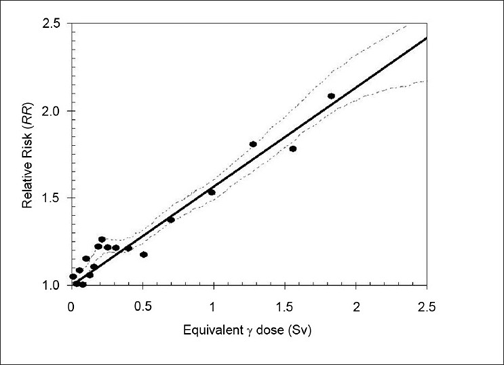
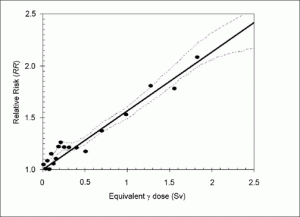 radiation is harmless has been a matter of continuous debate among nuclear scientists for decades. The statistical analysis of John Gofman (l,W, Gofman, 1981. Radiation and Human Health, Sierra Club, San Francisco, 1981, and 1990 RadiationInduced Cancer Fom Low-Dose Exposure: An Independent Analysis. Committee or Nuclear Responsibility Inc., San Francisco) shows there is no safe radioactive dose. Therefore, at any point in the chain of receiving, from overseas, transporting within S.A. and storage even small mishaps leading to only low-level contamination are not risk free. Naturally any large scale mishap would be catastrophic for the State.
- Historical Episode of radioactive contamination in South Australia: It is not feasible to claim that mishaps would not occur, that is, the risks are non-existent The radioactive contamination of Adelaide on the 12 October. 1956 due to an unfortunate change in the wind
 direction at the 11 October Maralinga Bomb Test is a case in point, This mishap caused the population of Adelaide and much of the rest of the State to be contaminated with ionising radiation from one of the Buffalo Bomh explosions (See Cross, R. 2001, Fallout: Hedley Marston and the British Bomb Tests in Australia, Wakefield Press, Adelaide, for information about this event).

- Transportation Risks: While these are impossible to quantify they are not
 negligible.Transportation of medium or high level radioactive waste in particular would require a
high degree of security and infrastructure. The former, in particular would challenge the well-being of South Australians through a system of near military style command and control intrusion into the lives of all South Australians. Such is the consequence of having to secure such a commodity.

- The Uranium back to source Argument: An argument has been mounted that because SA
 exports Uranium, and may one day become a world leading exporter of themineral, we should take back the highly radioactive waste from the user of our Uranium. This argument is entirely false, as in no other exported mineral has it been suggested that we have such an obligation. For example, do coal and iron ore producing States receive back the waste slag and ash. This can be applied to almost any raw material exported. Waste is an inevitable consequence of industrial processing and is the end-users responsibility.
- South Australia’s future World image: The risks are not confined to technical issues but are
 also present in the image we wish to present to the rest of the world. This will become increasingly important in our push to attract more overseas visitors. Tourism is and can play and ever greater part in our economy as the State is currently seen as fl safe, clean and green place to visit. This advantage we have would naturally disappear in the minds of prospective visitors if we went ahead with the storage of medium and high level radioactive waste from around the World.

Taken from research by the pre-eminent researcher into the health effects of low-dose ionizing radiation, Emeritus Professor John W. Gofman. See for example:- Radiation Induced Cancer from Low-Dose Exposure. An Independent Analysis, 1990, and Synapse article
Disproof of any Safe Dose: The Threshold Question In Chapters 18 through 21 it is proved beyond reasonable doubt that no safe dose or dose rate exists. His analysis of the absence of a threshold below which no harm will be done from a dose of ionizing radiation is based on human evidence. The data analysed rules out the idea of a threshold with regard to radiation-induction human cancer.
The practical implications for these findings are obvious for the establishment of any storage facility of ionising radiation material, and especially the concern here, medium to high level material. There cannot be any doubt that any exposure to radiation as a result of the multiple handling steps that are required even to reach a storage facility would have human health consequences forthose exposed, and may have, even, heritable consequences.
It should be noted that possible exposures do not end with the material reaching the storage facility but continue at that facility virtually in perpetuity. Consider the following:-
“How would a safe level of radiation come about? It could come about in theory jf the biological repair 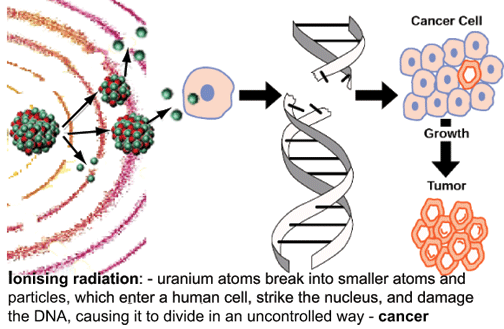 mechanisms – which exist and will repair DNA and chromosomes – work perfectly. Then a low dose of radiation might be totally repaired. The problem, though, is that repair mechanisms don’t work perfectly. There are lesions in DNA and chromosomes that are unrepairable. There are those where the repair mechanisms don’t get to the site and so they go unrepaired. . .. The evidence that the repair mechanism is not perfect is very solid today…. Ionizing radiation is not like a poison out of a bottle where you can dilute it and dilute it. The lowest dose of ionizing radiation is one nuclear track through the cell- you cannot halve it.”
1 Quotation from Gofman on Health Effects of nuclear Radiation, Synapse, Vol 38, No 16, 1994. http://www.parliament.sa.gov.au/Committees/Pages/Committees.aspx?CTId=2&CId=333

South Australian Parliamentary Inquiry asks inconvenient questions about nuclear waste import costs
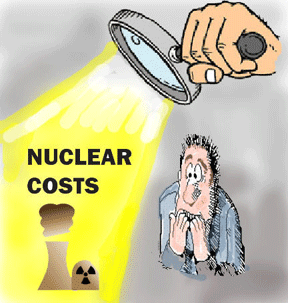 SA parliamentary committee questions economics of importing nuclear waste, Independent Australia, 19 August 2016, The economic benefits of SA’s push for a global nuclear waste dump took a negative turn during the current parliamentary committee inquiry. Noel Wauchope reports.
THE SOUTH Australian Parliament is holdinga Joint Committee on Findings of the Nuclear Fuel Cycle Royal Commission (NFCRC).
The five committee members, with one exception, the Greens Mark Parnell, have pro-nuclear opinions. I thought that it was going to be just a rubber stamp for the NFCRC. Now I am not so sure. The committee gave the NFCRC a grilling on the economics of the plan to develop a nuclear waste import industry in South Australia.
Answers indicated that the NFCRC is keen to have discussions with other countries before the matter is resolved at the political level…….
Trawling through the 173 pages transcript of hearings of this committee, I was surprised at the rigour of the questioning of witnesses by the politicians. They did ask hard questions about the arrangements for contracts from overseas countries, customers sending radioactive wastes to South Australia. They asked questions about who pays and when, and for what aspects of the process.
The most intensive questioning of witnesses was certainly on that subject of economics. After all, the plan is to make a financial bonanza for the state. There is no other reason for it. I sensed that the parliamentary committee was indeed focussed on this one basic question:
If it’s not going to make money, why do it?……
Dr Johnson went on to rather confusing statements about the contractual arrangements, and particularly about at what stage revenue would come to South Australia. I don’t think that the committee was inspired with confidence as Johnson discussed this. It was a very lengthy discussion. A few extracts illustrate the economic problems that were revealed in this discussion:
(Transcript p.24) Dr JOHNSON:
We recognised that, once waste got to South Australia, it was very unlikely to leave South Australia. It was very unlikely that there would be anywhere else you could move it on to, so the liability and the responsibility for that waste would be transferred to South Australia. What was a realistic value of that willingness to pay number? We looked at that in a number of different ways because there is no market for it……
a rare mention of the probability of a serious nuclear accident happening – who knows when? It raised the spectre of the expected nuclear waste bonanza suddenly fizzling out, after South Australia had committed to building the nuclear waste repository …..
Dr Johnson seemed to get a bit rattled:
Dr JOHNSON:
In essence we are spending money up until we start signing the contracts, and at this stage on the 28-year timeline that occurs at year six-ish, but if it’s a 40-year timeline and there are delays, then it may well be that you keep spending money and you don’t get the precommitments until later than year six. : I am not an economist; I am a chemist. Quite clearly, we were not looking at this from an economic perspective. Our remit was to look at it from a financial perspective…….
Kristen Jelk asks:
Who is talking about “Brand South Australia”? ……….If SA is pitching safe products to an international market, and it becomes known that this Australian state has established a dump for nuclear waste, then the damage to brand SA will be immeasurable….It will not matter that the dump is in a desert, nor will it matter if the dump is a distance from prime agricultural land, nor will it matter if experts assure of safety standards. The perception that would prevail is that SA will be a dumping ground for nuclear waste. Perception is everything….
China is our largest trading partner. At present, Australia has clear marketing opportunities in China, and for our other nearer neighbours. In assessing the so called golden coin to be gained for bringing in radioactive trash, South Australia needs to also consider the other side of that coin —the economic opportunities that could be lost, along with the risk of a poor or no return on the waste facility investment. https://independentaustralia.net/environment/environment-display/sa-parliamentary-committee-questions-economics-of-importing-nuclear-waste,9371
Corporate greenwashing – invented by the nuclear industry
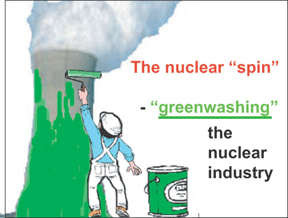
The troubling evolution of corporate greenwashing The term “greenwashing” was coined in the 1980s to describe outrageous corporate environmental claims. Three decades later, the practice has grown vastly more sophisticated, Guardian, Bruce Watson, 21 Aug 16, In the mid-1980s, oil company Chevron commissioned a series of expensive television and print ads to convince the public of its environmental bonafides. Titled People Do, the campaign showed Chevron employees protecting bears, butterflies, sea turtles and all manner of cute and cuddly animals.
The commercials were very effective – in 1990, they won an Effie advertising award, and subsequently became a case study at Harvard Business school. They also became notorious among environmentalists, who have proclaimed them the gold standard of greenwashing – the corporate practice of making diverting sustainability claims to cover a questionable environmental record.
The term greenwashing was coined by environmentalist Jay Westerveld in 1986, back when most consumers received their news from television, radio and print media – the same outlets that corporations regularly flooded with a wave of high-priced, slickly-produced commercials and print ads. The combination of limited public access to information and seemingly unlimited advertising enabled companies to present themselves as caring environmental stewards, even as they were engaging in environmentally unsustainable practices.
But greenwashing dates back even earlier. American electrical behemoth Westinghouse’s nuclear power division was a greenwashing pioneer. Threatened by the 1960’s anti-nuclear movement, which raised questions about its safety and environmental impact, it fought back with a series of ads proclaiming the cleanliness and safety of nuclear power plants. One, featuring a photograph of a nuclear plant nestled by a pristine lake, proclaimed that “We’re building nuclear power plants to give you more electricity,” and went on to say that nuclear plants were “odorless […] neat, clean, and safe”……
Government quietly removes Clive Hamilton’s page that listed climate deniers
 Plimer rebuttals disappear https://www.crikey.com.au/2016/08/19/plimer-rebuttals-disappear/ We predicted the government would delete this document, and guess what, they did.
Back in 2014, Crikey published a piece by Clive Hamilton on the 12 people doing the most to block action on climate change in Australia, including Ian Plimer. Hamilton included this paragraph on Plimer’s book How to Get Expelled From School: “Plimer’s 2011 book — How to Get Expelled From School (launched by John Howard and mailed by the IPA to hundreds of schools) — listed 101 questions for sceptical students to ask their “warmist” teachers, i.e. those who respect science. The federal Department of Climate Change (abolished by Abbott) prepared a responsethat thoroughly debunked his claims in words a child can understand. How long before Environment Minister Greg Hunt is instructed to have this demolition of Plimer taken down?”
A Sydney blogger checked back with the department’s website at regular intervals over 2014, and stopped by this week to see if the PDF was still up — but now it’s nowhere to be found. We knew it would happen eventually.
Surprise surprise – our new Resources Minister loves coal, not renewables
 Mining key to our past and future Matt Canavan
The focus is firmly on the north, where major infrastructure works are under way. (subscribers only)
http://www.theaustralian.com.au/opinion/mining-is-central-to-australian-history-and-has-a-strong-future/news-story/451fc21ef62b338467bfe301b17570a9
Canberra heading to be a smart c ity
Canberra is getting much closer to smart city status, Canberra Times, Merlin Kong,21 Aug 16 Cities calling themselves smart seem to be all the rage these days. The checklist of must-haves is pretty standard, and here are a few: sensors at traffic lights and parking lots, apps to access public services, a chief data officer and smart-city IT platforms.
Smart connected infrastructure is good. However, this is only part of the smart city equation. The other element, and noted in last week’s Chief Minister’s Governance Lecture, involves using that infrastructure to generate community involvement. To this end, Access Canberra is engaging in customer-focused digital transformations aimed at enhancing the quality of their services – it represents just the beginning of the type of service redesign made possible by digital technology.
The numbers are quite impressive. Currently, Access Canberra delivers 195 digital transactional services, which includes 930 service options. The uptake by users is equally impressive, between May to July this year, 100,696 smart forms were submitted…….http://www.canberratimes.com.au/comment/canberra-is-getting-much-closer-to-smart-city-status-20160820-gqx7ic.html
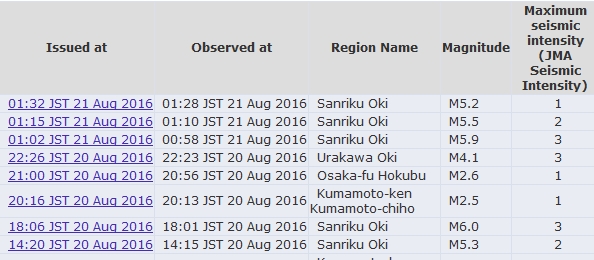
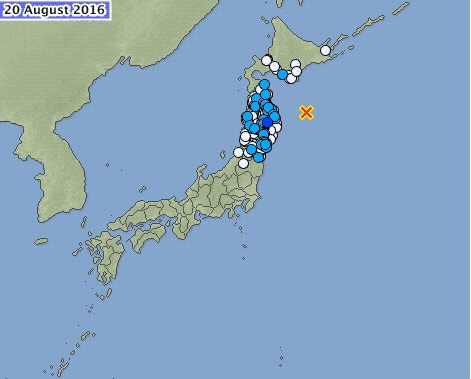
Succession of earthquakes in the Sanriku Oki area (epicenter in the ocean off Fukushima)

 Succession of earthquakes in the Sanriku Oki area (epicenter in the ocean off Fukushima) yesterday and today (5 or 6 earthquakes of magnitude ranging from 5.3 to 6)
Seismotectonics of Japan and Vicinity
The North America plate, Pacific plate, Philippine Sea plate, and Eurasia plate all influence the tectonic setting of Japan, Taiwan, and the surrounding area. Some authors divide the edges of these plates into several microplates that together take up the overall relative motions between the larger tectonic blocks, including the Okhotsk microplate in northern Japan, the Okinawa microplate in southern Japan, the Yangzee microplate in the area of the East China Sea, and the Amur microplate in the area of the Sea of Japan.
The seafloor expression of the boundary between the Pacific and North America plates lies 300 km off the east coasts of Hokkaido and Honshu at the Kuril-Kamchatka and Japan trenches. The subduction of…
View original post 947 more words
Anti-nuclear power protest tents in Tokyo attacked by far-right group
On August 14th, members of Japan’s ultra Right targeted the anti-nuclear power protest tents that have stood for nearly five years outside the Ministry of Economy, Trade and Industry (METI) in Kasumigaseki, the government district in central Tokyo.
The “attack”, as it was swiftly dubbed by those on the Left, happened perhaps deliberately on the day before the annual anniversary of Japan’s surrender in the Pacific War that always turns Yasukuni Shrine into something of a pantomime of militarist cosplay.
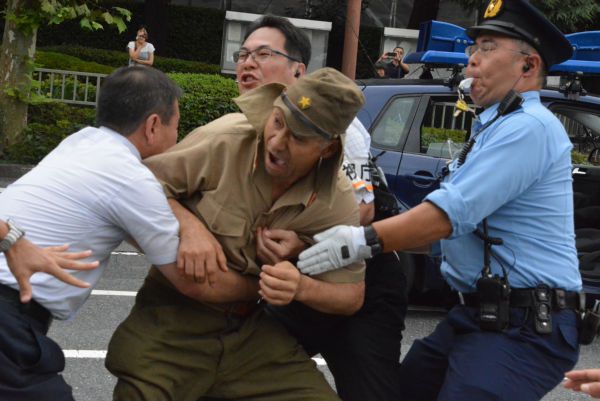
It is unclear to me if this was a co-ordinated action between several groups or individuals, but online reports claim that the racist hate group Zaitokukai was the main organiser. The perpetrators of the attack seemed to attempt to surround the tents with flags and banners. The hot summer day then quickly became more heated as supporters rallied to protect the tents, and police struggled to keep the two…
View original post 1,448 more words
State funds planned for cleaning heavily contaminated zones in Fukushima
Privatized profit, socialized risk and clean up
The government plans to use state funds to finance the radiation cleanup in the areas most seriously contaminated by the Fukushima disaster in 2011, government sources said Friday.
It is the first plan to decontaminate the “difficult to return to” zones, including a large portion of the two towns hosting the crippled Fukushima No. 1 nuclear power plant and parts of other nearby municipalities in the prefecture.
The move is intended to expedite the cleanup process but may draw criticism because it will effectively reduce the financial burden on Tokyo Electric Power Company Holdings Inc., the utility responsible for the world’s worst nuclear crisis since Chernobyl.
Under the current legal framework, the decontamination costs are first shouldered by the state, with Tepco told to reimburse the expenses over time. But since the costs are expected to far exceed the ¥2.5 trillion estimated earlier…
View original post 219 more words
Worker’s leukemia deemed result of his work at Fukushima Daiichi Nuclear plant granted compensation
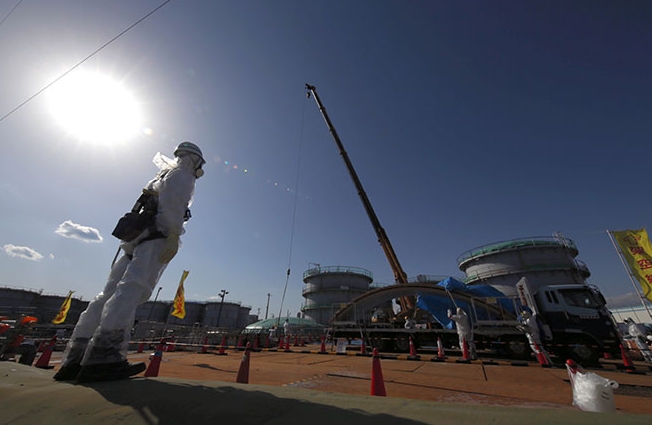
Workers in protective gear at the Fukushima No. 1 nuclear power plant in February
Man’s leukemia deemed result of his work at Fukushima plant
The labor ministry said a man who developed leukemia by helping in clean-up efforts at the crippled Fukushima No. 1 nuclear power plant is entitled to work-related compensation.
It marks the second such case since the 2011 nuclear disaster.
The Ministry of Health, Labor and Welfare recognized that the cancer was due to exposure to radiation at the facility and said the government will cover his medical expenses.
The ministry said Aug. 19 that the man, who is in his 50s, was involved in removing debris and repairing machinery that handled radioactive water at the plant between April 2011, a month after the triple meltdown triggered by the earthquake and tsunami disaster, and January 2015.
His accumulative radiation exposure was 54.4 millisieverts.
The man worked for…
View original post 362 more words
Tokyo 2020 Games prep beset with problems

“Some officials even suggested they were hoping Fukushima prefecture could host the first rounds of softball and baseball, which have been added to the program for the 2020 Olympics.
The northeastern prefecture hosts the Fukushima Daiichi nuclear power station which suffered a triple meltdown in March 2011 after it was hit by an earthquake and resulting tsunami.
About 100,000 residents have still been unable to return home because of radioactive contamination near the complex.”
Tokyo’s preparations for the 2020 Games have been beset by problems from soaring costs to a stadium designed without the Olympic cauldron.
In less than four years, the final torch bearer will light the cauldron in the opening ceremony to start the 2020 Tokyo Olympic Games.
But where was the cauldron in the newly selected design for the Olympic main stadium, Japanese officials asked in March.
It was just the latest in a series of controversies…
View original post 530 more words
Former town mayor recalls town referendum that booted plans for nuclear plant
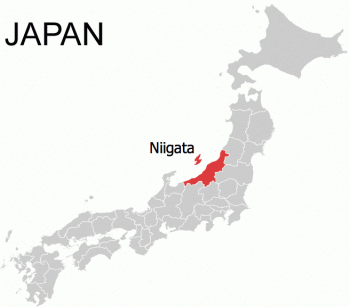
NIIGATA – Residents of the town of Maki, Niigata Prefecture, made the right decision 20 years ago, according to Takaaki Sasaguchi.
The town was Japan’s first ever to hold a referendum over a plan to build a nuclear power plant and firmly knocked it down.
“I’m proud that we opened our future through the referendum,” the former town mayor, 68, said in an interview. “Our choice not to allow a nuclear plant to be built in our town was not wrong.”
Maki no longer exists as a discrete entity as it has since been absorbed into the city of Niigata.
But memories run strong of what people power achieved, and in light of the Fukushima disaster what it may have prevented.
In 1971, Tohoku Electric Power Co. unveiled plans to construct a nuclear plant in the town. The facility was to generate electricity from a central 825,000-kw reactor of…
View original post 393 more words
1 This month
15 April – Zoom –Nuclear Power is Not the Solution
Apr 15, 2026 01:00 AM in Canberra, Melbourne, Sydney

Join the International Physicians for the Prevention of Nuclear War (IPPNW) on Tuesday, April 14th for a timely webinar exploring the risks associated with nuclear power and challenging the myth that it offers a simple, safe, carbon-free solution to the climate crisis

21 April Webinar: No Nuclear Weapons in Australia
Start: 2026-04-21 18:00:00 UTC Canberra, Melbourne, Sydney (GMT+10:00)
End: 2026-04-21 19:30:00 UTC Canberra, Melbourne, Sydney (GMT+10:00)
Event Type: Virtual
A virtual link will be communicated before the event.
Host Contact Info: australia@icanw.org

of the week – Australians for War Powers Reform (AWPR)
To see nuclear-related stories in greater depth and intensity
 Antinuclear