Roger Cross: Reasons to Reject a Medium and High Level Radioactive Waste Dump in South Australia
Roger Cross Submission to Joint Committee on Nuclear Royal Commission South Australian Parliament, August 2016 Some Reasons for rejecting the proposal to build a Medium and High Level Radioactive Waste Dump in South Australia. By Roger Cross (Author of Fallout: Hedley Marston and the British Bomb Tests in Australia, co-author of Beyond Belief The British Bomb Tests: Australia’s Veterans Speak Out)
Preamble:
The risks to the future health and security to all Australians, and South Australians in particular are many. A risk-benefit analysis is almost certainly impossible given a time-frame that extends for centuries (probably for the rest of human existence on the Planet). Benefits, in terms of financial gain to the State. and some employment must be secondary to the multitude of risks involved. These risks are worth restating so that the “golden egg” of a large financial windfall do not cloud the realities of such a decision.
Risks:
- Health Risks: The existence or otherwise of a threshold below which exposure to ionising
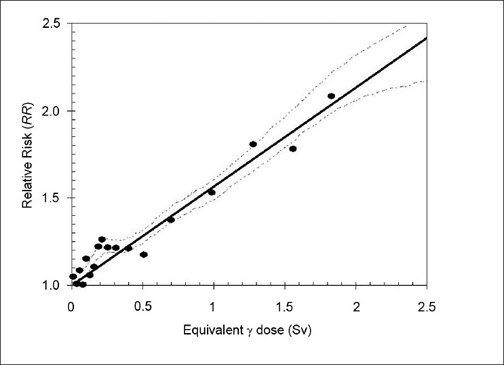
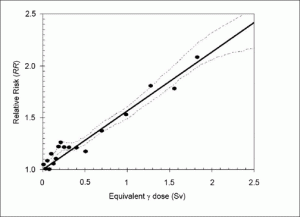 radiation is harmless has been a matter of continuous debate among nuclear scientists for decades. The statistical analysis of John Gofman (l,W, Gofman, 1981. Radiation and Human Health, Sierra Club, San Francisco, 1981, and 1990 RadiationInduced Cancer Fom Low-Dose Exposure: An Independent Analysis. Committee or Nuclear Responsibility Inc., San Francisco) shows there is no safe radioactive dose. Therefore, at any point in the chain of receiving, from overseas, transporting within S.A. and storage even small mishaps leading to only low-level contamination are not risk free. Naturally any large scale mishap would be catastrophic for the State.
- Historical Episode of radioactive contamination in South Australia: It is not feasible to claim that mishaps would not occur, that is, the risks are non-existent The radioactive contamination of Adelaide on the 12 October. 1956 due to an unfortunate change in the wind
 direction at the 11 October Maralinga Bomb Test is a case in point, This mishap caused the population of Adelaide and much of the rest of the State to be contaminated with ionising radiation from one of the Buffalo Bomh explosions (See Cross, R. 2001, Fallout: Hedley Marston and the British Bomb Tests in Australia, Wakefield Press, Adelaide, for information about this event).

- Transportation Risks: While these are impossible to quantify they are not
 negligible.Transportation of medium or high level radioactive waste in particular would require a
high degree of security and infrastructure. The former, in particular would challenge the well-being of South Australians through a system of near military style command and control intrusion into the lives of all South Australians. Such is the consequence of having to secure such a commodity.

- The Uranium back to source Argument: An argument has been mounted that because SA
 exports Uranium, and may one day become a world leading exporter of themineral, we should take back the highly radioactive waste from the user of our Uranium. This argument is entirely false, as in no other exported mineral has it been suggested that we have such an obligation. For example, do coal and iron ore producing States receive back the waste slag and ash. This can be applied to almost any raw material exported. Waste is an inevitable consequence of industrial processing and is the end-users responsibility.
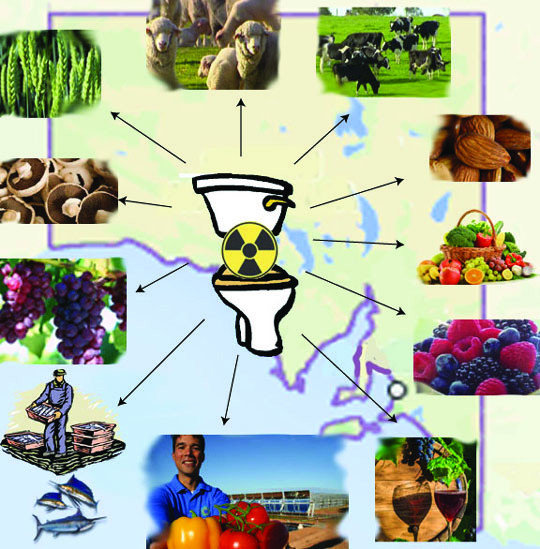
- South Australia’s future World image: The risks are not confined to technical issues but are
 also present in the image we wish to present to the rest of the world. This will become increasingly important in our push to attract more overseas visitors. Tourism is and can play and ever greater part in our economy as the State is currently seen as fl safe, clean and green place to visit. This advantage we have would naturally disappear in the minds of prospective visitors if we went ahead with the storage of medium and high level radioactive waste from around the World.
Taken from research by the pre-eminent researcher into the health effects of low-dose ionizing radiation, Emeritus Professor John W. Gofman. See for example:- Radiation Induced Cancer from Low-Dose Exposure. An Independent Analysis, 1990, and Synapse article
Disproof of any Safe Dose: The Threshold Question In Chapters 18 through 21 it is proved beyond reasonable doubt that no safe dose or dose rate exists. His analysis of the absence of a threshold below which no harm will be done from a dose of ionizing radiation is based on human evidence. The data analysed rules out the idea of a threshold with regard to radiation-induction human cancer.
The practical implications for these findings are obvious for the establishment of any storage facility of ionising radiation material, and especially the concern here, medium to high level material. There cannot be any doubt that any exposure to radiation as a result of the multiple handling steps that are required even to reach a storage facility would have human health consequences forthose exposed, and may have, even, heritable consequences.
It should be noted that possible exposures do not end with the material reaching the storage facility but continue at that facility virtually in perpetuity. Consider the following:-
“How would a safe level of radiation come about? It could come about in theory jf the biological repair 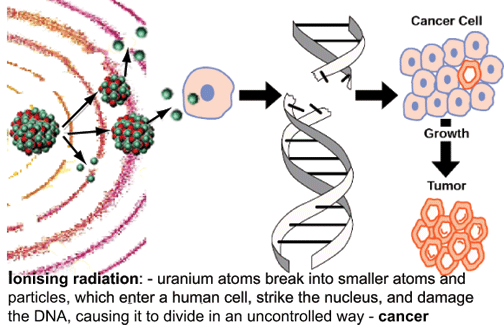 mechanisms – which exist and will repair DNA and chromosomes – work perfectly. Then a low dose of radiation might be totally repaired. The problem, though, is that repair mechanisms don’t work perfectly. There are lesions in DNA and chromosomes that are unrepairable. There are those where the repair mechanisms don’t get to the site and so they go unrepaired. . .. The evidence that the repair mechanism is not perfect is very solid today…. Ionizing radiation is not like a poison out of a bottle where you can dilute it and dilute it. The lowest dose of ionizing radiation is one nuclear track through the cell- you cannot halve it.”
1 Quotation from Gofman on Health Effects of nuclear Radiation, Synapse, Vol 38, No 16, 1994. http://www.parliament.sa.gov.au/Committees/Pages/Committees.aspx?CTId=2&CId=333

No comments yet.
1 This month
15 April – Zoom –Nuclear Power is Not the Solution
Apr 15, 2026 01:00 AM in Canberra, Melbourne, Sydney

Join the International Physicians for the Prevention of Nuclear War (IPPNW) on Tuesday, April 14th for a timely webinar exploring the risks associated with nuclear power and challenging the myth that it offers a simple, safe, carbon-free solution to the climate crisis

21 April Webinar: No Nuclear Weapons in Australia
Start: 2026-04-21 18:00:00 UTC Canberra, Melbourne, Sydney (GMT+10:00)
End: 2026-04-21 19:30:00 UTC Canberra, Melbourne, Sydney (GMT+10:00)
Event Type: Virtual
A virtual link will be communicated before the event.
Host Contact Info: australia@icanw.org

of the week – Australians for War Powers Reform (AWPR)
To see nuclear-related stories in greater depth and intensity
 Antinuclear
Leave a comment