
Wind and cars disperse radioactive material
By Kurumi Sugita
A remarkable documentary of the RTBF about contaminated areas, including Minami Soma in Fukushima prefecture.These areas are heavily contaminated.Nevertheless, the Japanese government makes the people return by lifting the evacuation order and stopping aid.
The Nos Voisins Lointains 3.11 association, exchanged messages with Mr. Ozawa,the engineer interviewed in the documentary.According to him, the most worrisome problem is the fact that black substances in the mall parking area get attached to car tires and are transported everywhere, as we can see in the documentary. The risk of radiation is thus dispersed.

On the other side of the parking area, we see collective dwellings from where children play outside, according to Mr. Owaza.
See also the video sent by Mr. Ozawa showing the wind lifting and dispersing the contaminated dust from fields now uncultivated.
Linens that are drying on the balcony outside are exposed to…
View original post 48 more words
American nuclear expert Arnie Gundersen warns: “There is a possibility that now in Fukushima recontamination is occurring.”
CCTV (Channel 17 in Burlington, Vermont), published Jun 20, 2016
Maggie Gundersen, Chiho Kaneko and Caroline Phillips of Fairewinds Energy Education discuss the nuclear risk concerns for children not only near the nuclear disaster sites of Fukushima-Dai-ichiin Japan and Chernobyl in Ukraine, formerly the Soviet Union, but globally where areas near all nuclear power plants are contaminated with radiation. Since mothers in Japan especially bear the responsibility to protect children, they experience greater hardships in an environment where just expressing one’s concern about radiation is seen as a treasonous act. Even 30 years later, the Belarus government recognizes the merits of relocating children away from radiation contaminated areas but the children of Japan are socially forced to stay put in highly contaminated areas.
Margaret Harrington, host: I know you mentioned Arnie Gundersen, the chief engineer at Fairewinds, and he said that he measured the radiation there, too. Could…
View original post 1,246 more words
【Thyroid Cancer in Fukushima】Fukushima Thyroid Examination Under Dual Review
Monday, August 8, 2016
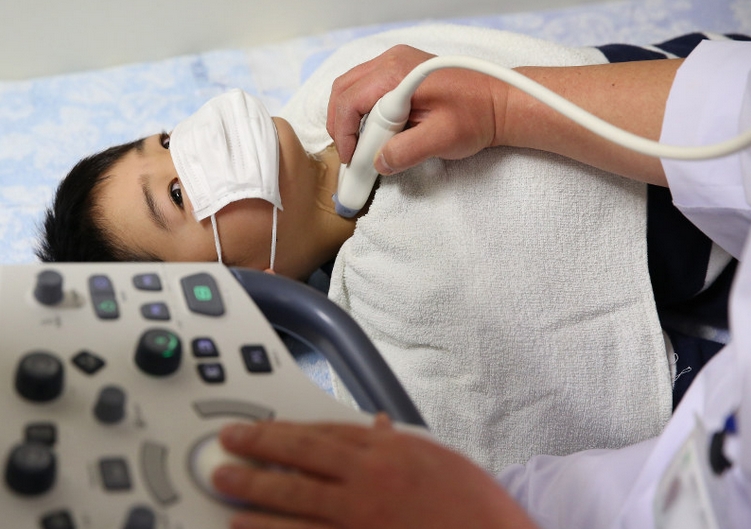
Below is unofficial translation of two Fukushima Minyu articles regarding the review of the thyroid examination, published on August 8, 2016 and July 4, 2016. The August article is based on an interview of Hokuto Hoshi, Chair of Oversight Committee for the Fukushima Health Management Survey. It might be tied to this post. The July article covers the launch of an independent exploratory committee by Fukushima Pediatric Association.
Interestingly, a telephone inquiry by a concerned citizen revealed the Division of the Fukushima Health Management Survey at the Fukushima Prefectural Office was unaware of the content of the August article before its publication in newspaper. They declined to comment on the issue for the time being while contacting Oversight Committee Chair Hoshi to confirm facts and discuss the issue internally.
On September 26-27, 2016, the 5th International Expert Symposium “Chernobyl+30, Fukushima+5: Lessons and Solutions for Fukushima’s Thyroid…
View original post 762 more words
Nuclear waste plan for South Australia not economically viable? Global nuclear lobby doesn’t care
The global nuclear lobby surely does not care about whether or not the South Australian nuclear waste importing scheme is economically viable.
A commitment by an Australian State to take in nuclear waste could do the trick for them – as Oscar Archer put it – by unblocking the back end of the nuclear fuel cycle. The NFCRC plan also promises the chance of a market in Australia for the mini nuclear reactors.
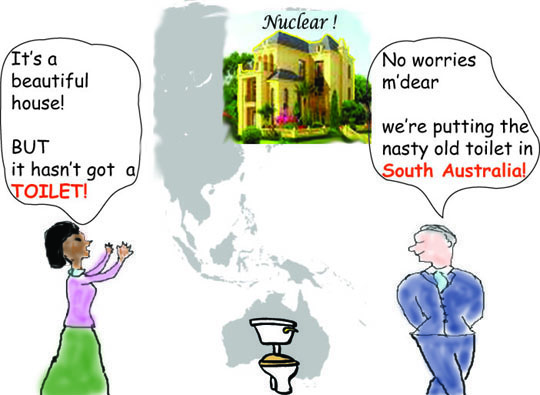
Mixed motives in South Australia’s nuclear waste import plan, Noel Wauchope, Online Opinion, 23 Aug 16, In South Australia the continued nuclear push focusses solely on a nuclear waste importing industry. Yet that might not be economically viable. Behind the scenes, another agenda is being pursued – that of developing new generation nuclear reactors.
First, let’s look at the message. The message from the Nuclear Fuel Cycle Royal Commission (NFCRC) is clearly a plan to make South Australia rich, by importing foreign nuclear wastes……This theme has been repeated ad nauseam by the NFCRC’s publicity, by politicians, and the mainstream media.…..
Meanwhile, the South Australian Parliament is holding a Committee Inquiry into the NFCRC’s recommendations. This Committee asked witnesses about various aspects of the plan. However, an intense focus in questioning Royal Commissioner Kevin Scarce, and Dr Tim Johnson from Jacob Engineering (financial reporter to the NFCRC) was directed at the economic question. It was clear that the politicians were concerned that there’s a possibility of the State spending a significant amount of money on the project, which might then not go ahead. And, indeed, Dr Johnson acknowledged that, financially,” there is a very significant risk”
Whereas other countries are compelled to develop nuclear waste facilities, to deal with their waste production from civil and military reactors,that is not a necessity for Australia, (with the exception of relatively tiny amounts derived from the Lucas Heights research reactor).
So, the only reason for South Australia to develop a massive nuclear waste management business is to make money.
If it’s not profitable, then it shouldn’t be done.
Or so it would seem.
There is another, quieter, message. When you read the Royal Commission’s reports, you find that, while the major aim is for a nuclear waste business, in fact, the door is kept open for other parts of the nuclear fuel chain…….
The clearest explanation of this came early in 2015, just as the NFCRC was starting, in an ABC Radio National talk by Oscar Archer…….
Archer’s plan is significant because it illustrates a very important point about South Australia’s nuclear waste plan – IT SOLVES A GLOBAL NUCLEAR INDUSTRY PROBLEM. Both in ‘already nuclear’ countries, especially America, and in the so far non nuclear counties, such as in South Asia, the nuclear industry is stalled because of its nuclear waste problem. In America, the “new small nuclear”, such as the PRISM, technologies (Power Reactor Innnovative Small Module) cannot even be tested, without a definite waste disposal solution. But, if South Australia provided not only the solution, but also the first setting up of new small reactors, that would give the industry the necessary boost……..
Once Australia has set up a nuclear waste importing industry, the nuclear reactor salesmen of USA, Canada, South Korea, will have an excellent marketing pitch for South Asia, as the nuclear waste problem has been removed from their shores.. And South Asia is exactly the market that the NCRC has in its sights. The NFCRC eliminated most of the EU, Russia, China, North America as customers. This was explained by Dr Tim Jacobs, of Jacobs Engineering, (financial reporters to the NFCRC), at the recent hearing of the South Australian Parliamentary Joint Committee on Findings of the Nuclear Fuel Cycle Royal Commission ………
South Australia’s government is influenced by a strong nuclear lobby push and the Royal Commission advocacy for solving that State’s present financial problems by a futuristic nuclear waste repository bonanza scheme…….
The global nuclear lobby surely does not care about whether or not the South Australian nuclear waste importing scheme is economically viable. Their fairly desperate need is to sell nuclear reactors to those countries that don’t already have them. In particular, the ‘small nuclear” lobby sees an urgency now, with ‘big nuclear’ failing, to get their industry happening.
A commitment by an Australian State to take in nuclear waste could do the trick for them – as Oscar Archer put it – by unblocking the back end of the nuclear fuel cycle. The NFCRC plan also promises the chance of a market in Australia for the mini nuclear reactors. http://www.onlineopinion.com.au/view.asp?article=18465&page=1
1 This month
15 April – Zoom –Nuclear Power is Not the Solution
Apr 15, 2026 01:00 AM in Canberra, Melbourne, Sydney

Join the International Physicians for the Prevention of Nuclear War (IPPNW) on Tuesday, April 14th for a timely webinar exploring the risks associated with nuclear power and challenging the myth that it offers a simple, safe, carbon-free solution to the climate crisis

21 April Webinar: No Nuclear Weapons in Australia
Start: 2026-04-21 18:00:00 UTC Canberra, Melbourne, Sydney (GMT+10:00)
End: 2026-04-21 19:30:00 UTC Canberra, Melbourne, Sydney (GMT+10:00)
Event Type: Virtual
A virtual link will be communicated before the event.
Host Contact Info: australia@icanw.org

of the week – Australians for War Powers Reform (AWPR)
To see nuclear-related stories in greater depth and intensity
 Antinuclear