Indigenous people oppose Australian company’s plan for massive uranium mine in Greenland
 Greenland Inuit oppose open-pit uranium mine on Arctic mountain-top http://www.theecologist.org/News/news_analysis/2988016/greenland_inuit_oppose_openpit_uranium_mine_on_arctic_mountaintop.html, Bill Williams ,17th August 2016
A collapse in the price of uranium has not yet stopped Australian mining company GME from trying to press ahead with a massive open-pit uranium mine on an Arctic mountain in southern Greenland, writes Bill Williams – just returned from the small coastal town of Narsaq where local people and Inuit campaigners are driving the growing resistance to the ruinous project.
Recently I was invited to assess an old Danish uranium exploration site in Kvanefjeld in southern Greenland.
Inuit Ataqatigiit – the opposition party in the national parliament – had asked me to talk to local people about the health implications of re-opening the defunct mine.
An Australian firm called Greenland Minerals and Energy (GME) has big plans to extract uranium and rare earth minerals here. It would be a world first: an open-pit uranium mine on an Arctic mountain-top.
From the top of the range above the mine site I looked down across rolling green farmland to the small fishing village of Narsaq. Colourful timber houses rested at the edge of a deep blue strait that the Viking Eric the Red navigated a thousand years ago. Hundreds of icebergs bobbed on its mirror-like surface. To the east, half way up the valley, a small creek tumbled into a deep rock pool.
Behind that saddle lies Lake Tesaq, a pristine Arctic lake that GME plans to fill with nearly a billion tonnes of waste rock. This part of the mine waste would not be the most radioactive, because the company plans to dump this material in a nearby natural basin, with the promise that an ‘impervious’ layer would prevent leaching into the surrounding habitat.
Left behind – all the toxic products of radioactive decay
These mine tailings would contain the majority of the original radioactivity – about 85% in fact – because the miners only want the uranium and the rare earth elements. They would mine and then leave the now highly mobile radioactive contaminants, the progeny from the uranium decay behind: thorium, radium, radon gas, polonium and a horde of other toxins.
Even at very low levels of exposure ionising radiation is recognised as poisonous: responsible for cancer and non-cancer diseases in humans over vast timespans.
This is why my own profession is under growing pressure to reduce exposure of our patients to X-Rays and CT scans in particular – making sure benefit outweighs risk. It’s also why ERA, the proprietors of the Ranger mine in Kakadu, Australia, are legally obliged to isolate the tailings for at least 10,000 years.
While this is hardly possible, the mere fact that it is required highlights the severity and longevity of the risk. My Inuit audience in Narsaq was particularly interested to hear the messages I brought from traditional owners in Australia like Yvonne Margarula, of the Mirarr people:
“The problems always last, but the promises never do.”
And Jeffrey Lee from Koongara:
“I will fight to the end and we will stop it, then it won’t continue on for more uranium here in Kakadu.”
So far in 2016, not a single new nuclear reactor has opened
When GME started touting this project a decade ago the price of uranium was over $120 per pound and everybody in the extractive industry was breaking open the bubbly in anticipation of the ‘nuclear renaissance’.
We were told that nuclear power would save the world from anthropogenic carbon-carnage and uranium was a stock-market wunderkind. Then came the global financial crisis of 2007/2008 and the spot-price halved. And then the nuclear reactors at Fukushima melted down, and the price halved again.
And so the ‘renaissance’ failed to materialize: the real news today is that there has not been one reactor construction start-up so far this year. Not one. Not even in China, the only place where one could honestly claim there has been significant build in the past decade. Consequently, the uranium price has collapsed down to about $25 a pound at present.
GME’s share price trajectory has amplified the fall in the uranium price – from $65 a share in 2007 to less than 3 cents today. Despite this reality GME continues to wax lyrical about the company’s prospects.
A small nation divided
Two years ago the newly elected Greenland national government rescinded a 30-year ban on mining and exporting uranium – but their majority of just one seat in the 31-seat parliament makes this a fragile promise. Inuit Ataqatigiit holds the other 15 seats and is strongly committed to preventing any mine.
Similar division exists in the region where the ore-body is located. The small town of Narsaq deep in the southern fjords has seen much conflict and distress ever since the Aussie miners came to town. While some locals believe the mine would mean jobs and dollars, many of their neighbours are profoundly suspicious and resistant.
When I reached the mine site I was reminded of Tolkien and of Orcs and Goblins. The Danes who first dug down deep into the mountain side 40 years ago left a great grey door fastened tightly into the mine entrance to deter any curious future visitors. And behind the door lies the booty – the fuel for the world’s most dangerous weapons and long lived industrial waste, buried in the mountain top.
If allowed to the Antipodean treasure hunters would dump a billion tonnes of waste rock in a sapphire lake and hundreds of thousands of gallons of liquid radioactive waste in a shallow ditch at the head of a primeval watershed. Then they would pack up and leave within a few decades.
But the wastes and risks they would have generated would not. Some of uranium’s radioactive byproducts would be a contamination threat to the surrounding region for tens of thousands of years.
And as the Inuit Party and a lot of folks in Narsaq have been trying to tell GME, keeping the door open for a truly green Greenland means keeping the great grey door in the mountain firmly shut on uranium mining. Bill Williams MBBS is Chair of the International Campaign to Abolish Nuclear Weapons(ICAN) – Australia.
Climate Change Adaptation – South Australia in the lead
National Climate Adaptation Conference 2016, Day Three – Sean Kidney
SOUTH AUSTRALIA: LEADING ON CLIMATE CHANGE ADAPTATION The Climate group, August 2016. Sandy Pitcher, Chief Executive of South Australia’s Department of Environment, Water and Natural Resources, reflects on the achievements of Australia’s preeminent climate change forum, the Climate Adaptation 2016 conference, which took place in Adelaide in July.
The Climate Adaptation 2016 conference provided an unprecedented opportunity for South Australia to highlight the important progress being made on climate change adaptation in our state, and learn from others in Australia and around the world.
The conference was presented by the National Climate Change Adaptation Research Facility and the Commonwealth Scientific and Industrial Research Organisation, with the South Australian Government – a member of The Climate Group’s States & Regions Alliance, the platinum sponsor. It attracted around 490 policy makers, researchers and practitioners and the debate focused on the challenges and opportunities presented by climate change adaptation.
The innovation that we’re seeing mainly happens at the local level, and can be shared at conferences like this. It is a crucial way, for us in South Australia and beyond, to share ideas, catalyze local action, and bring key influencers together.
ADAPTATION IS A VERY KEY TENANT TO ANY FUTURE STRATEGY – THERE ARE MANY PEOPLE WHO ARE GOING TO BE IMPACTED BY A CHANGING CLIMATE
South Australia has long been recognized as a global leader on climate action, and our work in climate change adaptation is central to our efforts.
Our award-winning adaptation framework is based on a collaborative, regional approach involving partnerships between local government, regional development committees and natural resources management boards, who are working together to develop well-informed adaptation solutions for their communities.
Currently, in each of the State’s regions, five climate adaptation plans have been completed with the remainder due to be finalized by the end of the year….https://www.theclimategroup.org/news/south-australia-leading-climate-change-adaptation
South Australia’s nuclear waste dump plan not economically viable? The nuclear lobby doesn’t care
The global nuclear lobby surely does not care about whether or not the South Australian nuclear waste importing scheme is economically viable. Their fairly desperate need is to sell nuclear reactors to those countries that don’t already have them. In particular, the ‘small nuclear” lobby sees an urgency now, with ‘big nuclear’ failing, to get their industry happening.
A commitment by an Australian State to take in nuclear waste could do the trick for them – as Oscar Archer put it – by unblocking the back end of the nuclear fuel cycle.
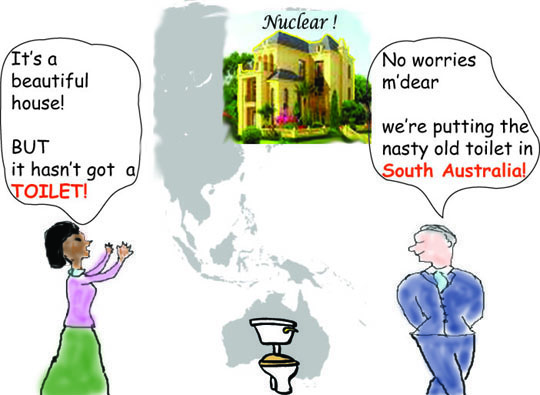
Mixed motives in South Australia’s nuclear waste import plan. Online Opinion, Noel Wauchope, 23 Aug 16 In South Australia the continued nuclear push focusses solely on a nuclear waste importing industry. Yet that might not be economically viable. Behind the scenes, another agenda is being pursued – that of developing new generation nuclear reactors.
First, let’s look at the message. The message from the Nuclear Fuel Cycle Royal Commission (NFCRC) is clearly a plan to make South Australia rich, by importing foreign nuclear wastes. …..This theme has been repeated ad nauseam by the NFCRC’s publicity, by politicians, and the mainstream media.…..
Whereas other countries are compelled to develop nuclear waste facilities, to deal with their waste production from civil and military reactors,that is not a necessity for Australia, (with the exception of relatively tiny amounts derived from the Lucas Heights research reactor).
So, the only reason for South Australia to develop a massive nuclear waste management business is to make money.
If it’s not profitable, then it shouldn’t be done.
Or so it would seem.
There is another, quieter, message. When you read the Royal Commission’s reports, you find that, while the major aim is for a nuclear waste business, in fact, the door is kept open for other parts of the nuclear fuel chain……… Continue reading
ERA unable to meet costs of cleaning up Ranger uranium mine
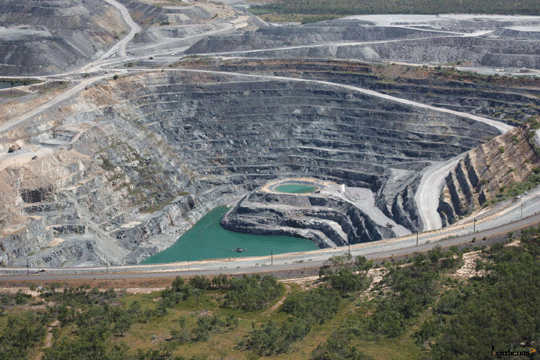 ERA short of Ranger rehabilitation costs
August 25, 2016. The slump in uranium prices is affecting ERA’s ability to build up enough cash to rehabilitate its Ranger mine…..(subscribers only)
http://www.theaustralian.com.au/business/mining-energy/era-short-of-ranger-rehabilitation-costs/news-story/13a3fd7135b1dfe49f7e057488ff2330
Ban the Nuclear Bomb in 2017 – call from huge majority of governments
 Overwhelming Majority: Ban The Bomb In
  2017, Huffington Post, Susi Snyder Nuclear Disarmament Programme Manager for Pax in the Netherlands 08/19/2016 A nuclear working group at the UN concluded its work in Geneva today and the majority of governments voted to recommended that the UN General Assembly set up a conference in 2017 to negotiate a new treaty prohibiting nuclear weapons.
Nuclear weapons are the only weapon of mass destruction that are not outlawed by international treaty. But that is about to change.
2017 Conference
After more than twenty years of nothing, this working group just had a breakthrough. 107 governments said they support:
“The convening by the General Assembly of a conference in 2017 open to all states, international organisations, and civil society, to negotiate a legally binding instrument to prohibit nuclear weapons leading towards their total elimination”
It was a group of Pacific Island countries that said these exact words first. Diplomats who have personal connections with nuclear weapons- relatives who remember seeing the bombs explode in the distance. Friends that can never go home to what were once islands of paradise, and are now radioactive wastelands.
The 54 member African Group, the 33 member Community of Latin America and Caribbean countries (33) also voiced their support for a conference in 2017. For the first time, the ASEAN grouping (11) added their collective voice to this call for negotiations next year on a new nuclear weapons treaty.
It is now up to the October meeting of the UN General Assembly First Committee to take up this recommendation, and set up a meeting next year to negotiate a new treaty to finally make nuclear weapons illegal.
Putting people first
This breakthrough is result of the new global discourse on nuclear weapons. Since Norway hosted the first conference on the Humanitarian Impact of Nuclear Weapons in 2013, the effect of the weapons on humans and the environment has taken center stage……http://www.huffingtonpost.com/susi-snyder/overwhelming-majority-ban_b_11610606.html
154 scientists press Australian government for urgent action on climate change
 154 Australian scientists demand climate policy that matches the science https://theconversation.com/154-australian-scientists-demand-climate-policy-that-matches-the-science-64359
- James WhitmoreEditor, Environment & Energy, The Conversation
Interviewed
- Andrew Glikson Earth and paleo-climate scientist, Australian National University
- Andrew Blakers Professor of Engineering, Australian National University
- Lesley Hughes Professor, Department of Biological Sciences, Macquarie University
August 25, 2016 154 Australian experts have signed on open letter to Prime Minister Malcolm Turnbull demanding urgent action on climate change that matches the dire warnings coming from climate scientists.
The letter, organised by Australian National University climatologist Andrew Glikson, calls on the federal government to make “meaningful reductions of Australia’s peak carbon emissions and coal exports, while there is still time”.
Signatories include leading climate and environmental scientists such as the Climate Council’s Tim Flannery, Will Steffen, and Lesley Hughes, as well as reef scientists Ove Hoegh-Guldberg and Charlie Veron.
They point out that July 2016 was the hottest month ever recorded, and followed a nine-month streak of record-breaking months. Average carbon dioxide concentrations in the atmosphere reached 400 parts per million (ppm) in 2015, and are rising at a rate of nearly 3 ppm each year.
The world is already witnessing the effects of climate change, the letter argues, including an increase in extreme weather events, melting of the polar ice sheets, and ocean acidification.
Australia, along with 179 other nations, has signed the climate treatybrokered in Paris last year, aiming to limit average global warming to “well below 2℃ above pre-industrial levels and to pursue efforts to limit the temperature increase to 1.5℃”.
However Glikson warned that “the Paris Agreement, being non-binding, is in danger of not being fulfilled by many of the signatories”. The deal will not enter into force until it is ratified by 55 nations accounting for at least 55% of the world’s greenhouse emissions.
Glikson called for action to “transition from carbon-emitting technologies to alternative clean energy as fast as possible, and focus technology on draw-down (sequestration) of greenhouse gases from the atmosphere”.
Australia’s current greenhouse gas target, which it took to December’s Paris climate summit, calls for emissions to be reduced by 26-28% below 2005 levels by 2030. It has been widely criticised by experts as not ambitious enough.
Andrew Blakers, professor of engineering at the Australian National University, said Australia could reduce emissions by two-thirds by 2030 “at negligible cost”.
He said the falling cost of renewable energy, particularly solar and wind, the replacement of gas with electricity for heating, and the advent of electric vehicles would eliminate most emissions. Solar and wind installation, currently at 1 gigawatt each year, would need to be increased to 2.5 gigawatts each year to reach 100% renewable energy by 2030.
Remaining emissions, from shipping, aviation, and industry, could be eliminated after 2030 at slightly higher costs.
Lesley Hughes, a member of the Climate Council and professor at Macquarie University, said there were a number of factors causing the gap between science and policy, including vested interests, perception of economic downsides of climate action, ideological biases, and inertia in the system from current investment in fossil fuels. But she said the “most important issue” was the difficulty in convincing people to act to reduce risk decades in the future.
The Climate Change Authority, which advises the government on climate policy, in 2014 recommended Australia adopt a target of 40-60% below 2000 levels by 2030.
In a report released yesterday, The Climate Institute highlighted that aiming for 1.5℃ instead of 2℃ would avoid longer heatwaves and droughts, and give the Great Barrier Reef a better chance of survival.
The institute recommended that Australia adopt an emissions reduction target of 65% below 2005 levels by 2030 and phase out coal power by 2035.
Britain demands world action on danger of nuclear drone terror attacks
 This would be a safety issue for South Australia, if it set up nuclear waste transport and nuclear waste dumps?
Britain warns UN security council it MUST act over threat of nuclear drone terror attacks BRITAIN has warned the UN security council that not enough is being done to  prevent chemical, nuclear and biological weapons finding their way into the hands of terrorists. Express, By SIOBHAN MCFADYEN, Aug 25, 2016 And they say evolving terrorist threats include materials created through technological advances including 3D printers and drones. The British Government is worried that border security is not tight enough to prevent the materials from falling into the wrong hands.
And they say that the security council, which is being chaired by Spain, should be able to implement an action plan before the end of the year.
UK Permanent Representative to the United Nations Ambassador Matthew Rycroft spoke to the council this week as fears the UN is not moving fast enough to clamp down on terrorists. Mr Rycroft said: “The threat of toxic, poisonous or nuclear materials falling into the hands of non-state actors, particularly terrorists, is a top priority that requires the closest cooperation between all Member States, as well as civil society and industry……. http://www.express.co.uk/news/world/704011/Britain-warns-UN-security-council-it-MUST-act-over-threat-of-nuclear-drone-terror-attacks
UK officials considering ways to pull out of Hinklely nuclear power plant deal
 Hinkley Point nuclear power station: Whitehall officials ‘exploring ways UK could pull out of deal’ Theresa May’s administration called an unexpected halt to the project amid security and viability concerns, Independent Joe Watts Political Editor @JoeWatts_ Thursday 25 August 2016 Whitehall officials reviewing the massive Hinkley Point nuclear project are exploring how the UK might withdraw from the deal while minimising financial risk and damage to international relations, it has been claimed.
Westminster sources told The Independent civil servants are looking to see if there is any loophole, clause or issue in contracts yet to be signed that allow the Government to pull back without huge loss and while also saving face.
Ministers are acutely aware of the potential damage a withdrawal could do to relations with China, which is committed to pouring billions of pounds into the controversial project.
Former Chancellor George Osborne was an enthusiastic supporter of the £18 billion scheme, but since Theresa May’s arrival it is being reviewed by the new administration. A Whitehall source said: “There is a working assumption of people in government that the civil service is looking for a way out, a legal loophole, a clause.
“They are looking for anything that will allow the Government to withdraw and also allow the Chinese to withdraw while also saving face.”
It was expected last month when the board of French energy company EDF voted to go ahead with Hinkley C power station that the British Government would give its approval.
Instead new Business Secretary Greg Clark announced he needed more time to make a decision.
It followed claims that the price promised for Hinkley’s electricity at £92.50 per MWh, more than double the wholesale price, was too expensive……..
EDF may also have problems fulfilling its end of any agreement. The company’s finance director Thomas Piquemal resigned earlier this year, fearing Hinkley could lead to the firm’s insolvency.
title=”24 August 2016 16:26 London”>A senior Government figure said: “The other thing no-one is talking about is what happens after the French election.
“Hollande is not going to be there and it is not clear whether Sarkozy or Juppe are committed to it.”
A spokesperson from the Department for Business, Energy & Industrial Strategy said: “No contract has been signed and it is only right that a new Government considers all component parts carefully before making a final decision.” http://www.independent.co.uk/news/uk/politics/hinkley-point-edf-nuclear-power-station-deal-how-uk-could-pull-out-a7207776.html
Suppression of native title for the Mirarr people- extinguishment of rights?
Timber Creek Aboriginal custodians win historic $3.3 million payout for native title rights loss, ABC News, By Avani Dias and Jessicah Mendes 25 Aug 16 “………Extinguishment principle ‘hard to accept’
In a separate decision, the Federal Court has partially recognised the rights of the Mirarr people to one of the longest-running native title claims in the Territory.
The court has recognised the Mirarr’s rights over sections of the township of Jabiru that have been subleased to government entities. But those rights only apply if and when the leases expire — a move described as the “suppression” of native title.
The ruling also rejected or ‘extinguished’ the Mirarr’s rights over areas of the town subleased to private companies such as Energy Resources Australia — the operators of the Ranger uranium mine.
Mr Morrison said the case had been a complicated one.
“I think it was a very difficult case but I think it also sets an important precedent to partially recognise, through suppression, native title in parts of Jabiru,” he said.
But he said the concept of a native title claim being rejected or “extinguished” could be very difficult for Aboriginal people to accept.
“Aboriginal people right around the country have said it’s an abhorrent feature of the Native Title Act, this extinguishment principle.”http://www.abc.net.au/news/2016-08-24/timber-creek-custodians-payout-for-native-titles-rights-loss/7779532
Germany’s power reliability as it ramps up renewable energy
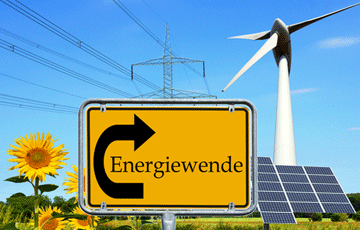
In short, Germany is paying coal to shut down, ramping up renewables far faster than nuclear shrinks, and enjoying unparalleled power reliability—while New York fails to move with solar and wind, pays nuclear to stay on, and has as much downtime a month as Germany has in a year.
Germany already has more green power than it ever had nuclear, Energy Transition 24 Aug 2016 by Craig Morris “….. Craig Morris takes a look at the data……In Germany, however, solar and wind are reducing the wholesale prices that baseload nuclear and coal sell at—because green power is growing fast. In 2002, the country adopted a plan to phase out nuclear by around 2022 (this is still the target). Most onlookers thought it would be impossible to ever offset nuclear power with renewables in such a short time. In fact, Germany hit that target last year—seven years early. Continue reading
South Australia: Future Business Council calls for National smart energy grid
 Tom Quinn: South Australian business is paying high price for ‘dumb’ national electricity grid
 http://www.adelaidenow.com.au/news/opinion/tom-quinn-south-australian-business-is-paying-high-price-for-dumb-national-electricity-grid/news-story/97918e65518213082303ddd011421d3f
Last week’s meeting of energy ministers fumbled their first chance to do so, leaving business hamstrung. Nowhere is that as painfully clear than in South Australia.
The state has led the country in tapping into rich, renewable resources but when it comes to accessing the benefits business is still missing out. The problem? South Australia must operate within a larger national system that’s designed for a different age.
The wholesale electricity price spikes seen in July, claims of gas market manipulation and barriers preventing the rapid shift to 100 per cent renewable electricity have highlighted the many systematic flaws. At the heart of all this, though, sits an outdated grid that is based on last century’s centralised generation model.
This obsolete system has served us well but is now holding back the state and business community.
The sand is rapidly shifting under the traditional energy market’s feet driven by households and businesses that are no longer just consumers of energy but also producers, particularly through domestic solar panels Continue reading
Turnbull’s plan to defund Australian Renewable Energy Agency will cause loss of 100s of solar energy jobs in Queensland
 Queensland solar projects that could create 2,600 jobs at risk in federal cuts
Many schemes may not go ahead if the Australian Renewable Energy Agency is defunded in the government’s omnibus bill, ACF warns, Guardian, Michael Slezak, 25 Aug 16, Thousands of jobs could be created in Queensland if 10 large-scale solar projects were to receive funding, according to analysis by the Australian Conservation Foundation.
The projects, earmarked for funding by the Australian Renewable Energy Agency (Arena), would create around 2,695 jobs according to the study.
The figure compared favourably with the 1,400 jobs which the Indian conglomerate Adani estimates its $16bn Carmichael coalmine would bring to the state if it obtains approval for the controversial project, the study claimed.
However, the findings comes as Arena faces defunding by the federal government, placing the projects in jeopardy. Continue reading
Landmark payout for Aboriginal custidians who have lost their native title rights.
Timber Creek Aboriginal custodians win historic $3.3 million payout for native title rights loss, ABC News, By Avani Dias and Jessicah Mendes 25 Aug 16 More than 20 years after the landmark Mabo decision, the Federal Court has for the first time determined how to award compensation to traditional owners who have lost their native title rights.
Key points:
- First time court has quantified loss of cultural attachment to land
- Decision expected to trigger new cases
- NLC ‘very happy’ with outcome of decision
Aboriginal custodians of Timber Creek, 600km south-west of Darwin, have been awarded $3.3 million in compensation for the loss of their native title rights. Continue reading
Wind projects now cheaper, appeal to utilities, commercial purchasers
 Annual wind report confirms tech advancements, improved performance, and low energy prices, Eureka Alert, DOE/LAWRENCE BERKELEY NATIONAL LABORATORY, 17 Aug 16 Wind energy pricing remains attractive to utility and commercial purchasers, according to an annual report released by the U.S. Department of Energy and prepared by the Electricity Markets & Policy Group at Lawrence Berkeley National Laboratory (Berkeley Lab). Prices offered by newly built wind projects are averaging around 2¢/kWh, driven lower by technology advancements and cost reductions.“Wind energy prices–particularly in the central United States–are at rock-bottom levels, with utilities and corporate buyers selecting wind as the low-cost option,” said Berkeley Lab Senior Scientist Ryan Wiser. “Moreover, enabled by technology advancements, wind projects are economically viable in a growing number of locations throughout the United States.”
Key findings from the U.S. Department of Energy’s reflective “Wind Technologies Market Report” include:
- Wind power represented the largest source of U.S. electric-generating capacity additions in 2015. Wind power capacity additions in the United States surged in 2015, with $14.5 billion invested in 8.6 gigawatts (GW) of new capacity. Wind power constituted 41% of all U.S. generation capacity additions in 2015, up sharply from its 24% market share the year before and close to its all-time high. Wind power currently meets about 5% of the nation’s electricity demand, and represents more than 10% of total electricity generation in twelve states, and more than 20% in three of those states.
- Bigger turbines are enhancing wind project performance……
- Low wind turbine pricing continues to push down installed project costs. Wind turbine prices have fallen 20% to 40% from their temporary highs in 2008, and these declines are pushing project-level costs down. …..
- Wind energy prices remain very low. Lower installed project costs, along with improvements in capacity factors, are enabling aggressive wind power pricing. ….
- The manufacturing supply chain continued to adjust to swings in domestic demand for wind equipment. …. http://www.eurekalert.org/pub_releases/2016-08/dbnl-awr081716.php
World Bank stories on opportunities for climate-friendly future
Six stories show renewable energy underpins a climate-friendly future http://blogs.worldbank.org/energy/six-stories-show-renewable-energy-underpins-climate-friendly-future [INCLUDES VIDEOS] BY ANDY SHUAI LIU ON TUE, 01/05/2016 In 2015 the world saw great momentum for climate action, culminating in a historic agreement in December to cut carbon emissions and contain global warming. It was also a year of continued transformation for the energy sector. For the first time in history, a global sustainable development goal was adopted solely for energy, aiming for: ACCESS TO AFFORDABLE, RELIABLE, SUSTAINABLE AND MODERN ENERGY FOR ALL.
1 This month
7 April – WEBINAR – Australia and the Doomsday Clock – Preventing nuclear war through NoFirstUse and other policies
Online | Tuesday April 7, 4:00-5:30pm, Australian Eastern Time / 8:00-9:30am Central Europe Time
– Access the registration link
15 April – Zoom –Nuclear Power is Not the Solution
Apr 15, 2026 01:00 AM in Canberra, Melbourne, Sydney

Join the International Physicians for the Prevention of Nuclear War (IPPNW) on Tuesday, April 14th for a timely webinar exploring the risks associated with nuclear power and challenging the myth that it offers a simple, safe, carbon-free solution to the climate crisis

21 April Webinar: No Nuclear Weapons in Australia
Start: 2026-04-21 18:00:00 UTC Canberra, Melbourne, Sydney (GMT+10:00)
End: 2026-04-21 19:30:00 UTC Canberra, Melbourne, Sydney (GMT+10:00)
Event Type: Virtual
A virtual link will be communicated before the event.
Host Contact Info: australia@icanw.org

of the week – Australians for War Powers Reform (AWPR)
To see nuclear-related stories in greater depth and intensity
 Antinuclear