The real reason for Australia’s opposition to a ban treaty (that a ban will make it more difficult for Australia to continue its reliance on extended nuclear deterrence) was never mentioned. The transparent dishonesty in Australia’s rhetoric only increased scepticism of Australia’s commitment to nuclear disarmament.
On Friday at the United Nations in Geneva, Australian diplomats called a vote they knew they would lose, split their already modest support base in half, and enraged more than 100 other countries that had been ready to agree to a painstakingly negotiated compromise. For its trouble, Australia gained precisely nothing, and seriously damaged its credibility and influence. If it sounds like a diplomatic train wreck, it was. What on earth was going on?
The drama unfolded on the final day of the UN Open-ended Working Group on taking forward multilateral nuclear disarmament negotiations. This group has met intermittently throughout 2016; the principal goal for Australia and around 28 other countries in nuclear alliances (also known as ‘umbrella states’ or, more colourfully, ‘nuclear weasel states’) was to ensure that the group did not recommend the negotiation of a new treaty prohibiting nuclear weapons (Tim Wright covered the ban treaty proposal and the associated dilemmas for Australia in The Interpreter in June).
Australia’s manoeuvres on Friday were merely the latest in a series of ill-conceived efforts to try to stop the ban treaty, but which have only fuelled support for it. Continue reading →
August 27, 2016
Posted by Christina Macpherson |
AUSTRALIA - NATIONAL, politics international, weapons and war |
2 Comments
Australia has steadily retreated from the push for universal nuclear disarmament that Bill Hayden, notably, inserted into policy when he was foreign minister in the Hawke government to provide moral balance to the alliance with the US.
 As we’ve noticed before, the new Defence White Paper this year dropped all that. “Australia’s security is underpinned by the ANZUS Treaty, United States extended deterrence and access to advanced United States technology and information,” it stated. “Only the nuclear and conventional military capabilities of the United States can offer effective deterrence against the possibility of nuclear threats against Australia.”
Julie Bishop is all for nuclear weapons, gushing that “the horrendous humanitarian consequences of nuclear weapons are precisely why deterrence has worked”. In Geneva, her diplomats have been hard at work trying to derail efforts for a United Nations ban on nuclear weapons.
…..much bad will towards Australia. But Bishop can be sure of brownie points in Washington, no doubt.
People’s tribunal finds Australia guilty over nuclear weapons, The Saturday Paper, HAMISH MCDONALD, AUG 27, 2016
Weasel words at UN working group Malcolm Turnbull is getting accused of many things as he  heads towards the first anniversary of his snafu-prone prime ministership. But aiding and abetting the planning of genocide, ecocide and even omnicide (that is, the destruction of everyone and all living things)?
Well, yes. The University of Sydney was recently the venue for an international people’s tribunal, a kind of volunteer court, in which the leaders of the nine nuclear powers were on trial for planning the above crimes through their explicit threats to use their weapons. Turnbull, as our current leader, was up for facilitating the use of American weapons. The judges were New Zealand’s former disarmament minister Matthew Robson and Sydney politics academic Keith Suter, who duly found the accused guilty, in absentia of course.
They ruled that nuclear weapons violate the accepted principles of international humanitarian law in wartime because they cannot discriminate between military and civilian targets; go far beyond proportional response and military objectives; don’t protect non-combatants; cause unnecessary suffering by spreading poison, disease and genetic damage; cause massive environmental damage; threaten future generations; threaten death on a scale amounting to genocide; and involve massive collateral damage to neutral countries.
The United States, France, Russia, Pakistan and Britain refuse to rule out first use of their nuclear weapons, “but all indicted leaders have military plans and exercises that demonstrate that they are ready to use nuclear weapons if they deem it necessary”, the tribunal found. …….
The gesture comes as nuclear powers are expanding or modernising their arsenals. India and Pakistan are in a nuclear arms race: even use of 100 Hiroshima sized-bombs in that theatre would plunge the Earth into its coldest climate for a thousand years, University of Missouri expert Steven Starr told the tribunal. An exchange between the big powers would, aside from the immediate casualties, create a new Ice Age and result in most surviving humans and large animals dying of starvation……
August 27, 2016
Posted by Christina Macpherson |
AUSTRALIA - NATIONAL, politics international, weapons and war |
Leave a comment
studies have detected among area residents heightened levels of leukemia and cancer of the breast, colon, esophagus, liver, lung and thyroid. They have also revealed higher levels of cardiovascular and blood diseases, chromosomal aberrations and congenital anomalies.
Kazakhstan: Living with Semipalatinsk’s Nuclear Fallout, EurasiaNet August 26, 2016 – by Joanna Lillis In the village of Znamenka in northeastern Kazakhstan, adults have vivid memories of nuclear explosions rocking the steppe.
“We saw mushroom clouds — big and terrifying ones,” recalled Galina Tornoshenko, 67, shaking her head at the traumatic memory and gesturing upward at the clear blue sky. “I was small at the time, but I remember it well.”…….Over the next 40 years, 456 blasts were detonated there, releasing energy 2,500 times that of the first atomic weapon dropped on Hiroshima in 1945. The tests turned swaths of Kazakhstan into a toxic wasteland and ravaged the health of locals, who were, in effect, human guinea pigs……..
The site was mothballed in 1991, the year of the Soviet Union’s collapse. But for the people still suffering from the fallout, the atomic legacy is living on. Now renamed Semey, Semipalatinsk lies 120 kilometers east of the former ground zero, which is marked by a poignant monument in a city park depicting a woman nursing a child under an exploding mushroom cloud.
In a small apartment on the outskirts of Semey, Mayra Zhumageldina is massaging her daughter’s twisted limbs. “If you don’t do massage, they freeze up,” Zhumageldina told EurasiaNet.org, smiling down fondly at her disabled daughter. “I took a special massage course to do this.”
Zhannur Zhumageldina, 25, was born in the village of Olzhabay, 200 kilometers from the polygon, the year after it closed and three years after it conducted its last explosion.
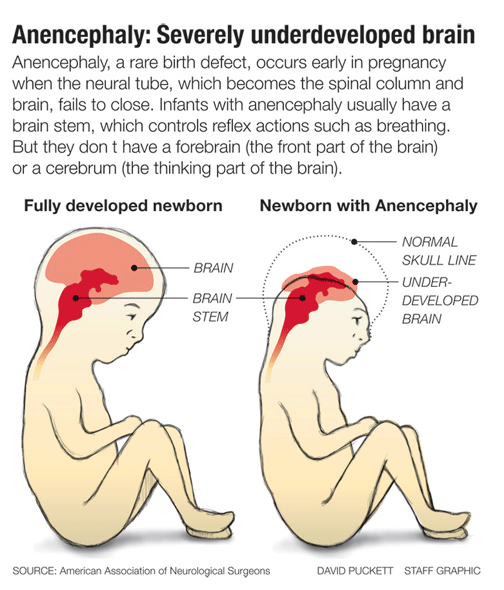
At 15 months old, she was diagnosed with microcephaly, a rare neurological condition in which the head is abnormally small, impeding brain development, and scoliosis, curvature of the spine. Both conditions were caused by radiation exposure. Continue reading →
August 27, 2016
Posted by Christina Macpherson |
Uncategorized |
Leave a comment
It is time to turn nuclear common sense into national policy. A declaration that the United States would never use nuclear weapons when conventional weapons could destroy the target could reduce the number of nuclear weapons we need for legitimate deterrence purposes.
 The common-sense fix that American nuclear policy needs, WP, By Jeffrey G. Lewis and Scott D. Sagan August 24
Jeffrey G. Lewis is director of the East Asian Nonproliferation Program at the Middlebury Institute of International Studies at Monterey. Scott D. Sagan is the Caroline S.G. Munro professor of political science and senior fellow at the Center for International Security and Cooperation at Stanford University. This op-ed was adapted from an article that will appear in the fall issue of Daedalus.
President Obama, in his final months in office, is considering major nuclear policy changes to move toward his oft-stated goal of a world without nuclear weapons. One option reportedly under consideration is a “no first use” pledge, a declaration that the United States would not be the first state to use nuclear weapons in any conflict. While we think that such a pledge would ultimately strengthen U.S. security, we believe it should be adopted only after detailed military planning and after close consultation with key allies, tasks that will fall to the next administration.
There is, however, a simpler change that Obama could make now that could have as important, or even greater, benefits for U.S. security. The president could declare, as a matter of law and policy, that the United States will not use nuclear weapons against any target that could be reliably destroyed by conventional means.
This might seem like common sense, but current U.S. doctrine allows the use of nuclear weapons against any “object” deemed to be a legitimate military target. Continue reading →
August 27, 2016
Posted by Christina Macpherson |
Uncategorized |
Leave a comment
Legal win for Tasmanian anti-mining groups fighting two Tarkine proposals, ABC News By Pablo Vinales , 27 Aug 16 Tasmanian conservationists have won the right to find out why previous state governments granted mining leases in the Tarkine region.
The Supreme Court in Hobart has dismissed an appeal by the State Government in an ongoing dispute with the Tarkine National Coalition.
Conservationists were seeking the reasoning behind decisions made by both Labor and Liberal governments which gave Venture Minerals Limited leases at Mount Lindsay and Livingstone in the Tasmania’s north-west.
Scott Jordan from Save the Tarkine said the decision was emphatic.
“This is a really clear judgement, it’s a strong judgement that the minister must provide statements of reasons for decisions he made around mining leases and that he can’t withhold that information and it should be available to the public,” Mr Scott said.
“The judgement was very clear to that there wasn’t any merits to the case that was brought, we’re very pleased with the judgement.”……http://www.abc.net.au/news/2016-08-26/legal-win-for-tarkine-group-opposing-mines/7789080
August 27, 2016
Posted by Christina Macpherson |
General News |
Leave a comment
 Hinkley Point C nuclear plant not essential – think tank, BBC News 26 Aug 16, The Hinkley Point C nuclear power plant is “not essential” for the UK to meet its energy and climate change targets, according to a think tank.
The Energy and Climate Intelligence Unit (ECIU) also said opting for “established” approaches instead would save bill payers £1bn a year in total.
EDF Energy, which has agreed to back Hinkley, said the ECIU report did not offer “credible alternatives”.
The government is due to make a final decision on Hinkley in the autumn………
One of the report’s authors, former Npower chief executive, Paul Massara – who now runs North Star Solar – said: “You are looking at a deal which is two and half times the current price, it goes on for 35 years and effectively this report today shows we can transition to a low carbon, affordable secure option without Hinkley and that’s what we should be doing.”
Mr Massara said a more “flexible” cost saving approach was needed that “includes things like demand-side management, which means people can turn down their electricity demand and manage their demand, with smart meters and batteries which are going to come in the next five to six years”…….
In its report, the not-for-profit ECIU made the assumption that “the total annual cost of Hinkley will probably be about £2.5bn”.
It then calculated the cost of a basket of alternative measures to meet the country’s energy and climate change targets, and concluded that bill payers, both domestic and business, would end up paying a total of £1bn less per year for their energy if they were adopted than if Hinkley C were built.
‘Not essential’
The think tank’s alternative proposals include building more wind farms and gas-fired power stations than are currently planned and laying more cables connecting the UK grid with other countries.
“Our conclusion is that [Hinkley Point’s] not essential,” said ECIU director, Richard Black.
“Using tried and tested technologies, with nothing unproven or futuristic, Britain can meet all its targets and do so at lower cost,” he added……..http://www.bbc.com/news/business-37191222
August 27, 2016
Posted by Christina Macpherson |
Uncategorized |
1 Comment

 Protests threaten China’s nuclear energy plans, Global Risk Insights, 26 Aug 16 NIMBYism is on the rise in China, and without better dialogue between stakeholders, threatens to undermine Beijing’s nuclear plans and efforts to meet its COP21 goals.
Over the past two weeks, thousands of residents of Lianyungang, a town in Jiangsu province, have gathered, halting preparations for a proposed nuclear waste reprocessing plant. Lianyungang is one of six sites under consideration for the project, but the two companies developing the plant, China National Nuclear Co. (CNNC) and France’s Areva, have not yet decided on a final location.
China’s ambitious nuclear plans The proposed fuel reprocessing center would recycle spent fuel to create new fissile material. This process also reduces the final volume of nuclear waste that needs to be stored. Currently, spent fuel is stored onsite at the power plant, usually first in cooling pools and then in dry casks. Long term storage facilities, such as the controversial Yucca mountain repository in Nevada, have been unsuccessful in gaining regulatory approval. However, on-site waste storage is not viable in the long term, and fuel reprocessing centers, like the proposed $15 billion CNNC-Areva project, will be critical to the viability of nuclear energy in China.………
Chinese state media has attributed the movement in Lianyungang to “nimbyism.” The NIMBY (Not In My Backyard) mentality has led to the suspension or cancellation of other industrial projects in China, such as praxylene or waste incinerator plants.
Lack of public input fuels opposition There is growing advocacy in China for an expanded role for public input in planning these projects – currently decisions at the planning stages are made with little input from residents: “for many local residents, there is no absolute guarantee that those projects, if built in their neighborhood, can be 100 percent safe. If there is some harm, they will bear the brunt of the costs and risks…..” http://globalriskinsights.com/2016/08/nimbyism-threatens-china-nuclear-plans/
August 27, 2016
Posted by Christina Macpherson |
Uncategorized |
Leave a comment
The revival of concern about the humanitarian impacts of these weapons is shifting old assumptions.
Australia’s reliance on END keeps us on the wrong side of history. And it has led previous governments and the current government to actively oppose the growing calls for a ban on nuclear weapons.
Instead of blindly following US nuclear policies into whatever a future president might envisage, Australia should carefully consider its non-nuclear defence and challenge all claims, surrogate or otherwise, to nuclear weapons.
 Australia’s stance on nuclear deterrence http://www.swinburne.edu.au/news/latest-news/2016/08/australias-stance-on-nuclear-deterrence-.php 26 August 2016
IN SUMMARY Analysis for The Conversation by Swinburne PhD candidate Dimity Hawkins and Swinburne senior lecturer Julie Kimber.CONTACT Lea Kivivali +61 3 9214 5428 lkivivali@swin.edu.au
For Australia, the US election should provide an opportunity to rethink defence relationships, especially as they relate to nuclear weapons.
There has been much hand-wringing at the thought of Donald Trump becoming US president. If, by some miracle, Trump succeeds in November, he will have his hand on the nuclear trigger.
But this concern, while great political fodder, is dangerously simplistic. It presupposes there are “safe hands” when it comes to nuclear weapons. There are not.
The US has around 7,000 nuclear weapons. Hundreds of these can be launched within minutes. While the global community has outlawed other indiscriminate weapons of mass destruction, nuclear weapons are yet to be banned.
The Cold War’s MAD (Mutually Assured Destruction) doctrine has morphed over the years into a framework of nuclear deterrence. Many governments globally have played a double game: supporting nuclear disarmament on the one hand, while relying on a nuclear defence on the other.
One such government is Australia’s. Despite consecutive governments insisting they support nuclear disarmament, Australia’s reliance on Extended Nuclear Deterrence (END) means it is frustrating attempts at a total ban.
August 27, 2016
Posted by Christina Macpherson |
AUSTRALIA - NATIONAL, weapons and war |
Leave a comment
 Governor asks utility to halt nuclear reactors in Kagoshima THE ASAHI SHIMBUN August 26, 2016 KAGOSHIMA–New Kagoshima Governor Satoshi Mitazono on Aug. 26 asked Kyushu Electric Power Co. to immediately shut down its Sendai nuclear power plant for a fresh safety inspection following the earthquakes that rocked neighboring Kumamoto Prefecture.
“We will consider your request and discuss it with many people,” Michiaki Uryu, president of Kyushu Electric, told Mitazono at the Kagoshima prefectural government building.
The utility plans to make an official response by early next month, but it is set to reject the governor’s request, sources said.
The two reactors at the Sendai plant in Satsuma-Sendai, Kagoshima Prefecture, on the southern main island of Kyushu, are the only ones online in Japan.
A governor does not have the legal authority to order a shutdown of a nuclear power plant. But under safety agreements, a prefectural government can call for measures deemed necessary to ensure the safety of the plant based on an inspection of the site…….http://www.asahi.com/ajw/articles/photo/AS20160826003329.html
August 27, 2016
Posted by Christina Macpherson |
Uncategorized |
Leave a comment










 Antinuclear