Kazakhstan’s nuclear ‘sacrifice zone’ – Semipalatinsk
studies have detected among area residents heightened levels of leukemia and cancer of the breast, colon, esophagus, liver, lung and thyroid. They have also revealed higher levels of cardiovascular and blood diseases, chromosomal aberrations and congenital anomalies.
Kazakhstan: Living with Semipalatinsk’s Nuclear Fallout, EurasiaNet August 26, 2016 – by Joanna Lillis In the village of Znamenka in northeastern Kazakhstan, adults have vivid memories of nuclear explosions rocking the steppe.
In a small apartment on the outskirts of Semey, Mayra Zhumageldina is massaging her daughter’s twisted limbs. “If you don’t do massage, they freeze up,” Zhumageldina told EurasiaNet.org, smiling down fondly at her disabled daughter. “I took a special massage course to do this.”
Zhannur Zhumageldina, 25, was born in the village of Olzhabay, 200 kilometers from the polygon, the year after it closed and three years after it conducted its last explosion.
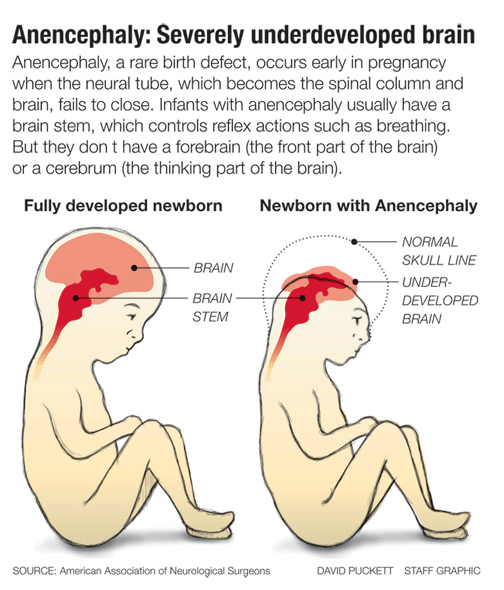
At 15 months old, she was diagnosed with microcephaly, a rare neurological condition in which the head is abnormally small, impeding brain development, and scoliosis, curvature of the spine. Both conditions were caused by radiation exposure. Her diagnosis came as a bolt from the blue to her mother, pregnant at the time with her second child, a son who was born healthy.
“I didn’t even know the polygon existed until Zhannur was 15 months old,” said Zhumageldina, a single mother who cares full-time for her severely disabled daughter, who cannot walk or talk. “I was in shock.”
Across the city, in a cramped apartment in another drab suburb, Berik Syzdykov whiles away his days listening to music videos and strumming on his dombra, a traditional stringed instrument. Syzdykov, 37, was born blind and with severe facial deformities in Znamenka, the village where adults remember mushroom clouds exploding on the horizon.
“Once, there was a big explosion,” said his 73-year-old mother Zina Syzdykova, leaning back and closing her eyes. “It was the winter of 1979 and I was pregnant. Two months later, Berik was born like this.”
“Polygon,” she said with a shrug. “We didn’t know anything about it… When Berik was born, I cried and cried, but how would I know what was wrong with him?”
………Over four decades, nuclear tests at Semipalatinsk affected 1.5 million Kazakhstanis in some form, Nazarbayev has asserted. Due to poor record-keeping and Soviet official secrecy, it is still not known precisely how many people received dangerous doses of radiation, Togzhan Kassenova of the Carnegie Endowment for International Peace’s Nuclear Policy Program told EurasiaNet.org. Data cited in one Kazakh-Japanese study suggests a quarter of a million people may have received elevated doses.
Dr. Zhaxybay Zhumadilov, a scientist from Astana’s Nazarbayev University who has researched the impact of the tests with experts from Hiroshima University, says studies have detected among area residents heightened levels of leukemia and cancer of the breast, colon, esophagus, liver, lung and thyroid. They have also revealed higher levels of cardiovascular and blood diseases, chromosomal aberrations and congenital anomalies.
Determining exposure and drawing meaningful conclusions is complicated, because “for years, what happened at the Semipalatinsk test site, [and] its effects on human health and the environment, were treated as classified information,” Zhumadilov told EurasiaNet.org. There is no international analogy for such “repeated acute external and long-term internal chronic exposure.”………
Showing files of records of her dogged – mostly futile – approaches to officialdom and charities for assistance, Zhumageldina counts herself lucky to have state-subsidized housing costing just $8 for her one-room apartment, from the $150 in monthly welfare that the family lives on. She notes that it took her 19 years of lobbying before she was granted the subsidy benefit.
The state provides free medical care for the test victims: Zhumageldina’s daughter has recently undergone treatment in Astana to alleviate her condition, for which there is no cure. Still, Zhumageldina strikes an upbeat note. “Zhannur means everything to me,” she said with a gentle smile, flicking through an album showing photos of her disabled daughter growing up. “Everyone said I should abandon her – the doctors, my husband, my mother-in-law. … I said no. I’m going to look after her.”
Syzdykov received financial support from the government and an Irish charity for multiple operations in Kazakhstan and Europe, but still this man robbed of his sight by the Semipalatinsk tests dreams of seeing what the world looks like.
“If I could see, it would be good,” he said. “If not, there’s no need for any more surgery.” http://www.eurasianet.org/node/80311
No comments yet.
1 This month

of the week – Australians for War Powers Reform (AWPR)
To see nuclear-related stories in greater depth and intensity
 Antinuclear
Leave a comment