
Solar-powered Pipe desalinizes 1.5 billion gallons of drinking water for  California, http://inhabitat.com/solar-powered-pipe-desalinizes-1-5-billion-gallons-of-clean-drinking-water-for-california/ Inhabitat, by Tafline Laylin, 29 aug 16 The infrastructure California needs to generate energy for electricity and clean water, which will be significant, need not blight the landscape. Designs like The Pipe demonstrate how the provision of public services like these can be knitted into every day life in a healthy, aesthetically-pleasing way. A finalist of the 2016 Land Art Generator Initiative design competition for Santa Monica Pier, the solar-powered plant deploys electromagnetic desalination to provide clean drinking water for the city and filters the resulting brine through on-board thermal baths before it is reintroduced to the Pacific Ocean.
August 28, 2016
Posted by Christina Macpherson |
Uncategorized |
Leave a comment

 Nuclear scientists push for freedom to express views without fear of reprisals http://www.theglobeandmail.com/news/politics/nuclear-scientists-push-for-freedom-to-express-views-without-fear-of-reprisals/article31219139/ GLORIA GALLOWAYOTTAWA — The Globe and Mail, Aug. 01, 2016 Scientists working for the Canadian Nuclear Safety Commission have asked their union to negotiate a policy on scientific integrity that would allow them to express their views about nuclear-safety issues without fear of reprisals from management. Continue reading →
August 28, 2016
Posted by Christina Macpherson |
Uncategorized |
Leave a comment
 Coalition climate numbskulls back again flogging CCS at a cost of $209 billion Lachlan Barker, Independent Australia 25 August 2016, The Coalition’s latest brainsnap of flogging Carbon Capture and Storage (CCS) as a solution to CO2 emissions from coal-fired power stations will set the taxpayer back an eye-watering $209 billion, says Lachlan Barker. “…… the utterly ludicrous notion of Carbon Capture and Storage (CCS), as a solution to CO2 emissions from coal fired power stations has raised its idiot head once more.
The CCS process involves capturing the CO2 emitted from the burner chamber, compressing it, and sequestering it underground.
 Resources Minister Matt Canavan recently handed out $23.7 million to various bodies around the country to (once more) discover CCS can never work. So I can tell you right here, right now, CCS is not feasible in any way — financially, ecologically or in an engineering sense.
However since Canavan has done this thing, once more we are all forced to go through the mill of showing why CCS is an utterly fallacious idea.
The Massachusetts Institute of Technology (MIT) has an excellent reference page for CCS, so I’ve distilled the Power Plants CCS Projects page down for you here: [excellent charts and graphs on original]……..https://independentaustralia.net/politics/politics-display/coalition-climate-numbskulls-back-again-flogging-ccs-at-a-cost-of-209-billion,9394
August 28, 2016
Posted by Christina Macpherson |
AUSTRALIA - NATIONAL, climate change - global warming, politics |
Leave a comment
 Can progress on climate change keep up with its quickening pace? WP, By Tom Steyer August 26 Tom Steyer is founder of the advocacy group NextGen Climate. July was the hottest month in recorded history, by a lot, and August isn’t looking any better. So how do we interpret that? What does it mean?
…. global climate change… may be happening faster than scientists previously predicted. Monthly global average temperatures have set records in each of the past 15 months . The concomitant climate events have been extreme: from wildfires burning in California to floods in Baton Rouge after rainfall of historic proportions to neurotoxic algae bloomschoking Florida beaches. Even the beloved moose of New Hampshire have been decimated by ticks that thrive in a warmer world……
If the new analyses imply an unpredictable and riskier world, that will necessitate a more urgent, and more difficult, response. Based on initial data, it now appears possible that the climate will warm by 2 degrees Celsius over pre-industrial levels — an amount of warming that scientists consider the danger zone — not by 2050, as once predicted, but years earlier. If further analysis supports this conclusion, this would be an enormous, and scary, change…..
if scientists start to project a dramatically shorter timeline for the impacts of climate change, any comfortable replacement scenario becomes something much more daunting. If we don’t have the decades needed for the vast bulk of our productive capacity to be replaced in the normal course, we would need to replace assets that had not reached the end of their usable lives — and that would affect industries beyond purely oil and gas.
Regardless of the scientific projections, we cannot afford to repeat the painfully slow and politically motivated dance of the past 10 years. As new data and analysis become available over the next year or so, we must be prepared to act decisively even though the cautious critics will want to wait for more definitive information. We will never have 100 percent certainty, except in hindsight. …..
Even cautious scientists are debating whether the previously accepted climate timelines are overly conservative. Meanwhile, Mother Nature has a timeline of her own. And she calls the tune. https://www.washingtonpost.com/opinions/can-progress-on-climate-change-keep-up-with-its-quickening-pace/2016/08/26/f5934118-68b8-11e6-8225-fbb8a6fc65bc_story.html?utm_term=.5d5c88ee5f7b
August 28, 2016
Posted by Christina Macpherson |
Uncategorized |
Leave a comment
Indian Scientists Design Solar Tree to Save Space for Solar Power Generation VOA, 26 Aug 16 NEW DELHI — Indian scientists have designed a “solar tree” that they hope will help overcome one of the key challenges the country faces in the generation of solar power.
With photovoltaic panels placed at different levels on branches made of steel, “solar trees” could dramatically reduce the amount of land needed to develop solar parks.
“It takes about four-square meters of space to produce energy which otherwise would have required 400 square meters of space. So almost 100 times the space is saved, which as you know is very valuable,” said Daljit Singh Bedi, chief scientist at the Council of Scientific and Industrial Research (CSIR) in New Delhi, whose laboratory in Kolkata developed the tree.
A scarce resource in India, acquisition of land to develop roads, factories and other infrastructure is a sensitive issue that has led to frequent and sometimes violent protests from displaced people.
Scientists estimate the energy generated by a solar tree would be sufficient to light up five homes. They say the space-saving tree would not only make it easier to increase solar power generation to light up homes and streets in cities, but also in rural areas where farmers are unwilling to give up large tracts of land for solar panel installations.
The solar tree will also harness more energy compared to rooftop panels. “This design, it facilitates placement of solar panels in a way that they are exposed more towards sun and that way they are able to harness 10 to 15 per cent more energy, which is more or less equivalent to one hour more than the conventional format,” said Bedi……http://www.voanews.com/a/indian-scientists-design-solar-tree-to-save-space-for-solar-power-generation/3481641.html
August 28, 2016
Posted by Christina Macpherson |
Uncategorized |
Leave a comment
 https://www.technologyreview.com/s/601218/desk-size-turbine-could-power-a-town/ GE sees its new turbine as a strong rival to batteries for storing power from the grid. by David Talbot, April 11, 2016 GE Global Research is testing a desk-size turbine that could power a small town of about 10,000 homes. The unit is driven by “supercritical carbon dioxide,” which is in a state that at very high pressure and up to 700 °C exists as neither a liquid nor a gas. After the carbon dioxide passes through the turbine, it’s cooled and then repressurized before returning for another pass.
The unit’s compact size and ability to turn on and off rapidly could make it useful in grid storage. It’s about one-tenth the size of a steam turbine of comparable output, and has the potential to be 50 percent efficient at turning heat into electricity. Steam-based systems are typically in the mid-40 percent range; the improvement is achieved because of the better heat-transfer properties and reduced need for compression in a system that uses supercritical carbon dioxide compared to one that uses steam. The GE prototype is 10 megawatts, but the company hopes to scale it to 33 megawatts.
In addition to being more efficient, the technology could be more nimble—in a grid-storage scenario, heat from solar energy, nuclear power, or combustion could first be stored as molten salt and the heat later used to drive the process.
While such a heat reservoir could also be used to boil water to power a steam turbine, a steam system could take 30 minutes to get cranked up, while a carbon dioxide turbine might take only a minute or two—making it well-suited for on-the-spot power generation needed during peak demand periods.
GE’s system might also be better than huge arrays of batteries. Adding more hours of operation just means having a larger or hotter reservoir of the molten salt, rather than adding additional arrays of giant batteries. “The key thing will come down to economics,” says Doug Hofer, the GE engineer in charge of the project. While there’s work ahead, he says, “at this point we think our economic story is favorable compared to batteries.”
August 28, 2016
Posted by Christina Macpherson |
Uncategorized |
Leave a comment
 The Unlimited Power of Ocean Winds, NYT By THE EDITORIAL BOARD, AUG. 27, 2016 The first offshore wind farm in American waters, near Block Island, R.I., was completed this month. With just five turbines, the farm won’t make much of a dent in the nation’s reliance on fossil fuels, but it shows the promise this renewable energy source could have. When the turbines start spinning in November, they will power the island, which currently relies on diesel generators, and will also send electricity to the rest of Rhode Island.
Putting windmills offshore, where the wind is stronger and more reliable than on land, could theoretically provide about four times the amount of electricity as is generated on the American grid today from all sources. This resource could be readily accessible to areas on the coasts, where 53 percent of Americans live.This technology is already used extensively in Britain, Denmark, Germany and other European countries, which have in the last 15 years invested billions of dollars in offshore wind farms in the North, Baltic and Irish Seas. In 2013, offshore wind accounted for 1.5 percent of all electricity used in the European Union, with all wind sources contributing 9.9 percent of electricity. By contrast, wind power made up only 4.7 percent of electricity in the United States last year.
While electricity generated by offshore wind farms is more expensive than land-based turbines, costs have fallen with larger offshore turbines that can generate more electricity. Construction firms have also become more efficient in installing offshore farms……http://www.nytimes.com/2016/08/28/opinion/the-unlimited-power-of-ocean-winds.html?ref=opinion&mtrref=www.nytimes.com&assetType=opinion&_r=0
 |
Click here to Reply or Forward
|
August 28, 2016
Posted by Christina Macpherson |
Uncategorized |
Leave a comment
 Fukushima 311 Watchdogs

Electric Power Company Holdings Inc.’s stricken Fukushima No. 1 plant topped ¥4.2 trillion by the end of fiscal 2015, it was learned Sunday.
The cumulative total at the end of last March, including costs for radioactive decontamination, reactor decommissioning and compensation payments to affected people and organizations, translate into about ¥33,000 per capita.
The public financial burden is expected to increase, with Tepco seeking further government assistance.
Jiji Press scrutinized the government’s special-account budgets through fiscal 2015 for the reconstruction of areas affected by the March 2011 earthquake and tsunami. It summed up the amounts of executed budgets related to the nuclear disaster and additional electricity rates consumers and businesses were charged by Tepco and seven other regional power utilities to help finance compensation payments, among other costs.
According to the study, a total of ¥2.34 trillion was disbursed for decontamination of affected areas, disposal of contaminated waste and an…
View original post 295 more words
August 28, 2016
Posted by Christina Macpherson |
Uncategorized |
Leave a comment
Fukushima 311 Watchdogs
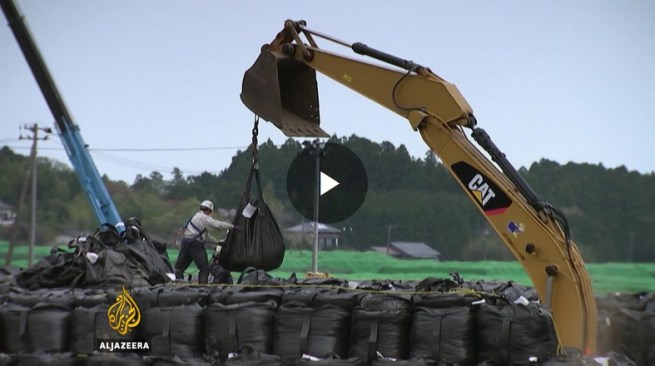
Five years after Japan’s Fukushima nuclear disaster many residents are still living in a radioactive nightmare.
Bubbling streams, lush forests, cherry blossoms in full bloom – Japan’s north is stunningly picturesque.
But nature’s beauty hides a lethal secret – dangerous levels of radiation contaminate this area, fall-out from the Fukushima nuclear disaster.
Five years after the twin catastrophes of the tsunami and nuclear meltdown, villages sit silent and empty.
Thousands of workers still toil to clean up the radioactive material but it could be decades before their work is finished.
As Japan continues to suffer the toxic aftermath of one of its worst ever disasters, 101 East reveals that the countryside may never again be safe.
http://www.aljazeera.com/programmes/101east/2016/08/fukushima-time-bomb-160824122108827.html
View original post
August 28, 2016
Posted by Christina Macpherson |
Uncategorized |
Leave a comment






 Antinuclear