Australian Nuclear, Climate , News to 27 August
 NUCLEAR Articles on weapons and disarmament dominate the nuclear news this week. On Monday 29 August, an international conference entitled ‘Building a Nuclear Weapons Free World’ will take place in Astana, the capital of Kazakhstan. That day will also be the 25th anniversary of of the closure of the Semipalatinsk Nuclear Test Site – largest in the world, where 456 weapons tests happened, leaving a terrible legacy for the people.
UN Secretary-General Ban Ki-moon calls for eradication of nuclear weapons. The nuclear working group at the UN concluded its work in Geneva, and the majority of governments voted to recommended that the UN General Assembly set up a conference in 2017 to negotiate a new treaty prohibiting nuclear weapons, despite the Australian government’s best efforts to sabotage this. This is one of those times when I am ashamed to be Australian.
CLIMATE. A new study declares that human-caused climate change began at around 1830. (I’ve always thought that it was 1801, because of the 1801 painting Coalbrookdale by Night – attached). Research indicates that the difference between 1.5 C and 2C rise in global temperatures will be significant, and in only 20 years’ time. Huge volume of Greenland Ice Sheet lost each year, due to global warming. Again this year, Indonesia’s blanket of smoke is back. India floods: Over 300 dead, millions affected Louisiana National Guard Rescues 19,000 in Flood-Affected Areas.
AUSTRALIA
NUCLEAR Details on Australia’s disgraceful performance at UN in Geneva can be read here and here. It was pretty stupid and counter-productive, too – made Australia unpopular, and cemented the resolve of other countries for a disarmament conference in 2017. Secretive Pine Gap remains an integral part of USA’s nuclear ‘star wars’ plans (an old newspaper article, still relevant, but now removed from their website)
SOUTH AUSTRALIA‘s nuclear waste dump plan not economically viable? The global nuclear lobby doesn’t care. Roger Cross: Reasons to Reject a Medium and High Level Radioactive Waste Dump in South Australia. SA govt going allout with pro nuclear propaganda forums.
Energy Resources of Australia unable to meet costs of cleaning up Ranger uranium mine. (What a surprise – not)
In Greenland, Indigenous people oppose Australian company’s plan for massive uranium mine in Greenland
CLIMATE CHANGE 154 scientists press Australian government for urgent action on climate change. Australia in grave danger if global warming exceeds 2 C. Adaptation – South Australia in the lead. Australian Government quietly removes Clive Hamilton’s page that listed climate deniers. Adani court decision: Traditional Owners say fight to stop QLD’s Carmichael mine continues.
RENEWABLE ENERGY South Australia: Future Business Council calls for National smart energy grid. Canberra heads to 100% renewable energy, helped by wind power from South Australia. Community solar fund shares sold out in nine minutes!.
Landmark payout for Aboriginal custodians who have lost their native title rights. BUT Suppression of native title for the Mirarr people= extinguishment of rights?
Australia trapped in its status as Nuclear Umbrella State
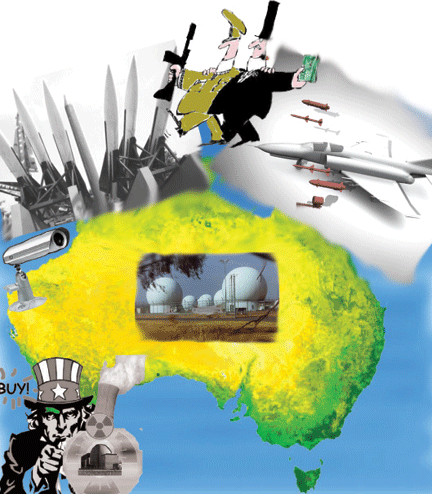 The great nuclear disarmament divide, “……On the one hand, there are umbrella states that are addicted to their nuclear protection, and on the other, there are umbrella states that clearly feel trapped by it, Livemint, 29 Aug 16 W.P.S. Sidhu, Austria, which remained neutral and nuclear weapon-free during the Cold War, has become the leading anti-nuclear crusader in the post-Cold War era. Last year, Austria, along with a group of non-nuclear countries—mostly from the southern hemisphere and Africa, which is entirely covered by nuclear weapon-free zones—proposed several United Nations General Assembly (UNGA) resolutions including on the humanitarian consequences of nuclear weapons. One of the significant Austrian co-sponsored resolutions proposed an open-ended working group (OEWG) to take forward multilateral disarmament negotiations.
Although this resolution was overwhelmingly supported by 138 countries, the five permanent nuclear weapon states of the UN Security Council plus Israel voted against it. While India and Pakistan abstained, North Korea, curiously, supported the resolution. Significantly, 34 states—mostly members of the North Atlantic Treaty Organization (Nato) and those protected by the US nuclear umbrella—also abstained.
Subsequently, while all nine nuclear-armed states (including India) stayed away from the OEWG deliberations in Geneva, the group made substantial progress. By 19 August, the group’s final report had drafted far-reaching recommendations, including a call to initiate negotiations in 2017 on a legal instrument to prohibit nuclear weapons—unlike biological and chemical weapons, nuclear weapons have never been banned. There were indications that this report would be carried by consensus among the states participating in the OEWG. Clearly, a consensus report recommending a treaty to ban nuclear weapons outright would be anathema not only for the nuclear armed states but also the so-called ‘umbrella states’, which depend on the nuclear protection particularly of the US. Thus, the nuclear-armed states sought to influence the OEWG process by proxy.
Enter Australia. In the past, Australia played a leading role in pushing disarmament initiatives, for instance, when it resurrected the Comprehensive Test Ban Treaty in 1996 and co-sponsored an International Commission on Nuclear Non-proliferation and Disarmament in 2008. However, this is at odds with its dependence on nuclear weapons.
As an umbrella state, it depends on the perceived security of US nuclear weapons. In the OEWG, Australia became a proxy of nuclear weapon states and a disarmament spoiler: it called for a vote on the group’s final report even though it was evident that the majority would support the report’s recommendations.
Australia’s objective was two-fold: first, to break the emerging consensus and, second, to close ranks among all the umbrella states. Australia almost succeeded in its second goal. Although 19 Nato states plus Australia and South Korea voted against the report, several other Nato members plus Japan abstai-ned, indicating that not all umbrella states are willing to sustain nuclear weapons and deterrence in perpetuity.
The OEWG process reflects a great disarmament divide not only among the nuclear haves and have-nots, but also among the umbrella states. On the one hand, there are umbrella states that are addicted to their nuclear protection, even though it is not apparent that such security is omnipotent. On the other hand, there are umbrella states that clearly feel trapped by the protection provided, but are unsure how get out of this situation. This debate will now play out on the floor of the UNGA…..http://www.livemint.com/Opinion/4smGv8MNF3hg63Y1WpRzQL/The-great-nuclear-disarmament-divide.html
Surface nuclear waste spurs community concern
Community concern is mounting about plans to store high level radioactive waste above ground for years before building a proposed nuclear waste dump, warns Conservation SA CEO Craig Wilkins.
“From our public consultation, most people think this proposed dump is an ‘out of sight, out of mind’ idea, where we bury the waste deep in the outback and that’s it,” he said. “The reality is very different.
“The Nuclear Fuel Cycle Royal Commission was very candid: The project only stacks up financially if we import and stockpile 50,000 tonnes of nuclear waste above ground for as long as 17 years before we can deposit it in an underground disposal site. Indeed, that ‘interim’ surface site will store tens of thousands of tonnes above ground for the next 100 years.

“So, we acquire the risk and responsibility for this nuclear waste before we know if we can actually build and operate the ultimate repository – let alone obtain community consent for it.
“Before we get there, ships containing that high-level waste enter South Australian waters through problem areas such as the South China Sea, then traverse our prawn and tuna fisheries, aquaculture zones and tourism hotspots every month for 70 years. That is a huge amount of risk.
“The plan would require a purpose-built nuclear port and rail line with nuclear waste being stored at five different locations across the state. While these facts are publicly accessible, they’ve been obscured by the promise of eye-popping windfall profits from this proposal.”
However, community concern has grown as South Australian citizens identify problems with the financial viability, environmental impact and community effects of the proposed nuclear waste dump.
In Port Augusta, a two-day community forum, called Exposure 2016, will run this weekend, from September 2-4, at the city’s Institute Theatre, starting on Friday night with ‘Talking Straight Out’. This exhibition showcases the famous Irati Wanti campaign when senior Aboriginal women from Coober Pedy, the Kupa Piti Kungka Tjuta, defeated Federal Government plans to dump radioactive waste on their land.
The free event will also include sessions on the SA Government’s international nuclear waste dumping plans; current Federal Government plans to dump waste in the Flinders Ranges; traditional owners’ voices and rights; impacts of radiation on people and the environment; impacts on industries including tourism, farming and recreation and the track record of radioactive waste management / mismanagement in South Australia and globally.
For many South Australians, the proposed nuclear waste dump in the State’s outback invokes memories of Maralinga and Emu Fields, the South Australian sites of nine British secret nuclear tests between 1953 and 1963. The tests exposed local Aboriginal communities to radiation that caused cancers, blindness and ongoing genetic damage. British and Australian servicemen were also exposed and radioactivity was detected in SA, NT, NSW and Queensland.
South Australian singer Mike Roberts also communicates concern about the nuclear waste dump in his new song Welcome to the Nuclear State. Listen at http://www.cdbaby.com/cd/mikeroberts23#. For community concerns about the SA nuclear waste dump, visit http://www.nodumpalliance.org.au/.
Montreal Declaration For Nuclear Fission Free World
We invite all people, groups and organizations involved in the effort for a world without nuclear fission and uranium mining, to commit themselves to this effort. We also ask them to endorse this declaration and to transmit it widely in their networks.
This declaration is partly inspired by the Tokyo Appeal issued by the First Thematic World Social Form for a Nuclear-Free World held in Tokyo and Fukushima in March 2016.
People and organizations who wish to sign this statement should write to ccnr@web.ca, indicating their e-mail addresses and country.
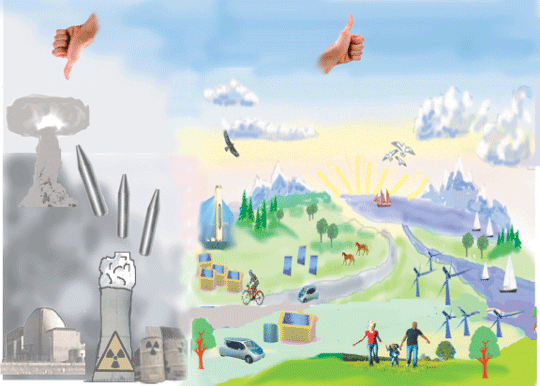
http://www.globalresearch.ca/montreal-declaration-for-nuclear-fission-free-world/5542890 By Countercurrents.org Global Research, August 28, 2016 By Global Network for a nuclear-free world.
As citizens of this planet inspired by the Second Thematic World Social Forum for a Nuclear-Fission-Free World, conducted in Montreal from August 8 to August 12, 2016, we are collectively calling for a mobilization of civil society around the world to bring about the elimination of all nuclear weapons, to put an end to the continued mass-production of all high-level nuclear wastes by phasing out all nuclear reactors, and to bring to a halt all uranium mining worldwide.
This call goes out to fellow citizens of all countries worldwide who see the need, whether as an individual or as a member of an organization, for a nuclear-fission-free world. We are committed to building a global network of citizens of the world who will work together, using the internet and social media to overcome isolation, to provide mutual support and to coordinate the launching of joint actions for a world free of nuclear fission technology, whether civilian or military.
We will begin by creating communication channels to share information and educational tools on legal, technical, financial, medical, and security-related matters linked to military and non-military nuclear activities. Continue reading
Climate inaction leaves Whopping $8.8 Trillion Tab for Next Generation
Report Shows Whopping $8.8 Trillion Climate Tab Being Left for Next Generation
26 August 2016 http://www.skepticalscience.com/9-trillion-climate-tab.html This is a re-post from Common Dreams by Lauren McCauley
“We do not inherit the Earth from our ancestors, we borrow it from our children,” is an oft-quoted proverb, frequently used to explain the importance of environmental preservation. Unsaid, however, is how much it will impact the next generation if the Earth is bequeathed in a lesser state.
Environmental campaigners NextGen Climate and public policy group Demos published a new study that attempts to quantify the true cost of not addressing climate change to the millennial generation and their children.
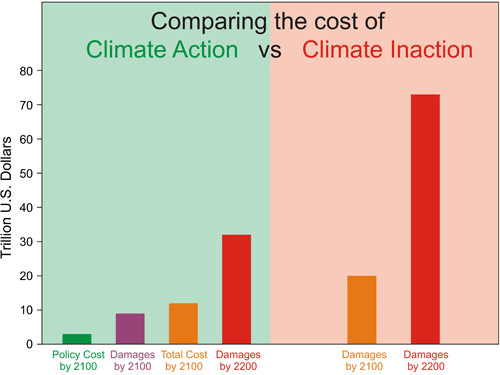
The Price Tag of Being Young: Climate Change and Millennials’ Economic Future (pdf) compares some of the high costs millennials will face in the “new inequality economy”—such as student debt, child care costs, stagnant wages, as well as financial and job insecurity—against the fiscal impacts of unmitigated global warming.
“The fact is,” the report states, “unchecked climate change will impose heavy costs on millennials and subsequent generations, both directly in the form of reduced incomes and wealth, and indirectly through likely higher tax bills as extreme weather, rising sea levels,drought, heat-related health problems, and many other climate change-related problems take their toll on our society.”
The impacts from climate costs alone, the report finds, are “comparable to Great Depression-era losses.” The study employs a model developed by researchers from Stanford University and University of California at Berkeley that measures the effects of rising temperatures on long-term economic growth and national productivity drawing on 50 years of data from 166 countries.
“no climate action” scenario found that by 2100 global per capita GDP will shrink by 23 percent relative to a scenario without climate change. The U.S. is estimated to take a 5 percent hit by 2050 that jumps to 36 percent by 2100 should no climate action occur.
This adds up to a loss of nearly $8.8 trillion in lifetime income for millennials and tens of trillions for their children. Continue reading
State of the Climate – 10 startling facts
 The 10 most startling facts about climate in 2015 — the warmest year on record [excellent maps and graphs] WP, By Jason Samenow August 2 Last year was unequivocally the warmest year on record for Earth. The National Oceanic and Atmospheric Administration Tuesday released a 300-page report documenting the historic warmth as well as scores of other aspects of 2015’s climate.
The hefty report, State of the Climate in 2015, was produced by more than 450 scientists from 62 countries around the world — more than any previous edition.
Every single direct indicator of temperature described in the report leaves no doubt that 2015’s global surface temperature towered over any year preceding it. Numerous other climate indicators related to temperature exhibited characteristics consistent with such historic warmth.
2015’s exceptional warmth was fueled by a record-challenging El Niño event, in which warmer-than-normal tropical Pacific Ocean waters infused heat into the atmosphere, and by record-setting concentrations of heat-trapping gases from human activity.
Here are the 10 most impressive findings from this report:
1. The global temperature was the highest on record…….
2. The average ocean surface temperature was warmest on record…..
3. Upper ocean heat content was highest on record…..
4. Global sea level was highest on record…..
5. The El Niño event was among the strongest on record……
6. Greenhouse gases were highest on record……
7. Record number of major tropical cyclones in Northern Hemisphere…….
8. Arctic sea ice had its lowest maximum extent……
9. Glaciers continued shrinking….
10. Extreme temperatures were most extreme on record……
The report is available online and will be published by the Bulletin of the America Meteorological Society. https://www.washingtonpost.com/news/capital-weather-gang/wp/2016/08/02/the-10-most-startling-facts-about-climate-in-2015-the-warmest-year-on-record/
Underground Coal Gasification (UCG) a disaster for climate
Friends of the Earth has recently released a report called ‘Fuelling the Fire: the chequered history of Underground Coal Gasification and Coal Chemicals around the world’
The report draws together evidence of UCG test projects over the last three decades and highlights how destructive UCG and Coal Chemicals are
 Fuelling the fire: New coal technologies like UCG spell disaster for climate https://independentaustralia.net/environment/environment-display/fuelling-the-fire-new-coal-technologies-like-ucg-spell-disaster-for-climate-,9393 Cam Walker 26 August 2016, Given UCG’s disastrous history including Linc Energy’s irreversible environmental damage in Queensland, Friends of the Earth is calling for a moratorium on all UCG projects in Australia. Cam Walker fromFriends of the Earth reports.
IN RECENT years Australia, like many countries around the planet, has seen a major expansion in the development of unconventional oil and gas drilling.
These are oil and gas resources which cannot be produced by conventional processes (that is, through using the natural pressure of the wells to release the resource trapped in a coal or rock seam).
Until the 1990s, production of conventionaloil and gas kept prices relatively stable, so there was limited incentive to develop technologies to explore and produce unconventional oil and gas resources.
In the 2000s, prices started to increase, and with known reserves starting to peak, it was clear that this trend would continue into the future.
As debate increasingly focused on energy independence, a number of countries who consume large volumes of fossil energy such as the USA, Canada and China started to realise they had potentially enormous volumes of unconventional oil and gas. This in turn lead to a major development effort that saw a huge expansion in the use of hydraulic fracturing (‘fracking’) to access methane in shale beds to produce gas in the USA and elsewhere.
Australia also has major reserves of oil and gas which could potentially yield through the use of unconventional drilling methods. Here the unconventional gas resource includes coal seam gas (CSG), shale gas and tight gas. Exploration for CSG in Australia began in 1976 in Queensland’s Bowen Basin. The industry took hold, initially in Queensland, where there are currently around 4,000 onshore gas rigs. More than 37% of the Australian landmass is currently under exploration permit or application for coal or gas.
The UCG industry has been strongly resisted by regional communities and environmental groups around the country and the many dangers of fracking are well documented. This has resulted in moratoriums on fracking in states such as Victoria. Continue reading
1 This month
7 April – WEBINAR – Australia and the Doomsday Clock – Preventing nuclear war through NoFirstUse and other policies
Online | Tuesday April 7, 4:00-5:30pm, Australian Eastern Time / 8:00-9:30am Central Europe Time
– Access the registration link
15 April – Zoom –Nuclear Power is Not the Solution
Apr 15, 2026 01:00 AM in Canberra, Melbourne, Sydney

Join the International Physicians for the Prevention of Nuclear War (IPPNW) on Tuesday, April 14th for a timely webinar exploring the risks associated with nuclear power and challenging the myth that it offers a simple, safe, carbon-free solution to the climate crisis

21 April Webinar: No Nuclear Weapons in Australia
Start: 2026-04-21 18:00:00 UTC Canberra, Melbourne, Sydney (GMT+10:00)
End: 2026-04-21 19:30:00 UTC Canberra, Melbourne, Sydney (GMT+10:00)
Event Type: Virtual
A virtual link will be communicated before the event.
Host Contact Info: australia@icanw.org

of the week – Australians for War Powers Reform (AWPR)
To see nuclear-related stories in greater depth and intensity
 Antinuclear