Federal govt slashes safety checks at Ranger uranium mine
ERA, controlled by Rio Tinto, stopped mining new ore in 2012. Since then, it has been extracting ore – totalling about 2000 tonnes a year – from tailings at a rate that leaves 999 tonnes of waste for every uranium tonne produced.
Under federal statutes, the millions of tonnes of waste rock and billions of litres of water must be stored so “radiological material is separated from the environment for 10,000 years”, Mr O’Brien said.
“All that contaminated matter … all the buildings, the mill, the power plant, all the machinery, all the trucks – everything – has to be put into pits.”
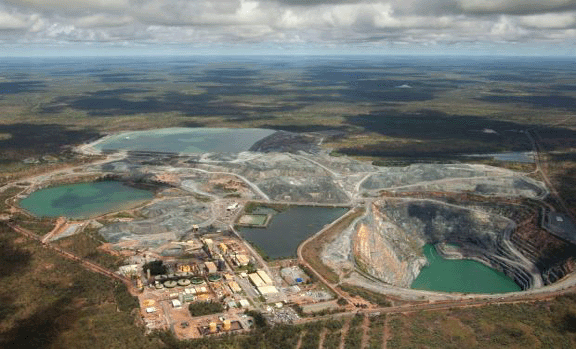
Lone Ranger: Kakadu uranium miner faces fewer safety checks, The Age, Peter Hannam, 30 Aug 16 The controversial Ranger uranium mine in the Top End has had its independent government oversight depleted just years before its closure in a move the local Aboriginal organisation describes as “absurd”.
Since December, the Supervising Scientist Branch – the agency under the federal environment department enforcing standards at the giant mine – has halted atmospheric testing of radon and other radioactive dust from the project owned by Energy Resources of Australia.
Neither has the SSB’s environmental research institute – known as ERISS – tested a range of foods including fish and wallaby eaten by the nearby traditional owners, the Mirarr people, since 2011, according to one insider.
The number of institute staff working with its field station at Jabiru, seven kilometres from the mine, has been cut from nine to five. One of the four positions was transferred to Darwin, 250 kilometres to the west, while three others have not been replaced, the source said.
“The decision to end atmospheric monitoring seems absurd in these twilight years of the Ranger operation when you have progressive rehabilitation, and you have the certainty of increased movement of material, particularly in the dry season, creating significant dust,” said Justin O’Brien, chief executive officer of the Gundjeihmi Aboriginal Corp (GAC), the body that helps manage funds paid by Ranger to the Mirarr clan.
“If this mine were located seven kilometres from a small town in the south-east of Australia, there would be an outcry.”
The scale of the engineering challenge ahead – which barely featured in campaigning for Saturday’s Territory election – is staggering.
ERA, controlled by Rio Tinto, stopped mining new ore in 2012. Since then, it has been extracting ore – totalling about 2000 tonnes a year – from tailings at a rate that leaves 999 tonnes of waste for every uranium tonne produced.
Under federal statutes, the millions of tonnes of waste rock and billions of litres of water must be stored so “radiological material is separated from the environment for 10,000 years”, Mr O’Brien said.
“All that contaminated matter … all the buildings, the mill, the power plant, all the machinery, all the trucks – everything – has to be put into pits.”
Unless the Atomic Energy Act is amended, ERA must cease operations on January 8, 2021.
Within five years, the roughly 10-square kilometre disturbed area must be restored so that they can be reincorporated into the World Heritage-listed park from which it was excised when Kakadu was established in 1981.
“We want to see ERA do a complete job and clean up the Ranger mine so it can be put into the Kakadu National Park,” said Annie Ngalmirama, chair of the GAC. “We have been wanting this for many years.”……
Gavin Mudd, a senior lecturer at Monash University, said the sensitivity of the mine and its product meant self-governance wasn’t enough.
“How many people trust ERA on their data without corresponding checks by the government?” said Dr Mudd, who is also a representative on the Alligator Rivers Region Technical Committee. “Nobody wants to leave it to ERA alone.
“If there’s another big incident, there’s no independent data,” Dr Mudd said, referencing the 2013 incident – the most serious among about 300 over the years – in which 1.4 million litres of a sulphuric acid slurry burst from a ruptured tank…….http://www.theage.com.au/environment/lone-ranger-kakadu-uranium-miner-faces-fewer-safety-checks-20160826-gr28kv.html
No comments yet.
1 This month
15 April – Zoom –Nuclear Power is Not the Solution
Apr 15, 2026 01:00 AM in Canberra, Melbourne, Sydney

Join the International Physicians for the Prevention of Nuclear War (IPPNW) on Tuesday, April 14th for a timely webinar exploring the risks associated with nuclear power and challenging the myth that it offers a simple, safe, carbon-free solution to the climate crisis

of the week – Australians for War Powers Reform (AWPR)
To see nuclear-related stories in greater depth and intensity
 Antinuclear
Leave a comment