Warm, Storm-Force Winds Blowing Up from the Equator Flip West Antarctic Winter to Summer

In a record-hot world, there’s a lot of lower-latitude heat just waiting for a weakness in the increasingly feeble Jet Stream to make a big poleward rush. Such was the case today as an intense wave of warmth exploded up from the Equatorial region and began to spread summertime temperatures over sections of West Antarctica — technically still in the grips of the Southern Hemisphere’s winter season.

(A surge of heat breaks over West Antarctica on September 2nd, 2016, pushing air temperatures over vulnerable coastal glaciers and ice shelves near or above the melting point [0 degrees Celsius]. Image source: Earth Nullschool.)
The warm winds began their southward turn about a thousand miles west of coastal South American and along the 20 degrees south latitude line. Tapping hot, tropical air, the winds then ran over hundreds of miles of open ocean — following the arch of a bulging ridge…
View original post 684 more words
G20: Which country is worst on climate change action? Oh it’s Australia, AGAIN!
 The report notes that if every country emulated Australia’s level of ambition, global warming would likely exceed 4C.
It also said that Australia’s currently implemented policy measures were not set to achieve even those inadequate targets and instead would rise to about 27% above 2005 levels by 2030, rather than the targeted 26 to 28% below 2005 levels.
Australia worst among G20 when it comes to action on climate change, report finds
Australia the only country to receive a rating of ‘very poor’ in a majority of categories in Climate Transparency scorecard, Guardian, Michael Slezak, 1 Sept 16, Australia is the worst country among the G20 when it comes to action on climate change, according to a comprehensive assessment before the G20 summit in China.
Under China’s leadership, this weekend’s G20 in the eastern city of Hangzhou has had a strong focus on climate-related issues.
By analysing the policies and actions of each of the 20 countries, which together produce 75% of the world’s greenhouse gas emissions, Climate Transparency produced a report, scorecard and series of country profiles detailing their findings, revealing Australia was not pulling its weight.
On the scorecard, Australia was the only country to receive a rating of “very poor” in a majority of categories.
Australia was given the worst possible rating of “very poor” for its performance on emissions trends, carbon intensity, share of renewables in its energy supply and overall climate policy.
It was rated as “poor” in every other category: for its energy intensity, share of coal in energy supply and electricity emissions intensity. Continue reading
Appeal lodged against Western Australia’s Mulga Rock uranium mine project
 Appeal against WA Mulga Rock uranium mine Sky News, Tuesday, 30 August 2016 An appeal has been lodged against the Environmental Protection Authority’s recommendation to approve the proposed Mulga Rock uranium mine in Western Australia’s Goldfields region.
The appeal was lodged on Monday by the Conservation Council of WA, the Australian Conservation Foundation, The Wilderness Society, Friends of the Earth Australia and the Anti Nuclear Alliance of WA.
The grounds for appeal include environmental factors for flora and fauna, mine closure, tailings management and impacts to water……
Following the EPA’s recommendation with 14 conditions, including having environmental and Aboriginal heritage management plans in place, it is now up to state and federal environment ministers to decide if the project will go ahead.
But CCWA campaigner Mia Pepper says the proposed mine sits in the Yellow Sand Plain Priority Community, which supports rare and endangered species.
‘If this mine were to proceed it would take 15 million litres of water a day from the environment and clear over 3000 hectares of native bushland and important habitat for 93 reptile species, 28 bird species and 10 mammal/marsupial species,’ she said.
‘This uranium mine would leave behind a legacy of 30 million tonnes of radioactive tailings and mine waste that would pose a threat to the environment for thousands of years.’
Earlier this month, the EPA rejected Cameco’s plan to mine uranium at its Yeelirrie project, 70km southeast of Wiluna, because the project posed unacceptable risks to subterranean fauna. – See more at:http://www.skynews.com.au/business/business/company/2016/08/30/appeal-against-wa-mulga-rock-uranium-mine.html#sthash.qqOmAFyx.dpuf
Legal action against transport of radioactive wastes through Niagara
The nuclear waste is a byproduct of the process used at the Chalk River laboratories to create medical radioisotopes from highly enriched uranium originally produced in the U.S. It’s being shipped back to the U.S. as part of a 2010 agreement to repatriate the radioactive material, costing the Canadian government about US$60 million.
According to the U.S. lawsuit filed Aug. 12 in Washington, D.C., the thick yellowy-green liquid being shipped contains highly enriched uranyl nitrate, highly enriched uranium, radioactive varieties of cesium, niobium, zirconium, rhodium, rubidium, iodine, xenon, tellurium, barium, lanthanum, cerium, strontium, praseodymium, neodymium, europium, neptunium and plutonium.
 Niagara on nuclear waste route, Welland Tribune, By ALLAN BENNER, August 31, 2016 Trucks loaded with liquid nuclear waste could be rolling down highways within days — likely travelling through Niagara on their way into the U.S.
But seven American environmental groups have teamed up to launch a lawsuit against the United States government and its Department of Energy (DoE) in the hope of stopping the shipments before they begin. Continue reading
Pope Francis calls for urgent action on climate: “environmental destruction is a sin”
 Pope Francis says destroying the environment is a sin Pontiff says humans are turning planet into ‘wasteland full of debris, desolation and filth’ in call for urgent action on climate change. Guardian, Josephine McKenna in Rome, 2 Sept 16 Pope Francis has called for urgent action to stop climate change and proposed that caring for the environment be added to traditional Christian works of mercy such as feeding the hungry and visiting the sick.
In a message to mark the Catholic church’s World Day of Prayer for the Care of Creation that he launched last year, Francis said the worst impact of global warming was being felt by those who were least responsible for it – refugees and the poor.
The pontiff used the occasion to revive many of the powerful issues he highlighted a year ago in his provocative encyclical on the environment, Laudato si’, and his latest message seems certain to rankle conservatives.
Francis described man’s destruction of the environment as a sin and accused mankind of turning the planet into a “polluted wasteland full of debris, desolation and filth”.
“Global warming continues,” the pope said. “2015 was the warmest year on record, and 2016 will likely be warmer still. This is leading to ever more severe droughts, floods, fires and extreme weather events.
“Climate change is also contributing to the heart-rending refugee crisis. The world’s poor, though least responsible for climate change, are most vulnerable and already suffering its impact. ”
The pope said the faithful should use the Holy Year of Mercy throughout 2016 to ask forgiveness for sins committed against the environment and our “selfish” system motivated by “profit at any price”.
He called for care for the environment to be added to the seven spiritual works of mercy outlined in the Gospel that the faithful are asked to perform throughout the pope’s year of mercy in 2016…….https://www.theguardian.com/world/2016/sep/01/pope-francis-calls-on-christians-to-embrace-green-agenda
Catholic Church and other religions going green for the climate
 Churches put their faith in green energy, Ft.com , Pilita Clark, Environment Correspondent, 1 Sept 16 Wind and solar farms have always had faithful adherents in the environmental movement but now more than 3,500 churches have turned their back on fossil fuels to embrace renewable energy.
Churches from a range of denominations have either made such a switch or registered their interest in doing so, but Roman Catholics have proved especially keen, according to figures from religious charities released on Thursday.
Nearly 2,000 Roman Catholic parishes have forsaken conventional energy in favour of green electricity in 16 dioceses, the charities said. Some made the decision after Pope Francis issued an encyclical last year urging the world to cut its dependence on fossil fuels. Continue reading
Australian govt’s cuts to clean energy will mean loss of many CSIRO jobs
 120 CSIRO jobs face the axe if clean energy cuts go through, http://www.canberratimes.com.au/national/public-service/120-csiro-jobs-face-the-axe-if-clean-energy-cuts-go-through-20160831-gr5hxc.html Noel Towell, 31 Aug 16
More than 120 research jobs at the CSIRO face the axe if the Coalition’s proposed cuts to the clean energy research agency are approved by Parliament.
The threatened jobs come on top of scores of university science positions on the chopping block if the Australian Renewable Energy Agency is de-funded as part of the government’s “budget repair” omnibus bill currently before the Parliament.
The new threat to CSIRO research comes less than a month after Science Minister Greg Hunt instructed the organisation to renew its focus on climate science, claiming it would be a “bedrock function” of the agency’s activities.
Fairfax reported on Wednesday that Australia’s leading renewables researchers were warning the nation was heading towards the “clean energy valley of death” if the ARENA cuts are passed. Continue reading
Fracking has brought radioactive isotopes to surface soil
Radioactive Waste Found at Oil Field Landfill in North Dakota, Oil Price By Irina Slav – Sep 01, 2016, North Dakota has had a problem with the inappropriate disposal of this radioactive waste for years. This time, the State Health Department of North Dakota is probing an oilfield waste landfill operated by IHD Solids Management after the detection of a significant amount of illegal radioactive matter.
The radioactive material was detected twice in two separate inspections that took place in May and June. Now the HD has ordered a third-party inspection of the landfill and instructed the operator to remove 950 tons of waste and take it out of the state, after radioactivity checks of all 12 oilfield waste landfills in the state revealed levels of between 5 and 80 picocuries, the latter standing 30 picocuries above the new maximum allowed for oilfield waste…….
The company will not be fined for the transgression because it dealt with the problem by removing the suspicious waste, as did two other landfill operators in North Dakota, Secure Energy and Gibson Energy. They too had to remove over-radioactive material from their landfills and ship it to special nuclear waste facilities.
Prudently, if not a tad belatedly, North Dakota will soon start requiring oilfield waste landfill operators to verify the radioactivity level of every load that arrives, rather than taking the word of the company generating the waste for it.
The waste from oil and gas wells include uranium, thorium, radium, a radioactive isotope of potassium, as well as isotopes of lead and polonium. These are naturally occurring elements that are brought to the surface through fracking. http://oilprice.com/Latest-Energy-News/World-News/Radioactive-Waste-Found-at-Oil-Field-Landfill-in-North-Dakota.html
Biggest buyers of renewable energy are not utilities, but giant corporations

 Corporate America Is Buying More Clean Energy Than Power Utilities Are https://www.fastcoexist.com/3063266/corporate-america-is-buying-more-clean-energy-than-power-utilities Want to get solar and wind power off the ground? It might be smarter to turn to Apple or Google rather than the power company. These days, the biggest buyers of renewable energy aren’t utilities. They’re corporations like Google, Walmart, and Owens Corning. Over the last year and a half, there’s been a surge of power purchases first by tech companies and more recently by more mainstream businesses, such as General Motors and Steelcase.
And, in some cases, companies are not only buying up power from a solar field or wind farm operator. They’re actually investing and running the plant themselves, or selling on power they don’t need. Ikea has invested in wind turbines in Texas and Illinois. And Apple has applied to sell on excess electricity as part of its $848 million California solar project (the new company would be called Apple Energy LLC).
Analysts say corporate players are increasingly driving decision-making in the large-scale energy market. “We’ve now reached the point where these companies that have shown leadership on renewables are doing that at a greater scale than utilities,” says Ian Kelly, manager of Rocky Mountain Institute’s Business Renewables Center. “It puts pressure on utilities to either offer renewable energy or see these companies go out and secure it directly themselves and leave utilities out of the picture.”
Australian Capital Territory Liberals back ACT govt’s targets of 100 per cent renewables by 2020 and zero net emissions by 2050

 Environmental groups urge ACT to commit to carbon neutrality by 2040, Canberra Times, Christopher Knaus, 1 Sept 16 Environmental groups have urged the ACT government to reach zero net emissions a decade earlier than its current target, while praising the territory’s newly-realised bi-partisanship on climate change.
The ACT government’s targets of 100 per cent renewables by 2020 and zero net emissions by 2050 were backed by the Canberra Liberals at an election forum on Monday night. Liberal leader Jeremy Hanson confirmed his party would continue to pursue Labor’s climate change policies if elected.
The position has drawn praise from the ACT Conservation Council and climate change action group 350.org, which said the approach of the Canberra Liberals “sits in stark contrast to the federal party’s ongoing support for the coal, oil and gas expansion industry and paltry emissions reduction targets”.But both groups have urged the ACT to speed up its transition to a carbon-neutral economy.
Conservation Council ACT executive director Larry O’Loughlin said the ACT should seek to achieve zero net emissions by 2040 to maintain its status as a nation-leading jurisdiction on climate change. Mr O’Loughlin said the government should also set an interim target at some point between 2020 and 2040, to ensure it stays on track to the ultimate goal of carbon neutrality.
He said speeding up the transition to a carbon neutral economy, if adopted across the globe, would help limit global warming to two degrees. The emerging evidence, he said, may even prove that target to be inadequate. “It may be that [2040] is soon unambitious. We might need to do more,” Mr O’Loughlin said.
The Conservation Council has also recently released its election policy document, which sets out the priorities for both major parties ahead of the October election……..
Climate change action group, 350.org, issued a statement on Wednesday congratulating the Canberra Liberals on adopting the existing climate change and renewable energy targets.
350.org Canberra spokesperson Josh Creaser said the ACT had been a leader in fighting climate change, but said more must be done. “Whilst the ACT Liberals have taken an important step by matching the ACT Government’s policies it’s clear that a transition to net zero emissions must happen sooner than 2050,” he said.
“This should also include the ongoing divestment of ACT Government shares in fossil fuel companies.” http://www.canberratimes.com.au/act-news/environmental-groups-urge-act-to-commit-to-carbon-neutrality-by-2040-20160830-gr4i5d.html
France increases nuclear compensation payment to French Polynesia
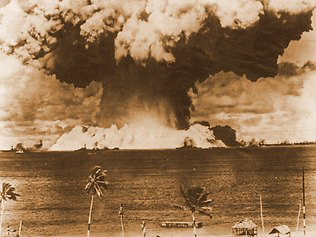 Paris to up Tahiti nuclear debt payment http://www.radionz.co.nz/international/pacific-news/312402/paris-to-up-tahiti-nuclear-debt-payment France says it plans to give French Polynesia an additional ten million US dollars from next year as part of its nuclear compensation payment.
This was announced by the French High Commission in Papeete and relates to the funding set up by Paris in 1996 after it stopped testing its nuclear weapons in the South Pacific.
The funding was originally conceived as a limited subsidy to help the territory readjust its economy overly dependent on military spending but it has since been converted into an annual transfer.
According to the High Commission, the French budget will next year allot French Polynesia $US100 million as a so-called autonomy fund.
This also follows an undertaking by the French president Francois Hollande in February to help the territory overcome the nuclear legacy.
France carried out weapons tests in French Polynesia for 30 years from 1966 and claimed until six years ago that they were clean.
There are continued calls for France to compensate the test victims and French Polynesia’s Protestant church has decided to take France to the International Criminal Court for alleged crimes against humanity.
Climate Change Authority’ s review on Australia’s climate goals and policies
 Towards a climate policy toolkit: special review on Australia’s climate goals and policies, Australian Policy Online Climate Change Authority 31 August 2016 The Climate Change Authority is pleased to release the third and final report of its Special Review into the actions or policies that Australia should take to implement outcomes flowing from the historic Paris climate change agreement……..The emissions reduction policy toolkit needs to take account of Australia’s climate policy history, be suited to the emissions opportunities and challenges in individual sectors and be able to be scaled up in the future to meet the emission reduction challenges in the Paris Agreement…….
The Authority is also recommending that an enhanced safeguard mechanism be put in place as an effective, pragmatic and durable way of reducing emissions across a range of industrial, manufacturing and resource sectors. For households, vehicles and buildings, the Authority recommends that energy efficiency standards be put in place or strengthened.
For the land sector, the Authority found that voluntary offsets are the best tool for the task, given the large number of landholders and the differences between farming operations. In this report, as flagged in the Authority’s Special Review final report on targets, the Authority has not sought to provide further advice on emissions reduction targets. Emissions reduction targets are very important parts of the emissions reduction armoury but without effective policy action they will remain aspirational rather than determinative for the way ahead.
ACT’s push for renewable energy is hampered by Federal govt’s push against renewables
One step forward and two steps back for ACT’s renewable energy future, The Canberra Times, 1 Sept 16 It really is a case of one step forward and two steps back when it comes to Canberra’s ongoing bid to become an international centre of excellence in the field of renewable energy.
On the same day the ACT government announced a groundbreaking investment deal that will deliver state-of-the-art hydrogen electrolysis to the territory, The Canberra Times reported planned federal Coalition cuts to renewable energy research would gut the Australian Renewable Energy Agency, slashing jobs and closing down potentially lucrative research programs…..
The Turnbull government’s antipathy towards renewable energy, highlighted some years ago by then treasurer Joe Hockey’s views on the wind farms between Sydney and Canberra, appear to be as irrational as they are inexplicable…….
Canberra’s greenhouse emissions will be running at about 40 per cent below what they were in 1990.
This is a remarkable effort that looks like being achieved while still providing Canberrans with access to some of the most affordable electricity, and certainly the cheapest renewable energy, in the country…….
Many of the game changers, such as the reduction in the cost of solar panels for private homes and the development of affordable battery systems that allow private consumers to accumulate power during the day and use it at night, are the result of intense and expensive research.
By encouraging that research, and actively trying to develop a hub of intellectual excellence within its own borders, the ACT government is doing its bit to ensure the good ideas keep on coming and may, in time, deliver even more remarkable dividends.
The Turnbull government, on the other hand, still seems to have ideological hang-ups that unless reversed, will continue to hold back what could be a boom industry for Australia. http://www.canberratimes.com.au/comment/ct-editorial/one-step-forward-and-two-steps-back-for-acts-renewable-energy-future-20160831-gr5939.html
1 This month
7 April – WEBINAR – Australia and the Doomsday Clock – Preventing nuclear war through NoFirstUse and other policies
Online | Tuesday April 7, 4:00-5:30pm, Australian Eastern Time / 8:00-9:30am Central Europe Time
– Access the registration link
15 April – Zoom –Nuclear Power is Not the Solution
Apr 15, 2026 01:00 AM in Canberra, Melbourne, Sydney

Join the International Physicians for the Prevention of Nuclear War (IPPNW) on Tuesday, April 14th for a timely webinar exploring the risks associated with nuclear power and challenging the myth that it offers a simple, safe, carbon-free solution to the climate crisis

21 April Webinar: No Nuclear Weapons in Australia
Start: 2026-04-21 18:00:00 UTC Canberra, Melbourne, Sydney (GMT+10:00)
End: 2026-04-21 19:30:00 UTC Canberra, Melbourne, Sydney (GMT+10:00)
Event Type: Virtual
A virtual link will be communicated before the event.
Host Contact Info: australia@icanw.org

of the week – Australians for War Powers Reform (AWPR)
To see nuclear-related stories in greater depth and intensity
 Antinuclear