Australian govt uses out-dated terminology, to disguise reality of High Level Nuclear waste
 Steve Dale, Nuclear Fuel Cycle Watch South Australia, 6 Sept 16 When exactly did Australia start calling what should be “High Level Waste” – “Intermediate Level Waste”? The following extract shows they had the correct definitions in 1985 : “The two categories of high level waste are unreprocessed spent fuel and the fission product/actinide residue generated from spent fuel reprocessing. Spent fuel is routinely stored in water-cooled ponds and HLW solution is stored for limited periods in water cooled tanks. HLW solution is being vitrified and stored in air-cooled vaults in France and India…. No country has yet disposed of either spent fuel or vitrified HLW.” from STORAGE AND DISPOSAL OF RADIOACTIVE WASTES by K.D. Reeve, Australian Atomic Energy Commission, 1985http://www.iaea.org/…/NCLCollec…/_Public/17/000/17000568.pdf
Steve Dale Date Found. Australia has based its definition of High Level Waste on an obsolete and superseded version of the IAEA “Classification of Radioactive Waste” 1994, (Safety Series 111-G-1.1). The latest version of the document defines HLW as “HLW typically has levels of activity concentration in the range of 104-106 TBq/m3”. The definition now is based purely on radioactivity and not thermal output. Time for Australia to get honest and start calling Spent Fuel and vitrified reprocessed waste what it is – High Level Waste. https://www.facebook.com/groups/1021186047913052/
Some telling Facebook comments on South Australian govt’s Your Say Nuclear site
 Judith Bruton After a weekend of debate on the Your Say Nuclear site I posted this on their site Monday morning.
‘The fundamental problem with Your Say Nuclear is that to be pro is assumed immediately by some to be right, well informed, science based. Those that are anti are cast as irrational, ill-informed, emotional and ignorant. The pro bullies try to educate those who are anti, like Christians converting ‘primitives’ (and we all know that worked well!) This FB site is totally biased and I would never recommend it to anyone. On the contrary I will spread the word that Your Say Nuclear is just more Government propaganda. Disappointing!’
What would you expect from a Government site?
Judith Bruton People power is the way to go. It has worked before and will work this time. Do we actually get a vote or what?
I asked how many jobs 9600 to construct ..found out only 600 ongoing jobs for the high waste site and 15 for the low waste site
That’s a huge amount of money for 615 jobs over 2 sites …
Ian Lloyd The SOUTH AUSTRALIAN GOVERNMENT IS SPENDING A A LOT OF TAX PAYERS MONEY PROMOTING NUCLEAR DUMPS. They say it may create a few jobs. I bet these really flash pens that they are giving away were not made in Australia. I heard it is illegal what they are doing, spending tax payers money to promote nuclear dumps. https://www.facebook.com/groups/941313402573199/
Confusion about the two South Australian nuclear waste dump plans
 Are these 2 proposals really so separate, or is the Federal dump choice of South Australia planned so as to soften up South Australians and Australia at large, to view South Australia as a suitable radioactive trash toilet? South Australian Liberals, and the Federal Liberal and Labor are all staying quiet about the Scarce Nuclear Commission plan – but are they secretly in support of it?
Two nuclear proposals ‘confusing discussion’ about potential waste dumps in South Australia, ABC News 2 Sept 16 By Lauren Waldhuter Two separate proposals for storing nuclear waste in South Australia have caused widespread confusion in communities and the Premier has conceded public consultation was badly timed.
The State Government has launched a state-wide public consultation program on royal commission recommendations to store the world’s high-grade nuclear waste in SA.
But at the same time the Federal Government hasshort-listed Wallerberdina station, near Hawker in the Flinders Ranges, as a preferred site for Australia’s first storage facility for low-to-intermediate level radioactive waste.
Hawker Community Development Board chairperson Janice McInnis said SA’s public consultation was clouding discussion about the federal plan.
“I’ve had phone calls from friends in Adelaide who said, ‘what’s this about a waste dump at Hawker?’, thinking it was the state one and they hadn’t heard about the federal one at all,” she said.
| March 2015 | Nuclear Fuel Cycle Royal Commission established. |
May 2015 |
Landholder nominations to host Australia’s Radioactive Waste Management Facility close. |
| May 2015 |
Royal commission releases four issues papers. Public consultation period begins. |
November 2015 |
Six sites around Australia identified for further assessment, including three in SA. Consultation period begins. |
| February 2016 |
Royal commission releases tentative findings. It suggests SA builds a dump for the world’s high-level nuclear waste. |
April 2016 |
Federal Government announces Wallerberdina station as its preferred site. |
| May 2016 | Final report released and consultation continues. | Present | Consultation continues until next year. |
Premier Jay Weatherill admitted the timing could have been better.
“Certainly we would’ve preferred if the federal process had have waited until our process had been underway,” he said.
“There’s no doubt there’s been confusion between the federal process and the South Australian Government process.
“We’ve detected that as we’ve gone out and spoken to people.
“I think the Commonwealth support the approach that we’ve taken but we’re going to have to find a way to bring those two decision-making processes together.”……..
Two sets of conversations ‘insulting’ Despite disagreeing with both government plans to pursue a nuclear future for SA, environmental groups agree the issue has become too confusing.
The Conservation Council of SA held an expo in Port Augusta on Friday to highlight concerns about both proposals as well as their differences.
“It’s actually insulting to have two sets of governments having two sets of conversations on two different proposals at the same time,” chief executive Craig Wilkins said.
“No wonder the community is confused. “It’s incredibly important that these two plans are kept separate because the impacts are very, very different.” http://www.abc.net.au/news/2016-09-04/nuclear-proposals-confusing-discussion-in-sa/7812646?pfmredir=sm
Japanese govt about to pull the plug on Monju reprocessing reactor?
Monju has drifted on for years after its future was clearly in doubt. A decision now to terminate the project seems sensible. Such a decision should also prompt the government to stop and consider whether its nuclear fuel cycle still makes sense.

 Monju and the nuclear fuel cycle http://www.japantimes.co.jp/opinion/2016/09/04/editorials/monju-nuclear-fuel-cycle/#.V8yFTFt97Gg Media reports that the government is finally weighing whether to pull the plug on the Monju fast-breeder reactor in Tsuruga, Fukui Prefecture, due to the massive cost needed to restart the long-dormant facility, should come as no surprise. Once touted as a “dream reactor” for an energy-scarce country that produces more plutonium than it consumes as fuel, Monju has been a nightmare for national nuclear power policy for the past two decades. Continue reading
China and USA ratify Paris climate agreement
 US joins China in ratifying Paris climate agreement in ‘turning point’ for planet , ABC News 4 Sept 16 America and China have formally joined the Paris climate change agreement, with US President Barack Obama hailing the accord as the “moment we finally decided to save our planet”.
The move by the world’s two biggest polluters is a major step forward for the 180-nation deal, which sets ambitious goals for capping global warming and funnelling trillions of dollars to poor countries facing climate catastrophe.
Mr Obama and his Chinese counterpart Xi Jinping handed ratification document to United Nations chief Ban Ki-moon, who said he was now optimistic the agreement will be in force by the end of the year.
Mr Ban described the two leaders as far-sighted, bold and ambitious.
“China and the United States represent nearly 40 per cent of global greenhouse gas emissions,” he said.
“Now by formally joining the Paris agreement your have added powerful momentum to the drive for the agreement to enter into force this year.”
Mr Obama said history would show that the Paris deal would “ultimately prove to be a turning point, the moment we finally decided to save our planet”……..http://www.abc.net.au/news/2016-09-04/us-joins-china-in-ratifying-paris-climate-agreement/7812366
High Profile Members of Climate Change Authority slam ‘Untrue and dangerous’ report
 ‘Untrue and dangerous’: Climate Change Authority board at war over own advice, The Age, 5 Sept 16 Adam Morton High-profile members of the federal government’s Climate Change Authority have launched a stinging critique of their colleagues, accusing them of giving “untrue and dangerous” advice that ignores what science demands.
Board members David Karoly, an internationally recognised scientist, and Clive Hamilton, an academic and author, have published a dissenting report criticising the authority’s advice to the government released last week.
The split is over whether the authority’s role is to give unflinching science-based advice or, after years of policy failure in Canberra, recommend what is politically achievable.
It follows then environment minister Greg Hunt’s appointment of five new board members last year, including former Coalition politicians.
The dissenting pair accuse the authority of failing to give independent guidance, and instead basing its report on “a reading from a political crystal ball”……..
Professor Karoly said the authority’s report failed to meet its terms of reference and was a recipe for further delay.
“It makes recommendations that are not soundly based on climate science,” he said.
Professor Hamilton, a former Greens candidate, said it gave the impression Australia had plenty of time to introduce measures that could bring down emissions sharply.
- “This is untrue and dangerous. Given this, we felt we had no choice but to write our own report,” he said…….
Climate Change Authority Special Review: Minority Report
 BY CLIMATE COUNCIL 05.09.2016 Last week, the Climate Change Authority (CCA) published its report on how Australia should deliver on its international climate commitments.
Meaningless climate weasel words from Environment Minister Josh Frydenberg
 Gaping chasm between Coalition’s climate mantra and the real debate, Guardian, Lenore Taylor, 3 Sept 16 Like the emperor with no clothes, Josh Frydenberg is continuing the grand parade, insisting that Australia is making a successful transition.
Amost every group with a financial, intellectual or ethical interest in salvaging a workable climate policy is now deep in an urgent debate about how Australia can break a decade of policy paralysis. Everyone except the Turnbull government, that is.
The debate, involving big business, small business, investors, the government’s own independent climate advisers, academics, environmentalists, the welfare lobby and the unions, is predicated on the obvious conclusion that our policy – as it stands – cannot deliver the cuts to greenhouse emissions that are domestically necessary and which Australia has promised internationally.
But like the emperor with no clothes, continuing with the grand parade even after the whole crowd has finally declared him naked, the new environment and energy minister, Josh Frydenberg, still insists Australia is “transitioning successfully with the policies we already have in place”. Continue reading
Farmers get economic safety net, thanks to wind farms
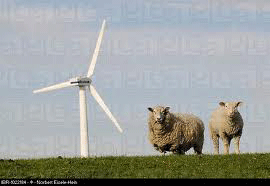 How wind farms provide a safety net for farmers, communities http://www.examiner.com.au/story/4136408/wind-turbines-can-power-a-bright-new-era-for-rural-areas/?cs=97 Charlie Prell 5 Sep 2016, In the 1950s, Australia “rode on the sheep’s back”. Wool was commanding obscene amounts of money, and farmers experienced a period of prosperity that hasn’t been seen since. It helped make Australia one of the wealthiest countries in the world.
Renewable energy promises to create a new “wool boom”. But, unlike the 1950s, the boost from the clean energy revolution will last decades, possibly generations.
Farmers, large and small, can grasp this once-in-a-lifetime opportunity that will breathe new life into struggling rural communities. That’s why I’ve signed up to host wind turbines on my sheep farm.
Wind farms offer both environmental and financial benefits. Turbines quietly produce clean, renewable electricity, replacing power from ageing, inefficient coal-fired generators that are driving climate change.
Each turbine generates a steady income of tens of thousands of dollars a year for the farmers who host them, as well as their neighbours. The community doesn’t miss out, with wind proponents promising thousands of dollars a year to projects like supporting local sporting teams, rejuvenating halls and providing community transport. This is on top of locals being employed to manage and maintain the turbines.
Despite record commodity prices, farmers are still doing it tough. As droughts and floods become more common, the stable income generated by turbines can make the difference between floating into sustainability or drowning in debt.
Instead of needing financial support from governments, farmers can become self sufficient for decades and generations. Wind turbines do more than change the landscape – they reinvigorate the economic and social fabric of rural communities for the better. Charlie Prell is a fourth-generation farmer from Crookwell, NSW and organiser for the Australian Wind Alliance.
Havasupai tribe fight uranium mining

 Grand Canyon tribe fears for its future amid battle against uranium mining Conservationists and other campaigners are urging President Obama to designate 1.7 million acres of the Canyon watershed a national monument before he leaves office, Independent Tim Walker Arizona @timwalker 30 August 2016 “…….First mined for copper at the turn of the 20th Century, the Orphan Mine became a source of uranium to supply the nuclear arms race in the 1950s. It was closed in 1969, but not before contaminating the water in nearby Horn Creek with enough uranium that passing hikers are warned not to drink it. The US National Park Service has already spent millions on a clean-up effort that is still in its early stages. “It proves not everything you dig up can be covered again,” says Kaska, a member of the Havasupai tribe. Continue reading
Here we go again: Fossil fuel industry takes a play from Big Tobacco’s playbook.
 http://www.dailyclimate.org/t/1692193038704125011 August 31, 2016 by Sen. Sheldon Whitehouse (D-R.I.)
Last year, coal mining executives attending the annual meeting of the Rocky Mountain Coal Mining Institute were treated to a presentation on the future of American mining titled:“Survival Is Victory: Lessons From the Tobacco Wars.” As the title implies, the presentation laid out a path for the fossil fuel industry to weather a barrage of lawsuits and new safety and health regulations, modeled on the efforts of the tobacco industry in the 90s and early 2000s. (See John Schwartz’s story in The New York Times.)
Richard Reavey, the Cloud Peak Energy vice president who delivered the presentation, described the similarities between what Big Tobacco went through and the challenges facing coal today as “remarkable and eerie.” (We should take his word for it. Before working for Cloud Peak, a mining company, Reavey was an executive at tobacco giant Philip Morris for 17 years, according to his LinkedIn profile.) His advice to the coal execs: do what tobacco did and “cut a deal while we are still relevant.” After all, “a much more heavily regulated tobacco industry is still viable and profitable.”
Ironically, Reavey’s presentation on these similarities between tobacco and fossil fuel strategies has a much deeper parallel.
For decades, cigarette makers hid from the public and from policymakers the scientific evidence they had of their product’s dangers. The Justice Department brought, and ultimately won, a civil racketeering lawsuit against the major tobacco companies for carrying out that fraud. Today, researchers often compare this tobacco fraud on the public to the fossil fuel industry’s suppression of its research on the dangers of carbon pollution.
Dr. Michael Mann of Pennsylvania State University has written about the pattern followed by both industries: hiring their own scientists to churn out favorable research; creating (and bankrolling) front groups to sow doubt in the public debate about scientific consensus, while obscuring the hand of the industry; and even attacking and harassing individual scientists whose work may discredit the industry propaganda. Professor Mann himself has been the target of vexatious “investigations” and efforts to intimidate and harass him, including death threats—just for producing peer-reviewed academic research shedding light on the effects of increasing concentrations of carbon dioxide in the atmosphere.
Dr. Robert Brulle of Drexel University has documented an intricate propaganda web of climate denial, with over one hundred organizations, from industry trade associations to conservative think tanks to plain old phony front groups. The purpose of this sophisticated denial apparatus, he says, is “a deliberate and organized effort to misdirect the public discussion and distort the public’s understanding of climate.” These are tactics that were developed, tested, and proven effective by the tobacco industry—and in some cases the very same front groups were involved.
Public lawyers demanded that the “tobacco files”” behind this fraud be made a public record. A recentanalysis by the Center for International Environmental Law of millions of documents from these tobacco industry archives reveals close collaboration over the better part of a century between cigarette manufacturers and oil producers on research, lobbying, and public relations. The new bookPoison Tea, by Climate Nexus Executive Director Jeff Nesbit, chronicles this same relationship.
In the book and filmMerchants of Doubt, Drs. Naomi Oreskes and Erik Conway identify spin doctors, spokespeople and even scientists-for-hire who were involved in the tobacco and now fossil fuel campaigns. Not only has the energy industry recycled tobacco’s strategies and front groups, it’s redeploying some of the same personnel, like Mr. Reavey, the coal convention presenter.
Sharon Eubanks, lead counsel on behalf of the United States in United States v. Phillip Morris, the federal tobacco litigation, has said she believes the government could make a case against fossil fuel producers very similar to the one she led against tobacco under federal civil racketeering laws. That’s not just because coal companies are openly taking cues from tobacco’s legal and regulatory fight. It’s because mounting evidence indicates that, like tobacco, the fossil fuel industry may have engaged in a deliberate, protracted fraud to mislead the public, to protect their profits, to the peril of us all.
Taxpayers cop clean-up costs as USA coal companies go bankrupt
As coal companies sink into bankruptcy, who will pay to clean up their old mines? Peabody is the latest to make big promises to a bankruptcy judge. VOX David Roberts on September 2, 2016, In the context of US capitalism, corporate bankruptcy has become less an admission of failure or a final chapter than a kind of R&R, a chance to shed some flab and come back stronger. As anyone who has followed Donald Trump’s career knows, a big company declaring Chapter 11 bankruptcy is like Lindsay Lohan checking into rehab. They’ll be back.
So it is with Peabody Energy, the world’s largest private coal company, which entered bankruptcy back in April. It is currently undergoing its bankruptcy spa treatment — shedding workers and retirees, their health and pension benefits — and preparing to get back to work (or so it hopes).
Put more simply: Who’s going to pay to clean up all those old mines? Continue reading
Poll shows broad support for green groups using ‘lawfare’ to challenge mining ventures
 Majority support green groups using ‘lawfare’ to challenge mining ventures: poll, The Age, Peter Hannam 4 Sept 16 The Turnbull government should make saving the Great Barrier Reef “an absolute priority”, and green groups should be able to use existing laws to protect the environment, new polling has found.
The ReachTEL survey of 2636 respondents commissioned by the Australian Conservation Foundation found broadbased backing for the reef and the use of the courts to challenge new mines, even among self-described as Liberal-National Party supporters.
The poll was taken Tuesday, a day after an ACF challenge failed in the Federal Court against the federal government’s approval of the giant Adani coal mine in Queensland. Some conservative politicians have accused green groups of using “lawfare” to delay major projects by testing approvals in court………Larissa Waters, the deputy Greens leaders, said the poll’s findings underscored the political risks for the Coalition.
“Last time the Coalition government tried to roll back our national environment laws, attack the voices of our environment and stop ordinary Australians from enforcing them in the courts, they got walloped,” Senator Waters said. “I’d be surprised if the government was out of touch enough to try the same attacks again.”
Sean Ryan, principal solicitor for the Environmental Defenders Office Queensland, said there already exists “a massive disparity” in financial resources available to the community compared with the mining sector……..http://www.theage.com.au/environment/majority-support-green-groups-using-lawfare-to-challenge-mining-ventures-poll-20160902-gr74v3.html
Solar power in Australia working better than expected
 Solar Power Does Work, Even Better Than Expected, Clean Technica, September 2nd, 2016 by Giles Parkinson Originally published on RenewEconomy. [excellent graphs]
One of the prices we have to pay for our ideological divide on renewable energy is that we have to read headlines like this, particularly in the Murdoch media: “Solar and wind power simply don’t work, not here, not anywhere”. It was written by the former chairman of a coal mining company, in case you were wondering.
Solar doesn’t work? New analysis of Australia’s first large-scale solar farms shows that solar actually does work, and rather better than expected. And the findings should make it a lot easier for future projects to get the backing of equity investors and bankers, if not the owners of coal fired generators desperately protecting their turf.
The research has been produced by US-based solar module manufacturer First Solar, whose panels have been used for around three quarters of the large-scale solar projects built in Australia to date, by capacity.
Its study shows that at all the solar farms built by First Solar – in western NSW, north Queensland and Western Australia – the output has been higher than forecast. Collectively, the Australian solar plants using First Solar thin-film PV modules are performing above expectations by an average of 3.2 per cent.
The best result has been produced by Broken Hill, the 53MW plant built near the iconic mining town in western NSW, which is so far delivering 4.2 per cent above expectations.
(Spectral advantage, btw, is a measure that First Solar uses to show how much better their panels work in humid conditions than silicon-based rivals).
Now, this might not sound like ground-breaking news – forecast production broken by a few percentage points.
But people in suits are very conservative types, and investment in renewable energy in Australia, both in wind and solar, has been hampered by the fact that bankers won’t finance investments unless they can actually touch, feel and watch the technology, and have proof that it actually works.
This data, Curtis says, is proof that the projects are, indeed, bankable. And that’s more important than it might sound.
Curtis says that even though large-scale solar has been proved in many international locations, local investors still wanted proof that it would work in Australia, even though it does have some of the best solar conditions in the world. Such, perhaps, is the insular nature and/or inherent conservatism of Australia’s banking system.
But Curtis is reassured, not just by the release of the production statistics, but also by the attitude of equity investors and financiers in the local market………
……Dylan McConnell, from the Melbourne Energy Institute, emailed through a production chart from the 102MW Nyngan solar farm, which also used First Solar technology.
McConnell pointed out that, indeed, Nyngan was producing at a capacity factor of 25 to 26 per cent. This, he said, was far higher than official forecasts relied upon for the Australian Power generation Technologies Report, which estimated the average capacity factor of large-scale solar PV at 19-22 per cent.
That, says McConnell, suggests that the forecasts relied upon by the federal government underestimate the output of solar farms by between 15 and 35 per cent.
Little wonder that the government can’t make any sensible decisions about large-scale solar, and why it insists on defunding the agency that has brought about most of the cost reductions in the past year, ARENA. https://cleantechnica.com/2016/09/02/solar-power-work-even-better-expected/
1 This month

of the week – Australians for War Powers Reform (AWPR)
To see nuclear-related stories in greater depth and intensity
 Antinuclear