Australia’s nuclear lobby wants waste dump as a prelude to setting up ‘new nuclear’ in South Asia
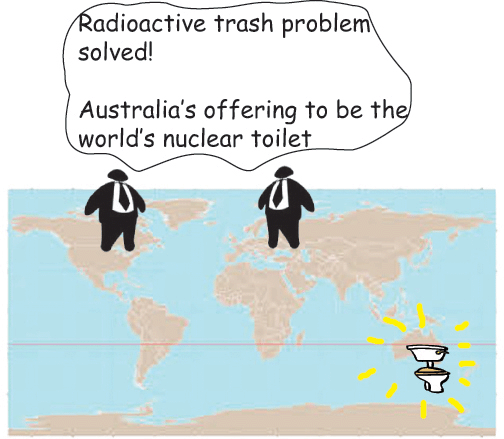 The global nuclear lobby is keenly interested in the South Australian government’s plan to import nuclear waste, because it would solve the waste problem for nuclear companies wanting to sell reactors and particularly, new types of nuclear reactors, to Asian countries.

despite the NFCRC’s distinct lack of enthusiasm for new nuclear technology, three of the only five pro nuclear submissions were focussed, not on waste importing, but on new nuclear reactors.
Ben Heard‘s whole argument is directed at new reactors:
Our research indicates that South Australia could make a significant contribution in this technology development beginning at a modest reinvestment of revenues from used fuel.
Many nations in this region already exploit nuclear technology however this use is constrained by lack of a back-end solution…… The availability of a multinational solution for the back end of the nuclear fuel cycle could change these investment decisions profoundly.
Heard backs up his argument by playing the climate card of nuclear being “low carbon” and so on.
Dayne Eckermann writes:
‘The main motivation for myself and others to embrace and openly support this technology is its immense power output from a relative small facility.’
And the South Australia Chamber of Mines and Energy’s (SACOME‘s) view:
Australia’s well-equipped political, legal and educational structures mean that a reactor program could – with the support of experienced international partners – be started swiftly
SACOME strongly believes that the advances in small modular reactors and advanced reactor designs will provide the necessary facilities…..
I understand that, for the Parliamentary Committee, all submissions were actually published. This is in contrast to the NFCRC process, in which submissions from interested parties such as foreign nuclear companies were kept confidential……..
Like Oscar Archer, at the beginning of the NFCRC saga, the Australian nuclear lobby is primarily keen for “new nuclear”, with the waste import as a necessary prelude……
French anti-nuclear activists force Australian delegation to leave National Radioactive Waste Management Agency (ANDRA)

 Australian Delegation to France Blockaded By Anti-Nuclear Activists http://earthfirstjournal.org/newswire/2016/09/05/australian-delegation-to-france-blockaded-by-anti-nuclear-activists/#more-51943 from Earth First! Newswire On the morning of September 1st an Australian delegation on a parliamentary inquiry into the management of nuclear waste, was blockaded in North-East France by anti-nuclear activists.
The delegation was visiting the National Radioactive Waste Management Agency (ANDRA) facilities in the municipality of Bure, where an anti-nuclear movement under the banner of Bure Zone Libre (Bure Liberated Zone, BZL) has been burgeoning in recent years.
A group of about twenty masked activists dressed in white overalls and armed with water guns, drums and a sound system blocked the Australian delegation from entering the ANDRA laboratory, forcing the delegation to turn around and leave.
“We’re here in solidarity with indigenous resistance to the planned nuclear facility in Australia,” said one activist with a red clown nose. “Nuclear industry endangers life itself, and we will resist it everywhere.”
The BZL movement recently got national headlines in France for toppling a three kilometer long wall which ANDRA has erected around the forest near Bure. The wall was intended to stop the group from reoccupying the forest which ANDRA aims to uproot for the construction of a controversial nuclear waste facility.
“Wherever they’ll build walls, we’ll turn them into wall jam,” the activist laughed, explaining the French wordplay confiture de mur, as mur means both blackberry and wall.
About twenty gendarmes (French military police) patrolled Bure after the action had already ended. The area has been increasingly militarized recently, with activists facing trumped legal charges.
The BZL activists sent the Australian delegates a letter explaining their actions, presented below.
Letter to Australian delegation: Continue reading
The great unnoticed climate threat – soaring ocean temperatures
Soaring ocean temperature is ‘greatest hidden challenge of our generation’
IUCN report warns that ‘truly staggering’ rate of warming is changing the behaviour of marine species, reducing fishing zones and spreading disease, Guardian, Oliver Milman. 6 Sept 16, The soaring temperature of the oceans is the “greatest hidden challenge of our generation” that is altering the make-up of marine species, shrinking fishing areas and starting to spread disease to humans, according to the most comprehensive analysis yet of ocean warming.

The oceans have already sucked up an enormous amount of heat due to escalating greenhouse gas emissions, affecting marine species from microbes to whales, according to an International Union for Conservation of Nature (IUCN) reportinvolving the work of 80 scientists from a dozen countries.
The profound changes underway in the oceans are starting to impact people, the report states. “Due to a domino effect, key human sectors are at threat, especially fisheries, aquaculture, coastal risk management, health and coastal tourism.”…..
The scale of warming in the ocean, which covers around 70% of the planet, is “truly staggering”, the report states. The upper few metres of ocean have warmed by around 0.13C a decade since the start of the 20th century, with a 1-4C increase in global ocean warming by the end of this century.
The ocean has absorbed more than 90% of the extra heat created by human activity. If the same amount of heat that has been buried in the upper 2km of the ocean had gone into the atmosphere, the surface of the Earth would have warmed by a devastating 36C, rather than 1C, over the past century.
At some point, the report says, warming waters could unlock billions of tonnes of frozen methane, a powerful greenhouse gas, from the seabed and cook the surface of the planet. This could occur even if emissions are drastically cut, due to the lag time between emitting greenhouse gases and their visible consequences.
Warming is already causing fish, seabirds, sea turtles, jellyfish and other species to change their behaviour and habitat, it says. Species are fleeing to the cooler poles, away from the equator, at a rate that is up to five times faster than the shifts seen by species on land.
Even in the north Atlantic, fish will move northwards by nearly 30km per decade until 2050 in search of suitable temperatures, with shifts already documented for pilchard, anchovy, mackerel and herring.
The warming is having its greatest impact upon the building blocks of life in the seas, such as phytoplankton, zooplankton and krill. Changes in abundance and reproduction are, in turn, feeding their way up the food chain, with some fish pushed out of their preferred range and others diminished by invasive arrivals.
With more than 550 types of marine fishes and invertebrates already considered threatened, ocean warming will exacerbate the declines of some species, the report also found…….
Ocean acidification, where rising carbon dioxide absorption increases the acidity of the water, is making it harder for animals such as crabs, shrimps and clams to form their calcium carbonate shells.
The IUCN report recommends expanding protected areas of the ocean and, above all, reduce the amount of heat-trapping gases pumped into the atmosphere.
“The only way to preserve the rich diversity of marine life, and to safeguard the protection and resources the ocean provides us with, is to cut greenhouse gas emissions rapidly and substantially,” said Inger Andersen, director general of the IUCN.https://www.theguardian.com/environment/2016/sep/05/soaring-ocean-temperature-is-greatest-hidden-challenge-of-our-generation
Australia the Pacific Pariah as it idolises coal
It is the world’s largest coal exporter, and both major political parties are financially backed by the coal lobby. Rather than move away from coal, the government is seeking to expand exports dramatically, with public subsidies and taxpayer-funded infrastructure.
The contrast could not be starker. While Pacific leaders are praised for their efforts to develop global climate solutions, Australia faces ignominy. Unless Australia changes direction, it will continue to be seen as an irresponsible middle power – a rogue state undermining global efforts to tackle climate change.
 Pacific pariah: how Australia’s love of coal has left it out in the diplomatic cold, https://theconversation.com/pacific-pariah-how-australias-love-of-coal-has-left-it-out-in-the-diplomatic-cold-64963 The Conversation, Wesley Morgan, 7 Sept 16, Australia’s Prime Minister Malcolm Turnbull will have some explaining to do when he attends the Pacific Islands Forum leaders’ meeting in Pohnpei, Micronesia, this week.
Australia’s continued determination to dig up coal, while refusing to dig deep to tackle climate change, has put it increasingly at odds with world opinion. Nowhere is this more evident than when Australian politicians meet with their Pacific island counterparts.
It is widely acknowledged that Pacific island states are at the front line of climate change. It is perhaps less well known that, for a quarter of a century, Australia has attempted to undermine their demands in climate negotiations at the United Nations.
The Pacific Islands Forum (PIF) – organised around an annual meeting between island leaders and their counterparts from Australia and New Zealand – is the Pacific region’s premier political forum. But island nations have been denied the chance to use it to press hard for their shared climate goals, because Australia has used the PIF to weaken the regional declarations put forward by Pacific nations at each key milestone in the global climate negotiation process. Continue reading
Australia an international pariah? as other nations ratify Paris Climate Agreement
 US-China ratification of Paris Agreement ramps up the pressure on Australia, The Conversation, Peter Christoff September 5, 2016, When President Barack Obama and President Xi Jinping announced their countries’ ratification of the Paris climate agreement ahead of last weekend’s G20 meeting in Hangzhou, they boosted its chances of coming into force by the end of this year, some 12 months after the deal was brokered last December.
To enter into force, the Paris Agreement requires ratification by at least 55 nations which together account for at least 55% of global greenhouse emissions. It will then become legally binding on those parties that have both signed and ratified it. These thresholds ensure that the deal has broad legitimacy among states, but are also low enough to limit the opportunities for blocking by states that may oppose its progress.
Aside from China and the United States – the world’s two largest emitters, which together produce 39% of the world’s emissions – another 24 countries have ratified the agreement.
To get over the threshold, it now only needs the support of a handful of major emitters like the European Union (a bloc of 27 countries producing some 10% of global emissions), India, Russia or Brazil. Ratification by countries such as Australia, South Africa and the United Kingdom (each of which contributes about 1.5% of emissions) would also contribute significantly to this momentum………
Australia left as a laggard
The US-China announcement not only increases the momentum for ratification, but also increases pressure on Australia. With the Kyoto Protocol, Australia loyally supported the United States and refused to ratify until 2007. This time, similar recalcitrance is likely to be met with strong international disapproval.
However, ratification is only the beginning. Australia will then be required to revise and toughen its targets for 2030 and beyond. Its weak 2030 mitigation target is accompanied by policies inadequate to meet this goal.
The Paris Agreement, once in force, will require a more robust Australian target to be announced by 2023 at the latest. This in turn will further highlight the gap between current and sufficient implementation measures.
The US-China ratification announcement is the next step along a path that must see Australia climb – or be dragged – out of its current climate policy torpor. https://theconversation.com/us-china-ratification-of-paris-agreement-ramps-up-the-pressure-on-australia-64821
Climate change brings increasing, and more severe, typhoons to East Asia
 Is not the push for nuclear reactors in East Asia (almost always located on coast) a dangerous trend, in view of increasing typhoons?
Super typhoons becoming more powerful and more frequent, new study finds, SMH, Peter Hannam 6 Sept 16 The most destructive categories of tropical storms to strike the heavily populated regions of east Asia are becoming more intense and increasing as much as four-fold in frequency because of climate change, according to new research by US-based scientists.
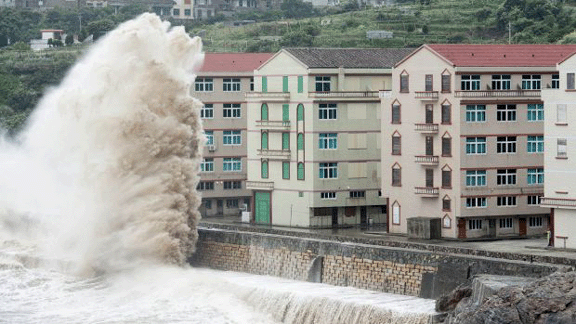
Since the late 1970s, typhoons making land in a region stretching from Vietnam and the Philippines to Korea and Japan have become 12 per cent to 15 per cent more intense.
Those hitting south-east Asia with a category 4 or 5 strength have more than doubled in number, with the increase even more for China and Taiwan and regions north, the paper published in Nature Geoscience on Tuesday found.
The increase in sea-surface temperature is key to providing extra energy to tropical storms, with the outcome for the megacities of the region looking grimmer……..
“The intensification is strongest for typhoons that tend to make landfall because of the stronger warming of the coastal waters near east and south-east Asia,” said Wei Mei, a researcher in the department of marine sciences at the University of South Carolina and co-author of the paper.
Additional warming is expected to intensify the storms, particularly in some of east Asia’s main economic centres, Dr Mei said: “The typhoons striking mainland China, Taiwan, Japan, and Korea will intensify further because of the faster warming of waters of 20 degrees north.”…….
The north-west Pacific basin has both the largest data set of super typhoon-strength storms and the clearest trend towards intensification as the planet warms, Steve Turton, an adjunct professor at the Central Queensland University, said.
This year has also been an active one for the region………http://www.smh.com.au/environment/climate-change/super-typhoons-becoming-more-powerful-and-more-frequent-new-study-finds-20160905-gr8rch.html
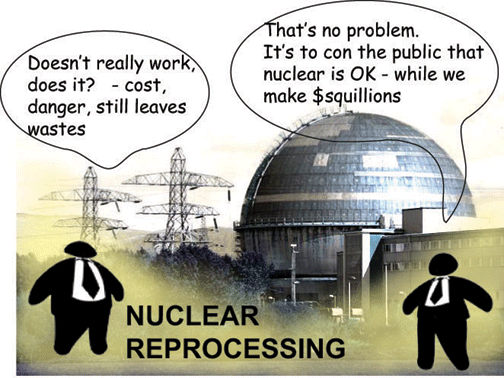
Nuclear fuel reprocessing: the British scandal of Sellafield
The National Audit Office (NAO) stated these tanks pose “significant risks to people and the  environment”. One official review published in The Lancet concluded that, at worst, an explosive release from the tanks could kill two million Britons and require the evacuation of an area reaching from Glasgow to Liverpool. These dangerous tanks have also been the subject of repeated complaints from Ireland and Norway who fear their countries could be contaminated if explosions or fires were to occur.
In short, the practice of reprocessing at Sellafield has been and remains a monumental national disgrace.
Especially serious are the ~20 large holding tanks at Sellafield containing thousands of litres of extremely radiotoxic fission products. Discussing these tanks, the previous management consortium Nuclear Management Partners stated in 2012:
“there is a mass of very hazardous [nuclear] waste onsite in storage conditions that are extraordinarily vulnerable, and in facilities that are well past their designated life.”
most of all, we should recognize that nuclear policies, in both weapons and energy, have poorly served the nation.

 Sellafield exposed: the nonsense of nuclear fuel reprocessing http://www.theecologist.org/reviews/2988095/sellafield_exposed_the_nonsense_of_nuclear_fuel_reprocessing.html Ian Fairlie 6th September 2016 Last night’s BBC Panorama programme did a good job at lifting the lid on Britain’s ongoing nuclear disaster that is Sellafield, writes Ian Fairlie. But it failed to expose the full scandal of the UK’s ‘reprocessing’ of spent fuel into 50 tonnes of plutonium, enough to build 20,000 nuclear bombs – while leaving £100s of billions of maintenance and cleanup costs to future generations.
Many readers will have seen the interesting Panorama programme on the poor safety record at Sellafield broadcast on BBC1 last night.
The BBC press release stated this was a “special investigation into the shocking state of Britain’s most hazardous nuclear plant” – and it certainly was.
The most important of several whistleblower revelations was that the previous US managers had been shocked at the state of the plant when they took over its running in 2008.
Although the programme producers are to be congratulated for tackling the subject, it was only 30 minutes long and tells only a fragment of the whole sorry story.
This article tries to give more background information, and importantly, more analysis and explanation. The full story would require several books, and provide exceedingly painful reading.
What is reprocessing for? Continue reading
Outcry against highly secretive transport of nuclear wastes
 Weapons-grade nuclear waste shipments to U.S. prompt
  outcry Trucks expected to carry casks containing highly enriched uranium and radioactive isotopes CBC News Sep 05, 2016 A highly secretive plan to ship weapons-grade nuclear waste from a federal lab northwest of Ottawa to the United States is drawing ire in some of the southern Ontario and American communities along the potential route.
Radioactive waste from the former Atomic Energy of Canada Ltd. laboratory in Chalk River, Ont., a major but dwindling world supplier of medical isotopes that is now run by a private consortium, is set to be transported in liquid form to a site in Savannah River, S.C., for processing and disposal. The route could take it through Ontario’s fruit-rich Niagara Region, or possibly even through the border crossing at Sault Ste. Marie, Ont., into Michigan, according to a lawsuit trying to stop the shipments. Thelawsuit was filed in a U.S. federal court last month by a coalition of American environmental and nuclear watchdog groups. …….
Kept secret from emergency personnel
The plan is for about 150 shipments by truck to South Carolina, a minimum distance of nearly 1,700 kilometres from Chalk River, which is 180 km northwest of Ottawa. Each shipment would carry four 58-litre steel containers placed inside a larger steel and lead tube, carrying liquid radioactive waste including isotopes of cesium, iodine, strontium and plutonium, according to the U.S. lawsuit.
The waste would also contain a modest but dangerous quantity of highly enriched uranium, which can be used to make a nuclear bomb, the lawsuit states.
The waste is a byproduct of making molybdenum-99, a medical isotope used in diagnostic tests of organs and other body parts.
The Niagara area’s regional government passed a motion last year opposing the shipments…….
One problem raised by opponents is that, for security reasons, the route through Canada and the timetable for shipments are being kept under tight secrecy — so secret that local emergency responders haven’t been kept in the loop.
“There would be no notice given, but of course it would be our first responders, my friends, my neighbours, working in our volunteer force and in our emergency services, that would be exposed… in case there was an accident,” Hodgson said, adding that even his local fire chief only found out through the media.
The Canadian Nuclear Safety Commission, the federal nuclear safety regulator, approved the steel tube design last year for transporting the nuclear waste, but full environmental assessments have not been conducted in either Canada or the U.S., opponents complain. …… http://www.cbc.ca/news/health/nuclear-waste-chalk-river-uranium-transport-carolina-1.3748658
Australian Renewable Energy Agency (ARENA) funding 12 large scale solar projects
 12 large scale solar projects to get ARENA funding. And the winners
  are … REneweconomy, By Giles Parkinson on 7 September 2016 All eyes are on the Pullman Hotel in Sydney, where on Thursday, 12 out of the 20 large-scale solar projects shortlisted for the Australian Renewable Energy Agency’s $100 million funding round are expected to be announced as winners of federal government grants.
The announcements are expected to trigger the biggest single investment surge in any renewable energy technology in Australia to date, even outpacing investment in rooftop solar at the height of the premium feed-in tariffs.
Apart from the projects set to go ahead directly from the ARENA tender, the results are also expected to trigger financing commitments for other large-scale solar projects, many of which are keen to cash in on high prices for renewable energy certificates, surging interest in financing from local and international funders, as well as another big slump in the cost of solar modules on international markets.
RenewEconomy understands that 12 of the 20 projects that made the final short list (out of 77 initial inquiries) will get some sort of funding.
The fact that more than half the projects will be helped by ARENA is not unexpected, given the huge reduction in the project costs elicited during the tendering process. It will mean that the ARENA funding round will produce around double the 200MW of large-scale solar capacity that it originally targeted.
It is thought that nine of these 12 projects will be using single axis tracking technology, which a recent study suggests – see our article Solar does work, and a lot better than we thought – provides the best outcome in terms of output and returns on investment.
The tender result is also expected to show that the levellised cost of energy for large-scale solar has fallen to around $100/MWh for the best projects, well below the $135/MWh targeted by ARENA when it started the process.
A lot of this cost reduction is credited to the competitive nature of the bidding process. Last week ARENA chairman Martijn Wilder told ABC Radio the process had knocked down the amount of assistance needed to 10 per cent of project costs from the near 50 per cent needed to get the Nyngan and Broken Hill solar farms built.
It also appears that large energy retailers – under pressure to meet their renewable energy targets,but lately on a capital strike – are prepared to offer around $80-$85/MWh for long-term contracts………..http://reneweconomy.com.au/2016/12-large-scale-solar-projects-to-get-arena-funding-and-the-winners-are-23169
Australian Renewable Energy Agency negotiating with govt, trying to save its funding
ARENA board seeks compromise on funding with government, REneweconomy By Giles Parkinson on 7 September 2016 The board of the Australian Renewable Energy Agency is believed to have proposed a compromise on its funding position, in an effort to continue its support of critical research and early stage development in new renewable energy and storage technologies.
The Coalition government is seeking to strip $1 billion in funds from ARENA, which was created by the Labor government in 2012, but the conservatives need the support of parliament, and Labor in particular, to pass legislation to do that.
ARENA currently has $1.3 billion in legislated funding in future years and would be left with just $300 million or so after the current $100 million funding round for large-scale solar, the results of which will be announced tomorrow.
The funding move has been included as part of the Turnbull government’s budget repair “omnibus package” that has attempted to wedge Labor by including initiatives that the opposition supported during the recent election campaign.
Labor has found itself in a tricky position on ARENA, having abandoned support of the agency in a fit of pique over the nature of NGO press releases that responded to Malcolm Turnbull’s announcement of a new clean energy innovation fund, which was really nothing more than a trick.
Labor has since tried to row back, but unless it refuses the whole package then ARENA appears doomed.
Current and former board members are apparently lobbying the Coalition government to abandon the proposed cuts, but in an attempt at compromise are suggesting that the scale of the funding cuts could be reduced.
They have outlined several scenarios where the cuts are reduced to $300 million or $500 million, and what that would mean for new projects, investments and jobs (remember the jobs and growth mantra).
It has also been suggested that ARENA funding could come from the so-called “penalty” prices that will be paid if large energy retailers fail to meet their obligations under the renewable energy target.
Currently, there is no penalty imposed on retailers if they fail to build or contract enough renewable energy to meet their obligations. The “penalty price” is paid by the consumer, and the money passed through to government coffers……….
What will be impacted by the savage ARENA cuts will be funding to the next generation of technologies, such as large-scale solar towers and storage, which attracted a response from the South Australian Labor government this week.
Storage technologies are seen as critical to supporting increased use of wind and solar in the grid, particularly with the cost of gas rising and the market controlled by just a few dominant players who have been allowed to exploit their market power and push prices higher.
ARENA funding has also been critical to development of battery storage technologies and discovering their use and value in the electricity network, either in homes and in peer-to-peer trading, or at grid level. It is also supporting many off-grid and edge-of-grid projects to use renewables and storage to slash the cost of diesel.
And, of course, there are hundreds of researchers whose jobs are at risk. It is believed the ARENA submission has made it clear to the government exactly what is at risk under the various funding cut scenarios. http://reneweconomy.com.au/2016/arena-board-seeks-compromise-on-funding-with-government-31836
Queensland University of Technology to divest its fossil fuel shares
Queensland University of Technology commits to divesting its fossil fuel shares, ABC News by Nick Kilvert, 5 Sep 16, Student activists and academics at the Queensland University of Technology (QUT) are celebrating after learning the university has committed to divesting its shares in fossil fuels.
The decision comes after an ongoing campaign by Fossil Free QUT, which included an open letter signed by more than 120 academics, calling for the university to join the global movement, following the success of similar campaigns at universities across Australia.
Vice-chancellor Professor Peter Coaldrake sent a statement via email on Friday informing staff of the decision to steer investments away from coal, oil, and gas companies.
“We have reviewed QUT’s investments relative to climate risk and instituted changes to the university’s investment strategy,” the statement said.
“QUT is committed to an orderly and considered transition away from investment in fossil fuel companies.”…….
The move makes QUT the first university in Queensland and the second largest in Australia to withdraw investment in fossil fuel companies, and comes despite a strong focus on geological science (earth science) at the university’s Gardens Point campus…….http://www.abc.net.au/news/2016-09-05/qut-to-divest-fossil-fuel-investments/7816016
1 This month

of the week – Australians for War Powers Reform (AWPR)
To see nuclear-related stories in greater depth and intensity
 Antinuclear