A lifetime of crashed markets for uranium producers
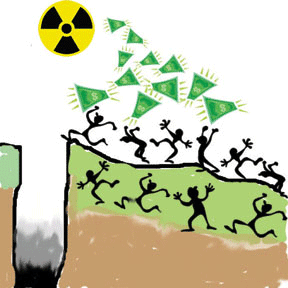 Why Uranium Investments Will Remain Radioactive No commodity faces the unique pressure that uranium and nuclear fuel do and there is little prospect of a near-term recovery WSJ By SPENCER JAKAB Sept. 18, 2016
There is too much of nearly every commodity in the world today. Then there is uranium.
The outlook for the element that powers nuclear reactors may be worse than for any other, and there is almost no prospect for improvement soon. Unlike other commodities, low prices won’t stimulate demand.
There are several reasons for the weakness, some obvious, others surprising. The result has been the price of triuranium octoxide, which surged 1,400% in the five years through June 2007 to $136 a pound, is now about $25. And the price of fuel processing has dropped by nearly two-thirds since 2010.
The obvious reasons are the shutdown of nuclear power plants after the 2011 nuclear accident at Fukushima, Japan. Plants also shut down in Germany, Sweden, and elsewhere, while Belgium and Taiwan may be next. Even China, the leading growth market for nukes, enacted a delay in plant approvals. Meanwhile, the fracking revolution made some planned and existing U.S. plants uneconomical……..
The end of a U.S.-Russia deal to convert old Soviet warheads in 2013 took the equivalent of 20 million tons of triuranium octoxide ore, or 10% of annual supply off the market. That should have been good news for prices. But in anticipation of the end of the deal, processors that turn their ore into fuel built arrays of expensive centrifuges.
Once built, these centrifuges must be run constantly. This has encouraged processors to engage in “underfeeding”—using less ore but enriching it more intensely to create extra fuel. It is the equivalent of mining about 15 million pounds a year of extra ore saysJonathan Hinze, executive vice president at Ux Consulting. U.S. stockpiles of all types of ore and fuel combined have risen by a third in four years, according to the U.S. Energy Information Administration.
Miners are partially cushioned by fixed long-term contracts with many customers. Canadian miner Cameco reported a cash cost of mining of over $27 a pound in the first half of 2016 but expects to realize an average price above $40 this year. Its capacity isn’t all needed, but shutting down uranium mines is expensive and difficult to reverse…….
Cameco, which has seen its share price drop by 84% since its 2007 peak, is one of the few pieces of the supply chain reacting to the dismal outlook. The miner shut down its Rabbit Lake mine, the longest-operating uranium mine in North America, this summer.
But such painful cuts alone won’t bring the market into balance for what feels to investors like a lifetime—or at least a half-life.http://www.wsj.com/articles/why-uranium-investments-will-remain-radioactive-1474225882
No comments yet.
1 This month

of the week – Australians for War Powers Reform (AWPR)
To see nuclear-related stories in greater depth and intensity
 Antinuclear
Leave a comment