to September 24 – climate and nuclear news Australia
 Once again, I have to admit, that however terrible the nuclear industry is, the climate threat is the currently urgent global danger. That’s because the “window of opportunity” to contain it is near to closing. Global warming will accelerate as oceans reach limits of remediation. Climate change action can be stopped by Trans Pacific Partnership.
AUSTRALIA
NUCLEAR
South Australia. Premier Jay Weatherill wrote a deceptive pro nuclear article. (I’ll be writing more about this at a later stage). However, the comments below his article showed that not all registered Advertiser readers were taken in. Weatherill has gone to Finland accompanied by pro nuclear advocates. Jay Weatherill’s plan is not only ridiculously long term, but also political dynamite. Meanwhile, Finland companies keen to market their nuclear waste technology to South Australia. In that same article Weatherill mentions the next step in his campaign – to change South Australia’s law against nuclear waste storage
The SA government runs a nuclear “Your Say” site. People must register to comment. And they do. Some critical comments are posted. 80 % of ABC North and West listeners oppose South Australia’s nuclear waste import plan.
The SA government continues its nuclear roadshow. Very little media information. Facebook can be a source of news, e.g. Nuclear Fuel Cycle Watch South Australia and Fight to Stop Nuclear Waste Dump in Flinders Ranges SA
CLIMATE. Australian Conservation Foundation (ACF) lodges appeal against Federal Court’s approval of giant Adani coal mine.
Renewable Energy. Business Investment in Renewable Energy hit by government cuts to Australian Renewable Energy Agency.
Adelaide Advertiser’s nauseous sycophantic account of Premier Weatherill’s nuclear jaunt to Finland
I knew that The Advertiser was the mouthpiece of the nuclear lobby, anyway, but their latest effort was really sick-making. A rave which portrays Premier Weatherill as some kind of democratic champion, and which is pushing the soft sell that the decision on nuclear waste importing will not happen soon, but be dragged on for years. (They don’t say this, but in the interim, the nuke lobby has time to get secret arrangements made – and money lent to South Australia, so that ultimately, it might all be just too committed to turn back.)No site has been selected to house the world’s high-level international waste for profit, should the state choose to build one, nor any explanation of how one would be picked. The State Government is yet to overturn laws that ban public money being spent on investigating the establishment of a nuclear dump or even to pick up the phone to ask places like Japan what they would pay…….
 The Finnish operators say they would jump at the chance to form an alliance with SA to build a dump here…..
Mr Weatherill is likely to confirm before Christmas that the Government will begin the serious work of developing a robust business case…….
Expect the Government to seek money from overseas to undertake a major geological survey that rules out places too unsafe for disposal to occur. At a cost of up to $1 billion, this is too expensive for SA to fund itself, but could have the benefit of doubling as a discovery tool for new mining deposits.
From there, it is likely the offer will be thrown open to communities to show an interest, and estimates made of what they could receive. Even on the most extremely rapid timeline, that point is unlikely to have been reached by the time voters head to the polls in March 2018.
This project is multi-generational, with a point of no return years away. But it is a doubtful and open question as to whether our politics are up to the job…….Mr Weatherill has framed this as a great test of our democracy’s ability to consider difficult questions and come to wise solutions. … http://www.adelaidenow.com.au/news/opinion/lack-of-trust-more-toxic-than-nuclear-dump-notion-daniel-wills/news-story/e927e455e6f244f35a8b6743bc791adb
We shouldn’t be the world’s nuclear dump, says Councillor Lynton Vomow
We shouldn’t be the world’s nuclear dump, Adelaide Hills Herald News. By Councillor Lynton Vomow, Lobethal 23 Sep 16, You may have recently had a say at one of the Nuclear Waste Dump forums being held around the state. My biggest concern, however, being the prevention of an 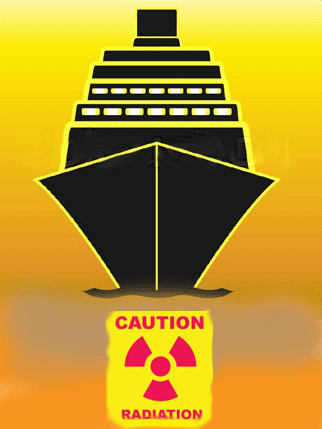 accident at sea and the loss of highly radioactive nuclear waste into the ocean, was not satisfactorily explained .
Indeed the attendant basically said that we could not guarantee against such a disastrous event, it could be impossible to retrieve every container of waste and modelling is showing it wouldn’t actually be that bad! Fish and all creatures of the ocean for hundreds of miles around the lost radioactive waste material would be devastatingly affected.
Did you know that medium or high level (depending on whether it’s France or Australia describing it) nuclear rubbish was brought to Australia, in December just last year, in a rust bucket that had failed three safety inspections in five years?
Can you imagine what could happen if we were to receive dozens of shipments? Can we be guaranteed the waste will make it here safely, every single time?
Some are saying that low level waste is non hazardous, so then why not store it near its source i.e Sydney, and save the fuel costs of transporting it?
Basically a low level waste dump would be coming here to soften us up for a high level dump.
There is a need to have safe repositories for the waste, somewhere, but it will have to be near its usage location.
Countries ought to be looking at phasing out nuclear power so that there is as little waste as possible.
How long does nuclear waste last anyway? Can you imagine two hundred years? Ten times that then takes us back to the birth of Christ. Ten times all of that now takes us back to just before the last ice age, 20,000 years ago. Then ten times 20,000 years? 200,000 years. That’s when only about half of the atoms in high level nuclear waste will have decayed to less harmful atoms. It is going to be a long wait for this deadly waste to become harmless, to care for our generation’s nuclear waste.
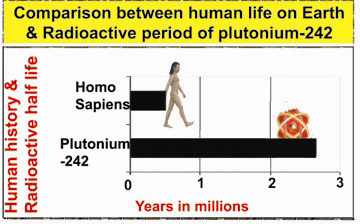
Are we going to be beggars or choosers? We are not so desperate that we have to take the world’s most toxic waste and prevent it from damaging anything for hundreds of thousands of years.
South Australia continues to have huge potential for growing the renewable energy industry instead.
The risk to the world’s environment of transporting high level nuclear waste across the oceans to to the furthest point on the planet, ie, South Australia, just doesn’t make sense.
And people, (including of course the Adnyamathanha Indigenous people of the Flinders Ranges) do not want it.
Pine Gap endangers Australia – a likely target for nuclear missiles
 Pine Gap: Secretive spy base’s role in drone strikes putting Australia in danger, expert warns http://www.abc.net.au/news/2016-09-23/pine-gaps-actions-could-endanger-australian-security/7872190?section=environment The World Today By Brendan Trembath An expert on Pine Gap has raised concerns about the spy base’s role in supporting drone attacks on suspected terrorists overseas.
Officially called The Joint Defence Facility Pine Gap, the site is jointly run by the Australian and United States governments and is one of Australia’s most secret sites. The facility has been in operation since 1970 and is located half-an-hour’s drive south-west of Alice Springs.
Professor Richard Tanter, from the University of Melbourne, says Pine Gap contributes targeting data to American drone operations, including assassinations. “One of Pine Gap’s two key functions is as a control station and a downlink station for signal intelligence satellites 36,000 kilometres up in space,” he said. “They are picking up a very wide array of radio transmissions, including cell phones, satellite phones and so forth. “And that provides the data, both the contents and the geolocation data for targets of interest through the United States military.”
He said Pine Gap was also used for counter-terrorism and wider intelligence programs, as the site was able to contribute data “pretty directly — for example into drone targeting operations.”
Professor Tanter acknowledged that those type of programs were part of the alliance between the US and Australia, and Australia’s interest in the global fight against terrorism
But he said the question was whether it could be considered a good idea on a political level, seeing the potential for creating “further terrorism” if a strike were to go wrong.
“At a legal and moral level do we really want to be involved in operations which are frankly illegal under international law. In countries where we’re not at war, such as Pakistan or Somalia or Yemen, these are simply assassinations.”
“We won’t like it very much when it’s done back to us I suspect.”
Base also a likely target for nuclear missiles Professor Tanter said the site continued to be a “pretty high priority nuclear missile target” in the event of a major conflict between the United States and Russia or China.
“It would be, as they say in the military, a lucrative target of many benefits,” Professor Tanter said . “Secondly it is itself involved in nuclear war planning. I think that’s a totally awful thing for us to contemplate — you can’t use nuclear weapons except in a fairly genocidal way.”The Defence Department said that “the facility makes an important contribution to national security.”
A spokesperson said: “It provides intelligence on priorities such as terrorism, the proliferation of weapons of mass destruction, and foreign military capability and weapons developments. “It also supports monitoring of compliance with arms control and disarmament agreements, and provides ballistic missile early warning information.”
Climate change is already destabilizing communities worldwide
 U.S. intelligence community warns climate change is already destabilizing communities worldwide, Mashable, 23 Sept 16 The U.S. intelligence community on Wednesday released a new report finding that global warming is already acting as a destabilizing force worldwide, with more serious ramifications to come in the next two decades.
The report also states that during the next five years, which will largely fall within the timeframe of the next presidential administration, climate change will cause growing security risks for the U.S. that “will arise primarily from distinct extreme weather events and from the exacerbation of currently strained conditions, like water shortages.” Continue reading
Hillary Clinton bought by the nuclear lobby
 Hillary Takes the Nuclear-Energy Option, National Review, by ROBERT BRYCE September 22, 2016 She recognizes that public perceptions about nuclear power are becoming more positive. Amid the avalanche of criticism aimed at Hillary Clinton in recent weeks about Pneumonia-gate, the Clinton Foundation, and her never-ending e-mail troubles, the Democratic nominee actually made an important policy statement, one that puts her directly at odds with America’s biggest environmental groups as well as her own party’s platform. What did Clinton do?
Within ten years, climate change could pass the 1.5 degree Celsius rise
 Climate change could cross key threshold in a decade: scientists By Laurie Goering 23 Sept 16, OXFORD, England (Thomson Reuters Foundation) – The planet could pass a key target on world temperature rise in about a decade, prompting accelerating loss of glaciers, steep declines in water availability, worsening land conflicts and deepening poverty, scientists said this week.
Last December, 195 nations agreed to try to hold world temperature rise to “well below” 2 degrees Celsius, with an aim of 1.5 degrees Celsius.
But the planet is already two-thirds of the way to that lower and safer goal, and could begin to pass it in about a decade, according to Richard Betts, head of climate impacts research at the UK Met Office’s Hadley Centre.
With world emissions unlikely to slow quickly enough to hit that target, it will probably be necessary to remove some carbon pollution from the atmosphere to stabilize the planet, scientists said at a University of Oxford conference on how to achieve the 1.5 degree goal.
That could happen by planting forests or by capturing and then pumping underground emissions from power plants. Or countries could turn to controversial “geoengineering” techniques, such as blocking some of the sunlight arriving on the planet, to hold down temperatures, they said.
“Negative emission technologies are likely to be needed, whether we like them or not,” said Pete Smith, a plant and soil scientist at the University of Aberdeen.
But other changes – such as reducing food waste and creating more sustainable diets, with less beef and fewer imported greenhouse vegetables – could also play a big role in meeting the goal, without so many risks, he said.
“There are lots of behavioral changes required, not just by the government … but by us,” Smith said……..http://www.reuters.com/article/us-climatechange-impacts-conference-idUSKCN11S1FE
Uranium Prices at 11-Year Low
 Economic Calendar, September 23, 2016 Uranium prices remain under pressure, and are currently at an 11-year low, as demand for the commodity remains weak with nuclear power in a hiatus while new plants come online. Even though demand is depressed, miners continue to explore for the commodity, which is adding sentimental pressure over concerns that new uranium supplies will come online before demand takes off.
1 This month

of the week – Australians for War Powers Reform (AWPR)
To see nuclear-related stories in greater depth and intensity
 Antinuclear